


Using a Cash Account to Trade Stock Options Alerts
Using a cash account to trade stock options alerts means every contract you buy is paid for with settled cash you already own. There is no borrowing, no margin interest and no margin call. For years traders picked cash accounts mainly to sidestep the Pattern Day Trader rule, but FINRA eliminated that rule on June 4, 2026, so that is no longer the reason.
What remains is a simpler account with a hard ceiling on risk and one real constraint: settlement. Options settle T+1, so cash from a sale is not reusable until the next business day. If you learn to plan around that one rule, a cash account is a clean, disciplined way to act on alerts. This guide shows you how.
A cash account limits you to money you actually have, which caps your downside on long options at what you paid. The trade-off is settlement: sale proceeds take one business day to become usable, so your alert plan has to budget around settled cash. Plan the cash and the account plans the risk for you.
| Buying power | Settled cash only. No borrowed funds. |
| Options settlement | T+1 (next business day) |
| Margin interest / margin calls | None |
| PDT rule status | Eliminated by FINRA on June 4, 2026 |
| Main violation risk | Good faith violations and freeriding |
| Common permitted strategies | Long calls and puts, covered calls, cash-secured puts (broker dependent) |
What Is a Cash Account, and How Is It Different From Margin?
A cash account is a brokerage account where every purchase must be fully paid with cash in the account by settlement. You cannot borrow from your broker, so your buying power equals your settled cash, nothing more.
A margin account lets you borrow against your holdings. That boosts buying power and opens up more complex strategies, but it also adds interest charges, maintenance requirements and the possibility of a margin call. If you want a full side-by-side breakdown, read our guide on margin vs cash accounts. Investopedia also has a solid primer on the cash account.
Settled cash is money that has completed the clearing process and is officially yours to spend again. Cash from selling an option shows in your balance right away, but it is unsettled until the next business day. Your broker usually labels these separately, often as “cash available to trade” versus “settled cash.”
| Feature | Cash Account | Margin Account |
|---|---|---|
| Borrowing | Not allowed | Allowed, with interest |
| Reusing sale proceeds | After T+1 settlement | Generally immediate |
| Spreads | Often restricted | Usually available with approval |
| Margin calls | Never | Possible |
| Maximum loss on long options | Premium paid | Premium paid (more if leverage is stacked) |
Why Use a Cash Account for Options Alerts Now That the PDT Rule Is Gone?
Because the real benefits never depended on the PDT rule. A cash account gives you no debt, no margin calls and a structure that forces you to size within your means.
Before June 2026, the cash account was the go-to workaround for anyone under $25,000 who wanted to make more than three day trades in five business days. That workaround no longer matters. If you want the full story, see our breakdown of the end of the PDT rule. Here is what still holds up:
- No borrowing, no margin calls. You trade only settled funds, so there is no interest bill and no intraday margin deficit to babysit.
- A hard risk ceiling. When you buy a call or put, the most you can lose is the premium. A cash account keeps that math honest because nothing is borrowed.
- Simpler management. Fewer numbers to track means more attention on the chart setup and your plan.
- Built-in pacing. Settlement naturally slows down revenge trading. You cannot instantly recycle the same dollars five times after a bad morning.
Options already carry built-in leverage, since one contract controls 100 shares. Adding borrowed money on top of that is a second layer many newer traders do not need. Our guide to leverage in trading explains why that matters.
How Does T+1 Settlement Affect Your Buying Power?
When you sell an option, the cash settles one business day later. Until then, you can sometimes use it to buy, but you cannot sell that new purchase before the original cash settles without risking a violation.
This is the single most important rule to understand. Here is a hypothetical walkthrough with round numbers.
Say you have $2,000 of settled cash. On Monday you buy one call at $3.00, which costs $300 (3.00 x 100). You now have $1,700 settled.
On Tuesday you sell that call for $3.50, bringing in $350. That $350 is unsettled until Wednesday. If you use it Tuesday afternoon to buy a different contract, you must hold that new contract until Wednesday’s settlement. Selling it on Tuesday would trigger a good faith violation.
The clean approach: on Tuesday, buy only with your remaining $1,700 of settled cash, and let the $350 settle before you touch it.
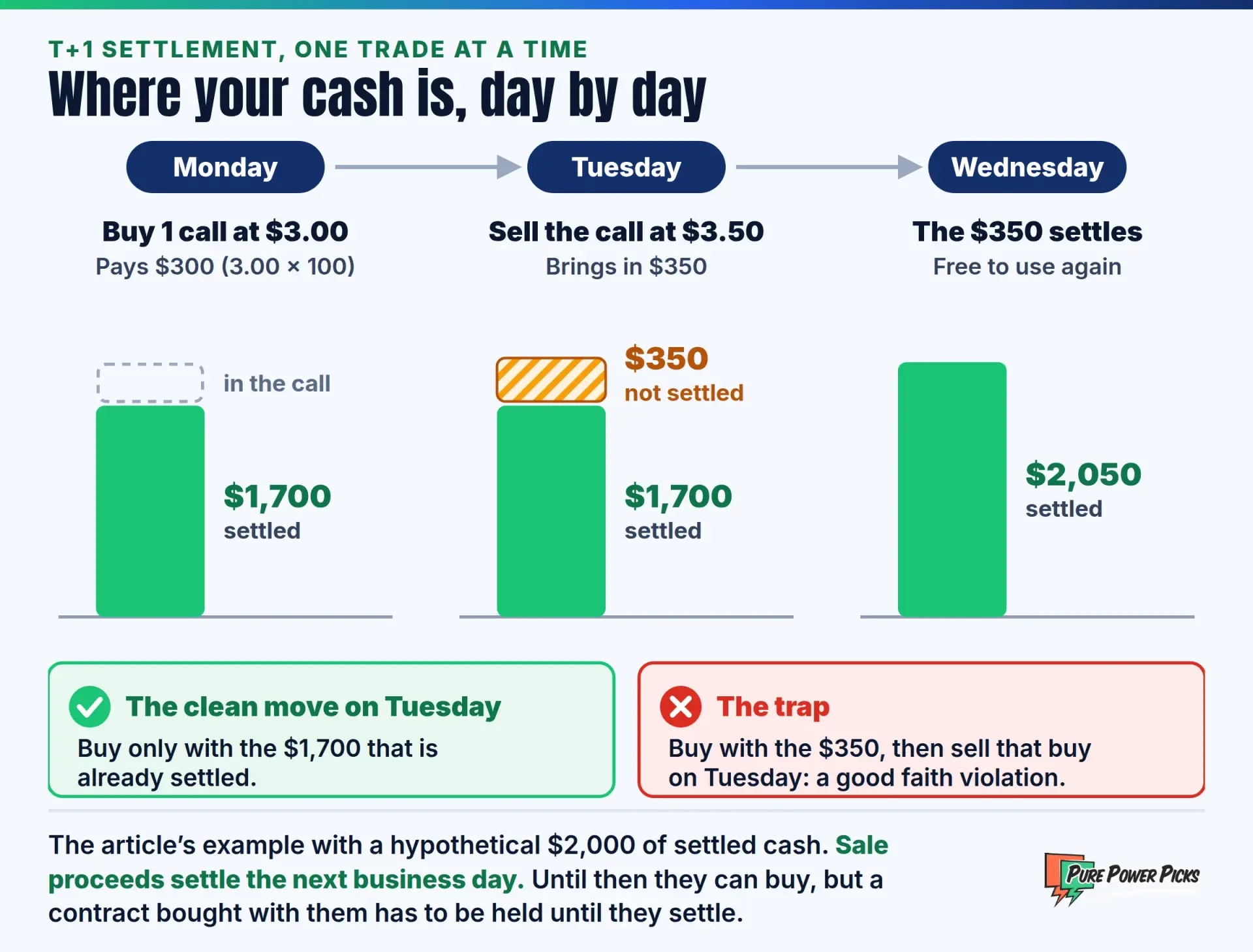
Good faith violation: buying with unsettled funds, then selling that purchase before those funds settle. Most brokers restrict the account to settled-cash-only buying for 90 days after a few of these in a 12-month window.
Freeriding: buying a security and paying for it with the proceeds of selling that same security. Under Regulation T this can freeze the account for 90 days. The SEC explains both in its guide to cash account trading and freeriding.
Broker policies differ in the details, so read your broker’s cash account rules before your first alert. Our guide on choosing the best broker for option alerts covers what to look for, including how clearly each platform displays settled versus unsettled cash.
How Should You Plan and Monitor Your Cash Around Alerts?
Treat settled cash like a daily budget. Decide in advance how much you will commit per alert and how much stays in reserve, so a good setup never shows up when your cash is still locked in settlement.
1. Fund the account for the contracts you actually trade
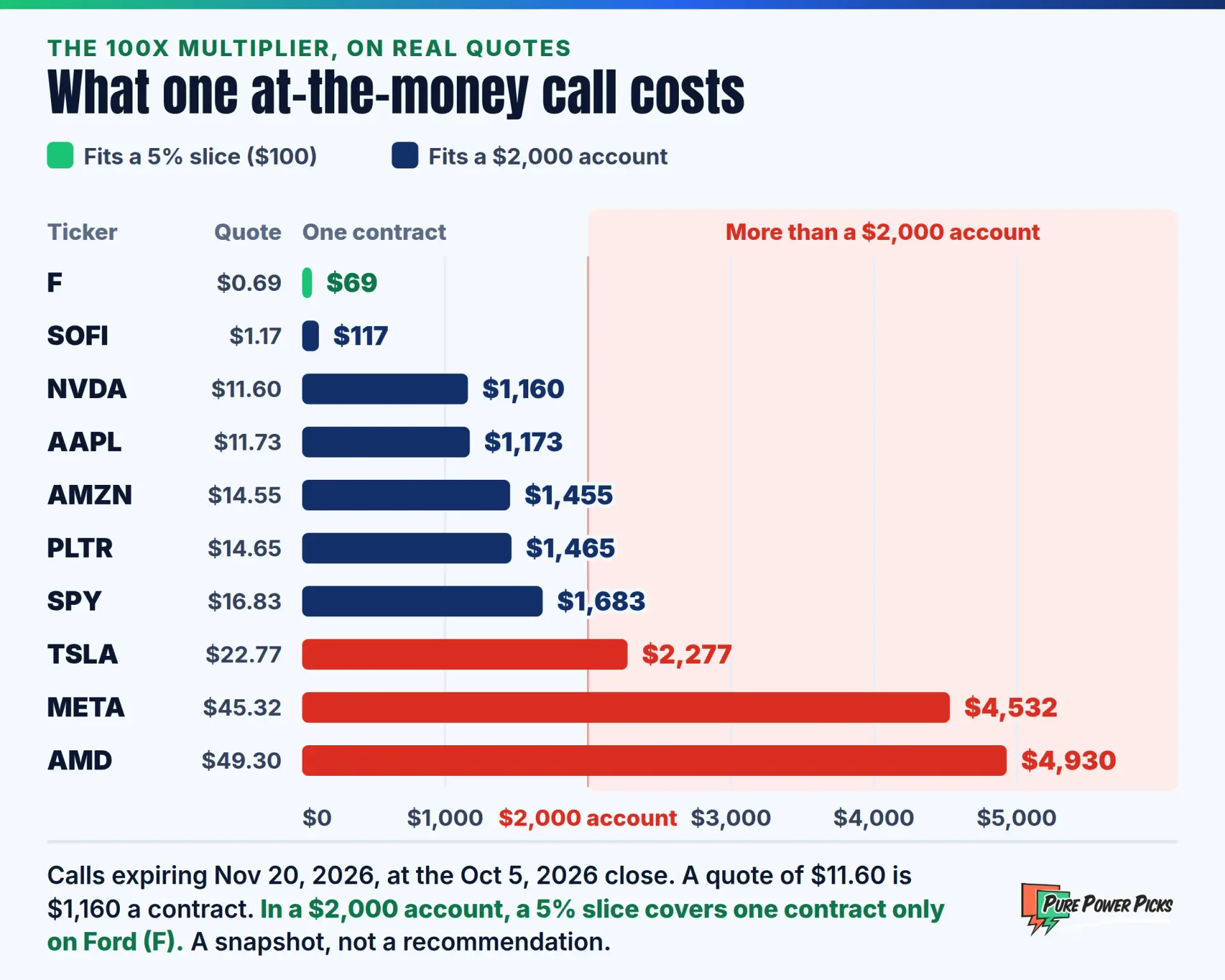
Remember the 100x multiplier. An option quoted at $1.50 costs $150 per contract, and one at $6.00 costs $600. Look at the typical premium range of the alerts you follow and make sure your account can handle several of them without going all-in on one. If you are working with a smaller balance, our guides on trading options with a small account and trading options with $1,000 walk through realistic starting points.
2. Size every alert as a fixed slice of the account
Many traders cap any single idea at a small percentage of the account, often in the 2% to 5% range for risk. In a cash account this also protects your settlement flow, because no single decision can lock up all your capital. Our guide to position sizing for options lays out the math.
3. Check settled cash every morning
Before the open, note two numbers: settled cash and cash that settles today. That tells you exactly how much you can commit without any violation risk. It takes thirty seconds and prevents the most common cash account mistake.
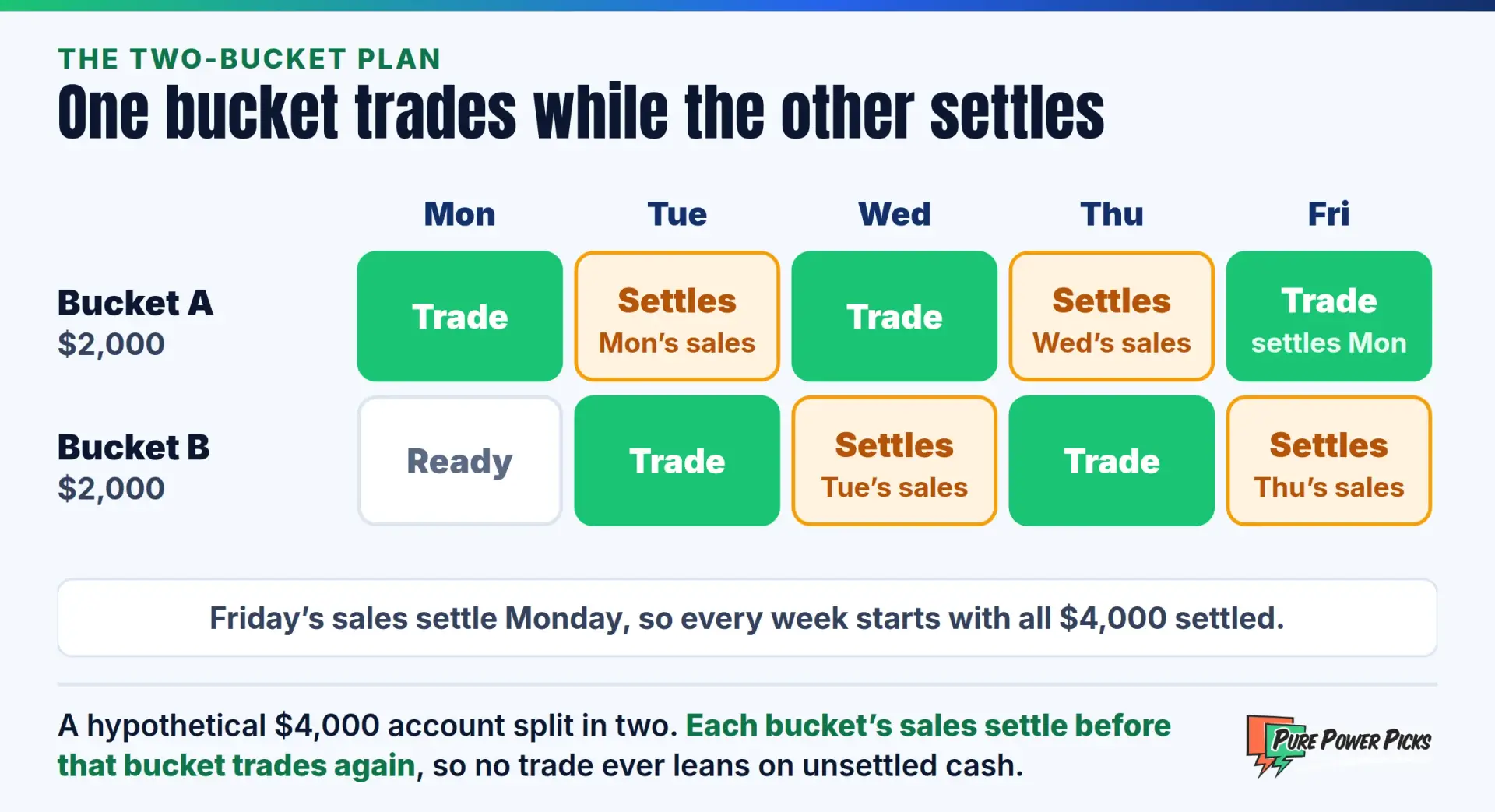
Split your account into two buckets. Use one for today and keep the other settling for tomorrow. For example, a hypothetical $4,000 account might allow up to $2,000 on Monday, Wednesday and Friday, and the other $2,000 on Tuesday and Thursday. Each bucket always has a full day to settle before it is used again, so you never have to think about violations.
4. Be selective with the alerts you act on
Limited settled cash makes selectivity a feature, not a burden. Filter alerts by your strategy, your risk tolerance and the cash you have today. Skipping an alert is a valid decision. Chasing every idea is how cash gets stuck in settlement right when a cleaner setup appears.
When you review an alert, focus on the alert price, the alert zone and the plan around it. Treat those as starting points for your own analysis, not instructions. Our guides on how to use options alerts and how our trade alerts work explain how to read each component.
Which Options Strategies Fit a Cash Account?
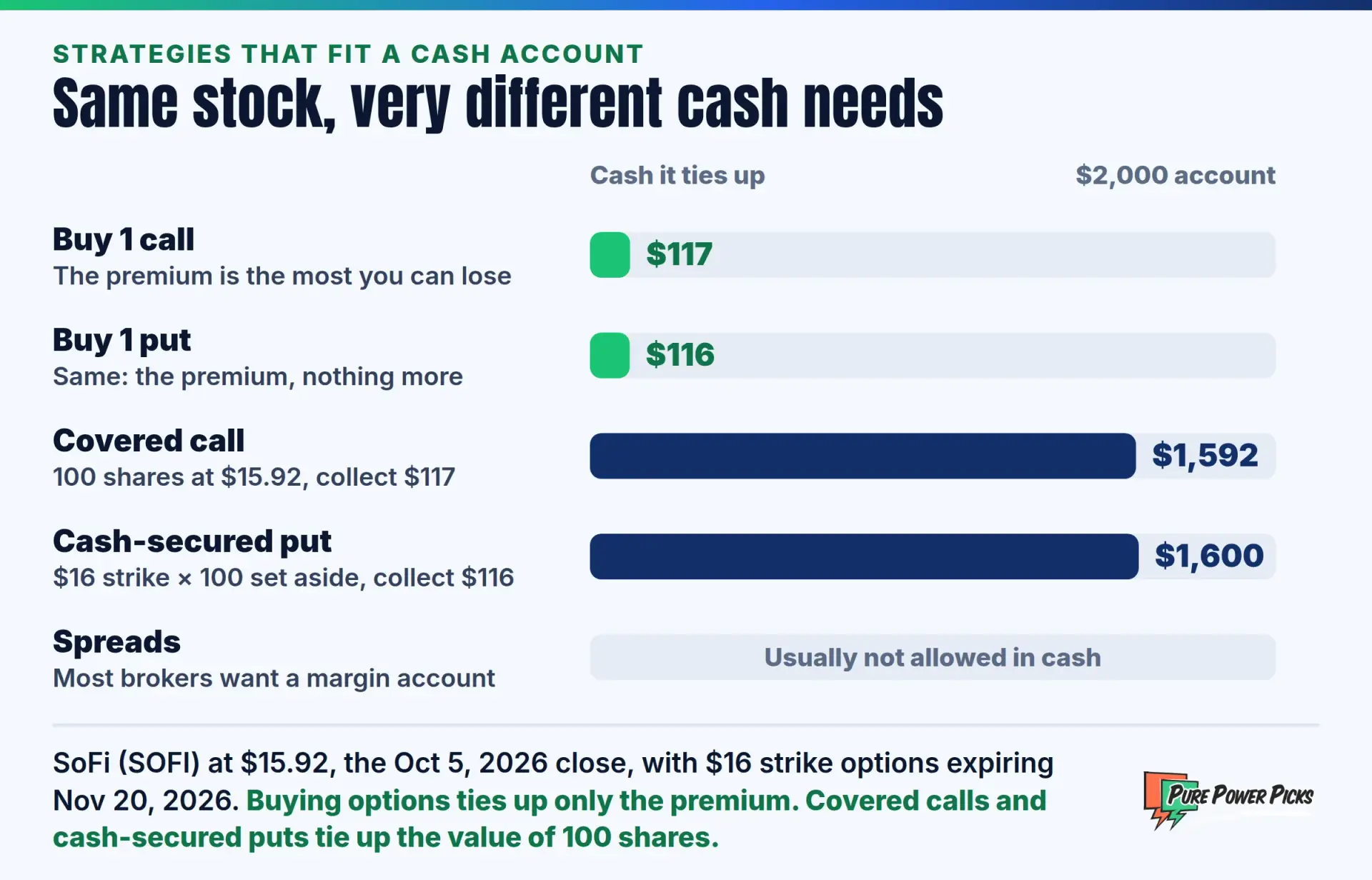
Defined, fully paid strategies fit best: buying calls, buying puts, covered calls and cash-secured puts. Many brokers do not permit spreads in a cash account, so confirm with yours before building a plan around them.
Older advice often suggested switching to spreads to reduce capital needs. That works in a margin account or an approved IRA, but most brokers require margin approval for multi-leg spreads, even defined-risk ones. Here is what typically works in a standard cash account:
- Long calls and puts. The core of most alert-based approaches. You pay the premium upfront, and that premium is your maximum loss.
- Covered calls. If you own 100 shares, you can sell a call against them. The shares serve as the collateral.
- Cash-secured puts. You set aside enough cash to buy 100 shares at the strike. Learn the mechanics in our guide to selling cash-secured puts.
If your capital is limited, consider lower-premium contracts and fewer, higher-conviction alerts rather than spreading thin across many tickers. Cboe’s Options Institute offers free material on how each of these strategies behaves.
Is a Cash Account the Right Choice for You?
A cash account is a strong choice if you mainly buy options, want zero exposure to borrowing and value simplicity over flexibility. It is less ideal if you need spreads, short options beyond cash-secured puts, or instant reuse of sale proceeds.
With the pattern day trader rule now retired, the decision comes down to how you trade, not a regulatory workaround. Many traders start in cash, build consistent habits and only apply for margin once they have a clear reason for it. Discipline, not account type, is what keeps you in the game.
Frequently Asked Questions
Can I day trade options in a cash account?
Yes, as long as you use settled cash. You can buy and sell the same contract on the same day with settled funds. The limit is reusing those sale proceeds, which settle the next business day.
How long do options take to settle?
Options settle T+1, meaning one business day after the transaction. Weekends and market holidays do not count, so a Friday sale settles Monday.
Does the end of the PDT rule make cash accounts pointless?
No. The PDT workaround is gone, but the benefits of no borrowing, no margin interest, no margin calls and a hard risk ceiling still apply. Those are the reasons to choose a cash account today.
What happens if I get a good faith violation?
Usually the first one results in a warning. Repeated violations within 12 months typically lead to a 90-day restriction where you can only buy with fully settled cash. Exact thresholds vary by broker.
Can I trade spreads in a cash account?
Usually not. Most brokers require a margin account, or an IRA with limited margin, for multi-leg spreads. Check your broker’s options approval levels before you plan around them.
Make Every Settled Dollar Count
A cash account rewards traders who plan. Pure Power Picks alerts give you educational chart setups with a clear alert price and alert zone, so you can decide in advance whether an idea fits your budget, your sizing rules and your settlement schedule.
See Alert Plans and Pricing
The PPP Team is the research and editorial team behind Pure Power Picks. We trade stocks and options and publish the work as we do it, with every alert tracked in public. Publishing since 2020. How we research and correct our work is written out in our editorial standards. Our content is strictly educational, never advice.
Disclaimer: The content on Pure Power Picks is for educational and informational purposes only and does not constitute financial, investment, or trading advice. Pure Power Picks is not a registered investment advisor or broker-dealer. All examples are hypothetical and are not real trades or results. Options trading involves substantial risk and is not suitable for every investor, and you can lose the entire amount paid for an option. Past performance, including any historical alert highs, does not guarantee future results. Always do your own research and consult a licensed financial professional before making any investment decisions.