


Top 5 Swing Trading Strategies Using Options Alerts to Maximize Profits
The best swing trading strategies using options alerts are momentum calls on breakouts, reversal puts on overextended rallies, earnings breakout plays, scaling into trades that prove themselves, and defined-risk spreads for uncertain markets. Each one targets moves that play out over days to weeks, so you avoid the frantic pace of day trading while keeping your capital working. The hard part is spotting the right trades and timing them well. That is where a quality alert service helps: it does the scanning and surfaces chart setups so you can spend your energy on planning, sizing, and risk. Below, we break down all five strategies, how alerts fit into each one, and the mistakes that sink most beginners.
No single swing strategy works in every market. Match the strategy to the setup: calls for confirmed breakouts, puts for exhausted rallies, spreads when you want defined risk. Alerts can surface ideas faster, but your results still come down to strike selection, sizing, and a plan written before you click buy.
How do you ride momentum with call options?
You buy calls after a stock breaks a well-defined resistance level on strong volume, then give the move enough time to develop. The breakout is the signal, the volume is the confirmation, and the call gives you leveraged upside with a known maximum risk.
Momentum is the lifeblood of swing trading. When a stock finally clears a price it has struggled with for weeks, trapped sellers often give up and new buyers pile in. Learning to read support and resistance levels is what separates a real breakout from noise.
Here’s a hypothetical example. Stock XYZ has stalled under $100 for three weeks. One morning it pushes to $102 with volume running about twice its 20-day average. A momentum-focused alert might flag the setup with an alert zone near the breakout, pointing to a $105 call roughly 30 to 45 days out. Your plan: if XYZ closes back below $100, the breakout has failed and the idea is invalid.
Notice what matters in that plan. The expiration gives the move room to breathe, the strike is close enough to the money to respond to price, and the invalidation level is defined in advance. Our guide to picking the right strike price goes deeper on the tradeoff between cheap out-of-the-money contracts and more responsive near-the-money ones.
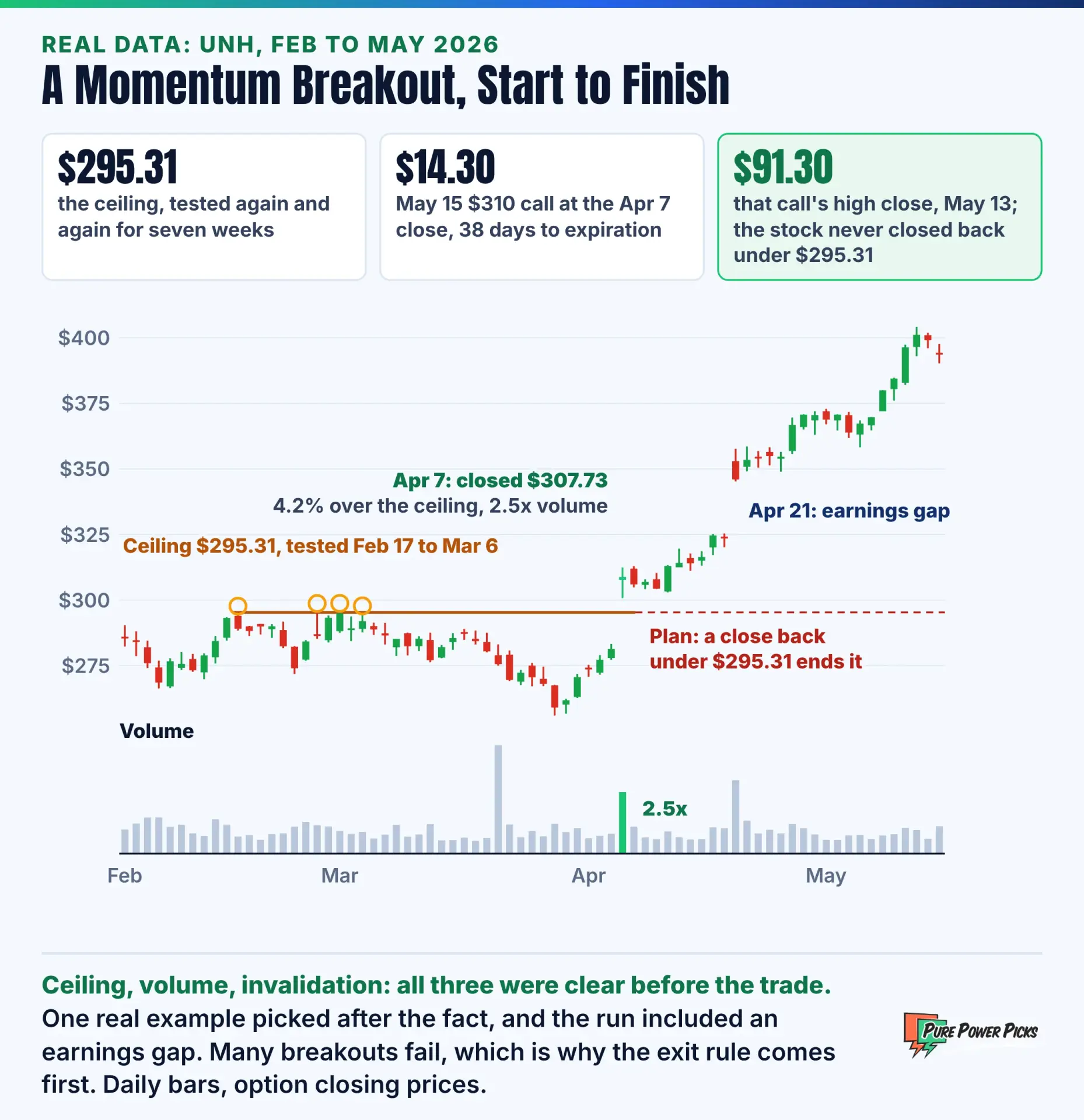
Here is the same setup on a real chart. UnitedHealth (UNH) pressed against $295.31 again and again from February 17 to March 6, 2026. On Tuesday, April 7 it closed at $307.73, 4.2% over that ceiling, on about 2.5 times its 20-day average volume. The May 15 $310 call closed that day at $14.30 with 38 days left, and the plan was simple: a close back under $295.31 would end the idea. It never came, and the call closed as high as $91.30 on May 13, helped by an earnings gap on April 21. That is one example picked after the fact; plenty of breakouts fail, which is why the exit rule is written first.
Pros: strong upside potential when trends follow through, clear technical triggers, easy to define invalidation. Cons: momentum can fade fast, chasing a move that is already extended raises your cost, and short-dated calls can expire worthless if the stock stalls.
Check the price against the alert price before you act. If the stock has already run well past the alert zone, the risk-reward has changed. Skipping a setup you missed is a skill, not a failure.
How do you trade reversals with put options?
You buy puts when a rally shows clear signs of exhaustion, such as an overbought RSI paired with a bearish candle at resistance, and you place a hard stop just above the recent high. Reversal plays are contrarian, so the confirmation and the stop matter even more than they do on breakouts.
Stocks do not climb forever. When the Relative Strength Index pushes above 70 and volume starts fading on up days, buyers are often running out of fuel. That does not guarantee a drop, but it tilts the odds enough to justify a small, defined-risk bet.
Let’s walk through a hypothetical scenario. A broad index ETF rallies hard to $200 after a policy announcement. RSI reads 76, and the next day prints a bearish engulfing candle. A reversal-focused setup might point to a $195 put about three to four weeks out. The rule is simple: if price closes above roughly $203, above the high, the reversal thesis is wrong and you step aside.
This is where real risk management comes in. Overbought markets can stay overbought far longer than your account can stay patient. Define your maximum loss before you buy the put, not after the first green candle against you.
Pros: reversals can move quickly, puts let you benefit from downside without shorting stock, and the stop level is usually obvious. Cons: false signals are common in strong trends, the window to act is short, and fighting a powerful rally can get expensive fast.
How do earnings breakouts work for swing traders?
Earnings breakouts target the large moves that often follow quarterly reports, either by positioning before the report or by waiting for a post-report gap that holds. The second approach is usually the safer one for beginners, because it avoids paying peak volatility prices.
Earnings season is a volatility buffet, and swing traders can feast if they understand one thing: option prices already include the expected move. Before a report, implied volatility climbs. After the report, it usually collapses, which can shrink option prices even when the stock moves in your direction.
Volatility crush: the sharp drop in implied volatility after a known event like earnings. Because volatility is part of an option’s price, a crush can reduce the value of calls and puts even if the stock moves the way you expected.
Here’s a hypothetical example. Stock ABC trades at $50 ahead of earnings, and options are pricing an expected move of about $4 in either direction. If you buy a $52 call before the report and ABC rises only $3, volatility crush may leave your call worth less than you paid. If ABC jumps $8 and holds that gap for a few sessions, the call can increase meaningfully in value.
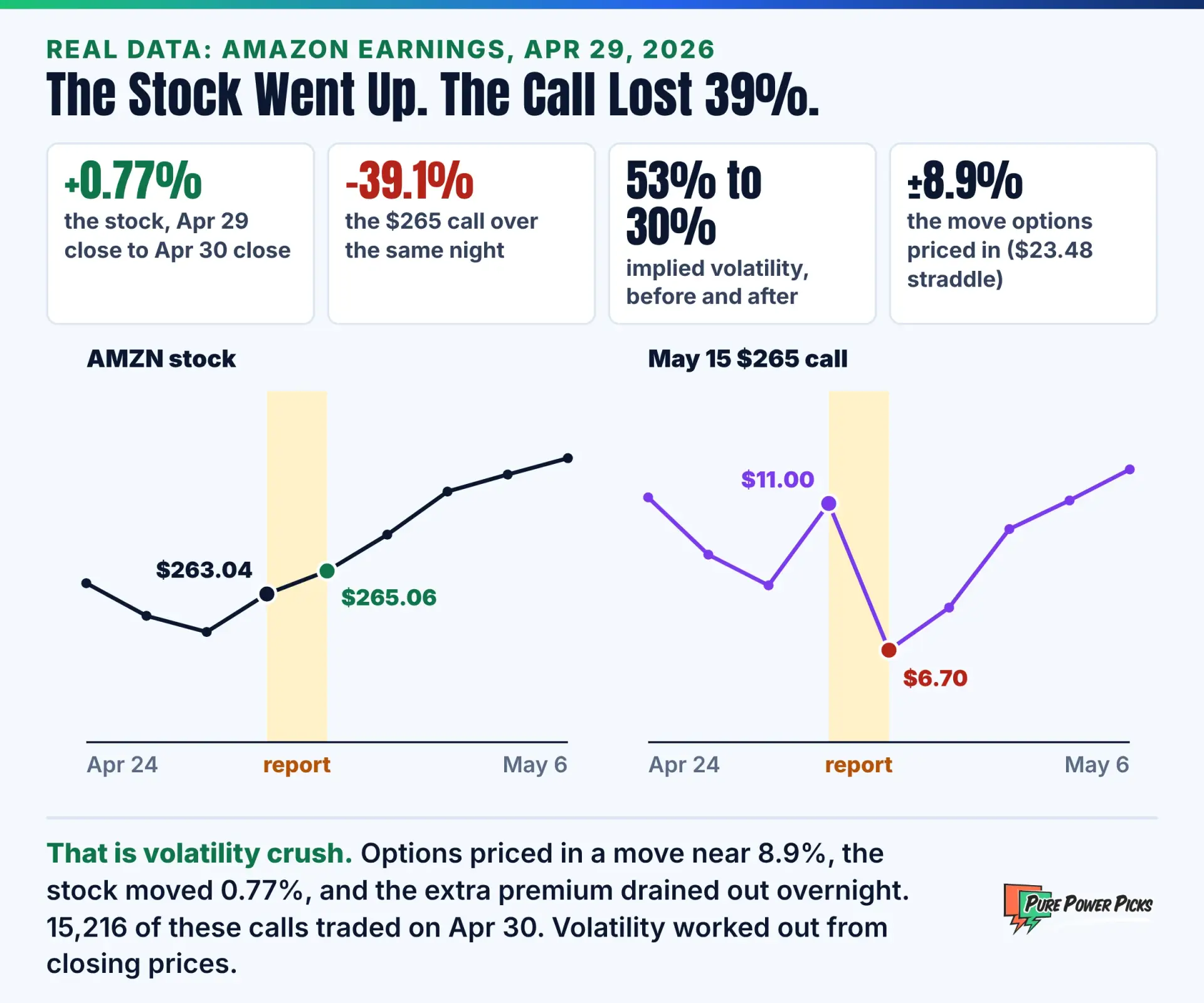
Amazon showed the first case on real prices in April 2026. Before its report on Wednesday, April 29, the May 15 $265 call closed at $11.00 and the matching put at $12.48, so options were pricing a move of about 8.9% either way. The stock rose 0.77% by Thursday’s close, yet the call fell to $6.70, a 39.1% drop, as implied volatility fell from about 53% to 30%.
The alternative is the post-earnings breakout. You wait for the report, let volatility settle, and look for a gap that holds above a key level for a day or two. You give up the first leg of the move, but you trade a confirmed reaction instead of a coin flip.
Pros: earnings create some of the largest swing moves of the quarter, and post-report gaps often define new trends. Cons: pre-report premiums are expensive, a miss can gap the stock against you overnight, and this is not a strategy for oversized bets.
Holding long options through earnings means you can lose most or all of your premium overnight, with no chance to react. Stops do not protect you from gaps. Size every pre-earnings trade as if it could go to zero.
How do you scale into trades that are working?
You start with a partial size, then add only after the trade confirms your thesis by moving in your favor or clearing a new level. This keeps your early risk small and puts more capital to work only when the market proves you right.
Not every setup takes off right away, but the good ones deserve more commitment once they show their hand. The key is deciding your full size and total risk before the first contract, so adding never turns into averaging up recklessly. Our breakdown of position sizing for options covers the math.
Here’s a hypothetical scenario. A stock pulls back to $95 support inside an uptrend, and you plan a maximum of two contracts on a 30-day call. You buy one contract near support. Four days later the stock reclaims $100 and the MACD crosses above its signal line, so you add the second contract and raise your stop to protect the first.
The other half of scaling is scaling out. Selling in chunks as the trade reaches predefined targets lets you lock in part of the move and still let strong trades run. Our guide on managing targets and setting stops lays out several frameworks you can adapt.
Pros: limits damage if the setup fails early, rewards patience, and builds discipline. Cons: ties up more capital, your average cost rises as you add, and it needs a trend strong enough to justify the second leg.
How do options spreads help you hedge swing trades?
A debit spread, such as buying one call and selling a higher-strike call with the same expiration, lowers your cost and caps your maximum loss in exchange for capping your maximum payoff. It is one of the most beginner-friendly ways to express a directional view with defined risk.
Spreads shine when the outlook is directional but the environment is shaky, think Fed pivots or tech volatility. The short call offsets part of the premium and part of the time decay, so you do not need a massive move to do well. Investopedia’s overview of the bull call spread is a solid primer.
Here’s a hypothetical example. A stock trades at $100. You buy the $100 call and sell the $110 call, both about four weeks out, for a net debit of $4.00 ($400 per contract). Your maximum loss is the $400 you paid. The spread can be worth at most $10.00 at expiration, so the most it can add is $6.00 per share, or $600 per contract, and your break-even is $104.
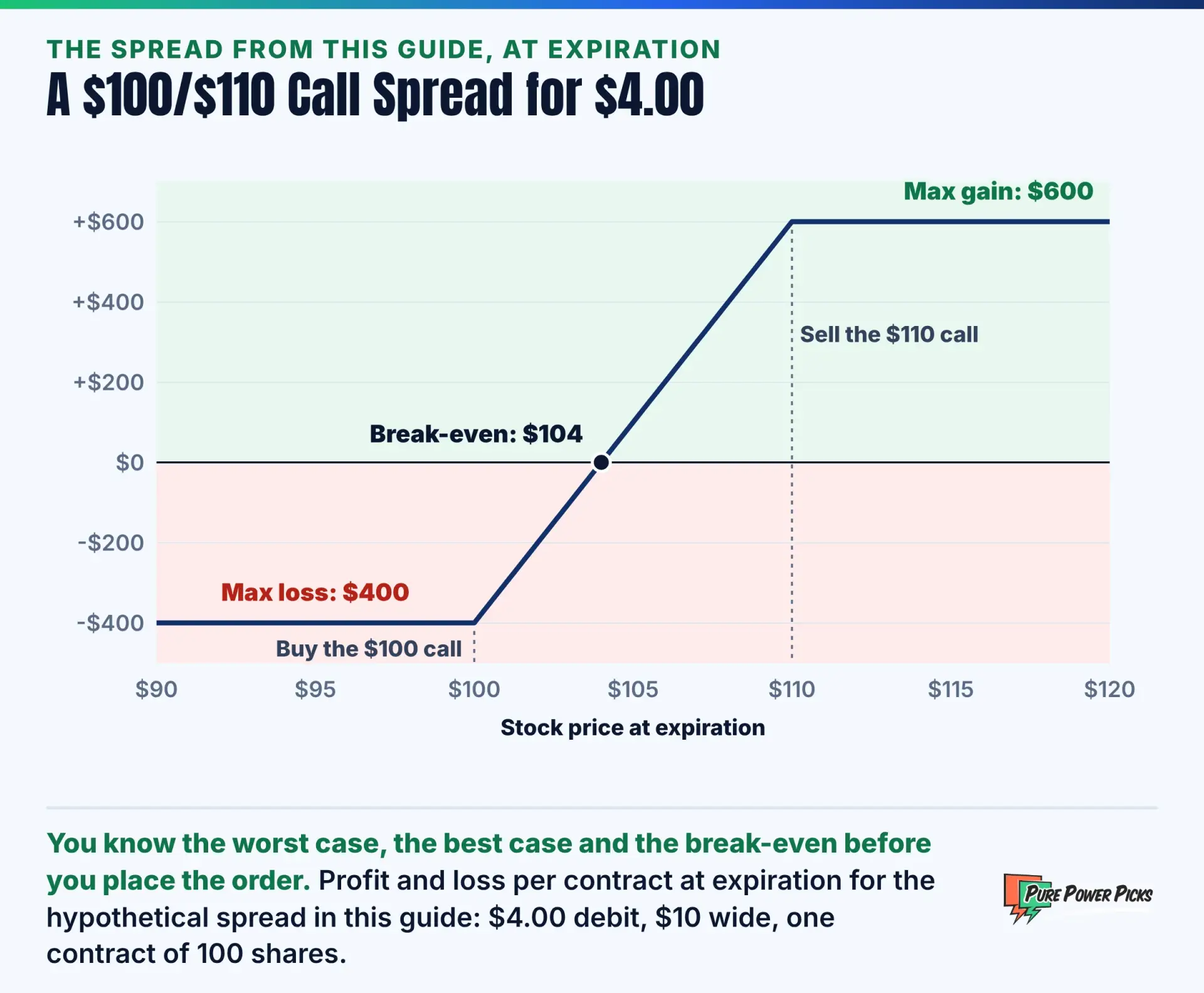
That clean math is the appeal. You know your worst case, your best case, and your break-even before you place the order. For strike width, debit versus credit, and adjustments, see our full vertical spread strategy guide.
Pros: built-in risk control, lower cost than a single call, less sensitive to time decay and volatility swings. Cons: capped upside, two legs mean more commissions and wider bid-ask spreads, and strike selection has to be precise.
| Strategy | Bias | Main Trigger | Main Risk | Best For |
|---|---|---|---|---|
| Momentum calls | Bullish | Breakout on volume | Failed breakout | Beginners |
| Reversal puts | Bearish | Overbought plus bearish candle | Trend keeps running | Intermediate |
| Earnings breakouts | Either | Report and gap hold | Volatility crush, gaps | Intermediate |
| Scaling in | Either | Confirmation after first leg | Higher average cost | Patient traders |
| Debit spreads | Directional | Any defined setup | Capped upside | Beginners |
How do options alerts fit into a swing trading plan?
Alerts work best as a filtered idea list, not a replacement for your own plan. They save scanning time and highlight setups that match these five strategies, but you still decide the strike, size, stop, and targets that fit your account.
When you receive an alert, read it the right way. The alert price is the potential price of the option at the time the alert was published, not a guaranteed fill. If a service reports that an alert reached “a high of +X%,” that is the best price the contract touched afterward, a historical data point rather than a typical or captured result.
A simple routine keeps you disciplined: confirm the chart yourself, check how far price has moved from the alert zone, apply your sizing rules, and write down your invalidation level. Our guide on how to use options alerts walks through that process, and our top swing trading setups guide shows the chart patterns behind many of them. Always weigh the risk-reward ratio before acting on any idea.
Put together, these five swing trading strategies give you a playbook for almost any market: momentum calls, reversal puts, earnings breakouts, scaling into strength, and hedged spreads. Want to see how we present educational setups? Sign up for our free trial and study the alerts alongside this guide.
Frequently Asked Questions
What expiration should I use for swing trading options?
Many swing traders choose expirations three to eight weeks out. That gives a multi-day move time to develop and slows the impact of time decay, which accelerates in the final few weeks before expiration.
Which of the five strategies is best for beginners?
Debit spreads and momentum calls on clean breakouts are usually the easiest to learn. Both have defined risk and clear triggers. Earnings plays and reversals take more experience because volatility and timing work against you more often.
Do I have to act on every options alert?
No. Alerts are educational ideas, and you should only act on setups that fit your plan, your account size, and your risk tolerance. Skipping alerts that have moved far from the alert zone is often the smarter choice.
How much of my account should I risk on one swing trade?
Many traders cap risk at a small percentage of their account per trade, often 1% to 2%. Since a long option can lose its full premium, the amount you pay is often the amount you should be prepared to lose.
What does “a high of +X%” mean on an alert?
It is the highest recorded price the alerted option reached after the alert was published, compared to the alert price. It is a historical data point, not what a typical trader received, and it says nothing about future alerts.
Turn these five strategies into a repeatable routine.
Pure Power Picks delivers educational options setups with clear chart context, so you can practice spotting breakouts, reversals, and spread opportunities while you build your own process.
See Alert Plans and Pricing
The PPP Team is the research and editorial team behind Pure Power Picks. We trade stocks and options and publish the work as we do it, with every alert tracked in public. Publishing since 2020. How we research and correct our work is written out in our editorial standards. Our content is strictly educational, never advice.
Disclaimer: Pure Power Picks is not a registered investment advisor or broker-dealer. All content is for educational and informational purposes only and should not be considered financial, investment, or trading advice. All examples in this article are hypothetical and do not represent actual trades or results. Options trading involves substantial risk and is not suitable for all investors. You can lose some or all of your invested capital. Past performance, including any reported alert highs, does not guarantee future results. Always do your own research and consult a licensed financial professional before making investment decisions.