


Vertical Spread Options Strategy: Full Guide for Traders
Share


A vertical spread options strategy is a two-leg options trade where you buy one option and sell another option of the same type (both calls or both puts), on the same underlying, with the same expiration, but at different strike prices. The result is a directional bet with a fixed maximum loss and a fixed maximum payoff, both known before you place the order. There are four versions: the bull call spread and bull put spread for bullish views, and the bear put spread and bear call spread for bearish views. Debit spreads cost money up front and benefit from a move in your direction. Credit spreads pay you up front and benefit when price stays on the right side of your short strike. Oil prices are swinging hard and Treasury yields are sitting near multi-decade highs, so traders keep looking for a way to express a directional opinion without open-ended risk. The vertical spread is that tool. Here’s exactly how to build, price, and manage one.
A vertical spread trades unlimited upside for a defined, known risk. Use debit spreads when implied volatility is low and you expect a move. Use credit spreads when implied volatility is high and you expect price to hold a level. Either way, your worst case is locked in the moment you open the trade.
What You’ll Learn
- What a vertical spread is and why it caps your risk
- How to choose between a bull call spread, bear put spread, bull put spread, and bear call spread
- How to pick strike price for options spreads, plus width and expiration
- The exact max profit, max loss, and breakeven formulas with worked examples
- How to adjust for high implied volatility during oil shocks and yield spikes
- When to close, roll, or hold a vertical before expiration
What Is a Vertical Spread Options Strategy and Why Does It Cap Risk?
A vertical spread caps risk because the option you sell offsets the option you buy beyond the short strike. Once price passes that short strike, every extra dollar gained on one leg is lost on the other, so both your best case and worst case are frozen.
The name comes from old options pricing sheets, where strikes were listed vertically. You’re moving “up” or “down” the strike ladder within a single expiration month.
The distance between the two strike prices in a vertical spread. A spread using the 100 and 105 strikes has a width of $5. Width times 100 shares sets the total dollar range of outcomes for one contract.
Compare that to buying a single call. A long call can lose 100% of its premium, and it bleeds time value every day. A vertical spread still has a maximum loss, but the short leg lowers your cost and partially cancels out time decay and volatility swings. For a solid primer on the mechanics, Investopedia’s vertical spread overview is a good companion read.
Bull Call, Bear Put, Bull Put or Bear Call: Which Vertical Spread Should You Use?
Use a bull call spread or bear put spread when you expect a meaningful move and implied volatility is reasonable. Use a bull put spread or bear call spread when you expect price to stay above or below a level and implied volatility is elevated.

That’s the core of the debit vs credit spread decision. Debit spreads need movement. Credit spreads need price to simply not break your short strike. Here’s the full map.
The Four Vertical Spreads Compared
A simple memory trick: in a debit spread, you buy the option closer to the money. In a credit spread, you sell the option closer to the money. If you want to go deeper on the credit side specifically, our credit spread strategy guide walks through it in the context of oil volatility.
How Do You Pick Strike Price, Width and Expiration for a Vertical Spread?
Pick strikes based on where you expect price to go, choose width based on how much you’re willing to risk, and choose expiration to give your thesis enough time to play out. Those three decisions define the whole trade.
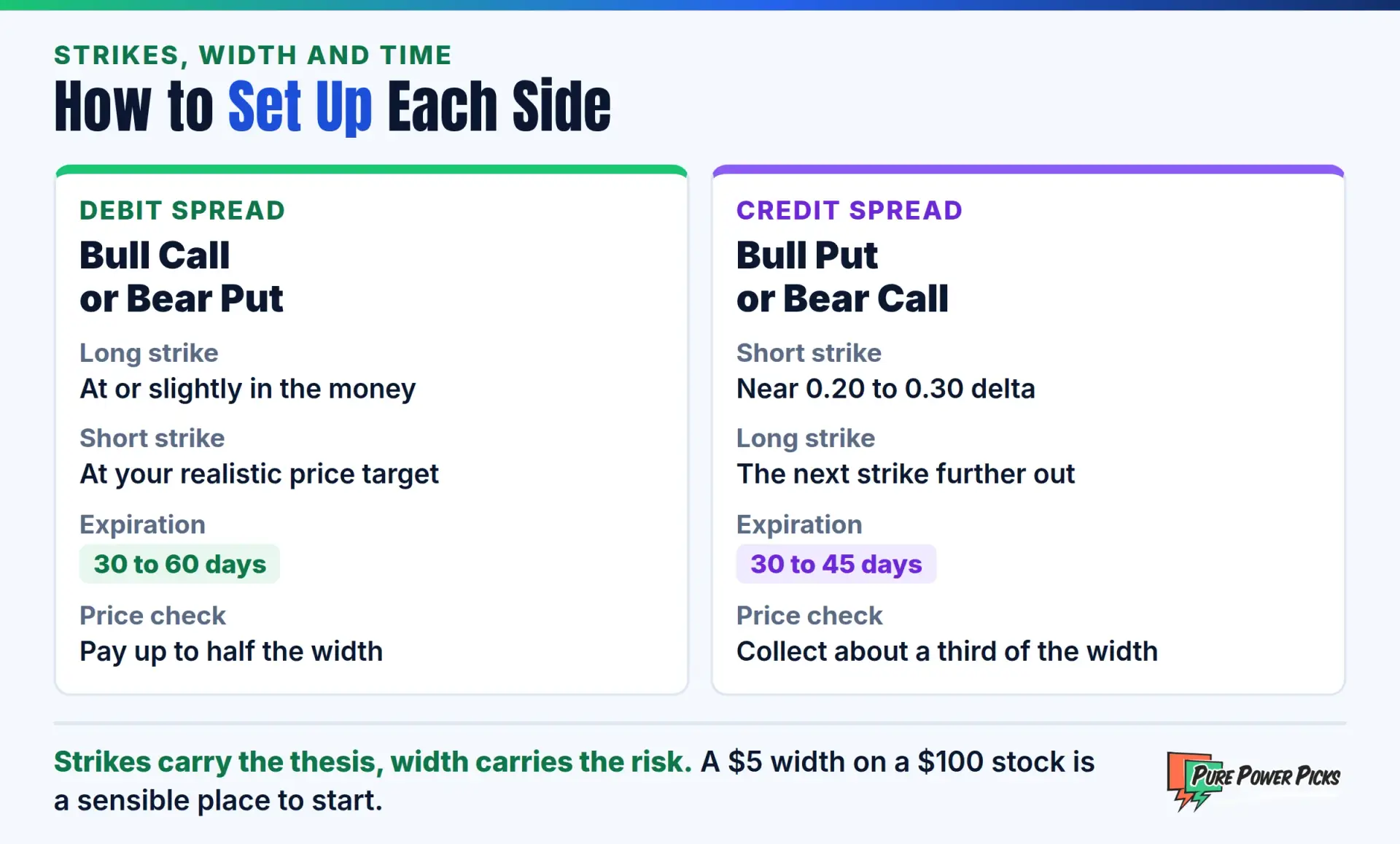
Here’s exactly how to pick strike price for options spreads, broken down by type:
- Debit spreads: Buy the strike at or slightly in the money. Sell the strike at your realistic price target. If you think a $100 stock can reach $105, the 100/105 bull call spread matches your thesis exactly.
- Credit spreads: Sell the strike outside a level you believe will hold, often around 0.20 to 0.30 delta. Buy the next strike further out as protection.
- Width: Wider spreads cost more and carry more risk, but offer a larger payoff range. A $5 width on a $100 stock is a sensible starting point.
- Expiration: Debit spreads need time to work, so 30 to 60 days is the sweet spot. Credit spreads benefit from faster time decay, so 30 to 45 days works best.
Strike selection is a skill on its own, and we cover it in detail in our guide to choosing the right strike.
For debit spreads, aim to pay no more than about half the spread width. Paying $2.50 or less on a $5 wide spread keeps your reward at least equal to your risk. For credit spreads, collecting roughly one-third of the width is a common benchmark that keeps the risk-to-reward ratio from getting lopsided.
How Do You Calculate Max Profit, Max Loss and Breakeven on a Vertical Spread?
For a debit spread, max loss equals the debit paid and max profit equals the width minus the debit. For a credit spread, max profit equals the credit received and max loss equals the width minus the credit.

Vertical Spread Formulas
Let’s walk through a hypothetical example. Imagine stock XYZ trades at $100 and you’re bullish over the next 45 days. You buy the 100 call for $4.00 and sell the 105 call for $1.80. Your net debit is $2.20, or $220 per contract.
- Max loss: $2.20 x 100 = $220, if XYZ finishes below $100
- Max profit: ($5.00 width minus $2.20) x 100 = $280, if XYZ finishes at or above $105
- Breakeven: $100 + $2.20 = $102.20 at expiration
Now flip it with a hypothetical credit spread on the same $100 stock. You sell the 95 put for $1.50 and buy the 90 put for $0.60, collecting a $0.90 credit, or $90. Your max profit is $90 if XYZ stays above $95. Your max loss is ($5.00 minus $0.90) x 100 = $410. Your breakeven is $95 minus $0.90 = $94.10.
Notice the trade-off. The credit spread wins more often because price only needs to stay above $95, but you risk $410 to collect $90. The debit spread needs a move, but the payoff is larger relative to the risk. For more on the mechanics, see our deep dive on breakeven price.
Formulas are the easy part. Reading a chart and knowing where the key levels sit is the skill that takes practice.
Every PPP alert comes with a detailed trade plan covering key levels, risk zones, and the reasoning behind the idea, so you can build the analysis habits this guide teaches.
How Should You Trade Vertical Spreads When Implied Volatility Is High?
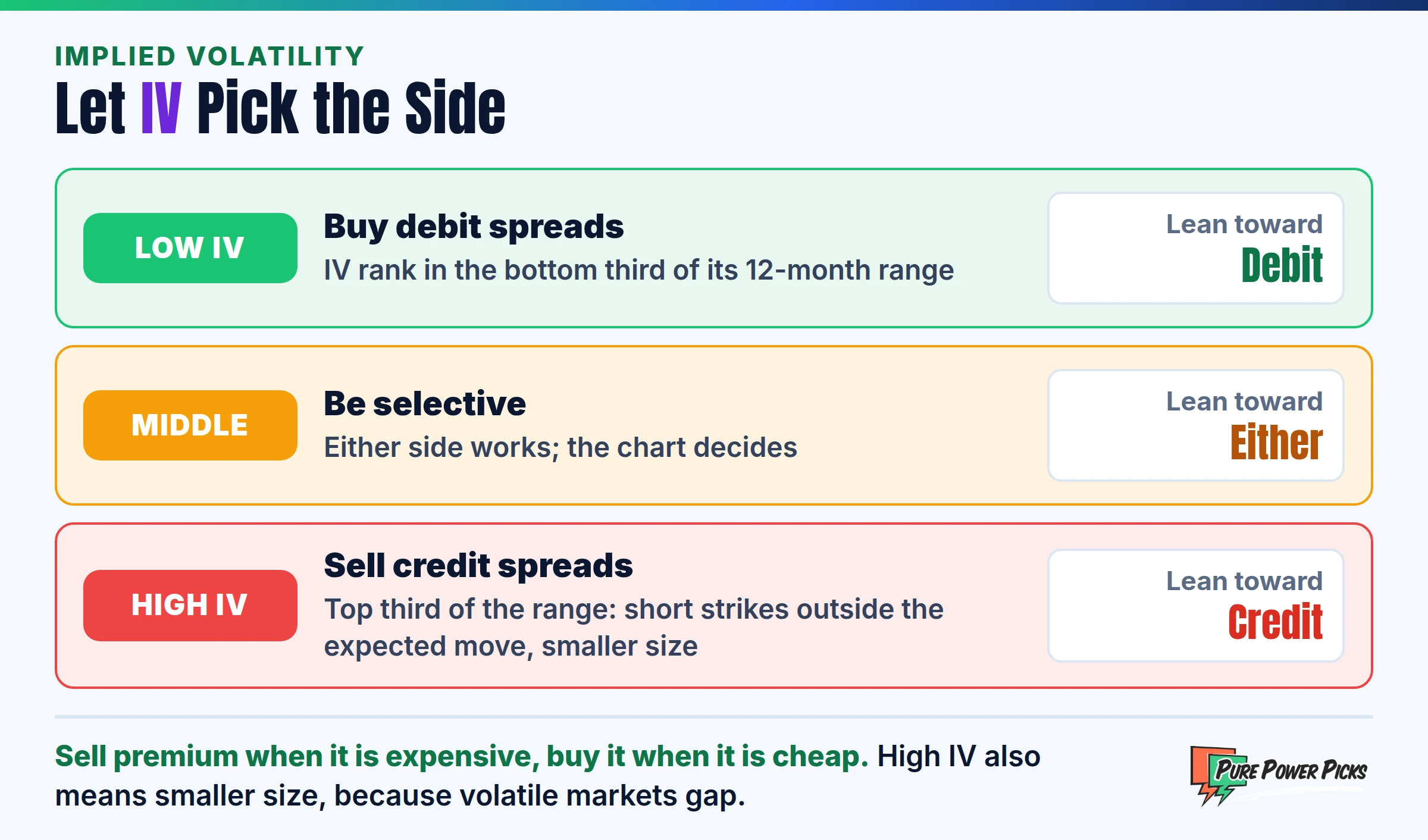
When implied volatility is high, you should lean toward credit spreads, because you’re selling expensive premium that tends to deflate once the panic fades. When implied volatility is low, debit spreads are the better tool, because the options you buy are cheaper.
That’s directly relevant right now. Sharp swings in crude oil have pushed option premiums higher across energy names, and rising yields have rattled rate-sensitive sectors like banks, homebuilders, utilities, and long-duration bond ETFs. You can track the 10-year Treasury yield yourself on FRED’s 10-year Treasury constant maturity series. When those macro moves hit, implied volatility on related options often spikes well above its normal range.
Here’s the edge vertical spreads give you in that environment. A naked long call bought during an IV spike can lose value even if you’re right on direction, because volatility collapses after the event. A vertical spread holds up far better because the short leg also loses value as IV falls. The two vega exposures largely cancel. If you need a refresher on how this metric works, read our guide to implied volatility.
Use these rules during oil shocks and yield spikes:
- Check IV rank first. If IV is in the top third of its 12-month range, favor credit spreads.
- Widen your distance. High IV means larger expected moves, so place short strikes outside the expected move, not inside it.
- Size smaller. Volatile markets gap. Risk a smaller slice of your account per spread than you would in calm conditions.
- Respect event dates. OPEC meetings, inflation reports, and Treasury auctions can move prices overnight. Know what’s on the calendar before you open the trade.
Defined risk does not mean small risk. A credit spread that collects $90 can still lose $410, and in a fast market you can hit max loss quickly. Also watch for early assignment on short in-the-money legs, especially around ex-dividend dates, and for pin risk when price closes near your short strike at expiration. FINRA’s investor guide to options covers these risks in plain language.
How Do You Manage, Roll or Close a Vertical Spread Before Expiration?
You should close most vertical spreads before expiration, typically once you’ve captured 50% to 75% of the maximum value or once the trade hits your predefined loss limit. Holding to the final day adds assignment and pin risk for very little extra reward.

Here’s a practical management framework:
- Debit spreads: Close when the spread is worth 50% to 75% of its maximum value. On a $5 wide spread, that means closing when it trades around $3.50 to $4.00. Cut it if the spread loses about half its cost.
- Credit spreads: Close once you’ve captured about 50% of the credit received. Cut it if the spread’s value reaches roughly twice the credit collected.
- Rolling: If your thesis is intact but you need more time, close the current spread and open a new one in a later expiration. Only roll for a net credit or a small debit. Never roll just to avoid admitting a trade didn’t work.
- Expiration week: Close anything with a short leg near the money. Our guide to early assignment risk explains exactly why this matters.
Always close the spread as a single order rather than legging out one side at a time. Legging out turns a defined-risk trade into an undefined one in a heartbeat. The Options Industry Council offers free tools and courses if you want to practice order mechanics.
Frequently Asked Questions
Is a vertical spread good for beginners?
Yes. A vertical spread is one of the best first multi-leg strategies because the max loss is known before you place the order. If you understand how single calls and puts work, you can learn verticals quickly.
What is the difference between a debit vs credit spread?
A debit spread costs money to open and needs the underlying to move in your favor. A credit spread pays you to open and needs the underlying to stay on the right side of your short strike. Debit spreads fit low IV environments, while credit spreads fit high IV environments.
Which is better, a bull call spread or a bull put spread?
Use a bull call spread when you expect a strong upward move and options are relatively cheap. Use a bull put spread when you expect the stock to hold support and IV is elevated. Both are bullish, but they win under different conditions.
Can you lose more than the max loss on a vertical spread?
Not if both legs remain open and you close them together. The risk rises if a short leg is assigned early and the long leg isn’t managed, or if you leg out of the trade. Closing as a single order protects the defined-risk structure.
How wide should a vertical spread be?
Start with a width of roughly 5% of the stock price, such as $5 on a $100 stock. Wider spreads increase both risk and potential payoff. Match the width to the dollar amount you’re willing to lose on a single idea.
What’s the Bottom Line on the Vertical Spread Options Strategy?
The vertical spread options strategy gives you a directional view with a hard ceiling on risk, which is exactly what volatile oil and elevated yields demand. Pick debit or credit based on implied volatility, set strikes around levels you can defend with chart analysis, size it small, and close it before expiration. Master these four versions and you’ll have a framework that works in any market regime.
Learn from detailed trade plans that walk through the reasoning, key levels, and risk zones behind every alert, so you build pattern recognition you can apply to any strategy.
Explore more trading guides to keep sharpening your edge.
Disclaimer: Pure Power Picks is not a licensed financial advisor. All content is for educational and informational purposes only and should not be considered investment advice. Options trading involves substantial risk of loss and is not suitable for all investors. Past performance does not guarantee future results.
Share

The PPP Team is the research and editorial team behind Pure Power Picks. We trade stocks and options and publish the work as we do it, with every alert tracked in public. Publishing since 2020. How we research and correct our work is written out in our editorial standards. Our content is strictly educational, never advice.