


Taking Profits and Setting Stops with Pure Power Picks: Tailored Strategies for Options Trading Success
At Pure Power Picks, one question comes up from members again and again: “Do you have general guidance on when to book profits and what stop-loss to use? I’m allocating a percentage of my portfolio to each trade, and while I’ve read that it’s up to each subscriber, I’d love more direction, or even an automation solution for placing orders based on your alerts.”
We get it. Options trading can feel overwhelming, especially when it comes to locking in profits and managing risk. Our alerts provide the thesis, contract details, target ranges, and key levels, but the decision of when to act is personal. It’s your account, your risk tolerance, and your call. That doesn’t mean you have to figure it out alone. We can give you actionable frameworks to help you make that call with confidence.
In this guide, we’ll walk through reliable ways to take profits and set stop-losses when you use our Options Trade Alerts, tailored to different trading styles and risk tolerances. We’ll also cover automation options that can streamline how you place orders. Whether you’re conservative or optimistic, trading one contract or several, you’ll leave with a plan.
Key Takeaway
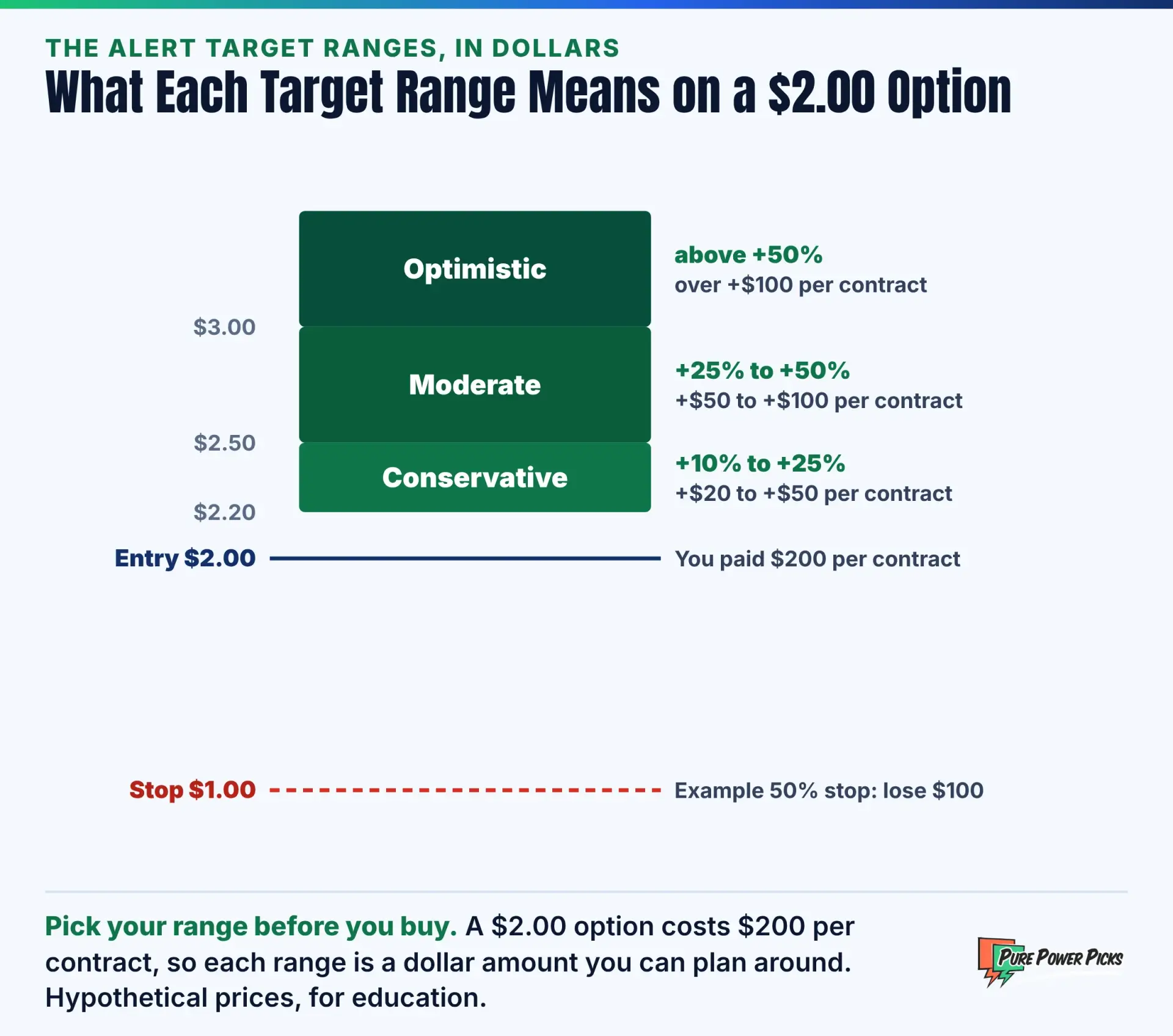
Pure Power Picks alerts give you the thesis, contract details, target ranges (Conservative 10% to 25%, Moderate 25% to 50%, Optimistic above 50%), and key support/resistance levels. When you sell and where you place your stop is your decision. Pick a profit-taking style and a stop method that fit your account size and risk tolerance, write them down before you place an order, and stick to them.
// At a Glance
| Topic | Taking profits and setting stops with PPP alerts |
| Skill level | Beginner to intermediate |
| Alert includes | Thesis, contract details, target ranges, key levels |
| Target ranges | Conservative 10% to 25% | Moderate 25% to 50% | Optimistic above 50% |
| Profit-taking styles | Conservative, Optimistic Scaling, Target-Based Flexibility |
| Stop methods | Percentage-based, Technical, Averaging In |
| Automation | Not built in; use broker conditional orders, notifications, or third-party tools |
Why Do Profit-Taking and Stops Matter in Options Trading?
Options are unique. They’re time-sensitive and leveraged, which means a contract’s value can climb quickly, and losses can mount just as fast. That’s exactly why you need a plan for both sides of the trade before you click buy.
Our alerts include target ranges to guide you:
- Conservative: 10% to 25%
- Moderate: 25% to 50%
- Optimistic: above 50%
They also include key levels (support and resistance) so you can see where the chart may react. Booking profits secures what you’ve earned on your own trade, while stop-losses protect your capital so you can keep trading tomorrow.
Definition: Stop-Loss
A stop-loss is a predetermined price or percentage at which you sell to limit how much you can lose on a trade. It can be a resting order at your broker or a mental rule you act on manually. For a deeper look, see the options risk management rules we teach.
Strategies for Booking Profits
There’s no single “right” way to take profits. Here are three approaches, each matched to a different type of trader.
Conservative Approach: Lock In Profits Early
- How it works: Sell all of your contracts when the option reaches the conservative target range of 10% to 25%.
- Who it’s for: Traders with smaller accounts or those prioritizing capital preservation.
- Pros: Quick profit and reduced exposure to reversals.
- Cons: You may miss a larger move if the stock keeps running.
Optimistic Scaling: Ride the Wave by Selling in Pieces
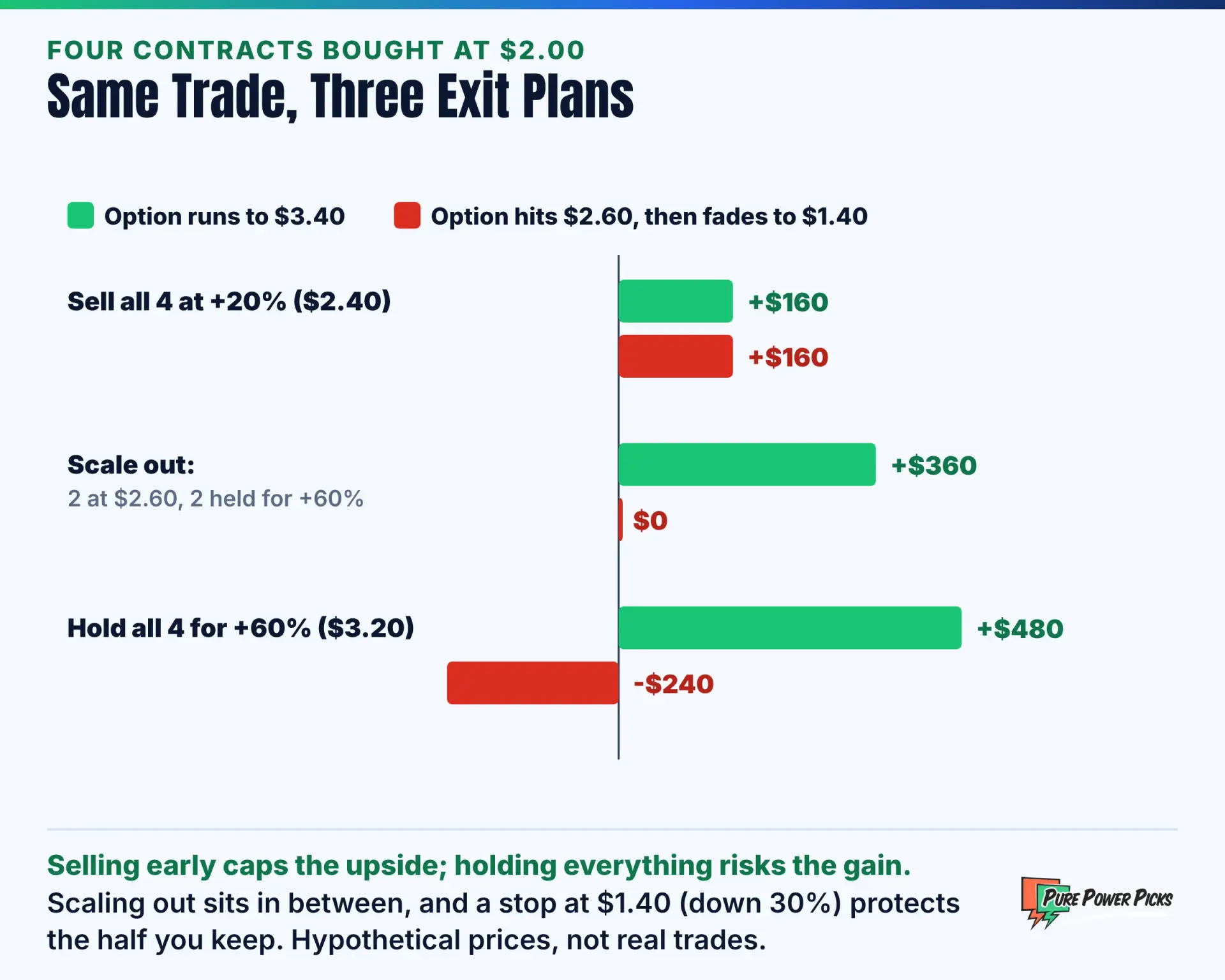
- How it works: If you hold multiple contracts, sell half in the moderate range (25% to 50%) and the remainder in the optimistic range (above 50%).
- Who it’s for: Traders with larger accounts seeking balanced risk and reward.
- Pros: Secures early profits while keeping upside potential alive.
- Cons: Requires multiple contracts and patience.
Scaling out pairs well with using trailing stops on the contracts you keep, so the remaining half has protection while it has room to move.
Hypothetical Example: Scaling Out
Let’s walk through a hypothetical scenario with round numbers. Say you buy 4 contracts at $2.00 each ($200 per contract, $800 total). Using Optimistic Scaling, you plan to sell 2 contracts once the option trades in the moderate range ($2.50 to $3.00) and hold the other 2 for the optimistic range (above $3.00). If the option hits $2.60, you sell 2 and lock in that piece. If it later fades, you still banked part of the move. If it keeps running past $3.00, your remaining 2 contracts participate. This is purely illustrative, not a real trade or a typical outcome.
Target-Based Flexibility: Match Your Goals
- How it works: Select a target range based on your risk tolerance and adjust as the stock approaches key levels.
- Who it’s for: Any trader seeking a customizable strategy.
- Pros: Adaptable to various trading styles.
- Cons: Requires discipline to stick with the strategy.
Pro Tip
Decide your target range before you place the order, not while you’re watching the contract tick. Flexibility works when you adjust based on the key levels in the alert, not based on emotion.
Strategies for Setting Stop-Losses
Your stop is what keeps one bad trade from becoming a bad month. Here are three methods, along with their tradeoffs.
Percentage-Based Stops
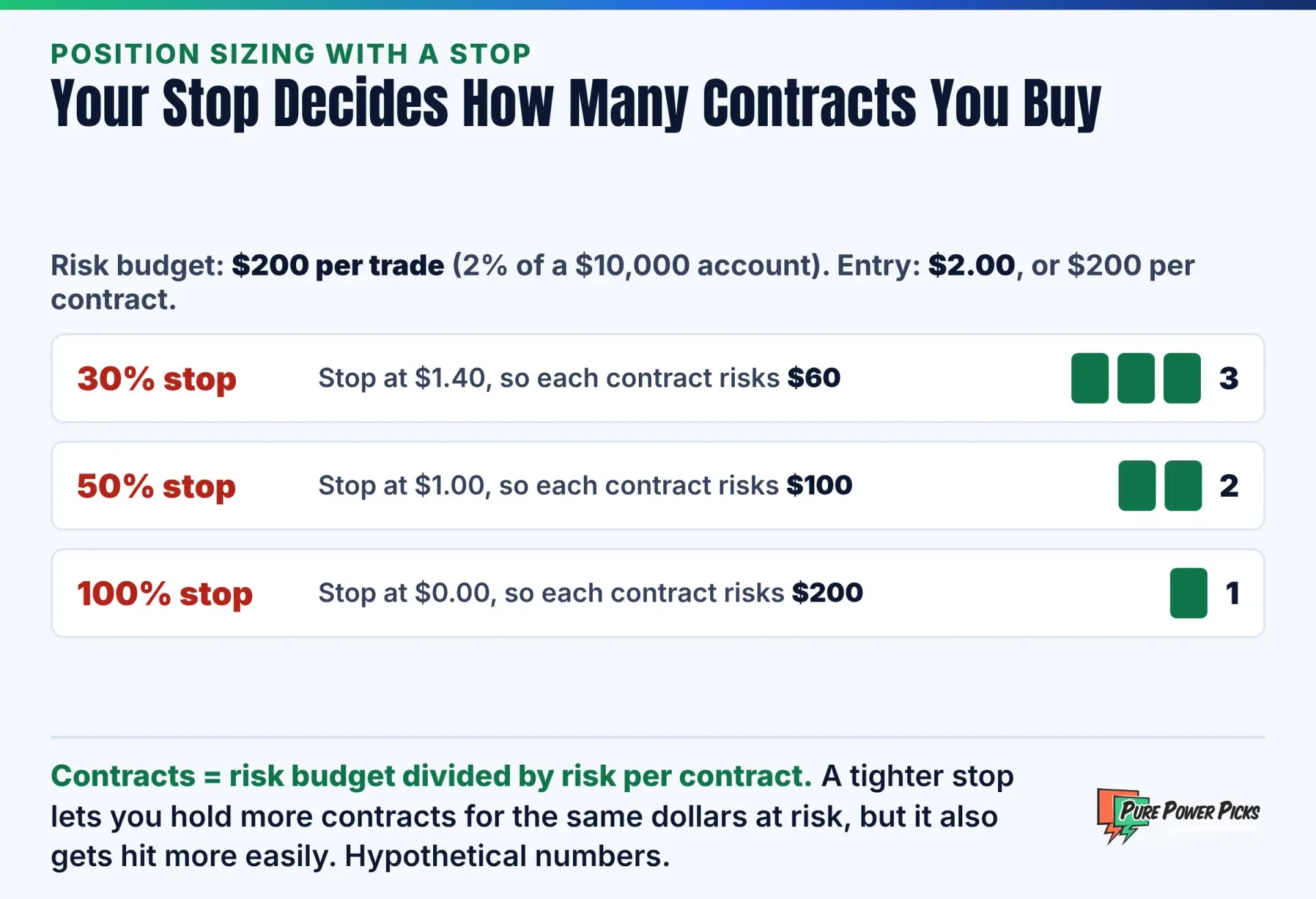
- How it works: Set stops at fixed percentage losses, such as 30%, 50%, or 100%.
- Pros: Simple and consistent.
- Cons: Might not account for a specific stock’s volatility.
A 100% stop effectively means you accept the full premium as your risk, so size accordingly. Our guide to position sizing for options shows how your stop and your contract count work together.
Technical Stops
- How it works: Place stops just below the support levels identified in the alert.
- Pros: Aligns with market analysis.
- Cons: Requires close monitoring of stock prices.
Definition: Support Level
Support is a price area where buying interest has historically stepped in and slowed a decline. If the stock breaks clearly below it, the original thesis may be weakening. Learn more about support and resistance levels.

Averaging In
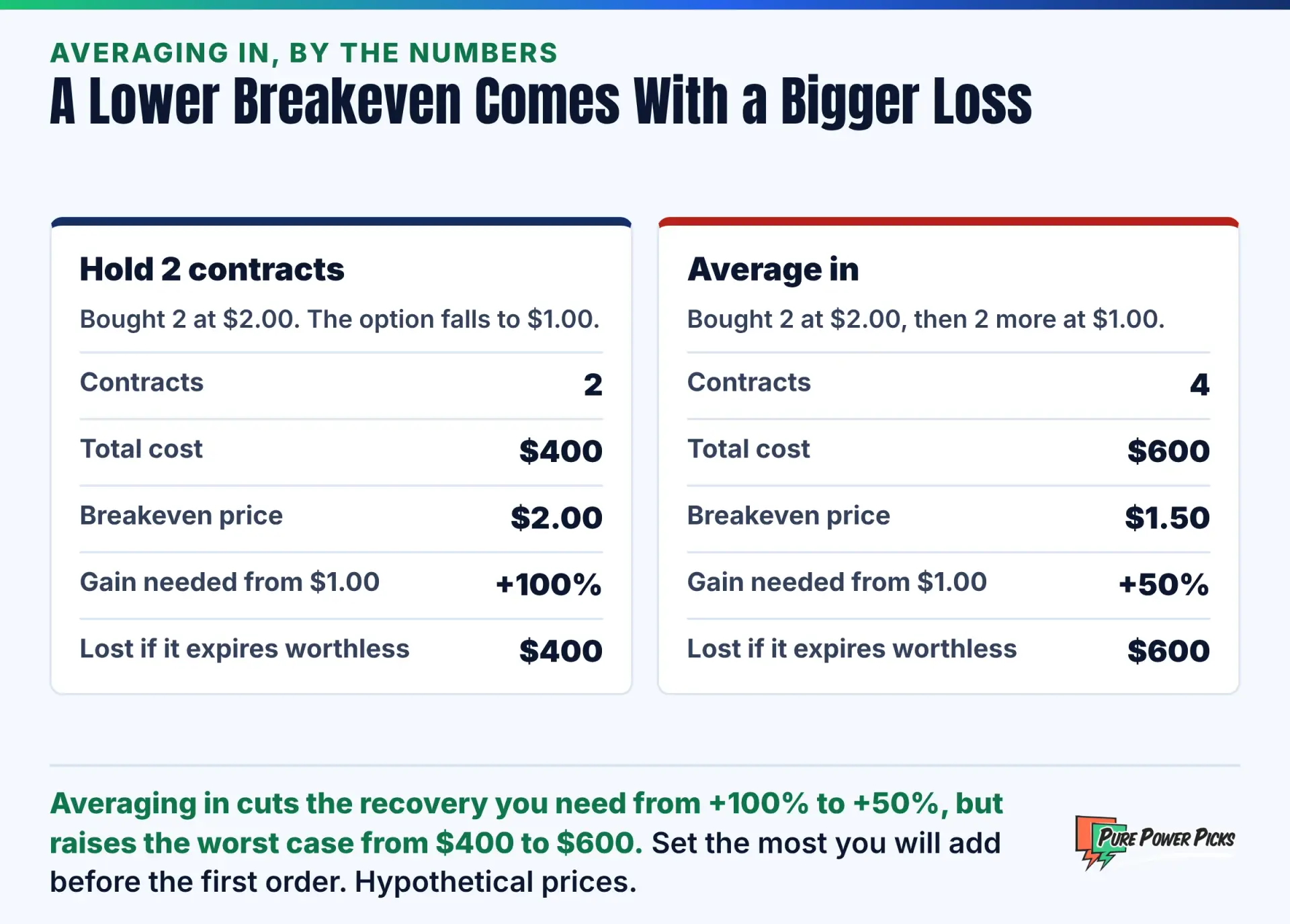
- How it works: Buy additional contracts at lower prices to reduce your average cost.
- Pros: Lowers your breakeven, increasing the chance of recovery.
- Cons: Increases exposure and potential losses.
Risk Warning
Averaging in increases your exposure and your potential losses. Because options lose value as expiration approaches, adding contracts to a trade that’s moving against you can compound the damage. Only consider it with a predefined maximum amount at risk, and know when to cut your losses instead.
Can You Automate Orders with Our Alerts?
We don’t offer built-in automation, but you have solid options for streamlining how you act on an alert:
- Conditional orders: Set “if/then” conditions with your broker for automated execution.
- Alerts: Configure notifications for key levels so you can act manually.
- Third-party tools: Use platforms like TradeStation for custom automation.
Whichever route you take, test it in a small size first so you understand exactly how your broker handles fills, gaps, and fast-moving option prices.
How Do You Find Your Perfect Strategy?
Align your profit-taking and stop strategy with your risk profile:
- Small budget: Target conservative profits with tight stops.
- Multiple contracts: Scale out and use technical stops.
- High risk tolerance: Go for higher targets and average in.
| Trader Profile | Profit-Taking Style | Stop Method |
|---|---|---|
| Small budget | Conservative (10% to 25%) | Tight stops |
| Multiple contracts | Optimistic Scaling | Technical stops |
| High risk tolerance | Higher targets (above 50%) | Averaging in |
Test and refine your strategy with each alert. Keep a simple journal: which target range you chose, where you set your stop, and whether you followed your plan. After a few dozen trades, your own data will tell you which approach fits you best.
Frequently Asked Questions
Does Pure Power Picks tell me exactly when to sell?
Our alerts provide the thesis, contract details, target ranges, and key levels. The decision of when to act is personal, because it depends on your account size and risk tolerance. The strategies in this guide give you a framework for making that decision.
What are the target ranges in the alerts?
Alerts include three target ranges: Conservative (10% to 25%), Moderate (25% to 50%), and Optimistic (above 50%). They are guides, not guarantees, and an option may never reach any of them.
What stop-loss percentage should I use?
Common fixed-percentage stops are 30%, 50%, or 100%. Percentage stops are simple and consistent, but they may not account for a stock’s volatility. Technical stops placed just below the support levels in the alert are another option if you can monitor prices closely.
Can I automate orders based on the alerts?
We don’t offer built-in automation. You can use conditional “if/then” orders with your broker, set notifications at key levels to act manually, or use third-party platforms like TradeStation for custom automation.
Is averaging in a good idea?
Averaging in lowers your breakeven, which can increase the chance of recovery, but it also increases your exposure and potential losses. It generally suits traders with a high risk tolerance and a clearly defined maximum amount at risk.
I only trade one contract. Can I still scale out?
Scaling out requires multiple contracts. With a single contract, the Conservative Approach or Target-Based Flexibility is usually a better fit, paired with a percentage-based or technical stop.
Ready to Level Up Your Trading Game?
Get educational chart setups with the thesis, contract details, target ranges, and key levels, then apply the profit-taking and stop framework that fits you.
Join Pure Power Picks Today
The PPP Team is the research and editorial team behind Pure Power Picks. We trade stocks and options and publish the work as we do it, with every alert tracked in public. Publishing since 2020. How we research and correct our work is written out in our editorial standards. Our content is strictly educational, never advice.
Disclaimer: The content provided by Pure Power Picks is for educational and informational purposes only and does not constitute financial, investment, or trading advice. We are not financial advisors. Options trading involves substantial risk and is not suitable for every investor; you can lose all of the money you invest. All examples are hypothetical and for illustration only. Past performance does not guarantee future results. Always do your own research and consult a licensed financial professional before making any investment decisions.