

Stop Loss in Trading: Pros and Cons
A stop loss in trading is a preset price level where your broker automatically closes a position to cap how much you can lose. Think of it as a safety net you build before you ever need it. Instead of watching a trade fall apart and freezing, you decide in advance the exact point where you admit the setup is wrong and step aside. Used well, a stop loss keeps one bad trade from wrecking a good week, and it takes emotion out of the hardest decision you face at the desk: when to walk away. Used carelessly, it can knock you out of solid trades right before they turn. In this refresh, we break down the pros, the cons, and how to actually place one.
A stop loss protects your account by capping losses and removing emotion from the exit decision, but it is not free insurance. Poorly placed stops get you shaken out early, and in fast markets they can fill worse than expected. The skill is not whether you use one, it is where you put it.
| What it is | An order that closes a position when price hits a preset level |
| Main job | Limit downside and enforce discipline |
| Common types | Stop-market, stop-limit, trailing stop |
| Biggest risk | Getting stopped out early or slipping in fast markets |
| Best paired with | Position sizing and a defined risk-reward ratio |
| Skill level | Beginner to intermediate |
What Is a Stop-Loss Order?
A stop-loss order is an instruction you give your broker to close a position automatically once price reaches a level you choose in advance. It is your line in the sand, set before the trade turns emotional.
Say you buy shares and decide you will not risk more than a fixed amount per share. You place a stop below your entry, and if price falls to that mark, the order fires and you are out. No hand-wringing, no hoping it comes back. The same logic applies to options, where a stop can be tied to the option premium or to a move in the underlying stock.
The key point most beginners miss: a stop loss is a plan, not a prediction. You are not saying price will hit that level. You are saying if it does, the reason you entered is no longer valid. That is why understanding different order types matters before you place a single one.
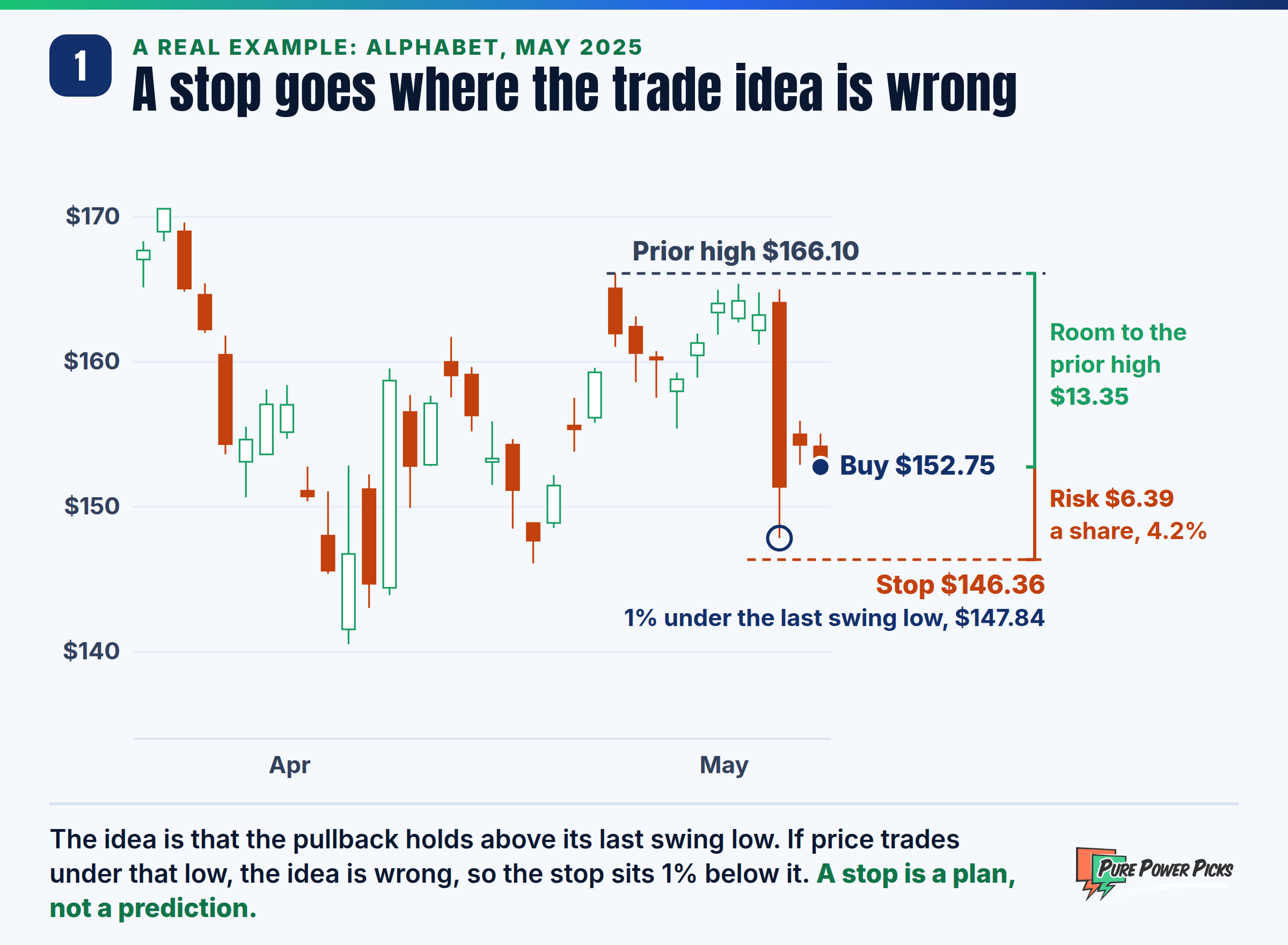
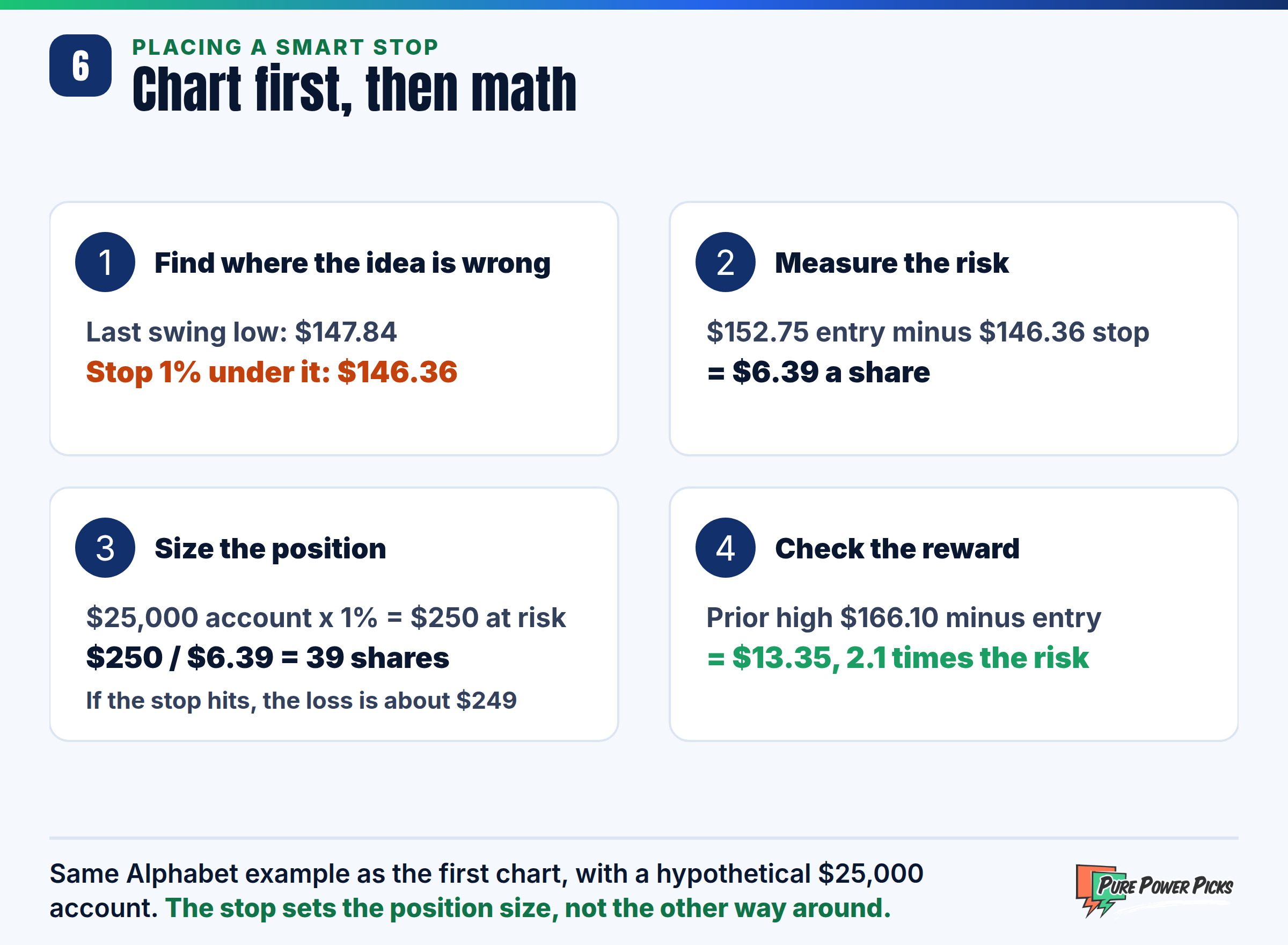
Here is that idea on a real chart. Alphabet fell to a low of $147.84 on May 7, 2025, then bounced. For a buyer at the May 9 close of $152.75, the trade is wrong if price trades back under that low, so the stop goes 1% below it, at $146.36.
Stop-market order: becomes a market order when your stop price is touched, so it fills fast but the exact price is not guaranteed. Stop-limit order: becomes a limit order at your chosen price, so you control the fill price but risk not filling at all in a fast drop.
How Do Stop-Loss Orders Actually Work?
The mechanics are simple: you pick a price, and when the market reaches it, the order triggers and your broker attempts to close the position. Everything after that depends on the type of stop you chose and how liquid the market is at that moment.
Here is a hypothetical example to make it concrete. Say you buy a stock at $100 and decide you are not willing to lose more than $5 per share. You set a stop-loss at $95. If price drifts down and trades at $95, your stop fires. With a stop-market order, it sells at the next available price, which in calm conditions is right around $95. Your loss is capped near the amount you planned for.
Now the catch. If bad news hits overnight and the stock opens at $88, your $95 stop does not protect you at $95. It triggers and fills near $88 because that is where the market actually is. This is called slippage, and it is why a stop caps most of your risk, not all of it. Learning to place stops around support and resistance levels instead of random dollar amounts is one of the fastest ways to improve your results.
UnitedHealth shows it on a real chart. Bought at its April 10, 2025 close of $594.40, a stop 5% lower sat at $564.68, and until April 17 the stock never traded that low. That morning the company reported earnings before the open, and the first trade was $481.95. A stop-market order would have sold near there, about 19% below the entry instead of the planned 5%.

For a broader breakdown of order mechanics, Investopedia’s stop-loss guide is a solid reference.
What Are the Benefits of Using a Stop Loss?
The biggest benefit is simple: a stop loss keeps a single bad trade from becoming a portfolio problem. Beyond that, it does a lot of quiet work for your psychology and consistency.
Risk control. By deciding your maximum loss before you enter, you make sure no one trade can take an outsized bite of your account. This is the foundation of everything we teach about how to manage risk.
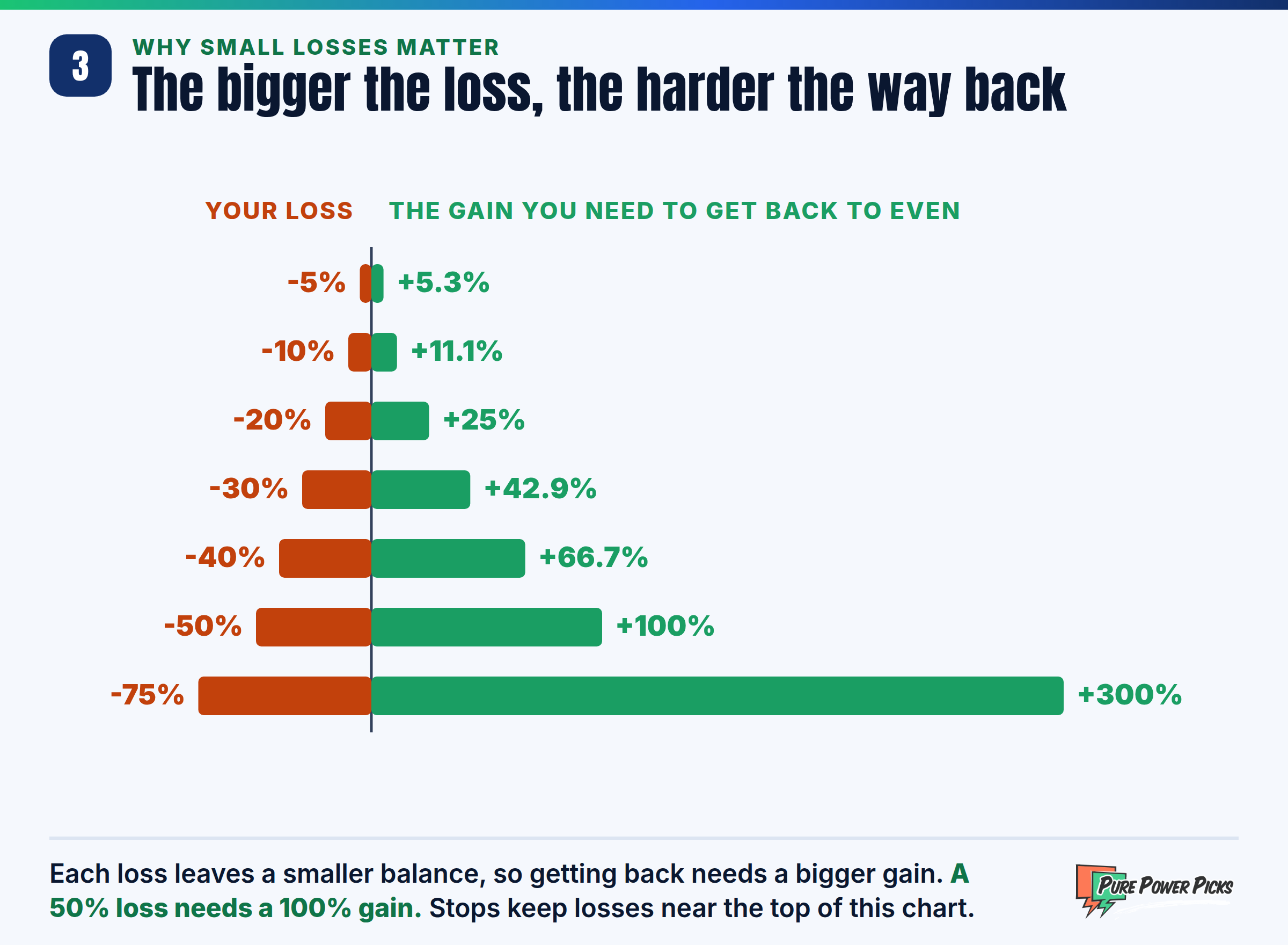
Keeping each loss small matters more than it looks, because the gain needed to get back to even grows faster than the loss. A 10% loss needs an 11.1% gain to recover. A 50% loss needs 100%.
Emotion control. The hardest moment in trading is admitting you are wrong. A stop makes that decision for you, in advance, when you are calm. That removes the “just one more candle” trap that sinks so many accounts.
Protection against gaps and time. A stop can shield you from overnight gaps and from the slow bleed of a trade that never works. It also frees you from staring at the screen all day.
Set your stop based on the chart first, then size your position around it, not the other way around. Decide where the trade is wrong, measure the distance to your stop, and let that dictate how many shares or contracts you take. Our guide to position sizing walks through the exact math.
What Are the Drawbacks of a Stop Loss?
A stop loss is not magic. The main drawback is that a stop placed too tight gets triggered by normal noise, taking you out of a trade that would have worked if you had given it room to breathe.
Getting shaken out. Markets rarely move in a straight line. If your stop sits just below your entry, ordinary volatility can clip it before the real move begins. This is where tools like the ATR indicator help, because they size your stop to how much the asset actually moves.
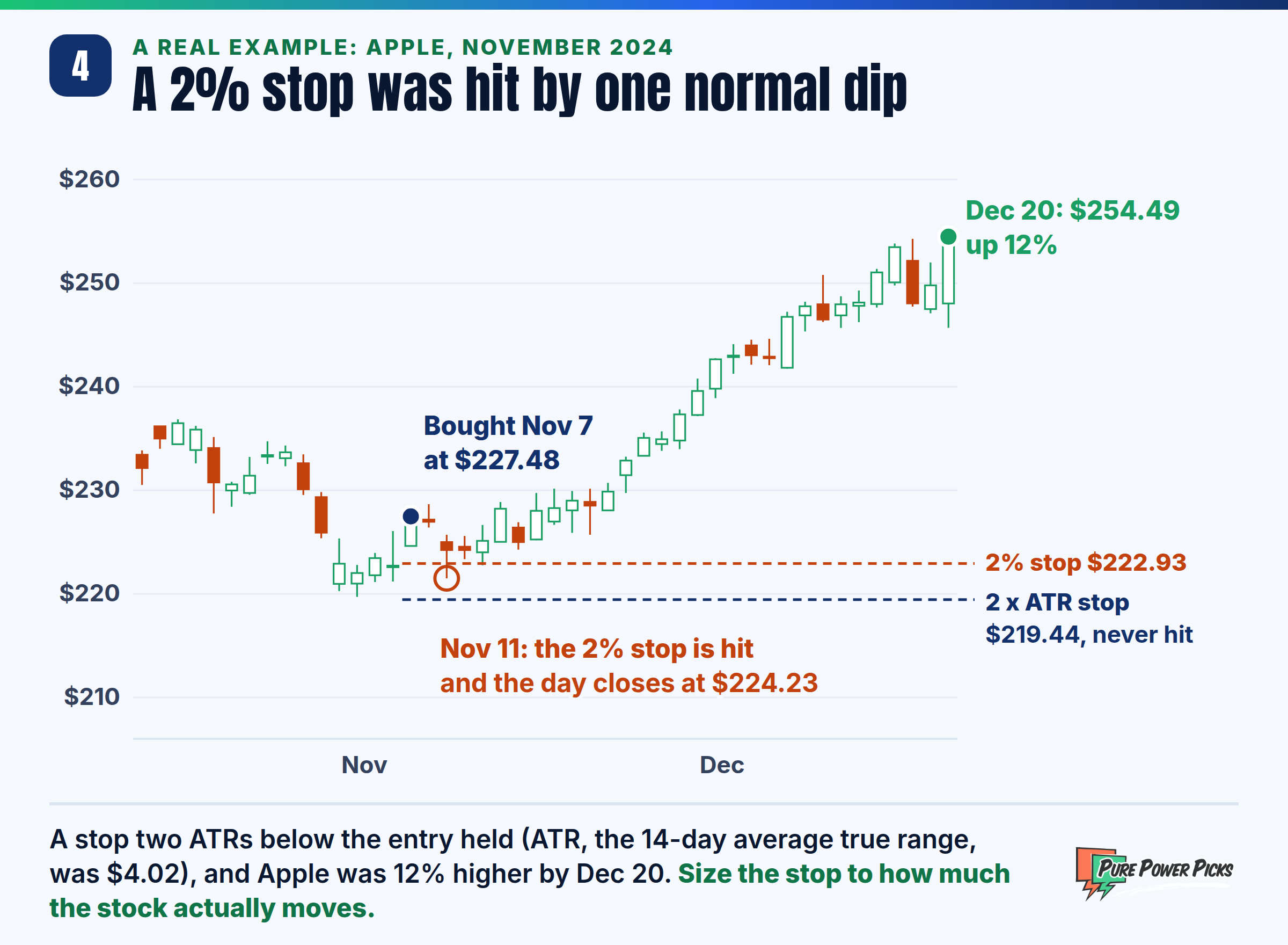
Apple in November 2024 is a real case. A stop 2% under the November 7 close of $227.48 sat at $222.93. On November 11 the stock dipped to $221.50, hit that stop, and closed the same day back above it at $224.23. A stop two ATRs below the entry, at $219.44, was never hit, and Apple closed at $254.49 on December 20, 12% above the entry.
Slippage in fast markets. As covered above, stop-market orders fill at the next available price, which can be well past your level during a gap or a flash move.
Stop hunting. Clusters of obvious stops, like the round number below a well-known support level, sometimes get swept before price reverses. Placing stops where everyone else does can work against you.
Never move a stop further away just because price is approaching it. That single habit turns a small, planned loss into a large, unplanned one. If you constantly feel the urge to widen stops, your position is probably too big. Review when to cut your losses before you talk yourself into holding.
Stop-Market vs. Stop-Limit vs. Trailing Stop: Which Should You Use?
The short answer: match the stop type to your goal. Use stop-market when getting out matters more than the exact price, stop-limit when price control matters more than certainty of the fill, and a trailing stop when you want to lock in an advantage as a trade moves your way.
| Type | Fill Certainty | Price Control | Best For |
|---|---|---|---|
| Stop-Market | High | Low | Getting out fast, volatile names |
| Stop-Limit | Lower | High | Calm, liquid markets |
| Trailing Stop | High | Medium | Protecting a favorable move |
Here is how each type handles the $88 gap from the example above, and how a trailing stop follows a trade that goes your way.
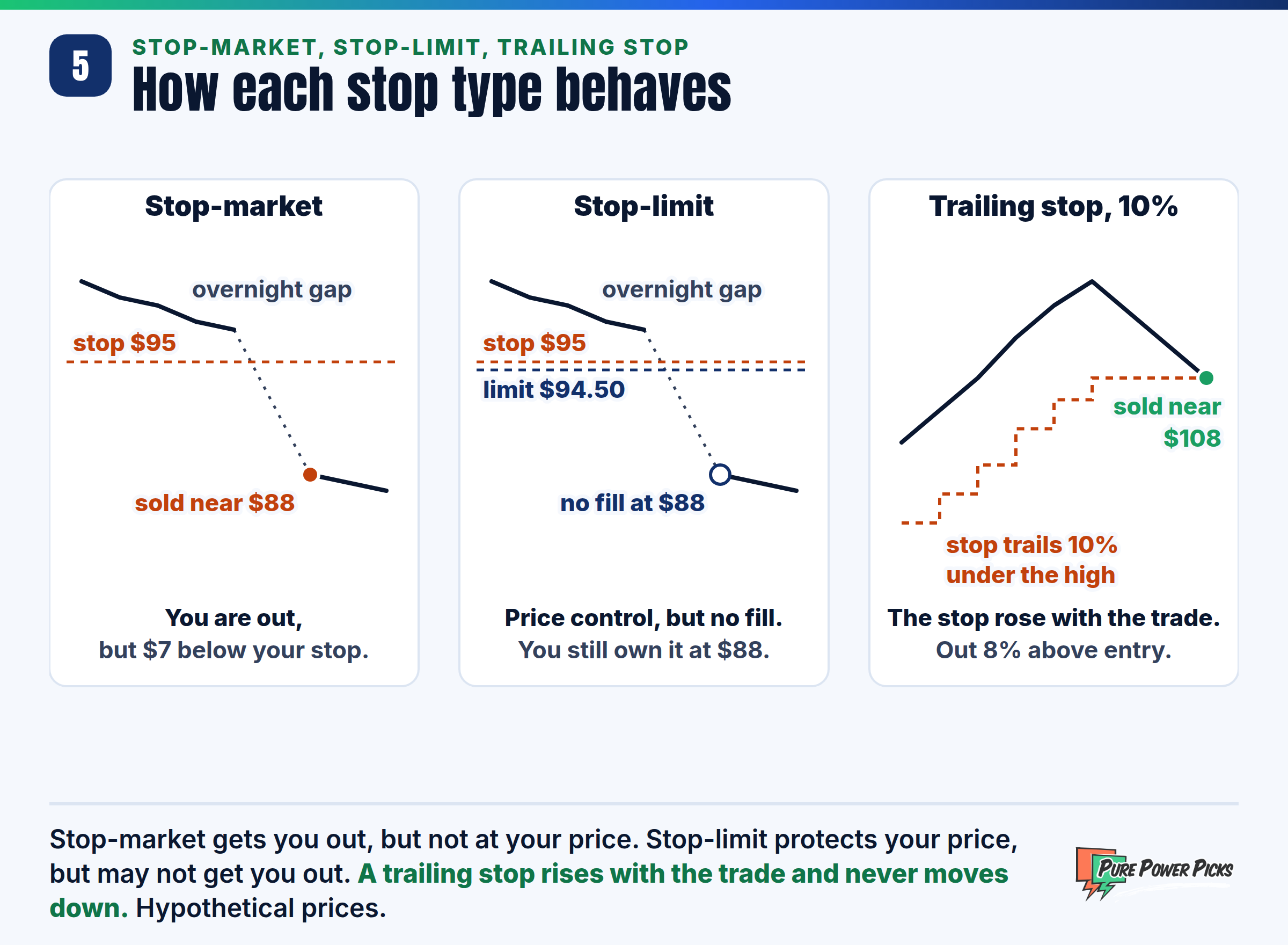
A trailing stop deserves special mention because it adjusts as price moves in your favor, locking in an advantage while still giving the trade room. If that appeals to you, we cover it in depth in our guide to trailing stops to protect profits. For the regulatory view on order handling, the SEC’s investor bulletin is worth a read.
How Do You Place a Smart Stop Loss?
Smart stops are placed where the trade thesis breaks, not at an arbitrary dollar or percentage figure. Start with the chart, then let math handle the rest.
A repeatable framework looks like this. First, identify the level that invalidates your setup, usually just beyond a support or resistance zone or a swing point. Second, measure the distance from your intended entry to that level. Third, use position sizing so that if the stop hits, the loss equals a fixed, small slice of your account, often one to two percent. Finally, confirm the potential reward is worth the risk by checking the risk-reward ratio before you commit.
Here are the four steps with the Alphabet example from earlier in this post, on a hypothetical $25,000 account that risks 1% per trade.
This process is exactly why we built our education around taking profits and setting stops and the broader set of risk management rules that keep traders in the game. Skipping this step is one of the most common trading mistakes we see. And none of it works without wrapping it inside a winning trading plan you can follow when the market gets loud.
Frequently Asked Questions
Does a stop loss guarantee I will not lose more than my set amount?
No. A stop caps most of your risk, but in gaps or fast markets a stop-market order can fill below your level, a phenomenon called slippage. It protects you far better than no stop at all, but it is not an absolute floor.
Where should I set my stop loss?
Set it just beyond the level that would prove your trade idea wrong, such as below key support for a long position. Then size the trade so the resulting loss is a small, fixed percentage of your account. Chart first, then math.
What is the difference between a stop-loss and a stop-limit order?
A stop-loss (stop-market) becomes a market order and prioritizes getting filled fast, even if the price is not exact. A stop-limit becomes a limit order at your set price, giving you price control but risking no fill at all in a rapid move.
Can I use stop losses when trading options?
Yes. You can set a stop on the option premium itself or tie your exit to a level in the underlying stock. Because options move faster and spreads can widen, many traders manage the exit manually or use levels on the underlying to avoid getting whipsawed.
How wide should my stop be?
Wide enough to survive normal noise, tight enough to keep the loss small relative to the potential reward. Volatility tools like ATR help you scale the stop to how much the asset actually moves, rather than guessing.
Stops Are One Piece. Master the Whole System.
Learning where to place a stop is powerful, but it works best alongside real chart education, structured setups, and a risk framework you can repeat. See how our alerts and lessons help you build that discipline step by step.
Explore Membership OptionsDisclaimer: Pure Power Picks provides educational content only and is not a registered investment advisor, broker, or dealer. Nothing in this article is financial, investment, tax, or legal advice, and no content should be treated as a recommendation to buy or sell any security. Examples are for education only. Charts of real stocks show past price history and do not represent actual trades, positions, or performance. Trading stocks and options involves substantial risk, including the possible loss of principal, and past performance does not guarantee future results. Always do your own research and consult a licensed professional before making any financial decision.

The PPP Team is the research and editorial team behind Pure Power Picks. We trade stocks and options and publish the work as we do it, with every alert tracked in public. Publishing since 2020. How we research and correct our work is written out in our editorial standards. Our content is strictly educational, never advice.