


Cash-Secured Puts Explained: Get Paid to Buy Stocks You Want
Share


A cash-secured put is one of the most conservative ways to use options: you sell a put option and set aside enough cash to buy 100 shares at the strike price if you’re assigned, and in exchange you collect a premium up front. Two things can happen. The stock stays above your strike and you keep the premium as income, or the stock drops and you buy shares at a discount to where they traded when you started — with the premium lowering your cost basis even further. That’s the whole idea: get paid to wait for a price you already wanted. It ties up real cash and it still carries downside if the stock falls hard, but there’s no leverage and no margin call, which is exactly why it’s the strategy most experienced traders point beginners toward first.
What You’ll Learn
- Exactly how a cash-secured put works, step by step, with a real example
- The capital it actually takes — and why small accounts feel it most
- The two outcomes at expiration and what each one means for you
- How cash-secured puts form the entry leg of the wheel strategy
- When selling a put is smart — and the one rule that keeps it from becoming a trap
What Is a Cash-Secured Put?
A cash-secured put is the sale of a put option fully backed by cash equal to the strike price times 100 — the exact money you’d need to buy the shares if you’re assigned. You collect premium today in exchange for the obligation to buy the stock at the strike price if the buyer exercises.
When you sell a put, you take on an obligation: if the stock is below your strike at expiration, you must buy 100 shares at that strike. The word “cash-secured” means you’re holding the full purchase price in cash the entire time — so there’s no leverage, no margin, and no possibility of a margin call. That single detail is what separates a cash-secured put from a “naked” put, where a trader sells the same option on margin and can lose far more than they ever collected.
Because the risk is fully funded with cash, brokers treat cash-secured puts as one of the lowest tiers of options approval, and many traders can sell them in a plain cash account. If you’re unsure which account type you have or need, our breakdown of a cash account vs. a margin account covers exactly what each one lets you do. This whole approach fits naturally into a broader plan for trading options for income, where selling premium — rather than buying it — does the heavy lifting.
How Does a Cash-Secured Put Work? A Step-by-Step Example
The mechanics are simpler than the name suggests. Let’s walk through a concrete, hypothetical example — an illustration for teaching purposes, not a real Pure Power Picks trade. Say stock XYZ is trading at $32, and you’d be genuinely happy to own it at $30. Here’s the sequence:
The payoff picture is the clearest way to see what you actually signed up for. Your gain is capped at the $150 premium no matter how high the stock flies, and your break-even sits at $28.50 — the $30 strike minus the $1.50 you collected. Below that, you’re underwater on paper, but you own a stock you wanted at an effective cost of $28.50, well below today’s $32.
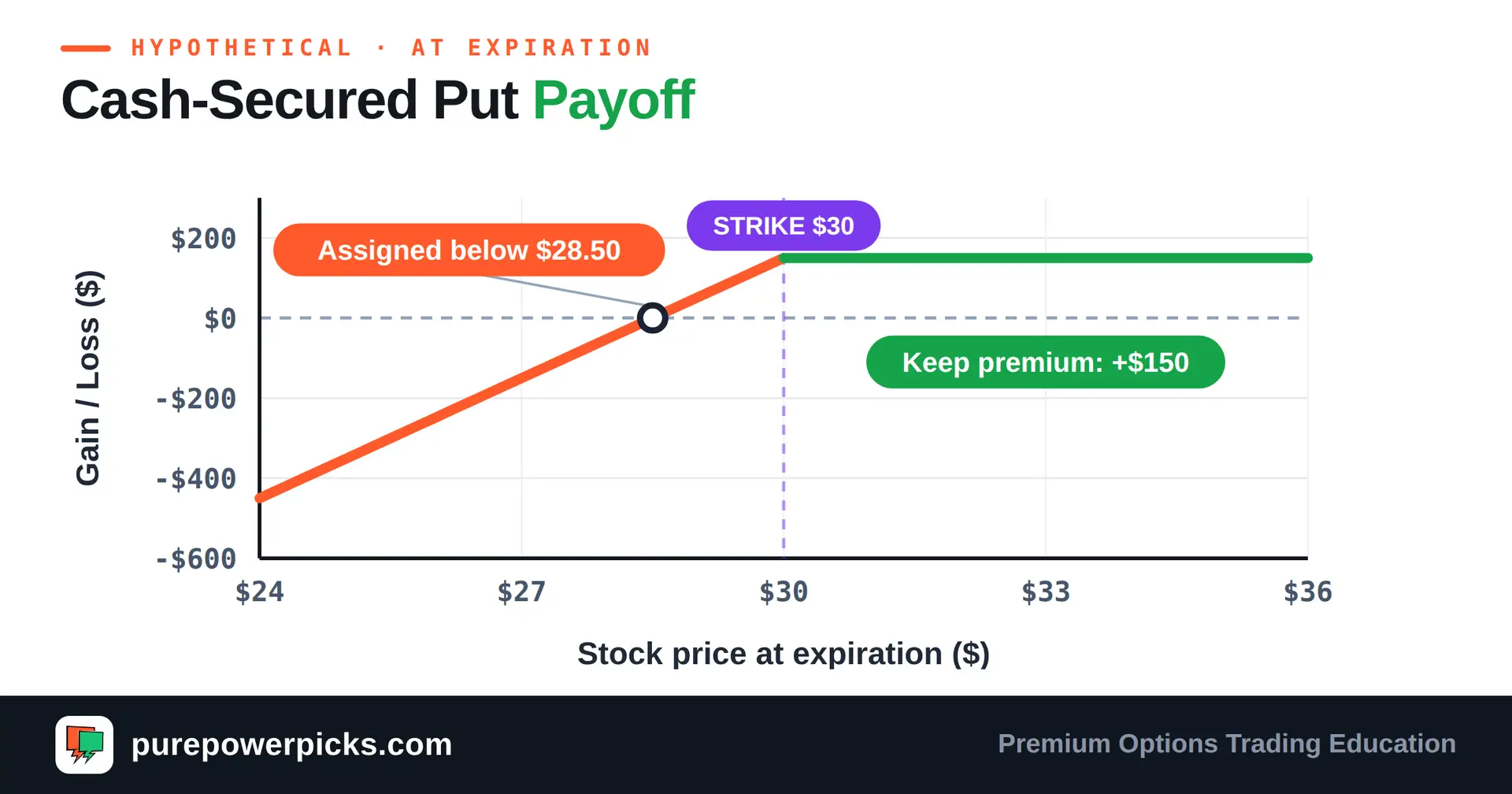
Notice the shape. This is the mirror image of buying a stock outright — you’ve traded away the unlimited upside for a fixed, high-probability payment, and in return you’ve agreed to step in as a buyer at a level you chose. That trade-off is the entire strategy in one line: you get paid a known amount to be a patient, disciplined buyer.
How Much Money Do You Need for a Cash-Secured Put?
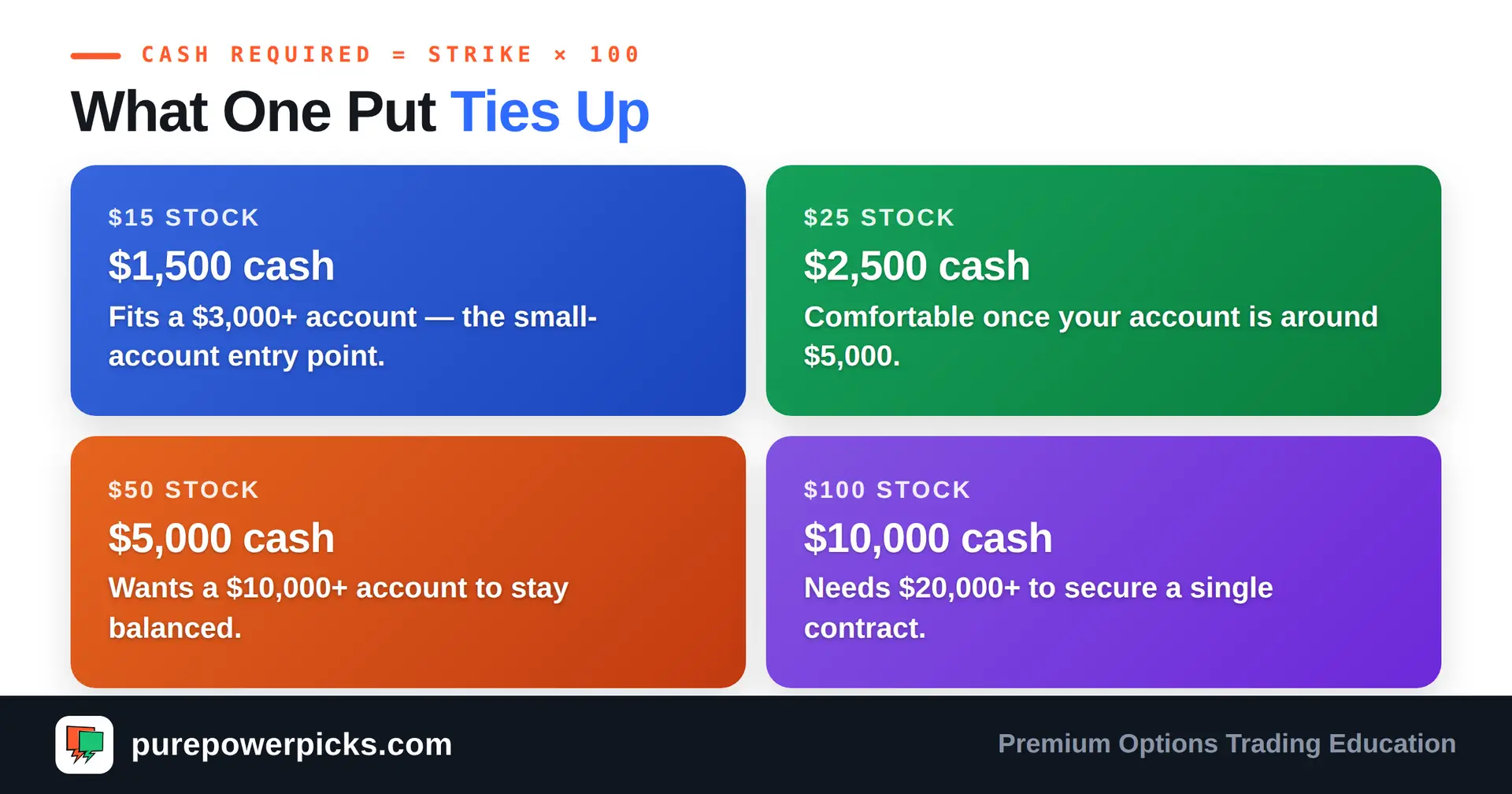
This is where cash-secured puts get honest with you fast. The cash required is simply the strike price × 100, and it’s locked up for the entire trade. A $30 strike ties up $3,000. That math doesn’t care how big your account is — which means on a small account, the stock’s price tag decides whether you can play at all.
| Stock / ETF price | Cash to secure 1 put | Comfortable on an account of… |
|---|---|---|
| $15 | $1,500 | $3,000+ |
| $25 | $2,500 | $5,000+ |
| $50 | $5,000 | $10,000+ |
| $100 | $10,000 | $20,000+ |
| $200 | $20,000 | $40,000+ |
The “comfortable on an account of” column applies a simple rule: don’t tie up more than about half your account in a single put’s collateral, so one trade never dominates your risk. That’s the same discipline we cover in our guide to position sizing for options — the strike you can sell is really a position-sizing decision in disguise.
For a genuinely small account, this is the honest catch: you can’t sell a cash-secured put on a $200 stock with $3,000 in the bank. You have two realistic paths — sell puts on lower-priced stocks and ETFs in the $15–$40 range, or treat CSPs as a strategy you grow into as your account scales. If you’re starting near four figures, our guides on trading options with $1,000 and the broader playbook for options trading with a small account map out which strategies fit before your capital catches up. And as it does, scaling your size the right way turns one put into two into a repeatable income engine.
What Are the Two Outcomes at Expiration?
Every cash-secured put ends in one of exactly two states, and neither one is a disaster if you set it up correctly. This is the whole risk picture in a single frame:
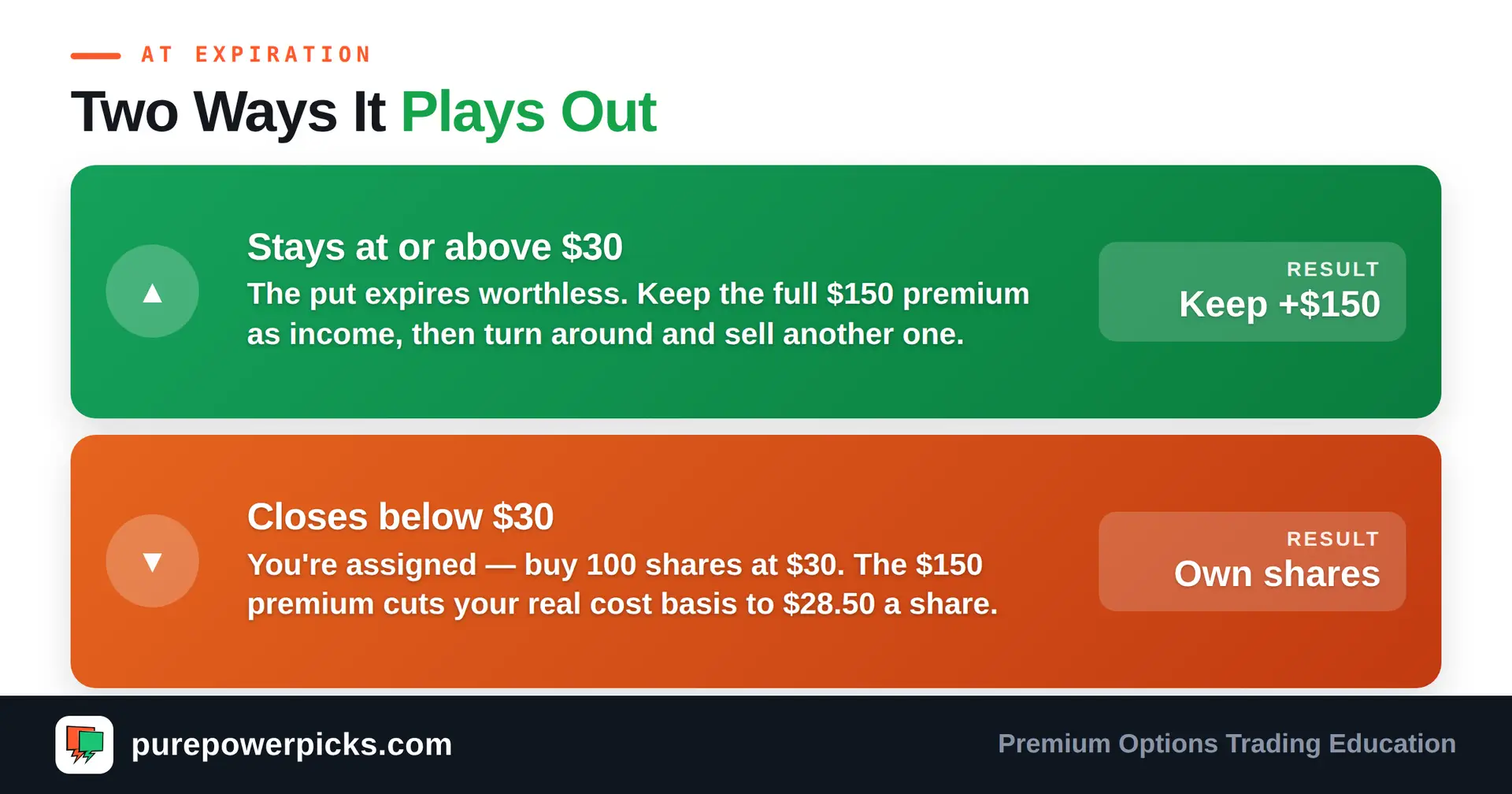
- Outcome A — the stock stays at or above your strike. The put expires worthless, the collateral is released, and you keep 100% of the premium. Your $150 is now realized income, and you’re free to sell another put and do it again. This is the outcome that turns cash-secured puts into a repeatable income loop.
- Outcome B — the stock closes below your strike. You’re assigned: you buy 100 shares at $30, using the $3,000 that was set aside. But you collected $150, so your true cost basis is $28.50 per share. You now own a stock you wanted, at a discount to where it traded when you sold the put.
Assignment isn’t the strategy failing — it’s the strategy working the way you designed it. The only time it stings is if you sold a put on a stock you didn’t actually want, or at a strike you couldn’t truly afford. When either of those is true, the problem was the setup, not the assignment. If you do get assigned and want a game plan for the shares, our guide on what to do when you’re assigned walks through the next move.
How Cash-Secured Puts Power the Wheel Strategy
Here’s where cash-secured puts stop being a standalone trade and become the opening move in a full income cycle. The wheel strategy is a loop: sell a cash-secured put, and if you get assigned, sell a covered call against the shares you now own. Collect premium at every step until the shares get called away — then start over with cash.
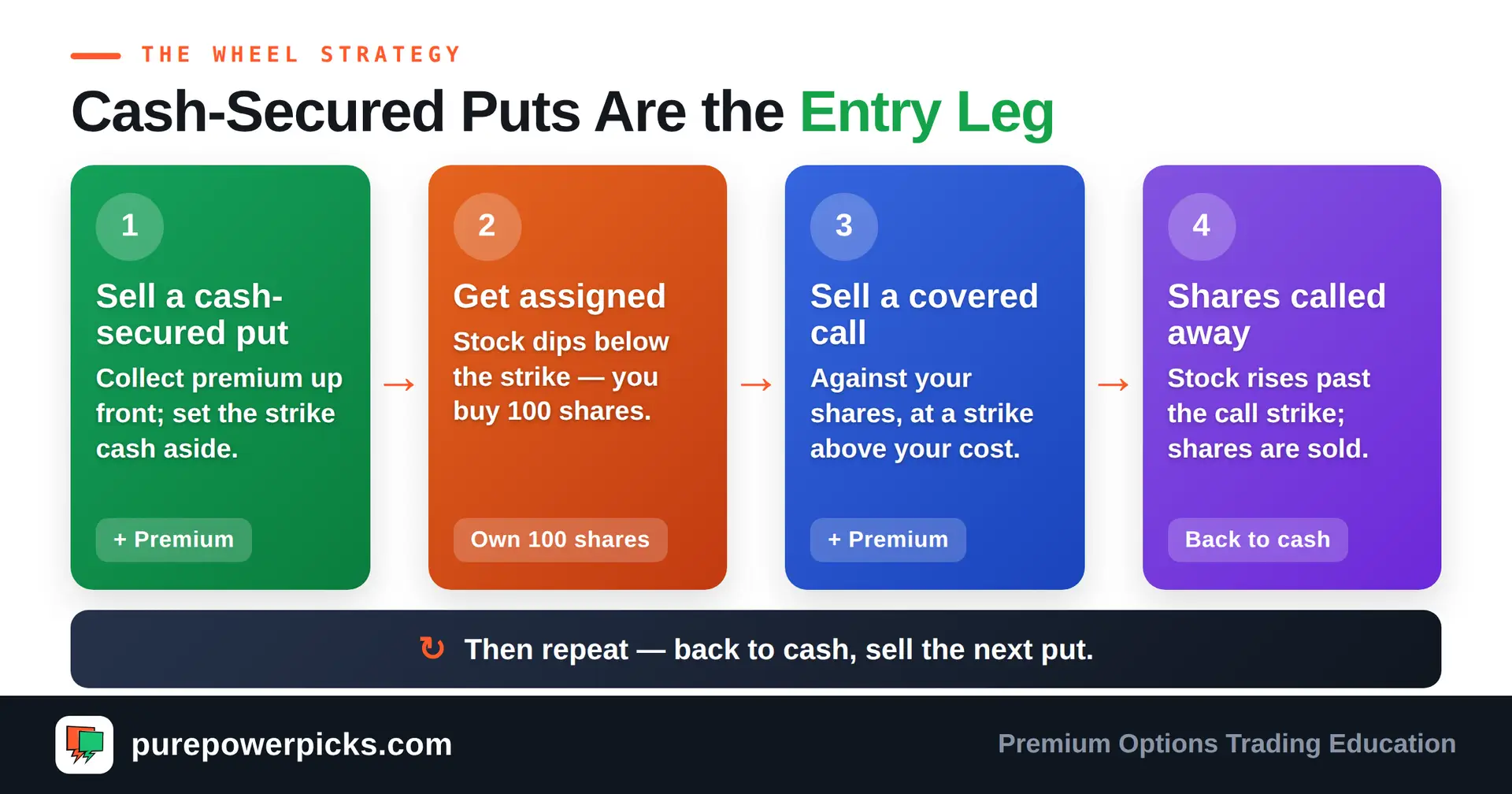
The cash-secured put is the entry leg — it’s how you get paid to build the position in the first place. Once you own the shares, a covered call becomes the exit leg, paying you to agree to sell them higher. A real-world walkthrough of the wheel strategy shows how the two legs fit together across a full cycle. And if the covered-call side is capital-hungry for your account, its cousin — the poor man’s covered call — replicates most of the payoff with a fraction of the cash. Together, these three form a complete premium-selling toolkit.
If you want to see how one full turn of that loop behaves before you place it, our free wheel strategy calculator models the cash-secured put leg and the covered call leg side by side, so you can compare the premium collected against the price you would pay if the shares are put to you.
When Should You Sell a Cash-Secured Put?
A cash-secured put is at its best in a specific set of conditions. Sell one when most of these line up:
- You genuinely want to own the stock at the strike price. This is the first filter and the last word — if you’d regret owning it, don’t sell the put.
- The strike sits at a level you’d buy anyway — often near technical support, a prior base, or simply a valuation you consider fair.
- The premium is worth the capital lockup. Compare the premium to the collateral as an annualized yield. Collecting $150 on $3,000 over 30 days is roughly a 5% monthly return on the cash if it repeats — attractive, but only if the stock is one you respect.
- You’re clear of known event risk you don’t want, like an earnings report landing inside your expiration window, unless taking that risk is the deliberate plan.
The golden rule of cash-secured puts: never sell one on a stock you wouldn’t be thrilled to own. If getting assigned would make you panic-sell the shares, you picked the wrong stock or the wrong strike. Chasing a fat premium on a company you don’t believe in is how “income” turns into a bag you’re stuck holding.
Notice what’s not on the list: a market forecast. You don’t need to nail the direction. You need a stock you’d own and a strike you’d buy — the premium is your payment for patience while you wait to find out. Picking that strike well is its own skill, and our guide on how to pick a strike price gets into the trade-offs between safer, lower strikes and richer, closer ones.
What Are the Risks of Cash-Secured Puts?
Cash-secured puts get marketed as “free money,” and that framing is exactly what gets people hurt. The strategy is conservative, not risk-free — three real costs come with it:
- Real downside if the stock falls hard. Your break-even is the strike minus the premium. If the stock drops well below that, you’re assigned into a paper loss, and there’s no premium large enough to offset a stock that’s fallen 40%. Your maximum theoretical loss is the strike minus the premium, times 100 — the stock going to zero.
- Opportunity cost and capped upside. If the stock rockets higher, you don’t participate — you made your $150 and watched from the sidelines while a buyer of the shares made far more. Your gain is fixed no matter how good the news.
- Capital drag. That $3,000 is frozen for the length of the trade. It can’t chase other setups, and if the stock chops sideways, you’ve tied up real money to earn a modest premium. On a small account, that opportunity cost is the most underrated risk of all.
The dangerous version of this trade is the naked put — selling the same option on margin without the cash to back it. It looks identical on the ticket but can lose far more than you collected and trigger a margin call. “Cash-secured” is the entire safety mechanism. Never let a broker’s margin approval tempt you into selling more puts than your cash can actually cover.
Sized correctly and sold only on stocks you’d own, a cash-secured put is a defined, manageable risk. The failure mode is almost always too much size on too speculative a stock — which is a risk-management problem, not a flaw in the strategy. Building those guardrails first is the point of our options risk-management guide, and it’s worth reading before your first put.
Cash-Secured Puts vs. Covered Calls: What’s the Difference?
These two strategies are mirror images, and understanding the symmetry makes both click. A cash-secured put pays you to maybe buy; a covered call pays you to maybe sell. They’re the two halves of the wheel, and most premium-selling income comes from running them back to back.
| Cash-Secured Put | Covered Call | |
|---|---|---|
| Your starting position | No shares yet; cash set aside | You already own 100 shares |
| You get paid to… | Agree to buy at the strike | Agree to sell at the strike |
| Best when you’re… | Willing to own it lower | Willing to sell it higher |
| Assignment means | You buy 100 shares at the strike | Your 100 shares are sold at the strike |
| Role in the wheel | Entry leg (step 1) | Exit leg (step 2) |
| Main risk | Stock falls well below the strike | Stock rips past the strike (capped upside) |
If you own shares and want to learn the exit leg next, our list of the best stocks for covered calls is the natural follow-up. Between the two, you can collect premium whether you’re waiting to buy or waiting to sell. For the full foundations behind either trade, the Options Industry Council publishes free, broker-neutral material worth reading before you place your first order.
Frequently Asked Questions
Are cash-secured puts a good strategy for beginners?
Yes — they’re one of the most beginner-friendly options strategies because the risk is fully funded with cash, there’s no leverage, and no margin call is possible. The main requirements are enough capital to secure the strike and the discipline to only sell puts on stocks you’d genuinely want to own.
Can you lose money selling cash-secured puts?
Yes. If the stock falls well below your strike, you’re assigned and hold shares worth less than you paid, minus the premium you collected. Your break-even is the strike minus the premium, and your maximum loss is that figure times 100 if the stock goes to zero. The premium cushions a small drop but can’t offset a large one.
How much can you make selling cash-secured puts?
Your gain on any single put is capped at the premium you collect. In our example, that’s $150 on $3,000 of secured cash over about 30 days — roughly 5% on the cash if it repeated monthly, though real results vary with the stock, strike, and volatility. You never make more than the premium, no matter how high the stock climbs.
What happens if my cash-secured put is assigned?
You buy 100 shares at the strike price using the cash that was set aside, and the premium you collected lowers your effective cost basis. From there you can hold the shares, or sell a covered call against them to keep collecting premium — which is exactly how the wheel strategy continues.
Cash-secured put or covered call — which is better?
Neither is universally better; they solve different problems. Sell a cash-secured put when you want to own a stock at a lower price and have the cash to back it. Sell a covered call when you already own 100 shares and would be happy to sell them higher. Run in sequence, they form the wheel.
Do you need $25,000 to sell cash-secured puts?
No. Cash-secured puts aren’t day trades, so the pattern day trader rule never applied — and as of 2026 that $25,000 minimum was eliminated anyway. The real gate is collateral: you need the strike price times 100 in cash. That’s why small accounts stick to lower-priced stocks and ETFs until their capital grows.
Every Pure Power Picks trade plan breaks down the setup, the key levels, and the defined risk — so whether you’re selling premium or buying it, you’re acting on a process you understand, not a hunch you hope on.
Or read more trading guides to keep sharpening your edge.
Disclaimer: This article is for educational purposes only and is not financial advice. All trade examples are hypothetical and provided to illustrate mechanics — they are not real trades, recommendations, or a representation of results you should expect. Options trading involves substantial risk of loss and is not suitable for every investor. Past performance does not guarantee future results. Always do your own research and consider consulting a licensed financial professional before trading.
Share

The PPP Team is the research and editorial team behind Pure Power Picks. We trade stocks and options and publish the work as we do it, with every alert tracked in public. Publishing since 2020. How we research and correct our work is written out in our editorial standards. Our content is strictly educational, never advice.