


Best Stocks for Covered Calls in 2026 (Updated Monthly)
Share


The best stocks for covered calls in 2026 share a few things in common: high options volume, predictable price behavior, and share prices that generate meaningful premium per contract. Below, we break down six specific stocks across four sectors, complete with real prices and hypothetical trade setups you can study.
The most profitable covered call stocks combine high options liquidity with moderate implied volatility (20-40%). Target established companies you’d be happy to own long-term, because the strategy works best when you view assignment as a profitable exit, not a problem.
What Makes a Stock Perfect for Covered Calls?
Not every stock works for covered calls. The ideal candidate checks five boxes:
- High options volume (1,000+ contracts/day at your target strike) for tight bid-ask spreads
- Share price between $50-400 so each contract generates $50-700 in premium, enough to justify the position
- Implied volatility between 20-40%, the sweet spot where premiums are meaningful without excessive assignment risk
- Weekly options available for flexible expiration timing
- A company you’d own anyway, because assignment is always possible and you need to be comfortable holding 100 shares
A strategy where you own 100 shares of stock and sell a call option against those shares, collecting premium income in exchange for capping your upside at the strike price. All trade examples below are hypothetical and for educational purposes only.
Before you sell a call against any of these names, model the exact trade in our free covered call calculator. It maps the payoff curve, the breakeven, and what time decay pays you week by week at your strike.
Top 6 Covered Call Stocks for 2026
We picked six stocks across technology, financials, consumer staples, and healthcare. Setups were refreshed on October 5, 2026; each card gives its actual expiration and quote timestamps. Cycle yield, 30-day equivalent and simple annual rates are different measures.
1. Apple (AAPL): The Gold Standard

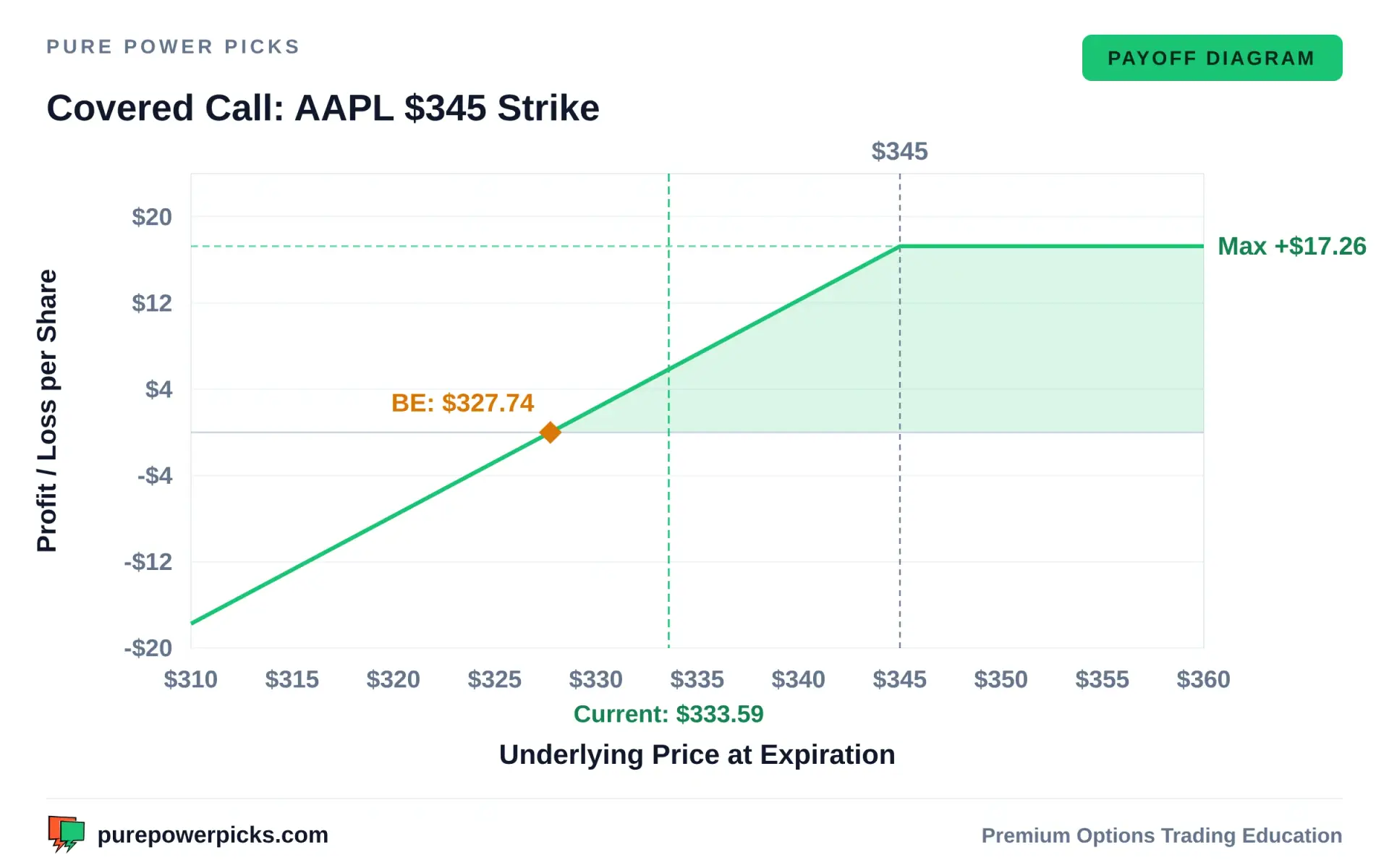
At $333.59 per share, the $345.00 call expiring 2026-11-06 has an illustrative premium of $5.85 (bid/ask midpoint). That is 1.75% of the share price over 32 days, equivalent to 1.64% over 30 days. If assigned at the strike, the maximum gain is $17.26 per share before fees and dividends. Prices and future premiums can change; the annual rate shown assumes repeated equivalent cycles and is not a return forecast.
The key with Apple: sell calls after product launch events (when IV tends to deflate) and avoid earnings weeks unless you’re comfortable with the gap risk. Apple’s narrow trading ranges between events make it a nearly mechanical covered call machine.
2. Microsoft (MSFT): Subscription Revenue Stability
At $524.50 per share, the $540.00 call expiring 2026-11-06 has an illustrative premium of $15.18 (bid/ask midpoint). That is 2.89% of the share price over 32 days, equivalent to 2.71% over 30 days. If assigned at the strike, the maximum gain is $30.68 per share before fees and dividends. Prices and future premiums can change; the annual rate shown assumes repeated equivalent cycles and is not a return forecast.
For Microsoft, monthly expirations tend to outperform weeklies because the stock moves in slow, grinding trends. Target strikes 3-4% out of the money for the best risk-reward balance.
3. JPMorgan Chase (JPM): Dividend + Premium Powerhouse

At $332.59 per share, the $345.00 call expiring 2026-11-06 has an illustrative premium of $4.60 (bid/ask midpoint). That is 1.38% of the share price over 32 days, equivalent to 1.30% over 30 days. If assigned at the strike, the maximum gain is $17.01 per share before fees and dividends. Prices and future premiums can change; the annual rate shown assumes repeated equivalent cycles and is not a return forecast.
Time your JPM covered call entries with the actual ex-dividend date in mind. Confirm the declared dividend and assess early-assignment risk before selling a call; a trailing annual dividend is not a guarantee of future payments.
4. Coca-Cola (KO): The Conservative Pick
At $86.34 per share, the $89.00 call expiring 2026-11-06 has an illustrative premium of $1.16 (bid/ask midpoint). That is 1.34% of the share price over 32 days, equivalent to 1.26% over 30 days. If assigned at the strike, the maximum gain is $3.82 per share before fees and dividends. Prices and future premiums can change; the annual rate shown assumes repeated equivalent cycles and is not a return forecast.
Coca-Cola is the ideal starter stock for covered calls. The combination of low price, high stability, and strong dividend creates a forgiving setup where even imperfect timing usually works out.
5. AbbVie (ABBV): Healthcare Dividend Machine
At $263.13 per share, the $270.00 call expiring 2026-11-06 has an illustrative premium of $5.82 (bid/ask midpoint). That is 2.21% of the share price over 32 days, equivalent to 2.07% over 30 days. If assigned at the strike, the maximum gain is $12.69 per share before fees and dividends. Prices and future premiums can change; the annual rate shown assumes repeated equivalent cycles and is not a return forecast.
Watch for FDA approval dates, which can spike IV. Sell calls heading into those catalysts to capture inflated premiums, but choose strikes far enough out to avoid assignment if the news is positive.
6. Amazon (AMZN): Premium Hunter’s Pick

At $251.70 per share, the $260.00 call expiring 2026-11-06 has an illustrative premium of $8.43 (bid/ask midpoint). That is 3.35% of the share price over 32 days, equivalent to 3.14% over 30 days. If assigned at the strike, the maximum gain is $16.73 per share before fees and dividends. Prices and future premiums can change; the annual rate shown assumes repeated equivalent cycles and is not a return forecast.
Amazon works best for traders who are comfortable with occasional assignment and view it as an opportunity to sell puts and re-enter via the wheel strategy.
These six aren’t the only options. Other names traders rotate in for covered calls include PEP, WMT, and JNJ among low-volatility staples, PFE and VZ for higher dividend yields, and more aggressive, higher-premium tickers like F or INTC if you accept more assignment risk. The screening framework above matters more than any single ticker: liquid options, an implied volatility you understand, and a business you would be comfortable owning.
How to Choose Your Strike Price
Strike price selection is where most covered call traders either leave money on the table or take on too much assignment risk. Here’s a framework using real numbers:
| Approach | Strike choice | AAPL example | Trade-off | When useful |
|---|---|---|---|---|
| Conservative | Farther above the share price | Check the current chain | Less premium, more upside room | Bullish, want to keep shares |
| Balanced | Above the share price | $345.00 call, $5.85 quoted premium | 32 DTE; bid/ask midpoint | Comfortable selling at the strike |
| Aggressive | Closer to the share price | Check the current chain | More premium, less upside room | Willing to accept assignment |
For most traders, the balanced approach (0.25-0.30 delta, 2-4% OTM) offers the best risk-reward. You collect meaningful premium while leaving room for moderate appreciation. If you’re running covered calls as a primary income strategy, the aggressive approach can work, but accept that you’ll be assigned more frequently.
For more guidance on choosing strike prices across different setups, delta is your best friend. It directly tells you the market’s probability of assignment.
When to Enter and When to Stay Away
Timing covered call entries is about volatility, not direction. The best entries happen when implied volatility is elevated relative to the stock’s recent history, because that’s when premiums are fattest.
- After a stock rallies into resistance (premiums are juiced)
- VIX above 25 (all premiums inflate)
- 2-3 weeks before earnings (IV expansion, close before the event)
- Right after ex-dividend dates
- When IV rank is above 50th percentile
- Stock at 52-week highs (max assignment risk, low premium)
- Earnings week (unless you’re experienced with gap risk)
- Major macro events (Fed decisions, election results)
- When IV rank is below 20th percentile
- If you wouldn’t buy 100 shares at the current price
Covered calls limit your upside. Buying AAPL at $333.59 and selling the $345.00 call for $5.85 caps the gain at $17.26 per share before dividends and fees. Further stock gains above the strike do not increase that payoff. Downside remains substantial: breakeven is $327.74.
Managing Your Positions: Take Profits, Roll, or Accept Assignment
Here’s the decision framework we use for every covered call position:
Take profits at 50-75% of the premium collected when appropriate. In this $5.85 AAPL example, buying the call back for about $1.46 to $2.93 retains approximately 75% to 50% of that premium before fees. Those are target levels, not current quotes.
Roll when the stock exceeds your strike only if the replacement trade fits your plan. A roll closes the existing call and opens a later contract. Compare both live bid/ask quotes: the difference determines the actual credit or debit. Moving the strike higher does not erase a loss or guarantee better returns.
Accept assignment when selling at the strike fits your plan. Buying AAPL at $333.59, collecting $5.85, and selling at $345.00 produces $17.26 per share (5.17%) over this 32-day example, before fees and dividends. Actual assignment timing can differ.
Track your total return, not just premium collected. A covered call that collects $300 in premium but sits on a $1,500 unrealized stock loss isn’t profitable. Calculate: stock gain/loss + premiums collected + dividends received = true P&L.
Building a Diversified Covered Call Portfolio
The illustrative portfolio below uses the share counts shown, costing $135,369.00 at these snapshot prices. Diversification does not remove stock downside or assignment risk. Premiums in the table apply to each displayed contract’s full cycle; the normalized yield column adjusts for its actual duration.
| Stock | Shares | Cost | Cycle premium | 30-day equivalent |
|---|---|---|---|---|
| AAPL | 100 | $33,359.00 | $585.00 / 32 days | 1.64% |
| JPM | 100 | $33,259.00 | $460.00 / 32 days | 1.30% |
| KO | 200 | $17,268.00 | $232.00 / 32 days | 1.26% |
| ABBV | 100 | $26,313.00 | $582.00 / 32 days | 2.07% |
| AMZN | 100 | $25,170.00 | $843.00 / 32 days | 3.14% |
| TOTAL | $135,369.00 | $2,702.00 across listed cycles | 1.87% |
The listed contracts collect $2,702.00 across their full cycles. Normalizing each by its own expiration gives an illustrative $2,533.13 per 30 days and $30,819.69 per 365 days (22.77% of share cost). The holdings’ trailing annual dividends total $1,804.00, a weighted 1.33%; adding that historical rate gives a combined illustrative 24.10%. These simple annualizations assume repeated equivalent opportunities and uninterrupted ownership. They exclude stock losses, fees, taxes, assignment effects and changing premiums or dividends; they are not income forecasts.
Stagger your expirations so roughly 25% of positions expire each week. This creates consistent income flow and prevents all positions from needing attention simultaneously.
For more on risk management across multiple positions, the cardinal rule is: never let one stock represent more than 30% of your covered call portfolio.
Want to see how we analyze covered call setups in real-time?
Our trade alerts break down exactly why we choose specific stocks and strike prices, building the pattern recognition that separates profitable traders from the crowd.
The 5 Biggest Covered Call Mistakes
- Selling calls on stocks you don’t want to own. If you’re only in it for the premium and the stock drops 15%, you’re stuck holding shares you never believed in. Every covered call position starts with the question: “Would I buy this stock if options didn’t exist?”
- Chasing high premiums without checking IV rank. A 5% monthly premium sounds amazing until you realize IV is at the 95th percentile because the company is being investigated by the SEC. High premiums exist for a reason. Check why before selling.
- Rolling indefinitely to avoid assignment. Some traders roll losing positions for months, paying net debits each time, turning what should have been a $500 loss into a $2,000 loss. Set a max of 2-3 rolls before accepting the outcome.
- Ignoring earnings dates. Selling a 30-DTE call that spans an earnings announcement is a different trade than selling one during a quiet period. Either close before earnings or choose strikes that account for the expected move.
- Concentrating in one sector. If you run covered calls on AAPL, MSFT, AMZN, and NVDA, you’re essentially making one bet on tech. A sector rotation will hit all four simultaneously. Spread across at least 3 sectors.
Weekly vs. Monthly: Which Expiration Works Better?
Both work. The right choice depends on how much time you want to spend managing positions.
Weekly options offer faster capital turnover and more frequent premium collection. Annualized yields can be 20-40% higher than monthly. But you need to monitor positions daily and transaction costs add up. Best for active traders comfortable with frequent adjustments.
Monthly options require less attention and capture the bulk of time decay in the final two weeks. One trade per month per position. Transaction costs are minimal. Best for investors who want income without constant management. For guidance on selling weekly options effectively, focus on stocks with consistent weekly volume.
Our recommendation: start with monthlies. Once you’re consistently profitable and comfortable with position management, experiment with weeklies on your highest-conviction stocks (AAPL, MSFT, and JPM all have excellent weekly liquidity).
Covered-Call ETFs vs. Doing It Yourself
If selling calls on individual stocks sounds like more management than you want, covered-call ETFs do the work for you. Funds like JPMorgan Equity Premium Income (JEPI), NEOS S&P 500 High Income (SPYI), and Global X NASDAQ 100 Covered Call (QYLD) hold a basket of stocks, sell calls against it, and pass the option income through as monthly distributions.
The convenience comes with trade-offs. You pay an expense ratio (typically 0.35-0.70%), you don’t choose the strikes or expirations, and broad-index call writing often caps upside harder than a hand-picked single-stock call. In a strong bull run, funds like QYLD have historically lagged the index they write on, because every rally gets capped while every drop is only partly cushioned.
| Approach | Best For | Main Trade-Off |
|---|---|---|
| Covered-call ETF (JEPI, SPYI, QYLD) | Hands-off monthly income | Fees, no control over strikes, harder upside cap |
| Your own covered calls | Control over timing, strike, and tax treatment | Needs an options-approved account and active management |
For pure autopilot income, an ETF sleeve is hard to beat. For control over which stocks you hold, when you sell, and how the gains are taxed, running your own covered calls on names like the six above wins. Plenty of investors split the difference: an ETF for set-and-forget cash flow, individual positions where they have a view.
How Market Conditions Affect Your Strategy
Sideways markets are covered call paradise. Stocks stay in range, calls expire worthless, you keep the premium. Repeat.
Bull markets are trickier. Stocks blow past your strikes, triggering assignment. Counter this by using higher strikes (0.15-0.20 delta) or shorter expirations to reduce assignment probability.
Bear markets offer the highest premiums (because VIX spikes), but your underlying shares are losing value. The premium provides a cushion, not a shield. In deep bear markets, consider pausing covered calls until stocks stabilize near support, then re-enter with elevated premiums.
High VIX (above 25): Broad-market volatility can affect option prices, but each company also has its own earnings, dividend and price risks. Check the actual contract bid and ask instead of assuming a fixed premium multiplier. A larger premium does not remove downside risk.
Frequently Asked Questions
What’s the minimum account size for covered calls?
A standard covered call normally requires 100 shares for each contract sold. At this snapshot, 100 KO shares cost $8,634.00. The sample portfolio above costs $135,369.00. Broker approval, fees and account requirements vary.
Can you lose money with covered calls?
Yes. In the AAPL example, a $333.59 purchase less $5.85 collected premium gives a $327.74 breakeven. If the stock finishes 10% below the purchase price, at $300.23, the position’s result is -$27.51 per share before fees and dividends. Premium reduces downside; it does not eliminate it.
Should I sell covered calls on NVDA?
NVDA’s 45-65% IV generates massive premiums, but the stock can move 10-15% in a week around AI news or earnings. If you’re bullish long-term and comfortable with frequent assignment, it can work. But for most traders, the six stocks listed above offer better risk-adjusted returns for covered calls.
How do dividends affect covered call strategies?
Dividends add income on top of premiums. But watch for early assignment risk just before ex-dividend dates: if your call is in-the-money and the dividend exceeds the remaining time value, the call buyer may exercise early to capture the dividend. Time your sales accordingly.
What happens if I get assigned early?
You sell your 100 shares at the strike price. This usually happens before ex-dividend dates or when deep ITM calls have minimal time value remaining. It’s not bad: you achieve your max profit earlier than expected. Sell a cash-secured put to re-enter if you want the shares back.
Can you sell covered calls in an IRA or Roth IRA?
Yes. Covered calls are one of the few options strategies brokers allow in retirement accounts, because the short call is fully collateralized by the 100 shares you already own. In a traditional IRA, assignment triggers no immediate tax bill; in a Roth IRA, the premium income and any gains are effectively tax-free as long as you follow the withdrawal rules. You’ll still need options approval (usually the lowest level) on the account.
How are covered calls taxed in a regular account?
In a taxable account, premium from a call that expires worthless is generally treated as a short-term capital gain, taxed at your ordinary income rate no matter how long you held the stock. If you get assigned, you also realize a gain or loss on the 100 shares based on your cost basis versus the strike. Because the “qualified covered call” rules and holding periods get nuanced, many income-focused traders prefer to run the strategy inside an IRA. This is general information, not tax advice, so check with a tax professional about your situation.
Are covered calls worth it, or can you get rich with them?
Covered calls are an income-and-stability tool, not a get-rich-quick strategy. They lower your effective cost basis and smooth out returns, but they cap your upside, so in a roaring bull market plain buy-and-hold often beats a covered-call version of the same stock. Think of them as a way to manufacture steady cash flow on shares you already want to own, not a path to outsized growth. Used consistently on quality names, that steady income compounds, which is the real appeal.
The best way to develop covered call skills is studying real setups with experienced traders. Our alerts show you the exact reasoning behind every trade.
Options Assignment: What to Do When You Get Assigned Early →Alert Blueprints – 2/14/2025 →Covered Call Strategy: Profit from Nvidia’s Post-Earnings Drop →0DTE Options Strategy Guide for Energy Market Volatility →
Share

The PPP Team brings decades of combined experience from some of the most well-known companies in the trading industry. Founded in 2020, Pure Power Picks delivers options trading education, scanner reviews, and trade alerts to help everyday traders develop real skills. Our content is strictly educational.