


Poor Man’s Covered Call (PMCC): Covered-Call Income With Less Capital
Share


A poor man’s covered call lets you collect covered-call income for a fraction of the capital — often 60–80% less — by replacing 100 shares of stock with a single deep-in-the-money LEAPS call. It’s a powerful, capital-efficient strategy, but it’s also leverage, and one common setup mistake can bake in a guaranteed loss before you even start. This guide gives you the honest version: exactly how to build one, a worked example with the numbers, the risks nobody likes to mention, and how to manage it.
What You’ll Learn
- What a poor man’s covered call is and why it mimics a covered call for less capital
- The exact LEAPS and short-call setup — delta, DTE, and strike rules
- The “broken diagonal” mistake that can lock in a loss (and the formula that prevents it)
- A hypothetical worked example across up, flat, and down markets
- The real risks — dividends, early assignment, and leverage — plus how to roll it
What Is a Poor Man’s Covered Call?
A poor man’s covered call (PMCC) is a long call diagonal spread: you buy one deep-in-the-money, long-dated LEAPS call as a stock substitute, then sell a shorter-dated out-of-the-money call against it for income. It replicates a covered call’s payoff using far less capital — which is exactly why it’s also called a synthetic covered call.
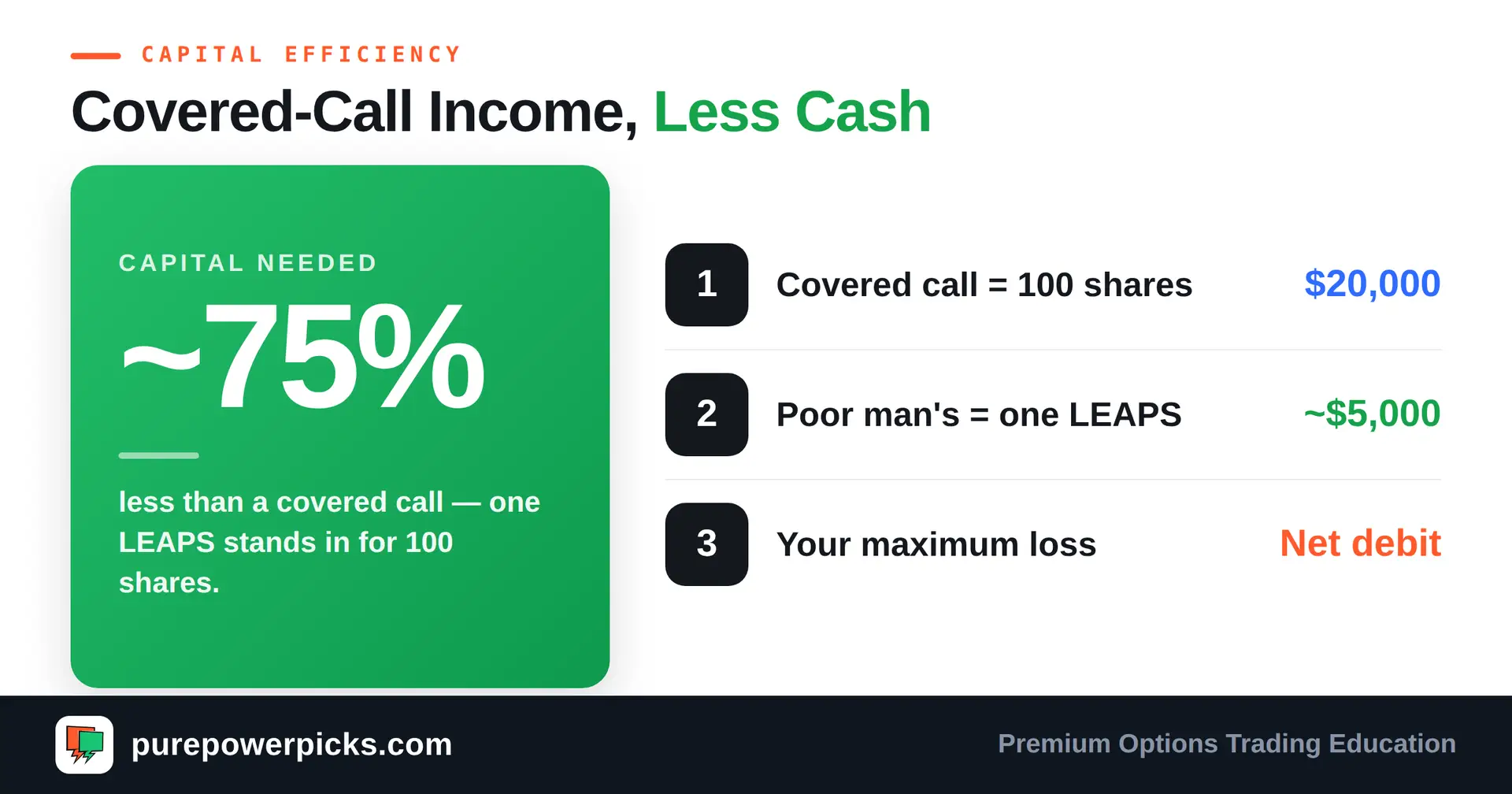
In a normal covered call, you own 100 shares and sell a call against them. The problem for most traders is the 100 shares — on a $200 stock, that’s $20,000 tied up in a single name. The poor man’s covered call swaps those shares for a high-delta LEAPS call that behaves almost like the stock, so you get similar exposure and the same premium-selling income for a small fraction of the outlay. If you’re working with limited capital, it’s one of the most useful strategies you can learn — and it pairs naturally with the broader playbook in our guide to options trading with a small account.
You can model your exact LEAPS-plus-short-call structure in our free options profit calculator (it has a one-tap poor man’s covered call preset) to see the payoff, breakevens and theta before you commit.
How Does a Poor Man’s Covered Call Actually Work?
It works because a deep-in-the-money LEAPS call moves almost dollar-for-dollar with the stock while barely decaying — so it acts as a stand-in for 100 shares. The key is understanding the two parts of an option’s price: intrinsic value (how far in-the-money it is) and extrinsic value (time and volatility premium). Only extrinsic value decays. A deep-ITM LEAPS is almost all intrinsic value with a thin sliver of extrinsic, so it loses very little to time decay and carries a high delta.
Delta is the bridge. A LEAPS with a 0.80 delta behaves like roughly 80 shares of stock — it gains about $0.80 for every $1.00 the stock rises. That’s the “stock substitute.” The short call you sell against it is the income engine, exactly like the call leg of a real covered call. Want a refresher on the mechanics? Our primer on the option Greeks that actually matter covers delta and theta in plain English.
Poor Man’s Covered Call vs. a Real Covered Call: What’s the Difference?
The difference is what backs the short call: 100 shares of stock in a covered call, versus a LEAPS call in a poor man’s covered call. That one swap changes the capital, the risk profile, the dividends, and even the account approval you need.
| Factor | Covered Call | Poor Man’s Covered Call |
|---|---|---|
| Capital required | 100 shares (e.g. $20,000 on a $200 stock) | One LEAPS (typically 60–80% less) |
| Max loss | Large, but shares can be held indefinitely | The net debit paid — and the LEAPS expires |
| Dividends | You collect them | You don’t (you don’t own shares) |
| Upside | Capped at the short strike | Capped at the short strike |
| Account approval | Level 1 (basic) | Level 3 (spreads) |
Two trade-offs stand out. First, the poor man’s covered call forfeits the dividend a real covered call would collect — which is why low- or no-dividend names are often preferred. Second, it needs Level 3 (spread) approval, a step up from the Level 1 approval a covered call requires. For the full-capital version, see our walkthrough of the covered call strategy.
How Do You Set Up a Poor Man’s Covered Call?
You set up a poor man’s covered call by buying a deep-ITM LEAPS with a high delta and selling a shorter-dated, out-of-the-money call above it. The specific parameters matter — here are the rules practitioners broadly agree on.
What’s the One Setup Mistake That Guarantees a Loss?
The single most common poor man’s covered call mistake is selling the short call at or below your LEAPS strike — a “broken diagonal” that builds a loss into the trade before it even moves. Get the strike relationship right and you avoid it entirely.
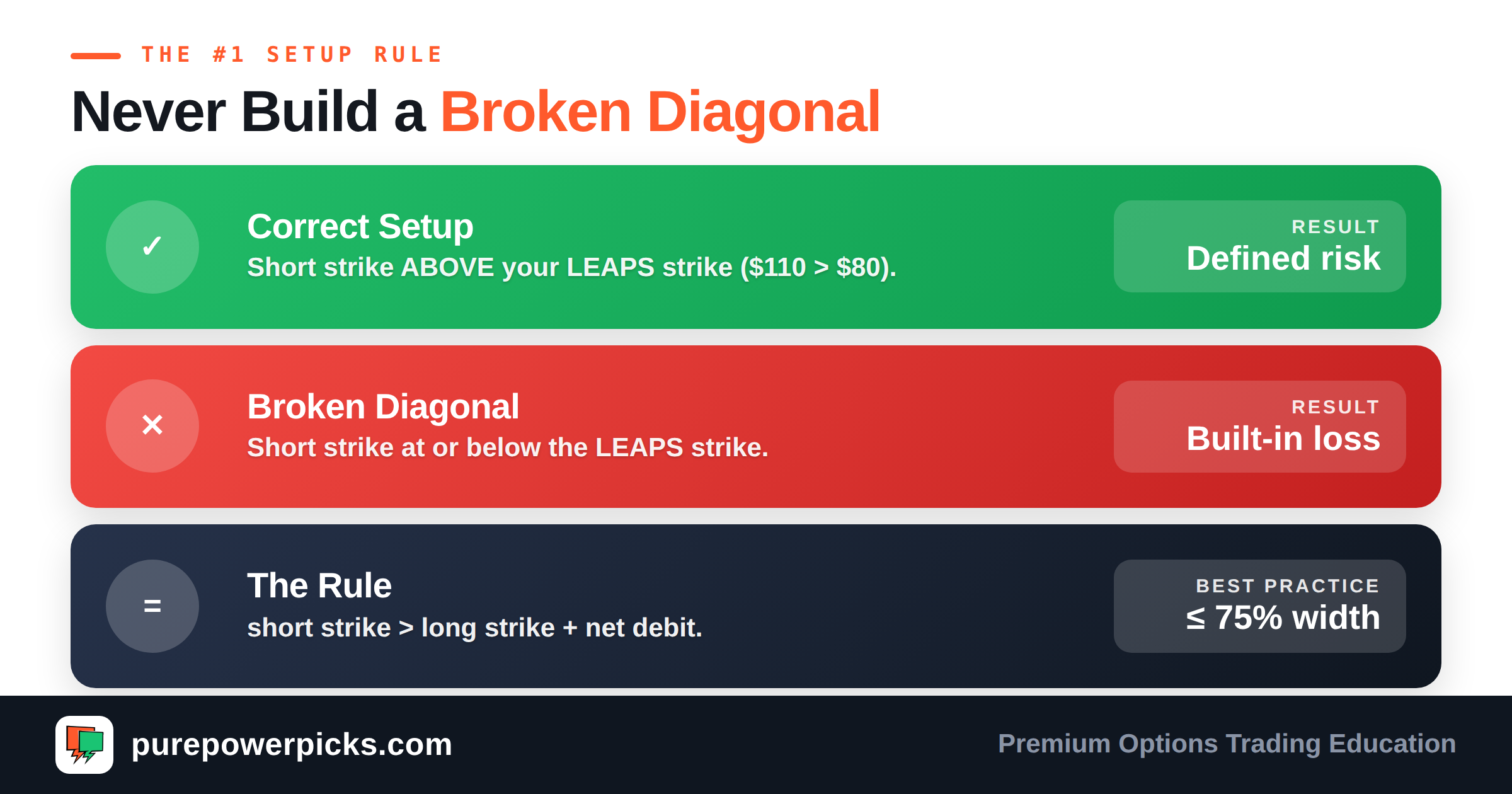
Sell the short call below the LEAPS strike and you’ve created negative intrinsic value — a structural loss that a rally can lock in. Keep the width wider than your net debit and the capped-upside scenario stays a winner instead of a trap. It’s the rule almost every competing guide skips, and it’s the difference between a defined-risk income trade and a slow-motion mistake.
What Do the Numbers Actually Look Like?
Let’s walk through a hypothetical example across three outcomes — up, flat, and down — so you see both the appeal and the honest downside.
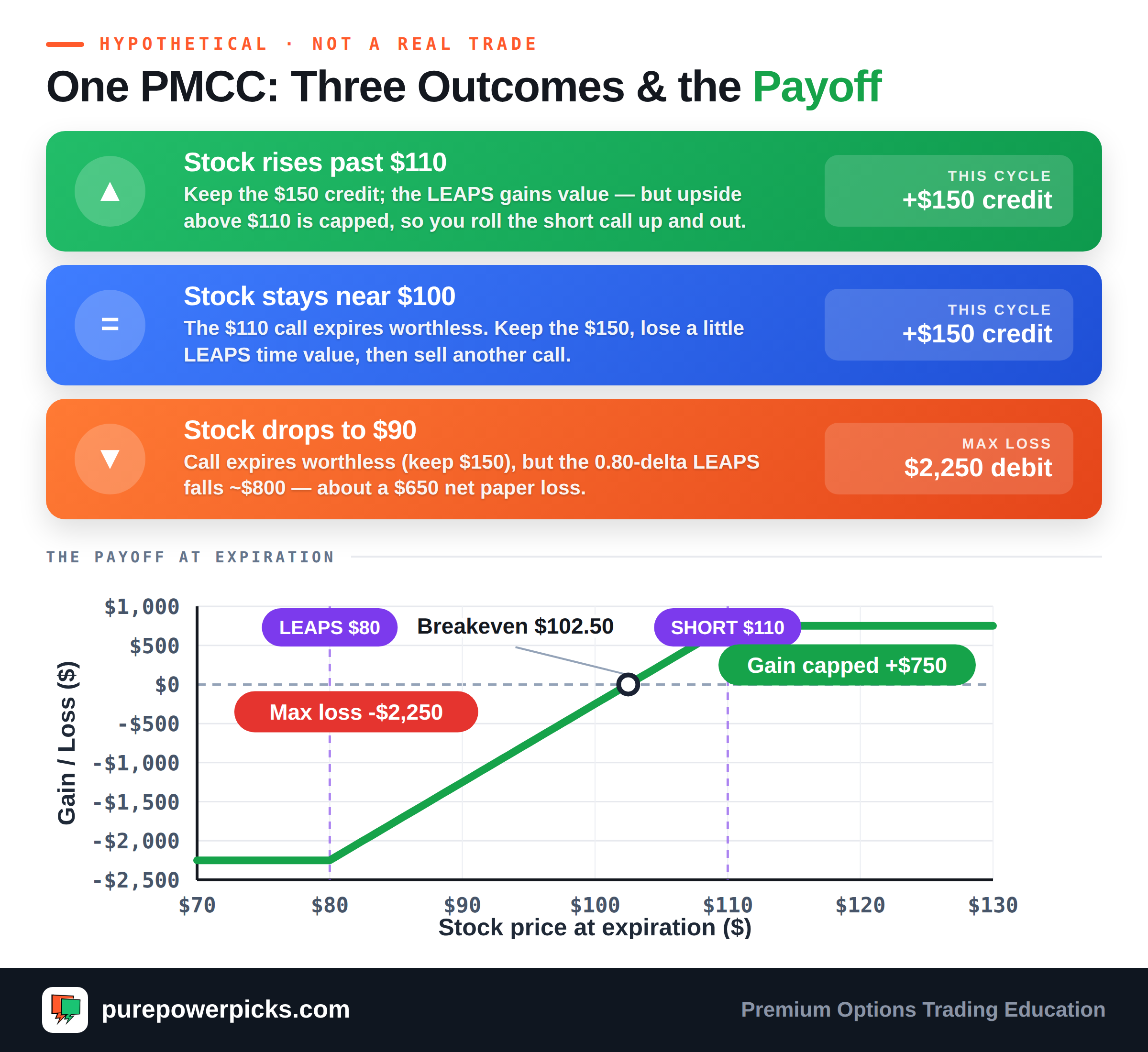
Hypothetical Example — Not a Real Trade
Stock “XYZ” trades at $100.
- Buy the $80-strike LEAPS, 12+ months out (~0.80 delta), for ~$24.00 → $2,400.
- Sell a 35-day $110 call (~0.25 delta) for ~$1.50 → +$150.
- Net debit ≈ $22.50/share = $2,250, which is your maximum loss.
Buying 100 shares would cost $10,000; this controls similar exposure for ~$2,250 — about 78% less capital. Width check: short $110 > long $80 + $22.50 debit = $102.50 ✓ (net debit is exactly 75% of the $30 width — right at the guideline).
Flat (XYZ ~$100 at expiration): the $110 call expires worthless — you keep the $150 premium, minus a little LEAPS time decay, then sell another call. Up (XYZ > $110): you keep the premium and your LEAPS gains value, but appreciation above $110 is capped — you’d roll the short call up and out. Down (XYZ → $90): the call expires worthless (keep $150), but your 0.80-delta LEAPS drops ~$800 on the 10% slide — a ~$650 net paper loss. And here’s the honest part: that’s a bigger percentage hit on your $2,250 than the same drop is for a shareholder, because a LEAPS is leverage — and it has an expiration date the shares don’t.
What Are the Real Risks of a Poor Man’s Covered Call?
The real risks come down to one truth: your stock substitute is still an option. That creates several exposures a share owner doesn’t face.
- The LEAPS can lose most of its value — and it expires. In a sharp decline you can lose most or all of the net debit, and unlike shares you can’t simply wait forever for a recovery.
- You collect no dividends. A long call doesn’t earn dividends, so you give up income a real covered call would receive.
- Ex-dividend early assignment. When your short call is in-the-money and its remaining time value is less than an upcoming dividend, the holder may exercise early to capture that dividend — leaving you short 100 shares you don’t own, and owing the dividend. The fix: close or roll in-the-money short calls before the ex-dividend date. Our guide to options assignment risk breaks down exactly how this unfolds.
- Capped upside. If the stock rockets past your short strike, those gains are forfeited — that’s the trade you signed up for.
- LEAPS liquidity. Long-dated options often have wide bid-ask spreads and thin volume, and you pay that spread on entry, every roll, and exit. Stick to the most liquid names.
A strategy is only as good as the discipline behind it.
At PPP we teach the reasoning behind every setup — mapping key levels, risk zones, and exits — so you learn to structure and manage trades like this one yourself.
How Do You Manage and Roll a Poor Man’s Covered Call?
You manage a poor man’s covered call by routinely rolling the short call for income and protecting the LEAPS from time decay. The short call is the active part; the LEAPS mostly sits.
- Roll the short call when it hits ~50% of its max value, or at ~21 days to expiration — whichever comes first — to sidestep the fastest gamma risk.
- If the stock approaches your short strike, roll up and out for a credit: buy back the current call and sell a higher strike, further out. Never roll the short strike below your LEAPS strike — that recreates the broken diagonal.
- Roll the LEAPS early. A long option’s time value bleeds fastest inside its final ~60–90 days, so most traders roll the LEAPS well before that — often around 6 months left, or once its delta climbs past ~0.90. Sell the old LEAPS, buy a fresh 12–18 month one back near 0.80 delta.
What Are the Best Stocks for a Poor Man’s Covered Call?
The best poor man’s covered call candidates aren’t specific tickers — they’re stocks with a specific set of characteristics. Because you’re paying for a long-dated option and rolling short calls monthly, the wrong underlying quietly bleeds you on spreads and whipsaw.
- Deep options liquidity — tight bid-ask spreads and healthy open interest on both the LEAPS and the short calls.
- Low-to-moderate implied volatility — low enough that the LEAPS is affordable, but with enough near-term premium to make selling calls worthwhile.
- A name you’re moderately bullish on — stable or trending up, not in a downtrend. The LEAPS needs to hold its value.
- Large, stable companies with low or no dividend — to reduce the early-assignment headaches described above.
Highly liquid broad-market ETFs (like SPY or QQQ) and large-cap names (like AAPL or MSFT) tend to have these traits, which is why they’re common illustrations — but this isn’t a recommendation to buy any of them, and liquidity and volatility shift over time. Screen for the characteristics, not the ticker. If income is your broader goal, our guide to options trading for income covers how the poor man’s covered call fits alongside covered calls, spreads, and the wheel — which kicks off with a cash-secured put.
Frequently Asked Questions
How much money do you need for a poor man’s covered call?
It depends on the stock and the LEAPS, but a poor man’s covered call typically costs 60–80% less than buying 100 shares. On lower-priced stocks the LEAPS can run roughly $800–$2,000, which brings the strategy within reach of a small account — far less than the five figures a comparable covered call would require.
Is a poor man’s covered call better than a covered call?
Neither is strictly better — they trade off. A poor man’s covered call uses far less capital and frees up cash, but it forgoes dividends, requires Level 3 approval, and the LEAPS expires. A covered call ties up more money but you own the shares outright and collect dividends. The PMCC suits capital-efficient, moderately bullish traders.
Can you lose money on a poor man’s covered call?
Yes. Your maximum loss is the net debit you paid, and you can lose most or all of it if the stock falls well below your LEAPS strike. Because a LEAPS is leverage, the percentage loss can be larger than on the equivalent shares — and unlike shares, the LEAPS has an expiration date.
What delta should the LEAPS be in a poor man’s covered call?
Target a delta of at least 0.80 (roughly 0.70–0.85). A high delta means the LEAPS is deep in-the-money, so it’s mostly intrinsic value, decays slowly, and tracks the stock closely. Going above ~0.90 usually costs more without adding much benefit.
Do you get dividends with a poor man’s covered call?
No. You hold a call option, not shares, so you don’t receive dividends. This is a genuine downside versus a real covered call, and it’s why low- or no-dividend stocks are often preferred for the strategy.
How do you roll the short call in a poor man’s covered call?
Buy back the current short call and sell a new one, typically at ~50% of max value or around 21 days to expiration. If the stock is rising toward your short strike, roll up and out for a credit — but never sell the new short strike below your LEAPS strike.
Our trade plans break down every setup with key levels, risk zones, and the reasoning behind the idea — so strategies like the poor man’s covered call become tools you understand, not gambles you hope on.
Or read more trading guides to keep sharpening your edge.
Disclaimer: This article is for educational purposes only and is not financial advice. All trade examples are hypothetical and provided to illustrate mechanics — they are not real trades, recommendations, or a representation of results you should expect. Options trading involves substantial risk of loss and is not suitable for every investor. Always do your own research and consider consulting a licensed financial professional before trading.
Best Stocks for Covered Calls in 2026 (Updated Monthly) →Tax Implications of Options Trading: 2026 Trader’s Guide →Options Assignment: What to Do When You Get Assigned Early →What Is the Death Cross? How To Use It in Stock and Options Trading →
Share

The PPP Team is the research and editorial team behind Pure Power Picks. We trade stocks and options and publish the work as we do it, with every alert tracked in public. Publishing since 2020. How we research and correct our work is written out in our editorial standards. Our content is strictly educational, never advice.