


Options Strategies for Small Accounts After the PDT Rule
The best options strategies for small accounts after the PDT rule are the same ones that worked before it: defined risk, small and consistent sizing, and selective, high-conviction setups. Nothing counts your day trades anymore, so those habits now have to come from you. FINRA eliminated the Pattern Day Trader rule effective June 4, 2026. It replaced the old trade counter with risk-based intraday margin standards. The $25,000 minimum and the “four day trades in five days” designation are gone. This guide sorts the old small-account habits into two groups. Some existed only to dodge the rule, and you can drop them. Others were good discipline all along, and you should keep them on purpose.
The PDT rule is gone, but your account size still has limits. Drop the workarounds that only existed to ration day trades, like multiple brokers and forced swing holds. Keep the discipline the rule happened to enforce: fewer, better-chosen trades and a hard cap on risk per idea.
What Actually Changed for Small Options Accounts?
The trade counter is gone, and a margin-based limit replaced it. You no longer have a weekly allowance of day trades. Your constraint now is whether your account can support what you hold during the session.
Options contracts are securities, so they were subject to the PDT rule the whole time it existed. A “day trade” meant opening and closing the same security in the same session. If you made four in five business days without $25,000 in equity, your broker flagged you. The Investopedia overview of the pattern day trader designation covers how that worked historically.
That definition, and the counter built on it, no longer apply. If you want the full regulatory story, read our breakdown of how the SEC officially ended the PDT rule. For a plain-English history of the old framework, see what replaced the PDT rule.
Intraday margin level: the margin needed to support the holdings you actually carry during the trading day.
Intraday margin deficit: what you owe when your account falls short of that level. You have to satisfy it, usually by depositing funds or reducing exposure. That deficit, not a trade count, is the line you watch now.
There is one wrinkle that matters specifically for options traders. The old rule required both a buy and a sell, so a 0DTE contract that simply expired worthless never counted as a day trade. Under the new framework, expiration, exercise and assignment all reduce your intraday margin level. For same-day options, this part is a tightening, not a loosening.
Which Planning Habits Should You Keep Without the Rule?
Keep selectivity, and stop treating swing trading as a workaround. Both habits were good trading. The rule just made the first one mandatory and the second one convenient.
Strategic Planning: Selectivity Is Now Your Job
Selectivity used to be forced on you. Three day trades a week made every one count. Nothing enforces that now, so the discipline has to come from you.
Choosing your highest-conviction setups instead of acting on every idea was always the better approach. Small accounts feel this most. Each extra marginal trade adds commissions, slippage and decision fatigue, and none of that improves your edge.
Swing Trading: A Style, Not a Dodge
Holding for days or weeks is no longer a workaround. It is simply a style. Choose it because your setups need room to develop, not because you are rationing day trades.
Ask yourself one question: does this setup need hours or days to play out? Answer it on the chart, and let that decide your timeframe.
Set your own weekly trade budget, for example three to five new ideas. Write it at the top of your trading journal. You are recreating the useful part of the old limit on purpose, without the penalty, and you can raise it once your journal shows the extra trades are earning their spot.
How Should You Set Up Your Account Now?
Consolidate into one account, understand the $2,000 margin minimum, and pick cash or margin based on how you trade. Avoiding PDT is no longer a reason to choose either one.
One Account Is Enough Now
Traders used to open accounts at several brokers to multiply their allowance of day trades. There is no allowance left to multiply. Splitting capital across brokers thins your buying power and makes your total risk harder to see in one place. Consolidate.
The $2,000 Minimum Still Exists
This one survived, and people often confuse it with the old rule. It is the long-standing minimum equity you need to borrow on margin at all. It is not a day-trading threshold, and it did not “replace” the $25,000 figure.
The Cash Account Option
A cash account still has real merits: no borrowing, no margin interest, and no intraday margin deficits to manage. Avoiding PDT is no longer one of them.
The tradeoff is settlement. US stocks and options settle T+1, a standard the SEC finalized in 2023. If you sell something you bought with unsettled funds, you can trigger a good-faith violation. Our margin vs. cash account comparison covers which account fits which style.
How Should You Use Trade Alerts After the PDT Rule?
Filter alerts on their merits, not on how many trades you have left. The filter changed from a regulatory one to a judgment one.
Selective Trading
Rank each alert by its setup, its levels, and how it fits your plan. An alert describes a chart setup and the price at the time of the alert. It is not a trade someone took on your behalf. Treat the alerted price as a reference point, and decide on your own whether the idea fits your account, your timeframe and your risk budget.
When you review past alerts, you will often see “the high,” meaning the highest recorded price the contract reached after the alert was published. It is a historical data point, not a typical outcome and not something anyone captured. Use it to study how setups behave, never to project what the next one will do.
Matching Alerts to Your Timeframe
Not every alert needs same-day action. Plenty of ideas are better expressed over days or weeks with more time on the contract. That was true while the rule existed, and it is still true.
Which Options Strategies Fit a Small Account Now?
Defined-risk structures still lead the list. When your account is small, knowing your maximum loss before you click is worth more than any amount of trading freedom.
- Debit spreads. Buying one option and selling another caps your cost and lowers the premium you pay. Your worst case is the debit itself.
- Credit spreads. Defined-risk credit spreads collect premium with a known maximum loss equal to the spread width minus the credit.
- Poor man’s covered call. The poor man’s covered call swaps 100 shares for a long-dated call. You get covered-call mechanics for a fraction of the capital.
- Cash-secured puts. These are best for accounts that can fully secure the strike. Selling cash-secured puts on lower-priced names you would actually own is a patient, rules-based approach.
- Long calls or puts with time. Buy enough days to expiration that the idea has room to develop, and size the premium as your full risk.
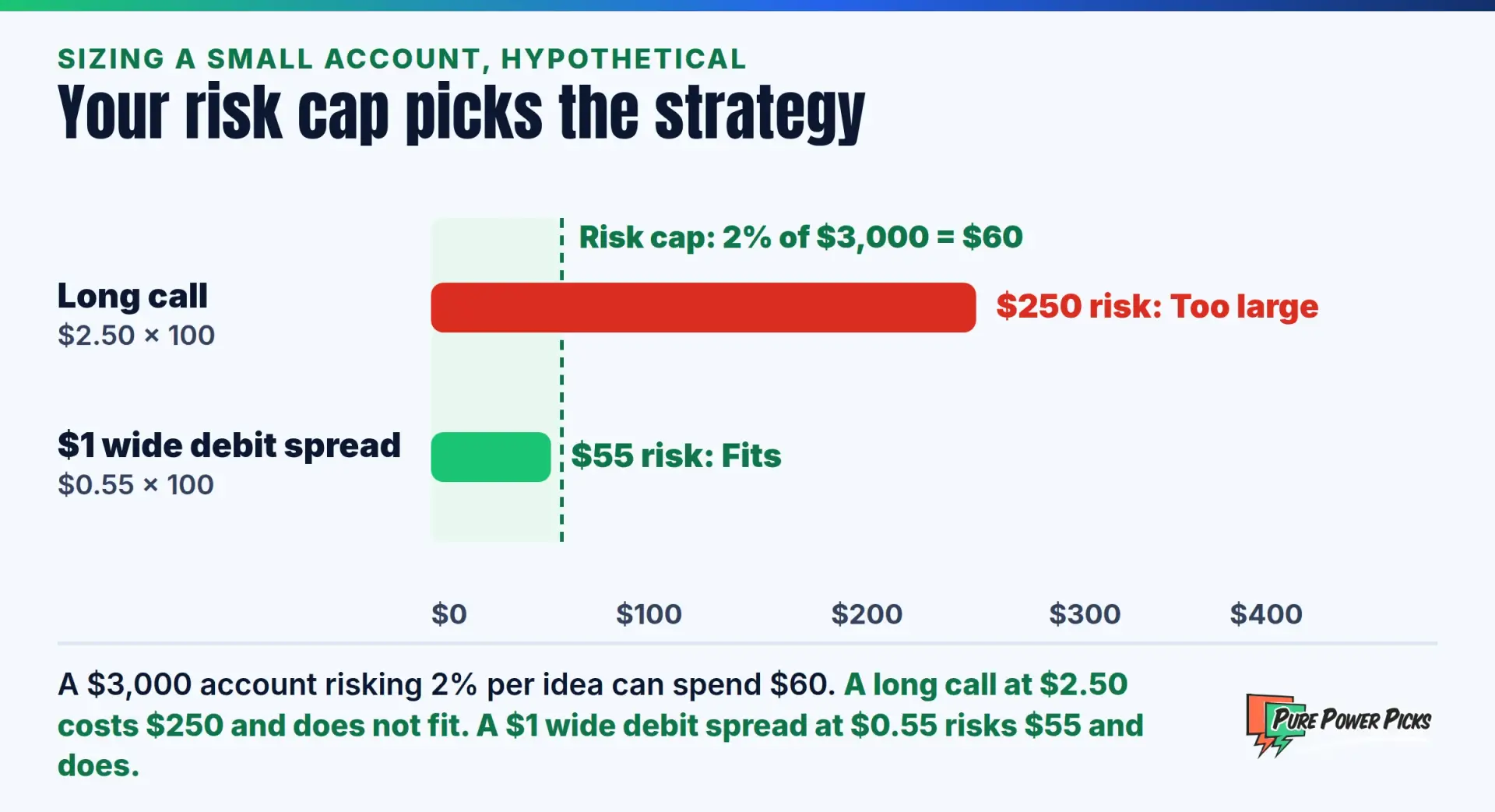
Here is a hypothetical example. Say you have a $3,000 account and cap risk at 2% per idea, or $60. A single long call priced at $2.50 costs $250, so it is too large. A $1-wide debit spread costing $0.55 risks $55 per contract and fits your budget. The strategy did not change because of a regulation. It changed because your risk cap told you what was allowed.
For deeper context on capital levels, see our guides to trading options with a small account and trading options with $1,000.
How Do You Manage Risk Now That the Guardrail Is Gone?
Build your own guardrail: a fixed risk cap per idea, a daily loss limit, and a trade budget. This is the part worth taking seriously.
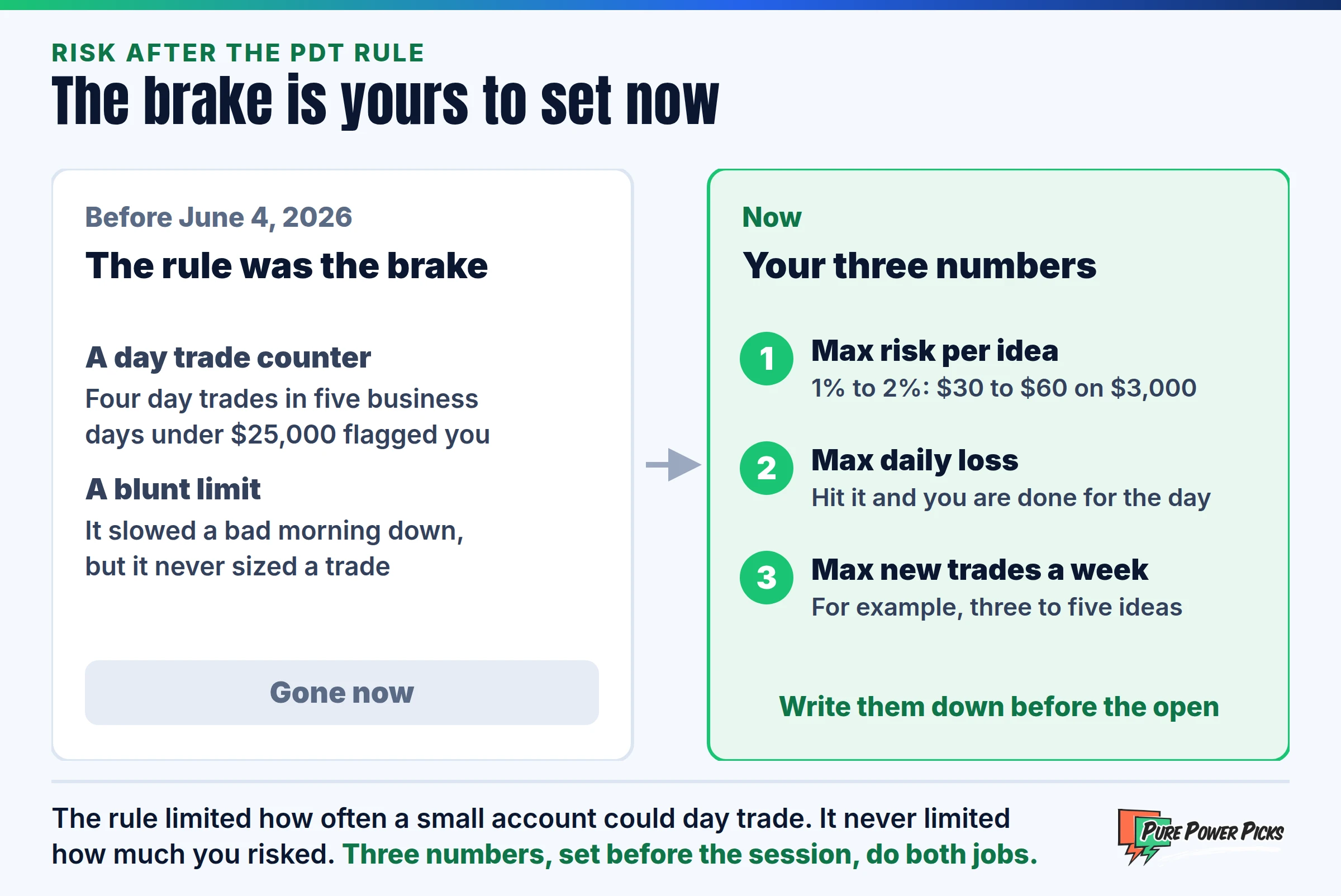
The PDT rule was a blunt instrument, but it did one useful thing for small accounts. It slowed people down. A trader having a bad morning could not keep firing contract after contract. That brake no longer exists. Overtrading, revenge trading and oversizing are now limited only by your buying power and your discipline.
Same-day options are where small accounts get hurt fastest. Time decay accelerates sharply into expiration, and the new framework now counts expiration, exercise and assignment against your intraday margin level.
If you trade 0DTE at all, size it as money you are prepared to lose in full. Read our guide to trading 0DTE options safely first.
Write three numbers down before the session opens:
- Max risk per idea. 1% to 2% of the account is a common educational benchmark. Our walkthrough of position sizing for options shows the math.
- Max daily loss. Hit it and you are done for the day, no exceptions.
- Max new trades per week. This is your self-imposed replacement for the old counter.
Our list of options risk management rules expands on each of these. When your journal shows consistency over months, not weeks, that is the time to scale up your position size gradually.
Frequently Asked Questions
Do I still need $25,000 to day trade options?
No. FINRA eliminated the $25,000 pattern day trader minimum effective June 4, 2026. Your limit is now set by intraday margin standards based on the holdings you carry during the day, and your broker may still apply its own house requirements.
Is the $2,000 margin minimum the new PDT threshold?
No. The $2,000 figure is the long-standing minimum equity needed to borrow on margin at all. It existed before the PDT change and is unrelated to day trading frequency.
Should I still use a cash account?
It can still make sense if you want no borrowing and no margin interest. Just plan around T+1 settlement so you avoid good-faith violations. Choose the account type for how you trade, not to dodge a rule that no longer exists.
Are 0DTE options easier to trade in a small account now?
In one respect they are stricter. Expiration, exercise and assignment now reduce your intraday margin level, which the old day-trade count never captured. Treat 0DTE as the highest-risk corner of the market and size it accordingly.
What is the single most important habit to keep?
A fixed maximum risk per idea. The PDT rule never enforced it, but it is what keeps a small account trading long enough to learn. Pair it with a daily loss limit and a weekly trade budget.
Fewer Rules Means You Need a Better Process
Pure Power Picks shares educational chart setups with the reasoning behind each one: the levels, the timeframe, and the risk framing. You can study how setups are built and decide for yourself what fits your account. The goal is judgment, not imitation.
Explore Alert Plans →
The PPP Team is the research and editorial team behind Pure Power Picks. We trade stocks and options and publish the work as we do it, with every alert tracked in public. Publishing since 2020. How we research and correct our work is written out in our editorial standards. Our content is strictly educational, never advice.
Disclaimer: Pure Power Picks is not a registered investment advisor or broker-dealer. All content is for educational and informational purposes only and should not be considered financial, investment, tax or legal advice. Options trading involves substantial risk and is not suitable for every investor; you can lose the entire amount invested. All examples are hypothetical and for illustration only. Past alert data, including any recorded highs, does not indicate future results. Regulatory details can change, so confirm current requirements with your broker. Consult a licensed financial professional before making any investment decisions.