

Option Trading Alert Services 101
An options trading alert service is a subscription that sends you timely, structured trade ideas: the ticker, the specific contract, the alerted price, and the reasoning behind the setup. You still decide whether to act on any of it. Used well, a quality service can simplify your decision-making, save you hours of screen time, and teach you how experienced traders read charts. Used poorly, it becomes a crutch that hands your judgment to someone else.
This 101 guide covers what these services actually do, the real benefits they offer, and the guardrails you need before you subscribe. By the end, you’ll know how to treat alerts as an educational tool inside your own trading plan.
An options alert service is a source of educational chart setups, not a substitute for your own plan. The value comes from understanding the “why” behind each alert and pairing it with your own sizing, risk limits, and discipline. No service can guarantee outcomes, so judge any provider on transparency and teaching, not hype.
What Exactly Is an Options Trading Alert Service?
It’s a service where experienced analysts scan the market, identify options setups that meet their criteria, and publish those ideas to subscribers as they develop. Alerts usually arrive by text, email, app notification, or a community channel like Discord.
A solid alert gives you everything you need to evaluate the idea yourself: the underlying stock, the exact contract, the price at the time of the alert, and the chart logic behind it. If you’re new to the mechanics of calls and puts, Investopedia’s overview of options is a good primer before you go further.
The key mindset shift: an alert is an idea, not an instruction. You’re the one with the brokerage account, the risk tolerance, and the final call. Our guide on how to use options alerts walks through that workflow step by step.
Alert price: the potential price of the option contract at the moment the alert was published. It’s a reference point, not a fill anyone received.
Alert zone: a price range around the alert price where the setup’s logic still holds.
The high: the highest recorded price the alerted contract reached after publication, often expressed as “a high of +X%.” It’s a historical data point, not a typical or captured result, and it should never be projected forward.

How Does an Alert Service Simplify Decision-Making?
It narrows thousands of tickers and contracts down to a handful of researched setups, so you spend your energy evaluating ideas instead of hunting for them. That filtering is the heavy lifting most part-time traders simply can’t do every day.
Think about the raw choice set. Every optionable stock has dozens of expirations and strikes, each with its own pricing, liquidity, and implied volatility. A good service applies a consistent screening process and hands you a short list with the reasoning attached.
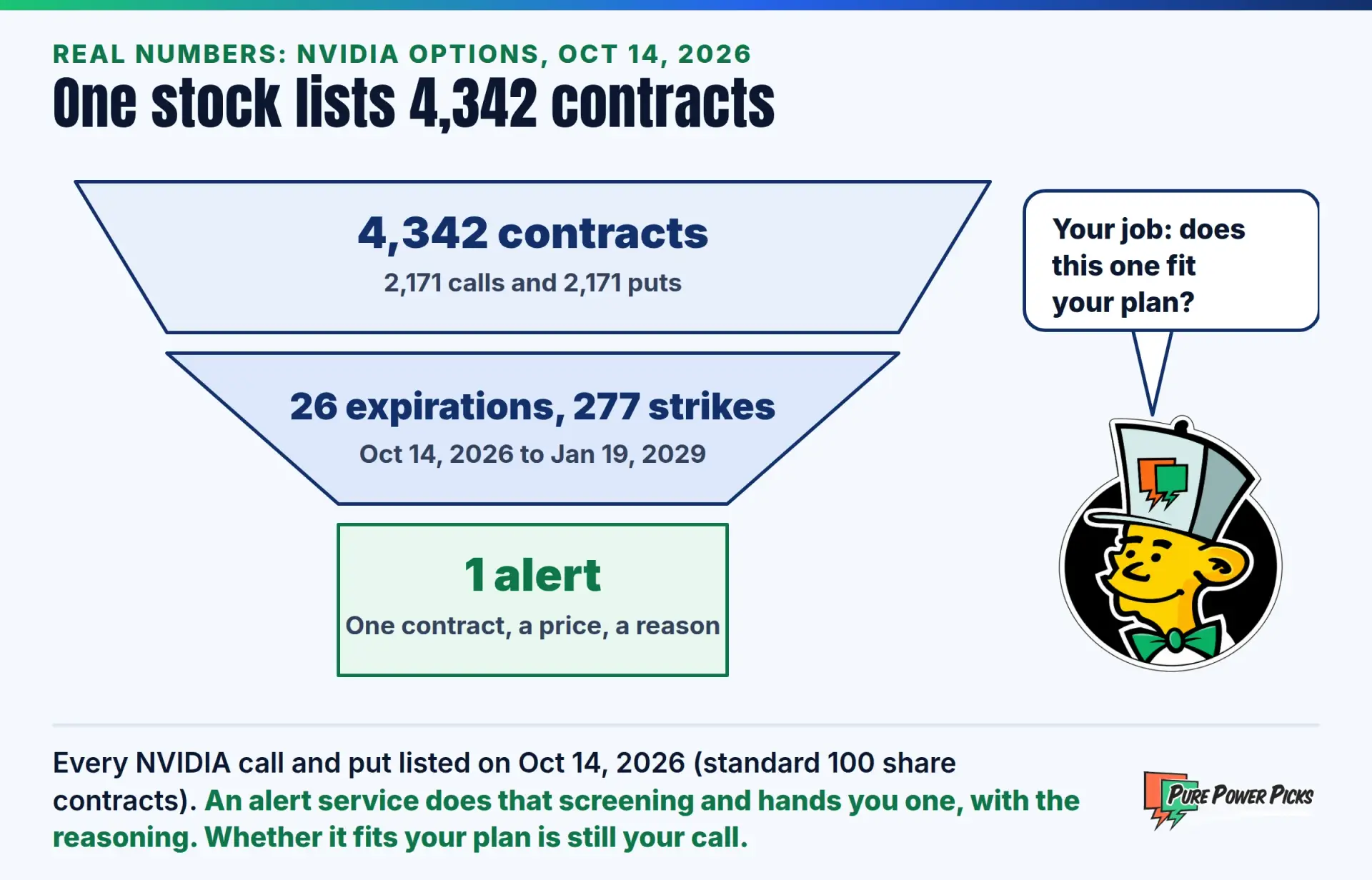
Simpler doesn’t mean automatic, though. Your job shifts from “find a trade” to “does this setup fit my plan, my account, and my risk limits today?” That’s a far more manageable question, and it’s the right one to be asking.
Not all signals are equal, either. Before you trust a provider’s filtering, read our breakdown on choosing quality trade signals so you know what separates a researched setup from noise.
Can Alerts Actually Teach You to Trade?
Yes, if the service explains the rationale behind each setup and you study it actively. The educational value is often worth more over time than any single alert.
The best alerts read like a mini lesson: why this support level matters, why this expiration was chosen, how volume or sentiment confirms the thesis. Repeat that exposure across dozens of setups and you start recognizing the patterns on your own.
Here’s how to turn alerts into a learning engine:
- Pull up the chart yourself. Before reading the rationale, try to spot the setup. Then compare notes.
- Track every alert in a journal. Note the thesis, the alert price, and how the chart behaved afterward, including the setups that fell short.
- Study the full record, not the highlights. Reviews like every alert charted and ranked show the complete picture, which is where the real lessons live.
- Dissect one alert deeply. Our anatomy of a real alert case study shows how to break down an alert from thesis to outcome.
Paper trade your first 20 to 30 alerts before risking real money. You’ll learn the rhythm of the service, see how option prices move relative to the stock, and find out whether the alert timing fits your schedule, all without putting capital on the line.
How Do Alert Services Support Risk Management?
A good alert defines the thesis and the conditions that would invalidate it, which gives you a clear framework for building your own risk plan. The risk decisions themselves, how many contracts and how much you’re willing to lose, stay with you.
This is where many beginners go wrong. They treat the alert as the whole plan and skip the part that actually keeps them in the game: sizing and loss limits. Our deep dive on risk management with alert services covers this in detail.
Let’s walk through a hypothetical scenario. Say a service publishes an alert on a fictional stock, XYZ, trading near $100. The idea is the $105 call expiring in about 30 days, with an alert price of $2.00 and an alert zone of $1.90 to $2.10. The thesis: a breakout above resistance, invalidated if XYZ closes back below $97.
Now you apply your own rules. One contract at $2.00 costs $200, since each contract represents 100 shares. Suppose you have a hypothetical $10,000 account and cap risk at 2% per idea, or $200. If your personal plan is to cut the trade at a 50% drop in premium, your planned risk per contract is $100, so two contracts keeps you inside your limit.

Notice that the alert gave you the setup, but the math came from you. That’s the right division of labor. For the full framework, read position sizing for options, and if you’re working with a smaller account, our guide to trading alerts in a cash account explains how settlement rules affect you.
Buying options can result in the loss of your entire premium, and time decay works against long options every day. Never size a trade based on how strong an alert sounds. Read the Options Clearing Corporation’s Characteristics and Risks of Standardized Options before trading, and only use capital you can afford to lose.
How Do Alerts Save Time and Broaden Your Strategy Toolkit?
Alerts replace hours of scanning with minutes of evaluation, and a well-rounded service exposes you to setups you might never have found on your own. Both benefits matter most for traders balancing the market with a job, family, or other commitments.
On the time side, you’re notified when a setup develops instead of watching screens all day. That’s the difference between catching a timely idea and seeing it hours too late. Make sure your broker’s app and alert delivery are fast and reliable; our guide to the best broker for option alerts covers what to look for.
On the strategy side, options offer far more than buying a call or a put. Spreads, different expirations, and directional versus neutral setups each suit different market conditions. Seeing a variety of approaches with explanations attached helps you discover what fits your style and risk tolerance. The Cboe options education center is a strong free resource for learning the mechanics behind each structure.
Here’s how the do-it-yourself approach compares with using a service:
How Do Alerts Help With Emotional Discipline and Access to Expertise?
Alerts built on a consistent, rules-based process give you a calm reference point when your emotions are running hot, and they connect you with analysts who study the market full time. Both help you trade from a plan instead of from impulse.
Trading is an emotional rollercoaster. Fear makes you bail too early, greed makes you hold too long, and frustration pushes you to chase losses with bigger bets. A structured alert, paired with your own written rules, slows you down and forces the question: “Does this fit my plan?”
The flip side is a trap worth naming. Blindly copying alerts isn’t discipline; it’s outsourcing. Real discipline means you understand the setup, size it yourself, and follow your own rules whether an idea hits a high of +50% or falls short.

As for expertise, a good service gives you a window into how seasoned analysts think about price action, volatility, and timing. Many also include a community where you can ask questions and compare notes; see our roundup of options trading discord communities. Just vet the source carefully, because the industry has its share of bad actors. Our list of red flags before you subscribe will help you spot them, and the SEC’s Investor.gov site has free guidance on avoiding investment fraud.
Write your rules down before the next alert arrives: max risk per idea, max number of open trades, and when you’ll cut a trade that isn’t working. When an alert hits your phone, check it against the list, not against your mood. To see how we structure our own setups, read how our trade alerts work.
Frequently Asked Questions
Are options trading alert services worth it for beginners?
They can be, if the service explains its reasoning and you use alerts to learn rather than to copy. Beginners get the most value by paper trading alerts first, journaling each setup, and keeping position sizes small while they build skill.
What should a quality options alert include?
At minimum: the underlying ticker, strike, expiration, call or put, the alert price or alert zone, and a clear rationale. The best alerts also explain what would invalidate the setup so you can plan your own risk.
What does “a high of +X%” mean on an alert?
It’s the highest recorded price the alerted contract reached after publication, compared with the alert price. It’s a historical data point only. It doesn’t represent what any trader actually received, and it should never be read as a typical or expected result.
Can I lose money following options alerts?
Absolutely. Options can expire worthless, and long options lose value from time decay. Any service that implies guaranteed results is a red flag. Your sizing and risk rules are what protect your account, not the alert itself.
How do I choose between alert services?
Look for transparency (a full, unedited alert history), education (explained rationale), realistic marketing (no guaranteed outcomes), and alert timing that fits your schedule. Avoid any provider that hides setups that fell short or pressures you with urgency tactics.
Learn the Setups, Keep the Decisions
An alert service isn’t a silver bullet. It’s a tool, and like any tool, it works best inside a balanced plan built around your goals, your sizing, and your discipline. Pure Power Picks is built education-first: every alert comes with the chart logic behind it so you understand the “why,” not just the ticker.
If you’re ready to study real-time setups alongside a structured process, take a look at our plans.
Explore Trade Alert Plans
The PPP Team is the research and editorial team behind Pure Power Picks. We trade stocks and options and publish the work as we do it, with every alert tracked in public. Publishing since 2020. How we research and correct our work is written out in our editorial standards. Our content is strictly educational, never advice.
Disclaimer: The content provided by Pure Power Picks is for educational and informational purposes only and does not constitute financial, investment, or trading advice. We are not registered financial advisors. Options trading involves substantial risk and is not suitable for all investors; you can lose some or all of your invested capital. All examples in this article are hypothetical and are used for illustration only. References to an alert’s “high” describe a historical data point and do not represent actual or typical results. Past performance is not indicative of future results. Always do your own research and consult a licensed financial professional before making any investment decisions.