

The Psychology of Trading: Mastering Emotions for Better Decision Making
The psychology of trading is the set of emotional and mental habits that shape every decision you make in the market, and mastering it is often the difference between a trader who survives and one who blows up. You can have a solid strategy and still lose money if fear makes you freeze or greed makes you oversize. That is especially true in options, where leverage and time decay amplify every mistake. The good news: emotional control is a skill, not a personality trait. In this guide, we will break down how fear and greed show up, the three biases that hurt traders most, and a practical system for making calmer, rules-based decisions. You will not eliminate emotions. You will learn to stop letting them make your decisions.
Your emotions are not the enemy. Unplanned decisions are. When you write your rules down before the market opens, size small enough to stay calm, and review your behavior in a journal, fear and greed lose most of their power over you.
What Is Trading Psychology, and Why Does It Matter So Much in Options?
Trading psychology is how your emotional and mental state influences your market decisions. It matters more in options because the instrument punishes hesitation and impulsiveness faster than almost anything else you can trade.
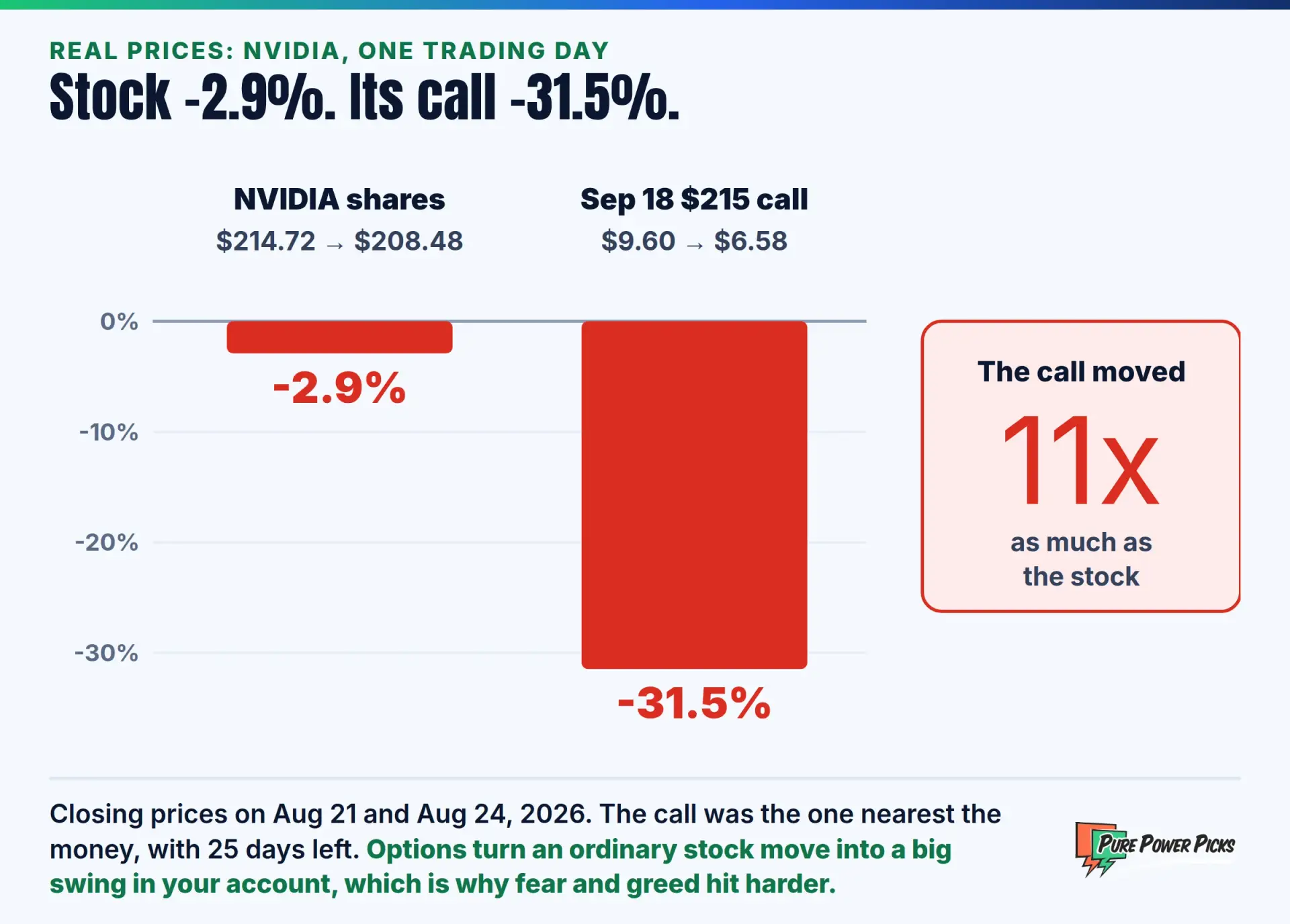
A stock that drops 3% is an annoyance. An option on that stock might drop 30% in the same move, and it keeps losing value to time decay while you decide what to do. That pressure makes it tempting to abandon your plan at exactly the wrong moment.
Strategy tells you what to do. Psychology determines whether you actually do it. Most traders do not fail from lack of information. They fail because they know the rule and break it anyway.
Cognitive bias: a predictable mental shortcut that distorts judgment. In trading, biases cause you to misread risk, ignore evidence, or act on emotion while feeling completely rational. You cannot remove them, but you can build rules that catch them before they cost you.
How Do Fear and Greed Show Up in Your Trading?
Fear makes you act too late or not at all. Greed makes you act too big or too often. Both pull you away from your plan, just in opposite directions.
Fear looks like panic selling on a normal pullback, skipping a setup that meets every one of your rules, or closing a trade the moment it shows a small green number. After a painful loss, fear often turns into paralysis.
Greed looks like doubling your size after a good week, chasing a contract that has already run, or refusing to close a trade because you want “just a little more.” It also shows up as revenge trading, where you try to win back a loss immediately.
Notice that both emotions spike during fast markets. If you want to go deeper on that specific pressure, read our breakdown of psychology mistakes during volatility. For quick, practical techniques you can use in the moment, see how to control emotions in trading.
Which Psychological Traps Cost Traders the Most?
Three biases do the most damage: overconfidence, confirmation bias, and loss aversion. Each one feels like good judgment while it is happening, which is exactly what makes it dangerous.
Overconfidence bias. After a few good trades, you start believing you cannot be wrong. You skip your checklist, size up, and take setups that do not really fit your criteria.
Confirmation bias. Once you have an opinion, you go looking for proof. You read the bullish headlines and scroll past the bearish ones, then call it research.
Loss aversion. Losses feel roughly twice as painful as equivalent wins feel good. So you hold losing trades hoping they come back, and close winning trades early just to feel safe.
| Bias | What It Sounds Like | Rule That Counters It |
|---|---|---|
| Overconfidence | “I’m on a hot streak, let’s go bigger.” | Fixed risk per trade that never changes based on recent results |
| Confirmation bias | “Everything I’m reading agrees with me.” | Write down the bear case (or bull case) before every trade |
| Loss aversion | “It’ll come back. I’ll close it at breakeven.” | Pre-set max loss level decided before you place the order |
These biases sit behind most of the common trading mistakes we see beginners make. The fix is never “try harder.” The fix is a rule that triggers before the emotion does.
How Do You Build a System That Manages Your Emotions?
You manage emotions by making most of your decisions before the market opens. A written plan, a small and fixed risk per trade, a journal, and a healthy routine do the heavy lifting so willpower does not have to.
1. Write a trading plan. Define your setup criteria, when you will close a trade for a loss, when you will take a win, and a daily loss limit that ends your session. If you need a template, here is how to build a winning trading plan.
2. Size small enough to stay calm. If a single trade can ruin your week, you will not think clearly. Proper position sizing is the most underrated psychology tool there is.
3. Keep a journal. Log the setup, your reasoning, how you felt before and during the trade, and what you would do differently. After 30 trades, patterns jump off the page: maybe you break rules on Fridays, or after two losses in a row. Our guide to keeping a trading journal shows exactly what to track.
4. Manage stress outside the screen. Sleep, exercise, and a few minutes of deep breathing or meditation before the open measurably sharpen focus. A tired, wired trader makes impulsive decisions. Build a daily routine for traders that protects your mental state.
5. Set realistic expectations. Losses are part of the business, even for experienced traders. Judge your day on whether you followed your plan, not on your account balance. Process is within your control. Outcomes on any single trade are not.
Rate your emotional state from 1 to 10 before every session. If you are above a 7 on frustration, excitement, or fatigue, cut your size in half or sit the day out. The market will be open tomorrow. Your capital might not be if you trade tilted.
How Should You Handle Losses Without Losing Your Discipline?
Treat every loss as tuition: close it by your rules, review it in your journal, and extract one lesson. A planned loss is a cost of doing business. An unplanned loss is a signal your process needs work.
Let’s walk through a hypothetical scenario. You buy one call contract for $2.00 ($200 total). Your plan says you will close it if it falls to $1.00, a 50% loss of the premium paid.
The stock dips and the contract drops to $1.05. Loss aversion kicks in: “It’s so close to my level, let me give it a bit more room.” It hits $1.00, and instead of closing, you move your line to $0.70. A week later, time decay has pushed it to $0.40. A planned $100 loss became a $160 loss, and worse, you trained yourself to ignore your own rules.
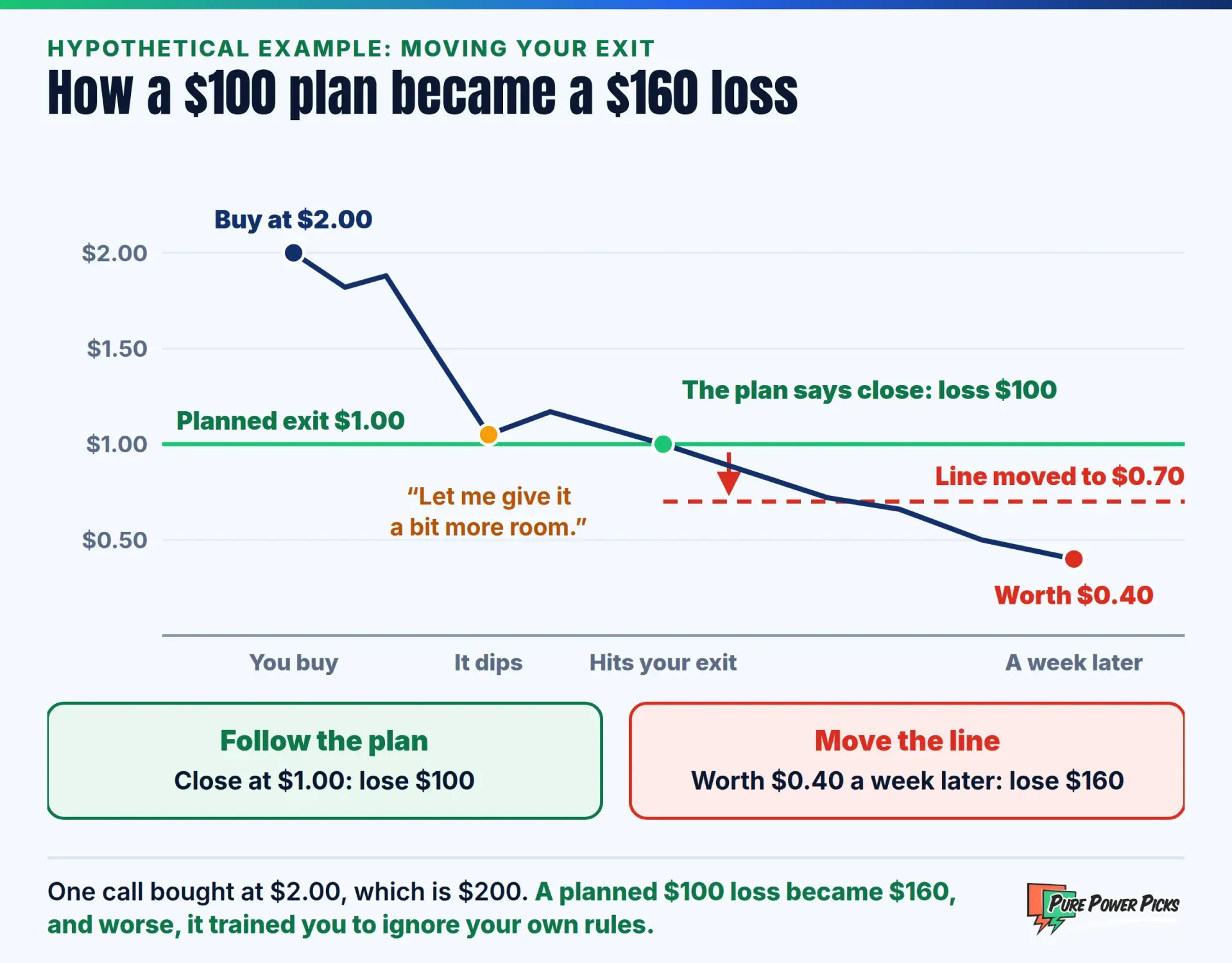
The lesson in that hypothetical is not about the money. It is about the habit. Learn when to cut your losses before you are in the trade, and the decision becomes mechanical instead of emotional.
The flip side matters too. Loss aversion also makes traders close good trades far too early. Learning patience in trading is just as important as learning to take a loss cleanly. And if you have already taken a hit that shook your confidence, here is a step-by-step guide to recover from a big loss.
Buying options carries the risk of losing 100% of the premium you pay, and some strategies carry even larger risk. Revenge trading after a loss is one of the fastest ways to compound damage. Before trading options, review the risk education provided by the Cboe Options Institute and investor resources at Investor.gov.
Why Do Education and Community Make You a Calmer Trader?
Knowledge reduces fear, and community reduces isolation. Most trading anxiety comes from uncertainty: not understanding why a contract moved or what to do next.
The more you understand concepts like implied volatility, time decay, and risk-to-reward, the less any single price move feels like a crisis. Continuous learning turns “What is happening?” into “I expected this could happen, and here is my plan.”
Trading alone also makes it easy to rationalize bad decisions. A mentor or a group of serious traders gives you perspective and accountability. Study the habits of great traders, and you will notice that almost all of them invest heavily in learning and review.
For a deeper set of mindset tools built specifically for options, check out our mental tips for options traders. Remember the bottom line: the goal is not to become emotionless. It is to understand your emotions well enough that they inform you without controlling you.
Frequently Asked Questions
Can you completely remove emotions from trading?
No, and you should not try. Emotions carry useful information, like a gut sense that you are oversized. The goal is to build rules and routines so emotions do not override your plan in the moment.
What is the most damaging emotion in options trading?
It depends on the trader, but greed tends to cause the biggest single blowups through oversizing and revenge trading. Fear causes slower damage through missed setups and closing trades too early.
How long does it take to develop trading discipline?
There is no fixed timeline. Most traders notice real improvement after consistently journaling a few dozen trades and reviewing them weekly, because that is when behavior patterns become visible.
What should I do right after a big loss?
Stop trading for the day. Write down what happened and how you felt, then review it with fresh eyes the next morning. Return with reduced size until your confidence and process feel stable again.
Does paper trading help with trading psychology?
It helps you learn mechanics and test your plan, but it does not fully replicate the emotions of real money. Many traders bridge the gap by starting live with very small size after paper trading.
Trade With a Plan, Not a Feeling
Pure Power Picks is built education-first. Our alerts are educational chart setups that show the alert price and the reasoning behind each idea, so you can study how a structured approach works and decide for yourself. No hype, no guarantees, just a clearer framework for your own decisions.
Explore Membership Options
The PPP Team is the research and editorial team behind Pure Power Picks. We trade stocks and options and publish the work as we do it, with every alert tracked in public. Publishing since 2020. How we research and correct our work is written out in our editorial standards. Our content is strictly educational, never advice.
Disclaimer: The content provided by Pure Power Picks is for educational and informational purposes only and does not constitute financial, investment, or trading advice. We are not registered financial advisors. Options trading involves substantial risk and is not suitable for all investors. You can lose some or all of your invested capital. All examples in this article are hypothetical and for illustration only. Past performance, including any historical alert data, does not guarantee future results. Always do your own research and consult a licensed financial professional before making any investment decisions.