


Essential Skills for Successful Stock and Options Trading
The essential skills for successful stock and options trading are financial literacy, technical analysis, risk management, emotional discipline, market research, adaptability, patience, continuous learning, analytical thinking, and persistence. No single skill carries you on its own. A great chart reader with no risk rules can blow up an account in a month. A disciplined risk manager who can’t read price action will bleed slowly from bad setups. The traders who last build all ten skills into one repeatable process. In this guide, we’ll break down what each skill actually looks like at the desk, how the skills connect to each other, and the specific habits you can start building this week, whether you trade shares, options, or both.
Trading skill is a stack, not a single talent. Knowledge (literacy and chart reading) tells you what to look for, risk management and discipline keep you in the game, and patience, learning, and persistence compound everything over time. Weakness in any one layer can erase the strength of the others.
| Skills covered | 10 core skills, grouped into 5 stages |
| Survival skills | Risk management and emotional discipline |
| Options-specific add-on | Greeks, implied volatility, time decay, reading the chain |
| Core tools | Written trading plan, trading journal, paper trading account |
| Most common beginner gap | Oversizing trades relative to account size |

What Market Knowledge Do You Need Before You Trade?
You need two kinds of knowledge: financial literacy (why prices move) and technical analysis (how prices are moving right now). Fundamentals give you context, and charts give you timing.
Skill 1: Financial Literacy
Start with the basics: earnings reports, balance sheets, revenue growth, margins, and the major economic indicators like CPI, jobs reports, and Fed rate decisions. You don’t need to be an accountant. You need to know why a stock might gap 10% overnight and which calendar events can move your whole watchlist at once.
At the core, prices move on supply and demand. Company performance, sector rotation, and macro trends shift that balance. When you understand the drivers, a sudden move stops looking random and starts looking explainable.
For options traders, literacy goes one layer deeper. You also need to understand how contracts are priced, which means understanding the options greeks and learning to read an options chain column by column. The Cboe’s options education resources are a solid free supplement.
Implied volatility (IV): the market’s expectation of how much a stock will move, baked into an option’s price. High IV makes options more expensive. After a known event like earnings, IV often drops sharply, which can shrink an option’s value even when the stock moves in the expected direction.
Skill 2: Technical Analysis
Technical analysis is the skill of reading price and volume to find areas where buyers or sellers are likely to show up. Start with support and resistance levels, trendlines, and basic candlestick patterns. These are the building blocks every other tool sits on.
From there, add a small set of indicators: moving averages for trend, the relative strength index (RSI) for momentum, and stochastics for overbought and oversold readings. Pick two or three and learn them deeply. Ten indicators on one chart usually produce confusion, not clarity.
The goal is to define, in advance, where your idea is right and where it’s wrong. A level on a chart is only useful if it tells you what you’ll do when price gets there.

How Do Risk Management and Emotional Discipline Protect Your Account?
Risk management limits how much any single trade can hurt you, and emotional discipline makes sure you actually follow those limits. Together, they are the survival skills. Everything else only matters if you’re still funded.
Skill 3: Risk Management
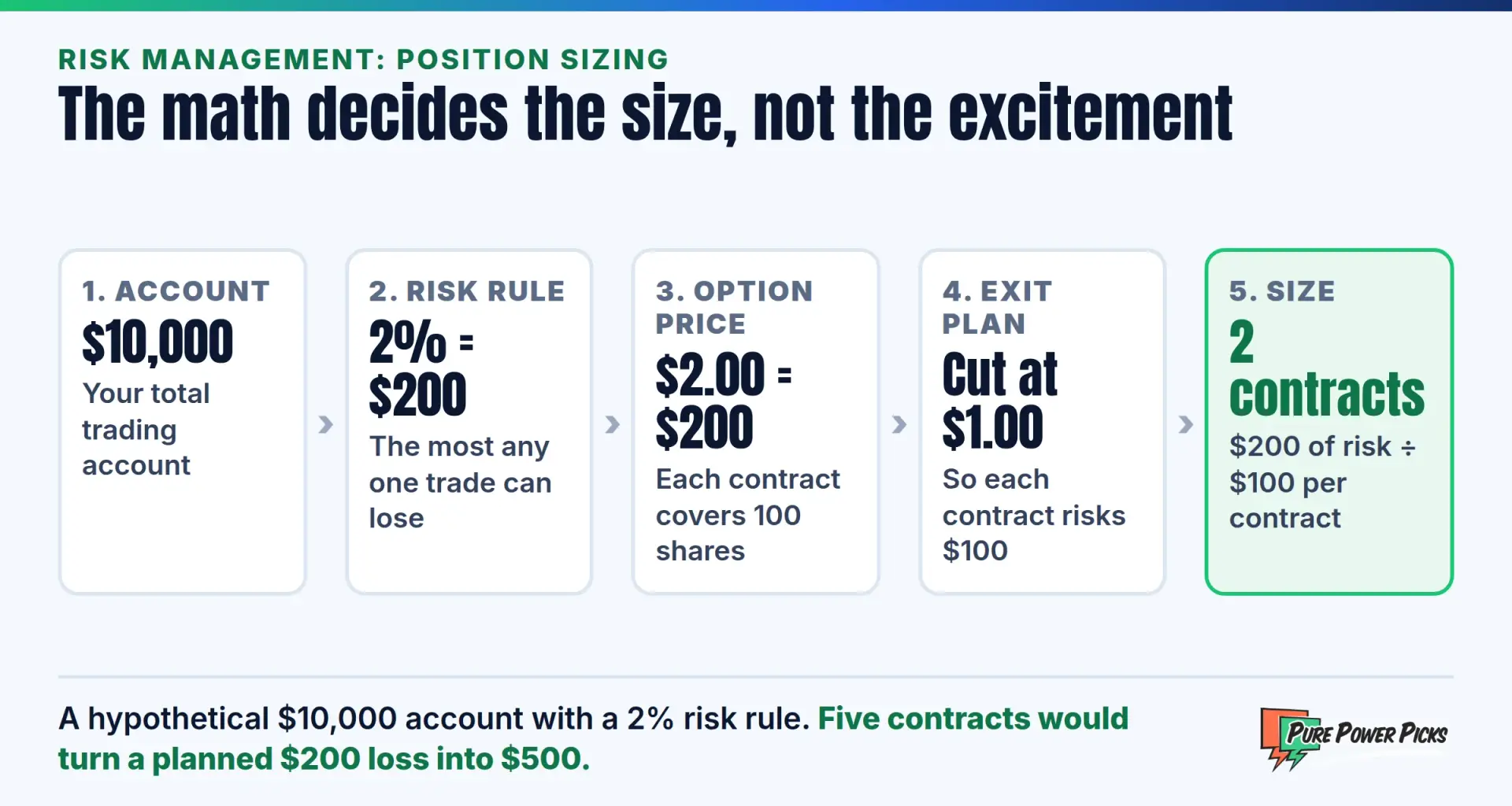
The first rule is proper position sizing. Many traders cap the risk on any single trade at 1% to 2% of their account. That way, a string of five or six bad trades is a setback, not a disaster.
Let’s walk through a hypothetical example. Say you have a $10,000 account and a 2% risk rule, so your maximum risk is $200. You’re looking at an option priced at $2.00, which costs $200 per contract. If your plan is to cut the trade if the contract loses half its value, your risk is $100 per contract, so your size is two contracts. The math decides the size, not your excitement about the setup.
Stop-loss orders, mental stops, and defined-risk spreads all serve the same purpose: capping the downside before you click buy. Pair that with evaluating the risk-reward ratio on every setup, and our full list of options risk management rules covers the rest.
Options can lose 100% of their value, and they can do it quickly. Time decay works against long option buyers every single day, and a contract can expire worthless even if the stock eventually moves your way. Never size an options trade as if it were a share purchase. Read the OCC’s Characteristics and Risks of Standardized Options before trading.
Skill 4: Emotional Discipline
Fear and greed drive most account-killing mistakes. Fear makes you bail on a good plan at the first wiggle. Greed makes you double down, skip your stop, or chase a move that already happened.
The fix is structural, not motivational. Decide your rules when you’re calm, write them down, and follow them when you’re not. If you haven’t done that yet, start here: build a winning trading plan. For the deeper psychology, see our guide to mastering your trading emotions.
How Do You Research a Setup and Adapt When Conditions Change?
Good research means checking the chart, the company, and the calendar before every trade. Adaptability means recognizing when the market environment has shifted and adjusting your approach instead of forcing yesterday’s playbook.
Skill 5: Market Research
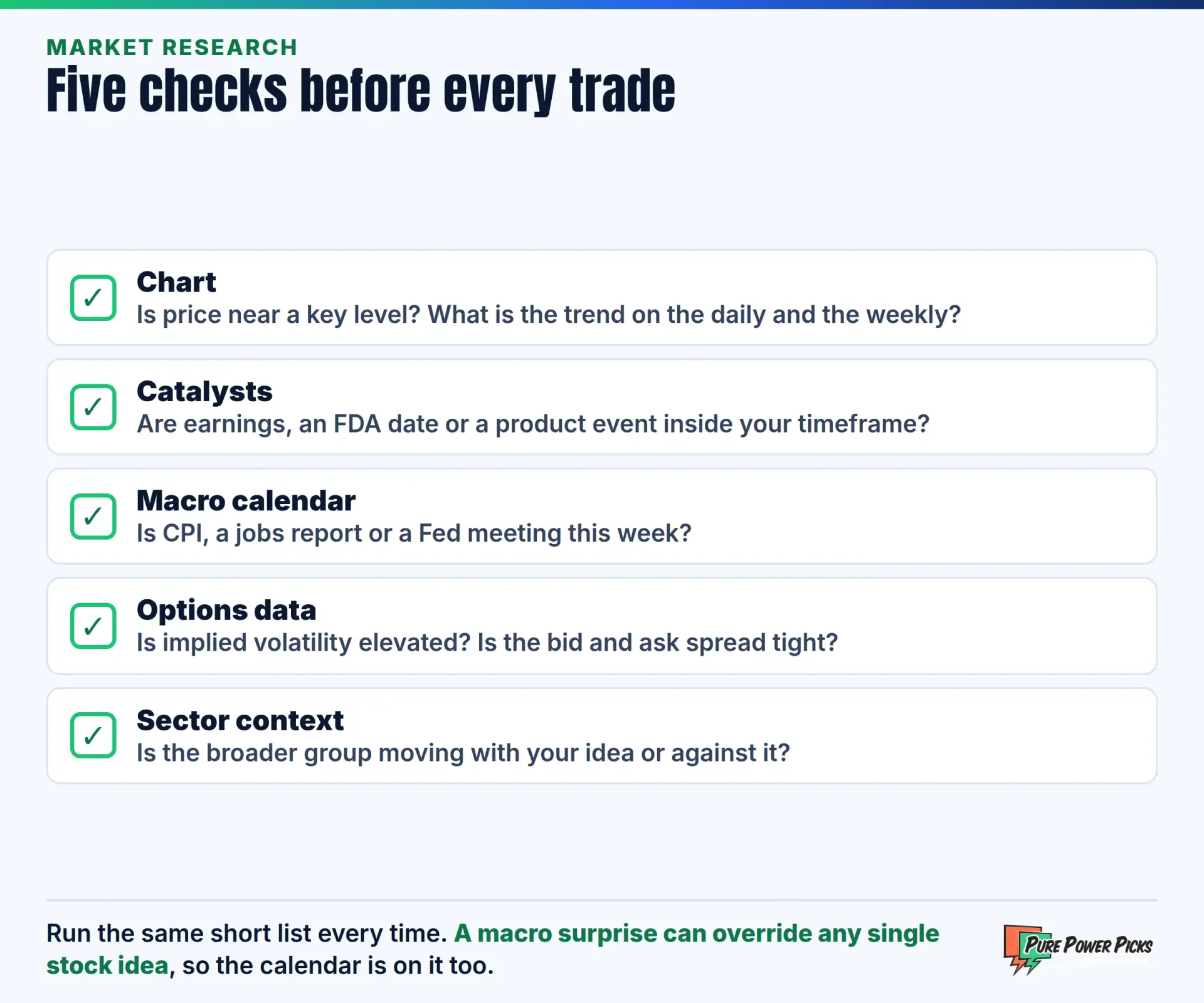
Due diligence doesn’t have to take hours. Build a short pre-trade checklist and run it every time:
- Chart: Is price near a key level? What’s the trend on the daily and weekly?
- Catalysts: Are earnings, an FDA date, or a product event inside your timeframe?
- Macro calendar: Is CPI, a jobs report, or a Fed meeting this week?
- Options data: Is IV elevated? Is the bid-ask spread tight enough to trade efficiently?
- Sector context: Is the broader group moving with or against your idea?
Geopolitical headlines and macro surprises can override any single-stock thesis. Knowing what’s on the calendar keeps you from getting blindsided.
Skill 6: Adaptability
Markets cycle between trending and choppy, calm and volatile. A breakout strategy that works beautifully in a strong trend can get chopped to pieces in a range-bound market. Your job is to notice the regime and adjust.
Adapting might mean trading smaller during high volatility, shifting from long options to spreads when IV is elevated, or simply trading less. Adaptability is not abandoning your plan after two bad days. It’s having pre-defined rules for different conditions.
Why Do Patience and Continuous Learning Matter So Much?
Patience keeps you out of low-quality trades, and continuous learning keeps your edge from going stale. Both are quiet skills, but they compound more than almost anything else.
Skill 7: Patience
Not every day, or even every week, offers a clean setup. Forcing trades out of boredom is one of the fastest ways to give back hard-earned progress. Sitting on your hands is a position too, and often the right one.
Patience also applies after you’re in a trade. Let the setup play out according to your plan instead of reacting to every five-minute candle.
Write your “A+ setup” criteria on a sticky note next to your screen. If a trade doesn’t check every box, it’s a pass. This one habit filters out most impulse trades, and it turns patience from a feeling into a rule.

Skill 8: Continuous Learning
Markets evolve. Zero-days-to-expiration options, new platform tools, and shifting market structure all change the game over time. Traders who stop learning eventually find their old edge isn’t working.
Read books, study charts after the close, and join communities where people share reasoning, not just tickers. Your own trades are the best teacher, which is why keeping a trading journal is non-negotiable. Investopedia’s technical analysis primer is a good reference to revisit as your skills grow.
How Do Analytical Thinking and Persistence Turn Skills Into Results?
Analytical thinking lets you evaluate each trade objectively, and persistence keeps you improving through the inevitable rough stretches. These two skills turn a collection of knowledge into a durable process.
Skill 9: Analytical Skills
Critical thinking means weighing risk against reward before you commit, and questioning your own bias. If you’re bullish, actively look for the bearish case. Confirmation bias quietly ruins more trades than bad charts do.
Analysis also means reviewing your results like a scientist. Which setups work best for you? Which times of day? Which market conditions? The data in your journal answers those questions far better than your memory will.
Part of objective analysis is knowing when to cut losses. When the reason you took a trade is gone, the trade should be gone too, no matter how much you want to be right.
Skill 10: Persistence
Every trader goes through drawdowns. There’s a reason we wrote about why trading is so challenging: the learning curve is steep, and the feedback is noisy. Persistence is what carries you through it.
Healthy persistence isn’t stubbornness. It’s showing up, reviewing honestly, adjusting, and continuing. Treat each setback as tuition, and build the daily routines described in our guide to the habits of great traders.
Frequently Asked Questions
What is the single most important skill for a new trader?
Risk management. You can learn chart reading and strategy over time, but only if your account survives long enough. Proper sizing and predefined stop rules buy you the time to develop every other skill.
Do I need to understand fundamentals if I only trade charts?
Yes, at least the basics. Even pure technical traders get hit by earnings gaps and macro events. Knowing what’s on the calendar helps you avoid holding options through events that can crush implied volatility or gap the stock past your stop.
How long does it take to develop these trading skills?
Most traders need months of focused practice to get comfortable with the basics and years to become consistent. Paper trading, journaling, and reviewing every trade can shorten the curve, but there’s no shortcut around repetition.
Are options trading skills different from stock trading skills?
The foundation is the same, but options add layers: the greeks, implied volatility, time decay, strike selection, and liquidity. A stock can sit still and cost you nothing, while an option can lose value just from the passage of time.
How can I practice emotional discipline?
Write a trading plan, size small enough that a single loss doesn’t sting, and journal how you felt on every trade. Over time, patterns appear, and you can build rules that address your specific emotional triggers.
Sharpen Your Skills With Real-Time Chart Setups
Reading about skills is step one. Applying them to live markets is where they stick. Pure Power Picks shares educational chart setups with a clear alert price, alert zone, and the reasoning behind each idea, so you can practice analysis, sizing, and discipline on your own terms.
Every alert is a learning tool, not a recommendation. You decide what fits your plan. Our guide to risk management with options trading alert services shows how to pair alerts with your own limits.
Explore Alert Plans
The PPP Team is the research and editorial team behind Pure Power Picks. We trade stocks and options and publish the work as we do it, with every alert tracked in public. Publishing since 2020. How we research and correct our work is written out in our editorial standards. Our content is strictly educational, never advice.
Disclaimer: The content on Pure Power Picks is for educational and informational purposes only and does not constitute financial, investment, or trading advice. We are not registered financial advisors. All examples are hypothetical and for illustration only. Trading stocks and options involves substantial risk, including the possible loss of your entire investment, and is not suitable for every investor. Past performance, including any historical high reached by an alerted option, does not guarantee or indicate future results. Always do your own research and consult a licensed financial professional before making any investment decisions.