


How to Read an Options Chain (Column-by-Column Walkthrough)
Share


Learning how to read an options chain is non-negotiable if you want to trade options without getting steamrolled. An options chain is the real-time menu of every call and put contract listed on a given ticker, organized by strike price and expiration, showing you bid, ask, volume, open interest, implied volatility, and the Greeks. On a high-stakes day, such as a major economic release like a CPI inflation print, the chain tells you exactly where liquidity sits, which strikes the smart money is loading, and where the bid-ask spread will eat you alive. Read it right, and you walk in with a plan. Read it wrong, and you are the exit liquidity. This guide breaks down the chain column by column, then walks through a full read on SPY ahead of a major event.
An options chain is your tactical map: strikes run vertically, calls and puts split left and right, and the columns (bid, ask, volume, open interest, IV, delta) tell you whether a contract is tradeable or a trap. Before any high-volatility event, prioritize tight spreads, high open interest, and IV that matches the event premium, then size accordingly.
What you’ll learn in this guide:
- The anatomy of an options chain and what every column actually means
- How to decode bid-ask spreads to avoid getting stuck in illiquid contracts
- The real difference between volume and open interest, and which matters more
- How implied volatility behaves around scheduled events like CPI and earnings
- A live, step-by-step read of the SPY chain heading into a major economic release
- The exact filters to apply before you even consider clicking buy
What Does an Options Chain Actually Show? (Anatomy in 60 Seconds)
An options chain shows every available call and put contract for a single underlying, organized by expiration date and strike price. Think of it as the order menu: each row is a strike, each column is a data point that tells you whether the contract is worth your capital.

Most platforms split calls on the left and puts on the right, with strike prices running down the middle. Above the chain, you pick an expiration date. On a big event day, that choice matters more than usual because event-day weeklies carry inflated premium that bleeds off the second the number hits.
A real-time table listing every standardized options contract for an underlying security, displaying pricing, liquidity, and risk metrics for both calls and puts across multiple strikes and expirations.
The chain is fed by the exchanges and updated continuously during market hours. If you want the canonical reference, the Options Industry Council publishes free educational material that mirrors what you’ll see on any broker platform.
Before you trade anything around an event, you need to know what each column is telling you. That’s where most beginners get lost, and where a volatile print will punish them.
How Do You Read Strikes, Premiums, Bid/Ask, IV, and Greeks Column-by-Column?
You read an options chain left to right by treating each column as a question: Is this contract liquid? Is the price fair? How much will it move? Every column answers one piece of that puzzle. Here’s the breakdown of what each core column means and how to weigh it.
The 8 Columns That Matter on Every Chain
The bid-ask spread is the gap between what buyers will pay and what sellers want. A wide spread means you instantly lose money the second you fill, because you’d have to sell at the bid right after buying at the ask. If you need a refresher, our breakdown of bid-ask spread basics walks through the mechanics.

Implied volatility is the column most beginners ignore and most pros watch first. It tells you how much premium is baked in for expected movement. Before a scheduled event like a CPI inflation report or an earnings release, IV inflates. After the print, it crashes. That’s called IV crush, and it’s why buying calls right before the number is one of the most expensive mistakes new traders make. Brush up on implied volatility basics before you size anything around an event.
Delta, gamma, theta, and vega are the Greeks. They quantify how the contract reacts to price, time, and volatility changes. We covered the practical version in option greeks that matter, which is required reading if you’re going to size positions on event days.
When IV is elevated above its 30-day average heading into a known event, you’re paying event premium. Selling-premium structures benefit from the crush; buying-premium structures fight against it. Know which side of that trade you’re on before you click.
What’s the Difference Between Volume and Open Interest, and Which One Signals Real Liquidity?
Volume counts contracts traded today. Open interest counts contracts that exist and remain open from all prior sessions. They sound similar, but they answer different questions, and you need both to assess whether a strike is safe to trade.
High open interest means there’s a deep pool of existing contracts at that strike. Market makers can hedge easily, spreads stay tight, and you get filled at a fair price. High volume alone, with low open interest, often means a single large order just hit, which can be misleading.
For a high-volatility event day on SPY, you want strikes showing at least four-figure open interest before you even consider them. SPY weeklies routinely show five and six-figure OI on near-the-money strikes, so there’s no excuse to trade an illiquid one. The deep dive in open interest explained shows how to use OI clusters to spot where institutional positioning sits.
- Tight bid-ask spreads
- Reliable fills near mid-price
- Easier to scale in or out
- Lower slippage on exits
- Wide spreads eat your edge
- Fills at the ask, exits at the bid
- Hard to close in a fast tape
- Higher risk of being stuck
Volume matters most when it confirms unusual activity at a specific strike. If a strike normally trades 500 contracts and you see 25,000 by mid-morning, something is going on. Combine that with OI growth over the prior sessions, and you’ve got a positioning footprint worth investigating.
Reading the chain is step one. Building the trade plan around it is where real edge is forged.
At Pure Power Picks, every trade idea comes with a detailed plan: key levels, risk zones, and the reasoning behind the setup, so you learn to think like a planner, not a gambler.
How Do You Read the SPY Chain Heading Into a Major Economic Release?
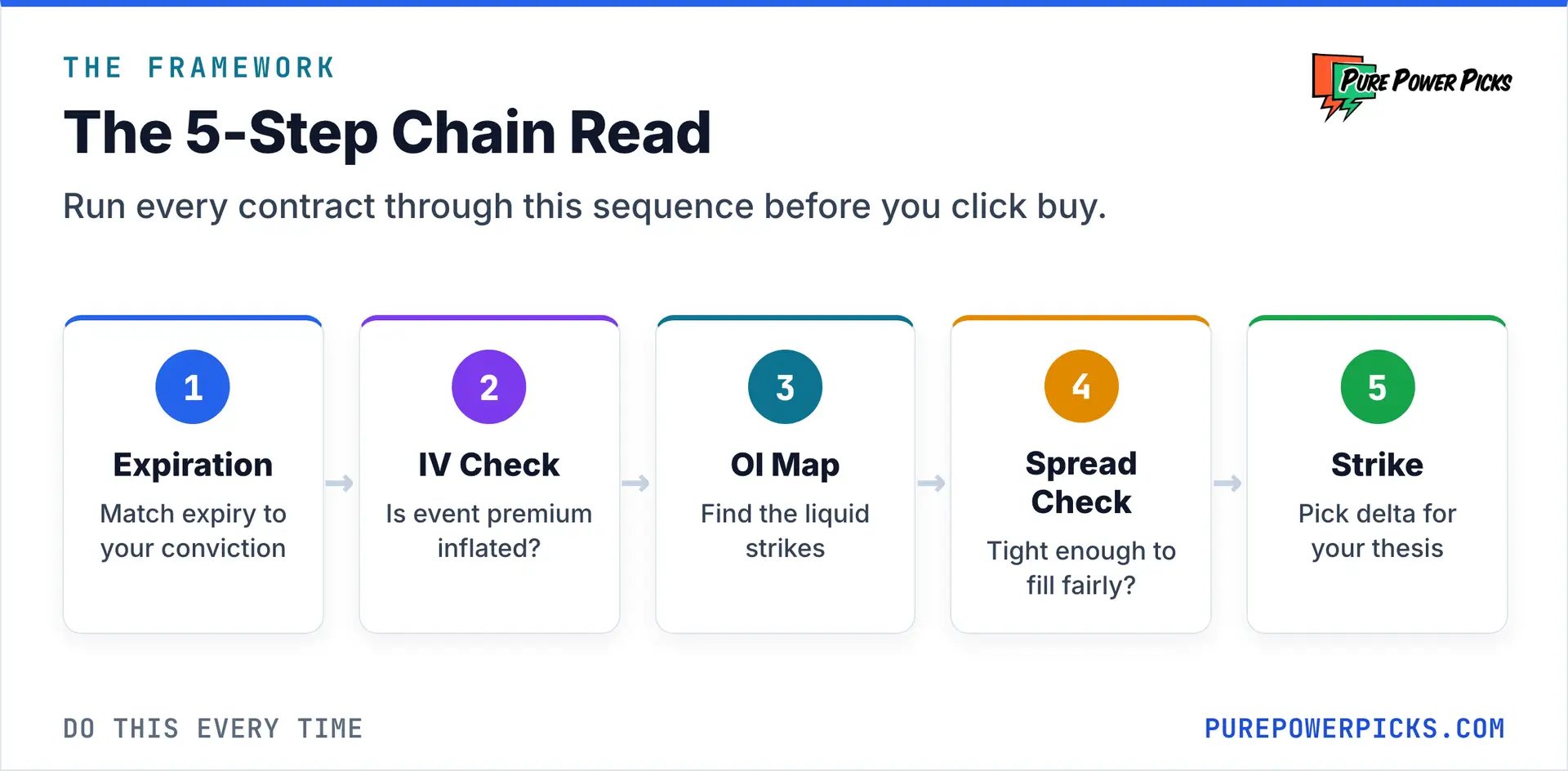
You read it in this order: expiration first, IV check second, OI map third, spread check fourth, then strike selection. That sequence keeps you out of trash contracts and forces you to confirm liquidity before pricing.
Major economic releases like the monthly CPI inflation print land on the calendar well in advance per the BLS release schedule. The SPY weekly options expiring closest to the event carry the most concentrated event premium. Let’s walk through how to read that chain like a professional.
A Hypothetical Walkthrough: SPY Weeklies Into an Event
Let’s walk through a hypothetical example. Assume SPY is trading around $605 the morning of a major print. You pull up the nearest weekly-expiry chain, and here’s what you’d look for.
Step 1, Expiration. You pick the nearest weekly, a few days to expiry. This is event-week premium, which means high theta decay and high IV crush risk. To learn how this timeframe behaves, see weekly vs monthly options.
Step 2, IV check. The at-the-money $605 call shows an IV of, hypothetically, 22%, versus a 30-day average of 14%. That gap tells you the market is pricing in roughly an 8-point implied move for the week. You’re paying for that expectation up front.
Step 3, OI map. You scan strikes from $595 to $615. Open interest clusters at $600, $605, and $610. The $600 put shows 45,000 OI, the $605 call shows 38,000 OI, and the $610 call shows 22,000 OI. Those are your liquid lanes.
Step 4, Spread check. The $605 call shows a bid of $2.40 and an ask of $2.43. A three-cent spread on a $2.40 contract is excellent. Compare that to the $620 call showing a bid of $0.18 and ask of $0.28, which is a 55% spread relative to the bid. That’s a trap.
Step 5, Strike selection. If you have a directional thesis, you weigh delta. The $605 call shows a delta of 0.52, the $610 call shows 0.30. Higher delta costs more but moves more dollar-for-dollar. The framework for this decision is in picking the right strike.
Buying premium minutes before a scheduled release is the fastest way to learn what IV crush feels like. Even if the market moves in your direction, the volatility collapse can erase your premium. Either trade after the dust settles or use defined-risk structures.
The macro context matters too. CPI feeds directly into Fed expectations, and a hot print reignites the rate-cut debate. Our piece on how Fed policy moves markets connects the dots between the data, the curve, and equity volatility. For real-time macro context, the FRED CPI series is the single best free data source.
If you’re trading an event same-day, you’re effectively in a 0DTE options strategy with massive gamma and theta exposure. Read that guide first, and tighten your risk parameters accordingly. The general framework for trading scheduled macro events is also covered in our guide to trading macro event days.
Frequently Asked Questions
What does a wide bid-ask spread mean on the options chain?
A wide bid-ask spread means low liquidity and immediate slippage. If the bid is $1.00 and the ask is $1.30, you’d buy at $1.30 and could only sell at $1.00 the next second, an instant 23% loss. Stick to strikes where the spread is under 5% of the contract price for active tickers like SPY.
Why does implied volatility drop after a scheduled event?
Implied volatility prices in uncertainty. Before the print, no one knows the number, so IV is elevated. Once the data is public, the uncertainty disappears and IV collapses, even if the market moves significantly. This is IV crush, and it’s the main reason naked long-premium trades into events are dangerous.
Is open interest or volume more important for picking a strike?
Open interest matters more for liquidity confirmation because it represents real, standing positioning. Volume confirms today’s activity and can flag unusual flow, but high volume on a low-OI strike can be misleading. Use both: high OI for safety, high volume for signal.
Can I trade options without understanding the Greeks?
Technically yes, but you’ll be flying blind on event days. Delta tells you how much your contract moves per $1 of underlying, theta tells you daily decay, and vega tells you IV exposure. On an event day, all three are actively working for or against you in real time.
What’s the safest expiration to pick for an event-day trade?
Safer doesn’t exist on event days, but longer-dated contracts (two to four weeks out) suffer less from IV crush than same-day or weekly expiries. You sacrifice gamma sensitivity for time cushion. Match the expiration to your conviction and your risk tolerance, not the cheapest premium.
Putting It All Together
Knowing how to read an options chain turns a wall of numbers into a tactical map. Strikes, bid-ask, volume, open interest, IV, and the Greeks each answer a different question, and on a high-volatility event day, getting those answers right is the difference between trading the move and being trapped in an illiquid contract while the tape rips without you.
The chain is just data. What separates traders who consistently improve from those who burn accounts is the framework they apply to that data. Build the habit of running the same five-step read every single time, expiration, IV, OI, spread, strike, and you’ll stop guessing. For the next step, our guide on finding options to trade connects chain reading to actual setup selection.
A step-by-step field guide to reading chains, sizing trades, and building a repeatable process, free. Skip the expensive lessons the market charges beginners.
Nvidia Options Trading: 5 Critical Mistakes to Avoid After Earnings →Pre-Market & After-Hours Trading →Covered Call Strategy: Profit from Nvidia’s Post-Earnings Drop →Implied Volatility Explained: Trading the Iran War Market Shock →
Share

The PPP Team brings decades of combined experience from some of the most well-known companies in the trading industry. Founded in 2020, Pure Power Picks delivers options trading education, platform reviews, and trade alerts to help everyday traders develop real skills. Our content is strictly educational.
Hi George, the alert page columns on the tracker are all listed here: https://docs.purepowerpicks.com/tracker/the-alerts-table
If you referring to something else, please let me know.
Thanks@
What do the columns on the Alert Page represent…???