


0DTE Options Strategy: How to Trade Same-Day Expiries Safely
Share


The 0DTE options strategy works when you treat same-day expiries as short-duration directional bets or premium-selling plays with strict position sizing, hard stop losses, and a deep respect for gamma risk. To trade 0DTE safely, you risk no more than 1-2% of your account per trade, you define your exit before entry, you avoid holding through the final 30 minutes unless you’re running a defined-risk spread, and you size down dramatically during high-volatility events like the current Brent crude spike above $103 and the VIX surge tied to Iran headlines. 0DTE is not a lottery ticket. It’s a precision tool that punishes sloppy execution and rewards traders who understand how gamma, theta, and implied volatility collide on expiration day.
0DTE options carry the highest gamma exposure of any contract on the board, which means small underlying moves create violent P&L swings. Trade them with defined risk, micro position sizing, and a written plan, or don’t trade them at all.
What You’ll Learn
- Why 0DTE volume exploded in 2026 and what’s driving the current surge
- The three core 0DTE strategies and when to deploy each one
- How to trade 0DTE around geopolitical catalysts like the Iran oil shock
- Position sizing rules and the gamma trap that wipes out beginners
- The 2026 regulatory landscape and what the SEC is watching
What Are 0DTE Options and Why Did Volume Explode in 2026?
0DTE options are contracts that expire the same trading day you buy or sell them. They’ve gone from a niche product to roughly half of all SPX options volume because every trading day now has a same-day expiry on major indexes, ETFs, and a growing list of single names.

The 2026 surge has three drivers. First, the CBOE expanded daily expirations across SPX, XSP, QQQ, and SPY, giving retail traders cheap, liquid contracts every session. Second, brokers eliminated commissions on options, making rapid-fire 0DTE scalping economically viable for small accounts. Third, the current geopolitical volatility, with Brent crude above $103 on Iran headlines and VIX spiking, has flooded the market with traders chasing same-day moves.
An options contract that expires at the close of the current trading session. Because there’s no time left, gamma is at its absolute peak and theta decay is happening by the minute, not the day.
You can read more about the regulatory framework around listed options at the Options Clearing Corporation, which clears every U.S. listed options contract including 0DTE.
What Are the Three Core 0DTE Options Strategies?
The three core 0DTE options strategies are directional long calls or puts, credit spreads, and iron condors. Each one expresses a different view: directionals bet on movement, credit spreads bet on a direction holding, and iron condors bet on the underlying staying inside a range until the close.

1. Directional Long Calls and Puts

You buy a call or put when you have a high-conviction read on the next 15 to 60 minutes. This is the highest-risk, highest-reward 0DTE play. You’re paying pure premium against a clock that’s ticking by the second.
Strike selection matters more here than on any other timeframe. Slightly out-of-the-money strikes give you the best gamma-to-cost ratio. Going too far OTM means you need a miracle move; going deep ITM means you’re paying for intrinsic value that vanishes if you’re wrong. Our guide on picking the right strike price walks through the exact framework.
2. Credit Spreads (Bull Put / Bear Call)

Credit spreads let you collect premium while defining your maximum loss. You sell a put spread below price if you’re bullish, or a call spread above price if you’re bearish. Your max profit is the credit collected; your max loss is the width of the spread minus that credit.
This is the strategy professionals lean on for 0DTE because it lets theta work for you instead of against you. You don’t need a big move. You just need price to stay on your side of the short strike.
3. Iron Condors
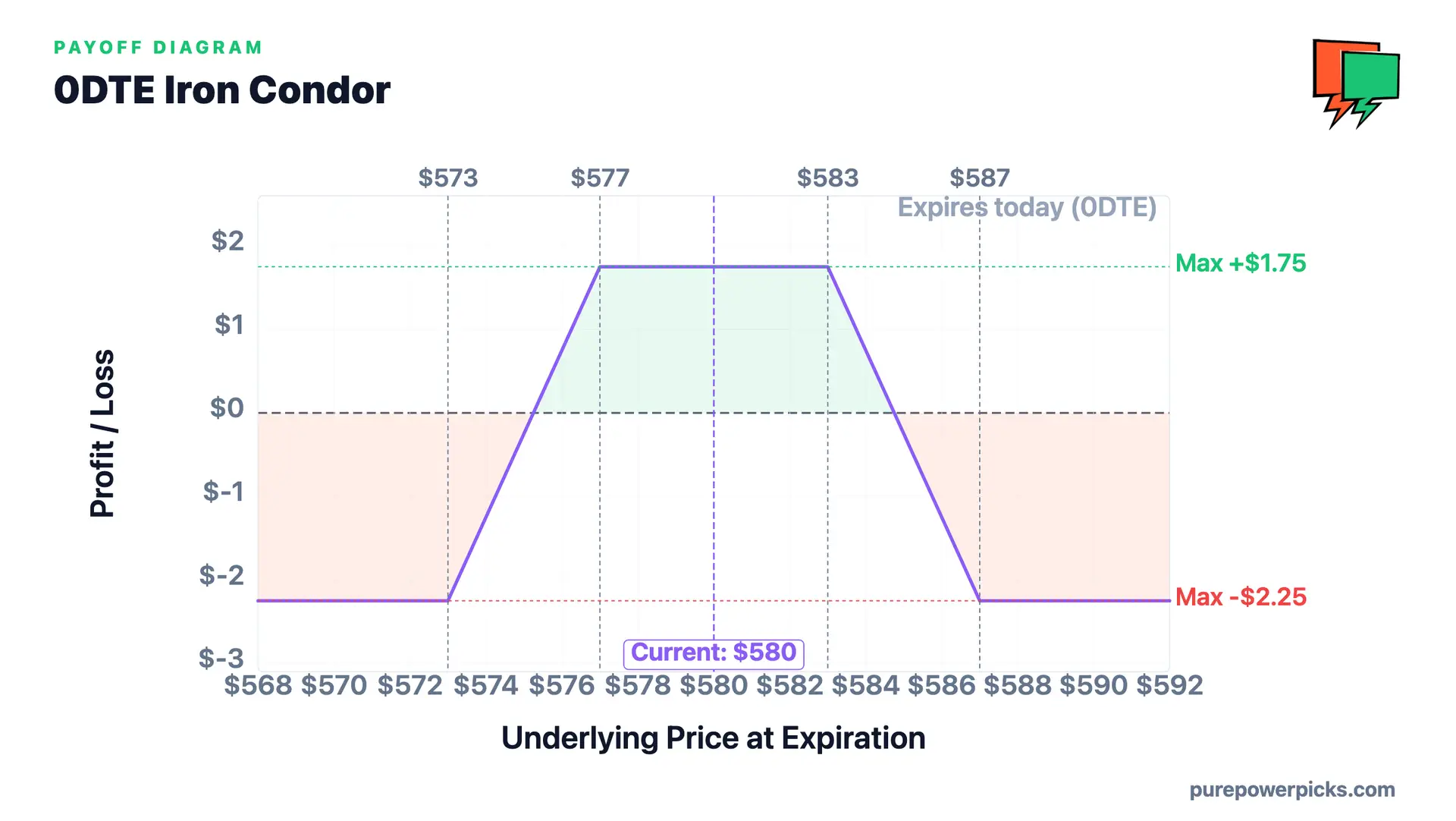
An iron condor combines a bull put spread and a bear call spread. You profit if the underlying stays between your two short strikes through the close. It’s a range-bound bet, and 0DTE iron condors can pay handsomely when implied volatility is elevated but actual movement stalls.
The catch: one violent move in either direction blows through your wing. For a deeper breakdown, our iron condor strategy guide covers strike placement, profit zones, and when to roll versus close.
0DTE Strategy Comparison
| Strategy | Best Conditions | Max Loss | Skill Level |
|---|---|---|---|
| Long Call/Put | High-conviction breakout | 100% of premium | Beginner+ |
| Credit Spread | Trending with support/resistance | Spread width minus credit | Intermediate |
| Iron Condor | Range-bound, high IV | Wider wing minus credit | Advanced |
How Do You Trade 0DTE Around Geopolitical Catalysts?
You trade 0DTE around geopolitical catalysts by waiting for the initial volatility spike to peak, then fading the overreaction with defined-risk spreads. You do not chase the first move. You let implied volatility expand, then sell premium back into it as the market digests the headline.

Right now, Brent crude is sitting above $103 on the Iran shock and VIX is elevated. That’s the exact environment where 0DTE traders get destroyed by chasing oil-related tickers with long calls 20 minutes after the news drops. By the time you’ve entered, the move is already priced in and IV is at the top of its range.
When a geopolitical headline hits, wait 15 to 30 minutes for the initial spike to digest. Then look for credit spreads on the opposite side of the move. The IV crush plus the fading gamma works in your favor instead of against you.
The Iran-driven oil spike is a textbook case for energy-sector 0DTE setups. Our 0DTE strategy for energy volatility guide breaks down how to approach USO, XLE, and oil futures-linked tickers when crude moves like this. You should also review implied volatility explained for the IV mechanics specific to this current shock.
For Fed-driven catalysts, the playbook is different. FOMC days create sharp two-way moves around 2 PM ET, and our fed day options trading guide covers the specific timing windows that matter.
Understanding 0DTE mechanics is one thing. Watching them play out in a structured trade plan is how you actually internalize the skill.
Pure Power Picks delivers detailed trade plans with key levels, risk zones, and the reasoning behind every setup so you learn to think like a planner, not a gambler.
How Do You Size Positions and Manage Gamma Risk on 0DTE?
You size 0DTE positions at 1-2% of your total account per trade, full stop. Gamma exposure on expiration day is exponentially higher than on any other contract, which means a position that “feels small” can produce a catastrophic loss in 90 seconds if you’re wrong.

The Gamma Trap Beginners Miss
Gamma measures how fast your delta changes. On a 0DTE contract that’s near the money in the final hour, gamma is at its mathematical peak. A $1 move in the underlying can swing your option’s value by 50%, 80%, or more.
This cuts both ways. It’s why 0DTE long calls can 5x in minutes. It’s also why credit spread sellers get steamrolled if price punches through their short strike with 30 minutes to expiration. Read our deep dive on option greeks that matter to internalize this before you trade.
Selling naked 0DTE options without a defined-risk structure is one of the fastest ways to blow up an account. A single gap or fast move through your short strike in the last hour can produce losses several times your collected premium. Always trade spreads with defined wings.
Stop Loss Rules That Actually Work
For long 0DTE calls and puts, set a mental stop at 30-40% of the premium paid. If you bought a contract for $1.00, you exit at $0.60 to $0.70. You do not “give it room.” There is no room on expiration day.
For credit spreads, exit if the spread doubles against you. If you collected $0.50, you close when the spread is worth $1.00. This locks in a known loss before gamma turns the position into a max-loss scenario.
Once a directional trade is up 50-100%, consider using trailing stops to lock in gains while leaving room for further upside.
Pros and Cons of 0DTE Trading
- No overnight risk or gap exposure
- Cheap premium relative to weekly contracts
- Fast feedback on trade ideas
- Theta works for premium sellers in real time
- Liquidity on SPX, SPY, QQQ is excellent
- Extreme gamma exposure near the money
- Theta decay accelerates by the minute
- Emotional intensity destroys discipline
- Slippage on wide spreads can crush edge
- One bad trade can erase a week of gains
Your psychology is the variable that breaks first. Our guide on psychology mistakes in volatile markets covers exactly what happens to your brain when a 0DTE trade goes 80% against you in three minutes.
What Is a Hypothetical 0DTE Credit Spread Trade?
Let’s walk through a hypothetical example using SPY 0DTE on a day when the market is grinding higher after a morning dip.
Assume SPY is trading at $580 around 11 AM ET, with the 5-minute chart showing a clean reclaim of the morning low and rising volume. You decide a bull put spread is appropriate because you expect SPY to hold above $578 into the close.
- Setup: Sell the $578 put, buy the $577 put, same-day expiry
- Credit collected: $0.30 per contract ($30 per spread)
- Max loss: $1.00 width minus $0.30 credit = $0.70 ($70 per spread)
- Position size: On a $20,000 account, 1% risk = $200, so you trade 2-3 spreads
- Exit plan: Close at 50% profit ($0.15 cost to buy back) or stop out if the spread doubles to $0.60
If SPY holds above $578 into the close, both legs expire worthless and you keep the credit. If SPY breaks below $578 with momentum, you close early at your stop. This is hypothetical and for education only, but it illustrates the structure that keeps you alive when gamma turns against you.
What Is the 2026 Regulatory Outlook for 0DTE Options?
The 2026 regulatory outlook for 0DTE options centers on SEC scrutiny of retail risk, potential margin rule tightening, and broker-level position limits. Nothing has been formally proposed yet, but the conversation is active and you should pay attention.
The SEC has flagged concerns about retail traders using 0DTE without understanding the risk profile, particularly around credit spread assignment and end-of-day liquidity. FINRA has also issued investor alerts about same-day expirations.
Brokers have already responded. Several major platforms now require additional approvals for selling 0DTE spreads, and some have raised margin requirements on uncovered short positions in the final hour of trading. Expect more of this through 2026.
What could change? Three things to watch:
- Mandatory disclosures: Plain-language risk warnings before placing 0DTE orders
- Position limits: Caps on the number of 0DTE contracts per account based on net liquidity
- Cutoff times: Possible restrictions on opening new 0DTE positions in the last 30 minutes
None of this changes the strategy. It just means you need to stay current on your broker’s rules. The CBOE publishes regular updates on listed product rules and is the primary source for any changes to SPX and XSP expiration structures.
For broader context on how same-day expiries compare to longer-dated contracts, our weekly vs monthly options breakdown is worth reading. And if you’ve taken a hit on a 0DTE trade recently, the recovering from a big loss guide covers both the mental and capital-management side. Solid options risk management rules remain the foundation under everything.
Frequently Asked Questions
Are 0DTE options good for beginners?
0DTE options are not ideal for beginners. The gamma exposure and emotional intensity create conditions where small mistakes become large losses fast. If you’re newer to options, build skills on weekly and monthly contracts first, master the greeks, and only graduate to 0DTE once you can consistently execute a plan without deviation.
How much money do I need to trade 0DTE options?
You can technically start with a few hundred dollars on SPY 0DTE contracts, but realistically you need at least $5,000 to $10,000 to size properly using the 1-2% rule. Anything smaller forces you into oversized positions where one bad trade ends the account. Defined-risk spreads also require enough capital to absorb the max loss without breaking your risk plan.
What’s the best time of day to trade 0DTE?
The best windows are typically 10:00 to 11:30 AM ET, after the opening volatility settles, and 1:30 to 3:00 PM ET, when intraday trends often resolve. Avoid the first 15 minutes unless you’re scalping the open with a specific plan, and be cautious in the final 30 minutes when gamma is at its most violent.
Can you make a living trading 0DTE options?
Some traders do, but they’re a small minority and they treat it like a full-time job with strict systems. Most retail traders who try lose money over time because the variance is brutal and discipline tends to break.
Our trade plans break down real setups with key levels, risk zones, and the reasoning behind every idea — the skill base that makes fast strategies survivable.
Explore more trading guides to keep sharpening your edge.
Disclaimer: Pure Power Picks is not a licensed financial advisor. All content is for educational and informational purposes only and should not be considered investment advice. Options trading involves substantial risk of loss and is not suitable for all investors. Past performance does not guarantee future results.
Should I Trade Options With $1,000? Honest 2026 Guide →Credit Spread Strategy for Oil Volatility Trading →What Is the Death Cross? How To Use It in Stock and Options Trading →How to Trade Options on Earnings: Oracle’s AI Surge Strategy →
Share

The PPP Team is the research and editorial team behind Pure Power Picks. We trade stocks and options and publish the work as we do it, with every alert tracked in public. Publishing since 2020. How we research and correct our work is written out in our editorial standards. Our content is strictly educational, never advice.
Hi Randy, we sure do! Come check us out on a 7 day free trial https://purepowerpicks.com/signup/options-trade-alerts-monthly/
We even have a Discord group as part of the membership for more active trading.
Do you give trades