


Implied Volatility Explained: Trading the Iran War Market Shock
Share


Implied volatility is the market’s expectation of future price movement built into options prices — and during geopolitical crises like the Iran war, understanding IV becomes critical for options traders. When fear spikes, implied volatility surges across the board, making options more expensive to buy but creating opportunities for sellers. The key is recognizing when IV is elevated versus normal levels, then positioning accordingly before the inevitable volatility crush occurs. Right now, with markets questioning whether traditional volatility indicators are accurately pricing war risk, traders who understand IV mechanics have a significant edge over those flying blind.
Geopolitical events create temporary IV spikes that eventually collapse back to normal levels. Smart traders buy when IV is low and sell when it’s elevated — or position for the inevitable volatility crush after crisis headlines fade.
What You’ll Learn
- How geopolitical events like the Iran crisis affect implied volatility levels
- Why the VIX might be “lying” about true market risk during wartime
- How to read IV rank and percentile during market crises
- Trading strategies for elevated IV versus volatility crush scenarios
- Risk management techniques when volatility is unpredictable
- Timing entries and exits around geopolitical news cycles
What Is Implied Volatility and Why Is It Spiking Right Now?
Implied volatility represents the market’s collective guess about how much a stock will move over a specific time period. Unlike historical volatility (which looks backward), IV looks forward — and right now, it’s pricing in significant uncertainty around the Iran conflict.
The market’s expectation of future price movement embedded in options prices. Higher IV means options are more expensive; lower IV means they’re cheaper.
When geopolitical tensions escalate, IV spikes because traders demand higher premiums to sell options. They’re essentially saying: “If you want me to take on risk during a war, you’re going to pay me more for it.” This creates a feedback loop where fear drives up option prices, which drives up IV readings.
The Iran situation is particularly interesting because it combines several volatility catalysts: energy supply concerns, regional stability questions, and potential U.S. military involvement. Each headline sends ripples through options markets, especially in energy, defense, and broad market ETFs.
For a deeper dive into how IV works mechanically, check out our guide on implied volatility basics — it covers the mathematical relationship between IV and options pricing.
How Do Geopolitical Events Like the Iran War Affect IV Levels?
Geopolitical crises create asymmetric risk scenarios that traditional volatility models struggle to price accurately. The Iran conflict exemplifies this challenge — markets must price in low-probability, high-impact outcomes like oil supply disruptions or broader regional conflict.
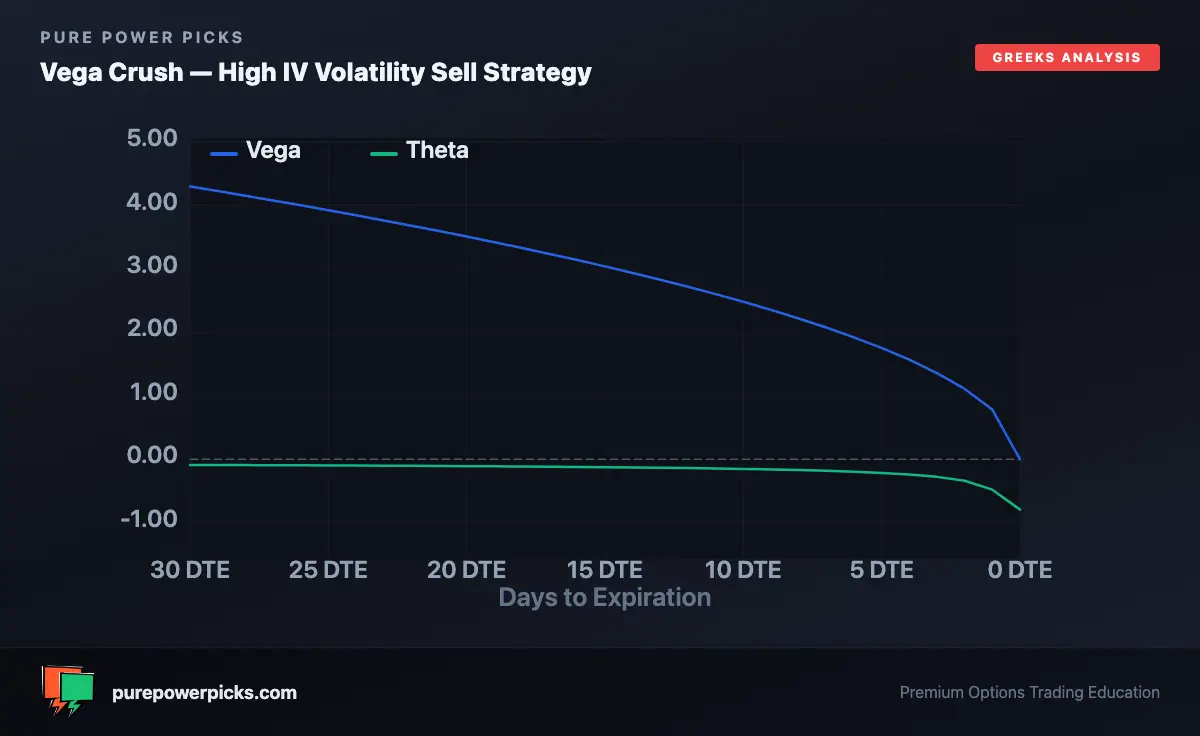
Here’s what typically happens during geopolitical volatility spikes:
Phase 1: Initial Shock (Days 1-2)
IV explodes across all sectors as traders scramble for protection. Energy stocks see the biggest spikes, but even unrelated sectors get caught in the fear trade. Options premiums can double overnight.
Phase 2: Sector Rotation (Days 3-5)
Smart money starts differentiating. Energy and defense stocks maintain high IV while tech and consumer discretionary begin to normalize. This is where sector-specific opportunities emerge.
Phase 3: Normalization or Escalation (Week 2+)
Either the situation stabilizes and IV crashes back to normal levels, or it escalates and we enter a new volatility regime. Most geopolitical events follow the normalization path.
Energy sector IV typically spikes 40-60% during Middle East conflicts, while broad market IV increases 20-30%. Trade the sectors most directly impacted for better risk-reward ratios.
The CBOE Volatility Index (VIX) provides a broad market IV reading, but sector-specific volatility often tells a more nuanced story. During the Iran crisis, oil volatility (OVX) has been more predictive of actual price moves than the VIX.
Why Might the VIX Be “Lying” About True Risk Levels?
The VIX measures S&P 500 implied volatility, but it might be underestimating true geopolitical risk for several structural reasons. During the Iran conflict, we’re seeing disconnects between VIX readings and actual market stress in specific sectors.
First, the VIX is heavily weighted toward large-cap tech stocks that have limited direct exposure to Middle East conflicts. Apple, Microsoft, and Google don’t immediately suffer from Iranian tensions, so their options don’t price in significant geopolitical premiums.
Second, modern portfolio theory assumes normal distributions of returns, but geopolitical events create fat-tail risks that standard models underestimate. A VIX reading of 25 might feel “normal,” but it could be missing tail risks that would justify a 35+ reading.
Third, algorithmic trading and systematic volatility strategies have changed how the VIX behaves. These systems often sell volatility mechanically, suppressing VIX spikes that would have occurred in previous decades.
| Volatility Index | Current Level | Historical Average | Crisis Premium |
|---|---|---|---|
| VIX (S&P 500) | ~28 | ~19 | +47% |
| OVX (Oil) | ~45 | ~28 | +61% |
| GVZ (Gold) | ~22 | ~16 | +38% |
Notice how oil volatility shows a much larger crisis premium than broad market volatility. This suggests the VIX might be missing sector-specific risks that could eventually spill over into broader markets.
Understanding these IV dynamics is just the beginning — applying them to real trades requires practice and pattern recognition.
Our trade alerts break down exactly how we analyze IV levels, identify opportunities, and manage risk when volatility is elevated or collapsing.
How Do You Read IV Rank During Market Crises?
IV rank compares current implied volatility to its range over the past year, expressed as a percentile. During market crises, IV rank becomes your primary tool for determining whether options are expensive or cheap relative to recent history.
An IV rank of 80 means current implied volatility is higher than 80% of readings over the past 252 trading days. During the Iran conflict, many energy stocks are showing IV ranks above 90, indicating extreme fear pricing.
Here’s how to interpret IV rank during geopolitical events:
IV Rank 0-20: Low Volatility
Options are cheap. This is prime time for buying calls or puts if you expect movement. During crises, you rarely see these levels except in unrelated sectors.
IV Rank 20-50: Normal Range
Standard volatility pricing. Options aren’t particularly cheap or expensive. Most stocks outside the crisis sectors fall here.
IV Rank 50-80: Elevated
Options are getting expensive. Consider selling strategies or waiting for better entry points. Many broad market ETFs sit in this range during geopolitical stress.
IV Rank 80-100: Extreme
Options are very expensive. Prime territory for selling volatility, but be careful — IV can stay extreme longer than expected during real crises.
High IV rank doesn’t guarantee volatility will drop immediately. During genuine crises, IV can remain elevated for weeks. Always use proper position sizing and risk management.
The Options Industry Council provides excellent resources on volatility analysis, including tools for calculating IV rank across different timeframes.
What Trading Strategies Work When IV Is Elevated?
Elevated implied volatility creates specific opportunities for options traders who understand how to position for eventual volatility contraction. When IV rank exceeds 70-80, the probabilities favor selling volatility rather than buying it.
Here are the most effective strategies during high IV environments:
Cash-Secured Puts
Sell puts on stocks you wouldn’t mind owning at lower prices. The elevated IV gives you higher premiums, improving your risk-reward. If assigned, you own the stock at a discount plus the premium collected.
Covered Calls
If you own stocks that have spiked on crisis news, sell calls against your position. The high IV means you’re getting paid well for potentially selling your shares at higher prices.
Credit Spreads
Our guide on credit spread strategies covers this in detail, but the basic idea is selling expensive options and buying cheaper ones for protection.
Let’s walk through a hypothetical example using energy stocks during the Iran crisis:
Hypothetical Scenario: XLE (Energy ETF) is trading at $85 with IV rank at 85. You sell a $80 put expiring in 30 days for $3.50. Your breakeven is $76.50 ($80 – $3.50). If XLE stays above $80, you keep the full premium. If it drops below $76.50, you start losing money.
The key insight: that $3.50 premium is inflated due to crisis fears. In normal markets, the same put might only fetch $2.00. You’re getting paid extra for the fear premium.
- Higher premiums for selling strategies
- Better risk-reward ratios
- Mean reversion probability
- Multiple profit scenarios
- IV can stay elevated longer than expected
- Underlying moves can be extreme
- Assignment risk on short options
- Requires active management
What About Trading Strategies When IV Crashes?
Volatility crashes happen fast and without warning. One day Iran tensions are escalating, the next day diplomatic talks begin and IV collapses 30-40% overnight. This creates different opportunities for prepared traders.
When IV crashes, options become cheap again — especially longer-dated ones. This is when you shift from selling volatility to buying it, positioning for the next move or volatility cycle.
Long Calls and Puts
Buy directional options when IV drops to low levels. The key is having a thesis about which direction the stock will move post-crisis. Our strike price selection guide helps with positioning.
Straddles and Strangles
When you expect big moves but aren’t sure of direction, buy both calls and puts. This works best when IV is low but you suspect volatility will return.
Calendar Spreads
Sell short-term options and buy longer-term ones. This profits from time decay while maintaining exposure to future volatility increases.
The timing challenge is real. IV crashes often coincide with strong directional moves, so you’re fighting both volatility contraction and potentially adverse price action. This is where weekly vs monthly options selection becomes crucial.
Hypothetical Post-Crisis Scenario: After diplomatic progress, XLE drops from IV rank 85 to IV rank 25 in two days. The same $80 put that was worth $3.50 is now worth $1.80, even though XLE only moved from $85 to $83. That’s a 49% loss from volatility crush alone.
This is why timing matters enormously in volatility trading. You want to be selling when IV is high and buying when it’s low — but the transitions happen quickly during geopolitical events.
How Do You Manage Risk When Volatility Is Unpredictable?
Geopolitical volatility is inherently unpredictable because it depends on human decisions, diplomatic outcomes, and military actions that don’t follow technical patterns. Your risk management must account for this uncertainty.
Position sizing becomes critical. During the Iran crisis, you should risk smaller amounts per trade because outcomes are more binary. A diplomatic breakthrough could crash volatility overnight, while military escalation could spike it to extreme levels.
Here’s a practical risk framework for volatile periods:
Reduce Position Sizes by 30-50%
If you normally risk 2% per trade, drop to 1-1.5% during geopolitical uncertainty. The higher volatility means your normal position size could create outsized losses.
Diversify Across Time Frames
Don’t put all positions in the same expiration cycle. Mix 0DTE options strategies for quick profits with longer-term positions for sustained moves.
Set Mechanical Stop Losses
Emotions run high during crises. Decide your exit rules before entering trades. A common approach: close any position showing a 50% loss, regardless of your original thesis.
Monitor News Cycles
Geopolitical events often follow predictable news patterns. Initial shock, analysis phase, diplomatic responses, then either escalation or resolution. Position your trades around these cycles.
The SEC’s options education materials emphasize that risk management becomes even more important during volatile periods. Their guidelines on position sizing and diversification apply especially during geopolitical uncertainty.
For comprehensive risk management techniques, our risk management guide covers 12 rules that become essential during volatile markets like we’re seeing with the Iran situation.
How Do You Time Entries and Exits Around Geopolitical News?
News-driven volatility follows predictable patterns, even when the news itself is unpredictable. Understanding these patterns helps you time entries and exits more effectively during events like the Iran crisis.
The best entry points often come during the initial overreaction phase. When breaking news hits, algorithms and emotional traders create temporary mispricings that smart money can exploit. But you need to move fast — these opportunities last minutes, not hours.
Here’s the typical news cycle pattern:
T+0 to T+30 minutes: Algorithmic Response
Automated systems react to headlines, creating sharp moves that might not reflect fundamental reality. This is often the worst time to enter unless you’re very experienced.
T+30 minutes to T+2 hours: Human Analysis
Professional traders start analyzing the actual implications. Prices begin to reflect more rational assessments. Better entry opportunities emerge.
T+2 hours to T+1 day: Institutional Response
Large institutions adjust positions based on thorough analysis. This often creates the most sustainable moves and best entry points for retail traders.
T+1 day to T+1 week: Market Digestion
The market fully processes the implications. IV begins normalizing unless new developments occur. Exit opportunities for volatility trades emerge.
Set alerts for IV rank changes, not just price moves. When a stock’s IV rank jumps from 30 to 80 in one day, that’s often a better signal than the underlying price action alone.
The psychology aspect matters enormously. Our trading psychology guide covers how to stay disciplined when headlines are screaming and markets are swinging wildly.
Frequently Asked Questions
How high can implied volatility go during geopolitical crises?
IV can spike 50-100% or more during major geopolitical events. During the 2020 oil crisis, some energy stocks saw IV increase by 200%. However, these extreme levels rarely last more than a few days to weeks.
Should I buy or sell options when IV is at extreme levels?
Generally, you should sell options when IV is extremely high (80+ percentile) and buy when it’s low (20- percentile). However, during genuine crises, high IV can persist longer than normal, so use proper risk management regardless of your strategy.
How quickly does implied volatility collapse after geopolitical events?
Volatility crashes can happen within hours of positive news. A 30-50% IV drop overnight is common when tensions ease unexpectedly. This is why holding short volatility positions through news events is extremely risky.
Is the VIX a good indicator during geopolitical crises?
The VIX provides a broad market view but might miss sector-specific risks. During Middle East conflicts, oil volatility (OVX) and gold volatility (GVZ) often provide better insights into actual market stress levels.
What’s the biggest risk when trading geopolitical volatility?
The biggest risk is that geopolitical events can escalate unpredictably, causing IV to spike even higher when you expect it to fall. Always use position sizing that allows you to survive being wrong about timing or direction.
See how we analyze implied volatility levels, identify high-probability setups, and manage risk through detailed trade plans that explain our reasoning behind every alert.
Explore more trading guides to keep sharpening your edge.
Disclaimer: Pure Power Picks is not a licensed financial advisor. All content is for educational and informational purposes only and should not be considered investment advice. Options trading involves substantial risk of loss and is not suitable for all investors. Past performance does not guarantee future results.
Best Defense Stocks for Options Trading: Iran War Playbook 2026 →Trading Stock Market Earnings with Options: The Challenges and Strategies →Nvidia Options Trading: 5 Critical Mistakes to Avoid After Earnings →0DTE Options Strategy: Profit from AI Stock Volatility →
Share

The PPP Team is the research and editorial team behind Pure Power Picks. We trade stocks and options and publish the work as we do it, with every alert tracked in public. Publishing since 2020. How we research and correct our work is written out in our editorial standards. Our content is strictly educational, never advice.