

Market-On-Close Orders: Benefits and Drawbacks
A Market-On-Close (MOC) order is an instruction that tells your broker to fill your buy or sell as close to the official closing price of the trading day as possible. Instead of trying to time an entry mid-session, you hand execution over to the closing auction, where the exchange matches a massive pool of buyers and sellers at one clearing price. That is why big institutions like index funds, pension funds, and mutual funds lean on MOC orders when they need to move size without leaving footprints all over the tape. In this refreshed guide we will break down exactly how MOC orders work, when they help you, where they can hurt you, and how to think about them as a trader learning the mechanics of the market.
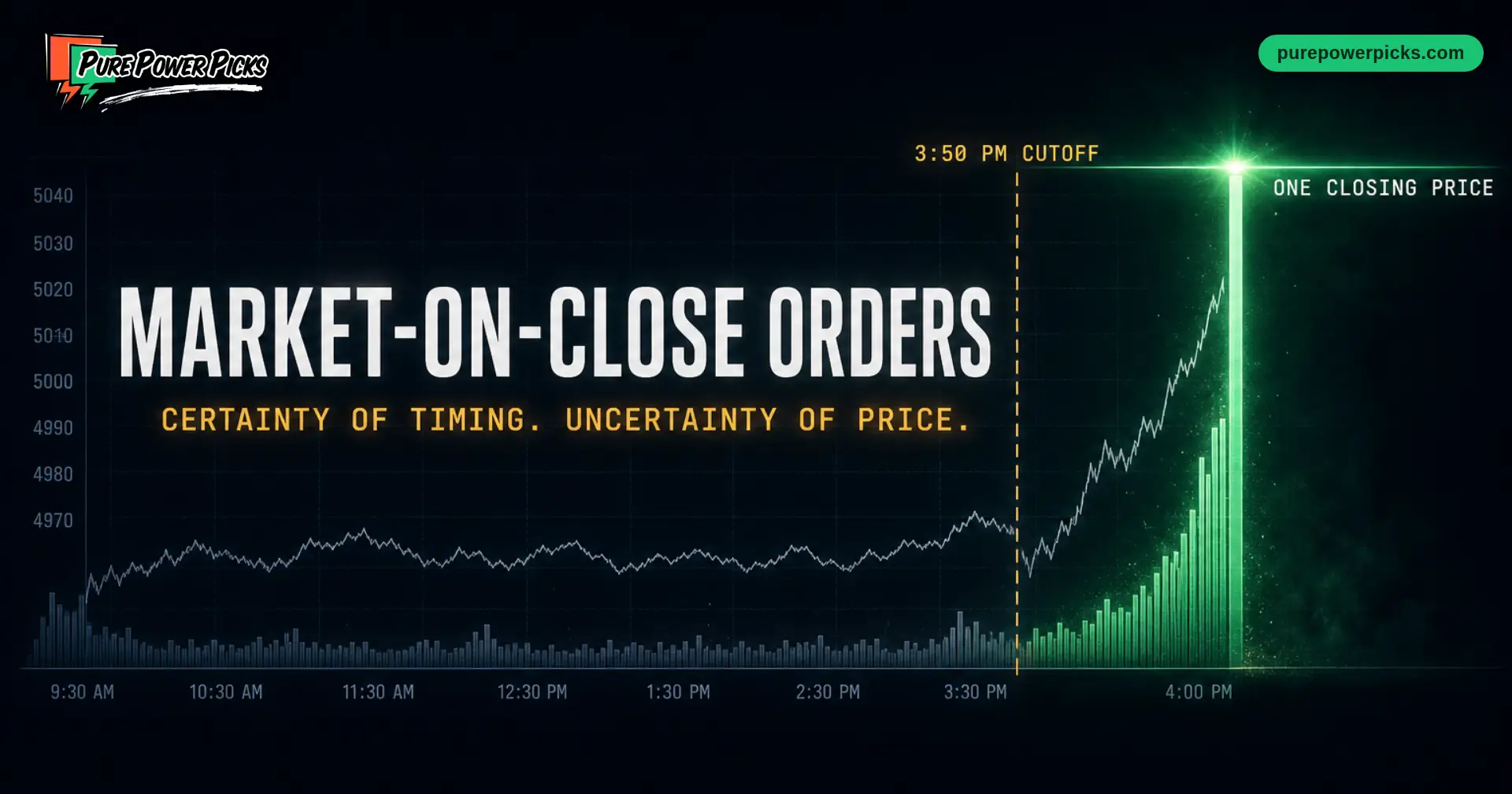
MOC orders trade certainty of timing for uncertainty of price. You are guaranteed to participate in the closing auction, but you are not guaranteed a specific fill price. That trade-off makes them powerful for institutions moving size and risky for retail traders who need precision.
| Order type | Market order executed at the closing auction |
| Typical users | Mutual funds, pension funds, index and ETF managers |
| Cutoff time (NYSE/Nasdaq) | Generally 3:50 PM ET, subject to exchange rules |
| Price control | None. You accept the official closing print |
| Main benefit | Price certainty at the close and deep auction liquidity |
| Main drawback | No control over the exact fill price |
What is a Market-On-Close order and how does it work?
A Market-On-Close order is a market order that is held back and released into the exchange’s closing auction so it fills at the day’s official closing price. You are not chasing a quote during the session. You are committing to participate in the single most liquid moment of the day.
Here is the mechanic. During regular hours, a standard market order fills against whatever is sitting on the book at that instant. An MOC order gets routed differently. The exchange collects all the MOC and closing-imbalance orders, matches them together in the closing auction, and prints one clearing price. That is the price you get, whether you like it or not. Traders who want more control over routing sometimes use DMA trading to send orders straight to the exchange book.
MOC orders sit inside the broader family of different order types you should know cold before you trade. If you understand how a limit order, a stop, and a market order behave, MOC becomes easy to place in context. It is a market order with a very specific timing rule attached. You can read the exchange’s own definition of the closing auction process on the NYSE trading info page for the operational details.
Closing auction: the end-of-day matching event where an exchange aggregates buy and sell interest, calculates a single equilibrium price, and prints the official close. MOC orders are guaranteed to participate as long as they are submitted before the cutoff.
What are the benefits of MOC trading?
The biggest upside of an MOC order is timing certainty with deep liquidity. You know your order will participate in the close, and the close is typically the highest-volume window of the day. Let’s walk through what that gets you.
Price certainty at the close. You are locked into the official closing price. For anyone benchmarking to the close, that is exactly what they want. No slippage games during the final minutes, just the print everyone else is measured against. That closing print also feeds the next day’s pivot points, which many traders use to map levels.
Efficient use of liquidity. Because the closing auction pools so much volume, large orders are far more likely to fill completely. Understanding trading volume essentials helps you see why the close is the friendliest place to move size.
Reduced market impact. Feeding a huge order through the book during the session pushes price against you. Routing it to the close lets a fund unload or accumulate without telegraphing the whole order to the market.

Portfolio rebalancing. Many funds rebalance to target weights using the closing price so their books match the marks they report. MOC orders make that clean.
Benchmark tracking. Index funds and ETFs live or die by how tightly they track their benchmark. Since index values are struck at the close, filling at the close keeps tracking error low. If you want to see how professionals think about execution discipline like this, our guide on how to trade like a professional connects the dots.
Before the close, watch the imbalance data on your level 1 and 2 data feed. A large buy imbalance can pressure the closing print higher, and a sell imbalance can drag it lower. Knowing the direction of the imbalance tells you where the auction may settle.
What are the drawbacks of MOC trading?

The core drawback is simple: you give up control of your price. Everything else flows from that.
No price control. You accept whatever the closing auction prints. If precision matters to your strategy, that lack of control is a real problem. Traders who need exact levels often prefer limit orders or protective stop loss orders instead.
Price risk near the bell. News, imbalances, and last-minute repositioning can swing the close away from where the stock traded moments earlier. The bid and ask spread can also widen into the auction on thinner names.
Missed cutoff windows. Miss the exchange deadline and your MOC order will not participate at all. That can leave you unfilled with no time to react. It is one of several common trading mistakes that come down to knowing your order rules.
Volatility on event days. Rebalance days, quad witching, and index reconstitution can turn the close into a chaotic print. Volume is enormous, but so is the potential for a violent swing. Even a mistyped size can cause damage, which is why understanding fat finger errors matters more when you are firing orders into the auction.
MOC orders are a market order at their core, which means no ceiling and no floor on your fill. On volatile or news-driven closes, the print can land well outside where you expected. If you cannot stomach an unknown fill price, an MOC order is the wrong tool.
How does MOC compare to other closing-related orders?
MOC is not the only way to interact with the close. The main sibling is the Limit-On-Close (LOC) order, which only fills if the closing price meets your limit. Here is how the common choices stack up.
For a deeper vocabulary refresh on these tools, our roundup of key trading terms is worth keeping open. Investopedia also maintains a clear breakdown of the market-on-close order definition if you want a second reference.
When should a trader actually use an MOC order?
Use an MOC order when your goal is to match the closing price and you value certainty of participation over control of price. That is a narrow but real use case.
Let’s walk through a hypothetical example to make it concrete. Suppose a hypothetical fund needs to buy 200,000 shares of a large-cap stock to match a new index weighting that resets at the close. Feeding that order through the book during the day could push the price up against them. Instead, they place an MOC order for the full size. In this hypothetical, the closing auction absorbs the order at the official close, and their book now matches the benchmark. This is illustrative only and is not a real trade or a claim about any outcome.
For most retail traders learning the ropes, MOC orders are less common. You will more often care about intraday setups, spreads, and timing your fills with tools like volume weighted average price. Still, knowing how the close works matters, especially as markets evolve toward 23-hour stock trading and extended pre-market and after-hours sessions. You can also review how auctions and order handling are regulated on the SEC order types resource.
Frequently Asked Questions
What time must an MOC order be submitted?
On the NYSE and Nasdaq, MOC orders generally must be entered by around 3:50 PM ET, though exact rules and modification cutoffs vary by exchange. Always confirm the current deadline with your broker, because missing it means your order will not participate in the close.
Can I cancel an MOC order once I place it?
You can typically cancel or modify an MOC order only up until the exchange cutoff time. After that window closes, the order is locked into the auction and cannot be pulled. Treat the cutoff as a hard commitment point.
Are MOC orders available for options?
MOC orders are primarily an equities and ETF tool tied to the stock closing auction. Options markets have their own closing procedures and are generally not handled the same way. If you trade options, focus on limit orders and spread control rather than expecting a clean MOC-style close.
Why do institutions favor MOC orders?
Institutions favor MOC orders because the close offers deep liquidity, a single benchmark price, and reduced market impact for large size. Funds that report and rebalance against the closing print get the cleanest match by trading in the auction itself.
Is an MOC order riskier than a regular market order?
In one sense yes, because you cannot see the final auction price before you commit, and closing prints can swing on imbalances or news. In another sense the deeper liquidity can reduce slippage on large orders. The right answer depends on whether you value participation certainty or price control more.
Understanding order mechanics like MOC is just the start. At Pure Power Picks we teach the frameworks, chart setups, and educational alerts that help you build real trading skill, step by step.
See Membership Options
The PPP Team is the research and editorial team behind Pure Power Picks. We trade stocks and options and publish the work as we do it, with every alert tracked in public. Publishing since 2020. How we research and correct our work is written out in our editorial standards. Our content is strictly educational, never advice.
Disclaimer: Pure Power Picks provides educational content only. We are not financial advisors, and nothing in this article is financial, investment, tax, or legal advice. All examples described are hypothetical and for illustration only. They do not represent real trades, real results, or any guarantee of performance. Trading stocks and options involves substantial risk of loss and is not suitable for every investor. Always do your own research and consider consulting a licensed professional before making any financial decision.