


How to Read Level 1 & 2 Data
Share
Published June 10, 2021 · Updated June 4, 2026 · 9 min read
Pull up any active trading platform and the screen fills with numbers, colors flashing on the bid and the ask. Most traders glance at it and tune it out. That is a mistake. Level 1 and Level 2 market data are a live feed of the order flow that moves price. Once you can read them, you are watching supply and demand fight it out in real time, often before the chart even reacts.
Key Readout
Level 1 shows you the best bid and ask, the NBBO. Level 2 shows you the full order book stacked behind those prices. Time and Sales shows you what actually filled. Level 1 is the price, Level 2 is the intent, and the tape is the truth.
2Quotes in Level 1
(best bid + ask)
10+Price Levels
Shown in Level 2
16+U.S. Equity
Exchanges
Real-TimeTime & Sales
Tape
What Is Level 1 Market Data?
Level 1 is the surface layer of market data. It shows the current best bid (the highest price a buyer is willing to pay), the current best ask (the lowest price a seller is willing to accept), the last traded price, and basic volume. Those two prices together are called the NBBO, the National Best Bid and Offer, the single tightest quote across every exchange.
Most retail brokers give you Level 1 for free. It is enough to place a trade, but nowhere near enough to read what is happening underneath the price. If you have never gone deep on this, brush up on bid and ask spreads first, because everything in Level 1 and Level 2 is built on that foundation.
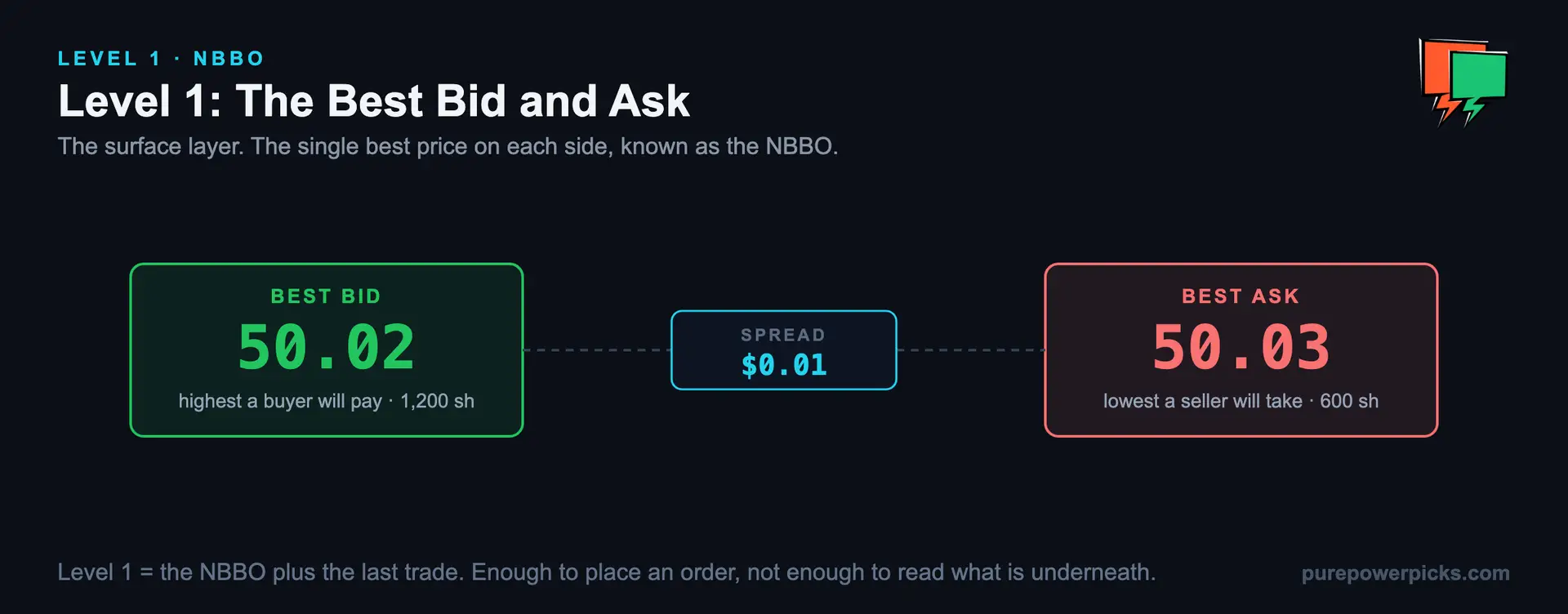
Definition · NBBO
The National Best Bid and Offer is the best available bid and the best available ask aggregated across all U.S. exchanges at a given moment. When your broker shows you a Level 1 quote, it is showing you the NBBO plus the last print.
Think of Level 1 as the marquee outside a movie theater. It tells you what is playing right now. It does not tell you how many seats are open, who is lined up to buy tickets, or whether the next showing is already sold out.

What Is Level 2 Market Data?
Level 2 is Level 1 with the curtain pulled back. Instead of just the best bid and ask, you see the entire order book: the stacks of resting orders at every price level, organized by size and by the exchange or market maker routing them. This is also called market depth or the DOM (depth of market).
A typical Level 2 window shows 10 or more price levels above and below the current market, with the size of orders sitting at each tier. That is the data professional day traders, scalpers, and momentum traders live inside.

Level 2 is not free for most brokers. You usually pay an exchange fee to subscribe, but if you trade actively it pays for itself by helping you time fills, avoid bad spreads, and read pressure on the tape. For more on accessing this kind of feed, look into direct market access.

Anatomy of a Level 2 Window: Who Is on the Book
Every row in a Level 2 window carries three pieces of information: the participant, the price, and the size. Read left to right and the whole picture opens up.
- MMID (the participant): a short code for who is quoting, like
NSDQ(Nasdaq),ARCA(NYSE Arca),BATS, orEDGX. These are exchanges and electronic communication networks (ECNs), the venues routing orders. - Price: the level the order is resting at. Bids climb down from the best bid, asks climb up from the best ask.
- Size: how many shares (or contracts) are resting at that price. Stack the sizes at each level and you have the market depth.
Definition · MMID & ECN
An MMID (Market Maker ID) is the four-letter tag identifying who posted a quote. An ECN (Electronic Communication Network) is an automated venue that matches buy and sell orders directly. On Level 2 you are seeing which venue each resting order lives on, which is why the same stock can show different sizes from NSDQ, ARCA, and EDGX at the same price.
Level 1 vs Level 2: What Is the Real Difference?
The difference comes down to depth and intent. Level 1 tells you the price. Level 2 tells you the conviction behind it.
| Feature | Level 1 | Level 2 |
|---|---|---|
| Best bid and ask (NBBO) | Yes | Yes |
| Market depth / order book | No | Yes |
| Exchange / MMID routing | No | Yes |
| Detects large buyers / sellers | No | Yes |
| Cost | Usually free | Subscription fee |
| Best for | Swing traders, investors | Day traders, scalpers |
If you hold positions for days or weeks, Level 1 is fine. If you trade momentum, breakouts, or scalp options, Level 2 is non-negotiable. The same logic applies to your order types: the deeper your data, the more precise your execution can be.
Market Depth and the DOM
Stack every resting order into a running total and you get the depth chart, a visual of how much size is waiting on each side. Tall steps are walls, large blocks of resting liquidity that can act as short-term support or resistance until they clear.
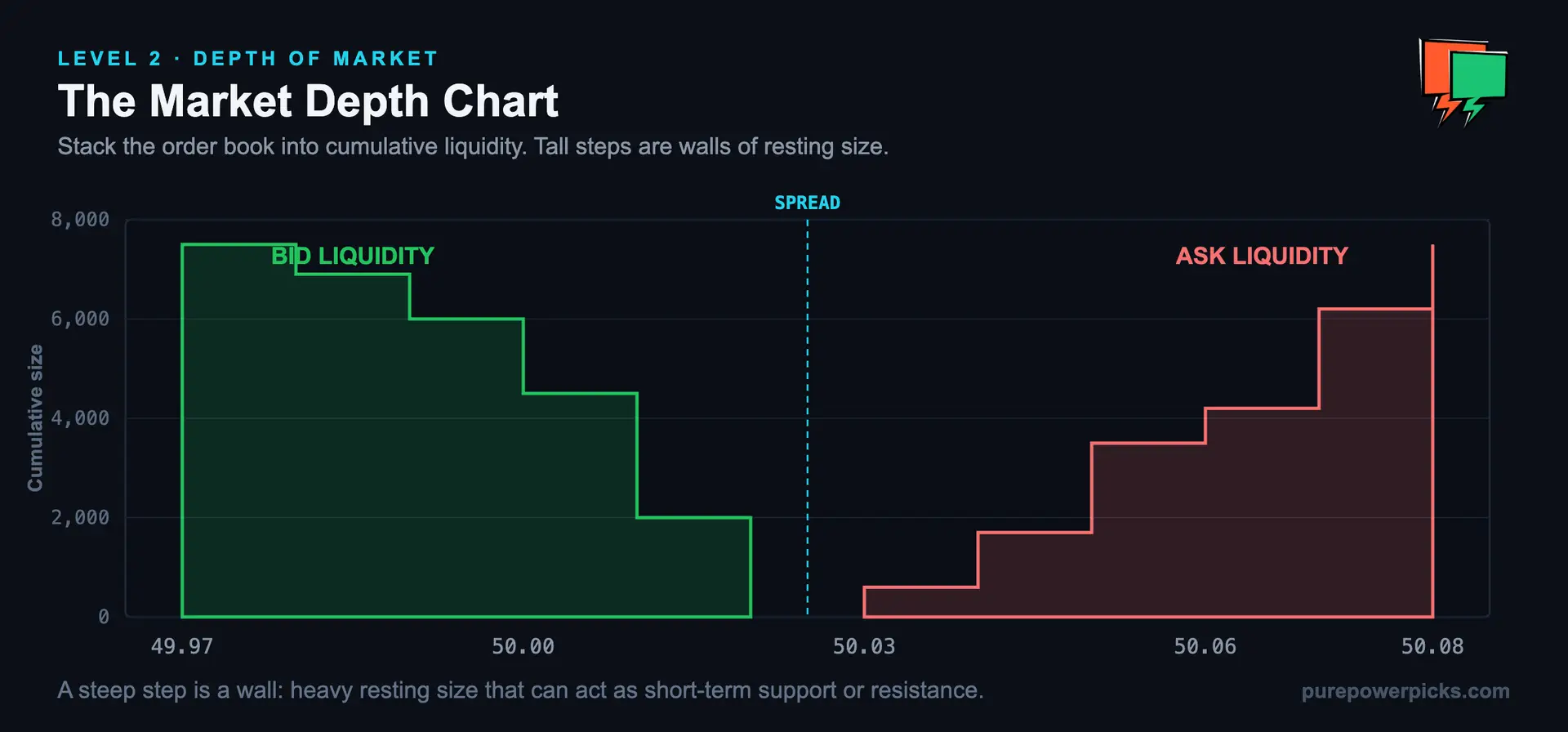
Depth is where Level 2 earns its keep. A thick bid wall under price tells you buyers are defending a level. A heavy ask wall overhead tells you sellers are capping it. When a wall suddenly clears or pulls, that absence of liquidity is often the cue the move is about to accelerate.
How Do You Read Level 2 Like a Pro?
Reading Level 2 well comes down to recognizing imbalances and how aggressively size is being lifted or hit. Here is a hypothetical. A stock trades near $50. On Level 2 you see 50,000 shares stacked on the bid between $49.95 and $49.90, but only 8,000 shares on the ask up to $50.10. Thick bid, thin ask, often a sign buyers are defending price and sellers are about to get run over. Flip it, big size on the ask over thin bids, and that is distribution. Price tends to leak lower until those asks clear.

Pair this with accumulation and distribution patterns and you start reading the tape like a professional. The signals to watch:
- Iceberg orders: small visible size that keeps refreshing as it gets hit. Someone big is hiding their full order behind a tiny tip.
- Spoofing patterns: large orders that appear and vanish before getting filled. Illegal, but it happens, and it is designed to fool you.
- Stacked bids / asks: heavy size at one specific level acting as support or resistance.
- Pulled offers: sellers yanking their asks right before a breakout, often a clue something is about to move.
Pro Tip
Level 2 is most reliable on liquid stocks with tight spreads. On thinly traded names, the book lies. A single algorithm can fake depth, pull it, and reset the entire ladder in seconds. Stick to high-volume tickers while you are learning to read flow.
What Is Time and Sales and Why Does It Matter?
Time and Sales, often just called the tape, is the live print of every executed trade. Each row shows the time, price, size, and often the exchange where the fill happened. Where Level 2 shows you intent, Time and Sales shows you reality.

Color coding tells the story. Green prints hit the ask (aggressive buyers paying up). Red prints hit the bid (aggressive sellers dumping). White or neutral prints fill between the spread. When a wave of green prints clears the ask at growing size, that is buying pressure. When red prints stack and the bid keeps getting hit, that is selling pressure. The tape does not lie because it is actual money moving.
Combine the tape with your charting setup and you see the same story from two angles: the chart shows you structure, the tape shows you what is happening inside it right now. Layer in candlestick patterns and your read gets sharper still.

Where Level 2 Goes Dark: Hidden Liquidity
Here is the catch that trips up new traders: the order book you see is not the whole book. A large share of volume trades in dark pools, private venues where big institutions move size without showing their orders on the public Level 2. Iceberg orders hide size in plain sight. And odd lots and late prints can distort the tape.
This does not make Level 2 useless. It means you treat it as a powerful clue, not a complete map. The visible book plus the tape still tells you more than price alone ever could, you just respect that some of the biggest players are deliberately invisible.
How Do You Use Level 2 With Options Trading?
Options have their own Level 2 book, and it works the same way: bids, asks, sizes, and exchange routing. The catch is that options markets are usually thinner than the underlying stock, so spreads matter more and depth is shallower.
When trading options, watch the Level 2 of the underlying stock to time your fills. Hypothetical: you want to buy calls on a stock breaking out at $100. You see massive bid stacking under $100 on the stock and aggressive green prints on the tape. That is confirmation the move has fuel, and you can lean into your option order with better timing. Pair it with open interest to see where positioning is building, and use VWAP as a reference line. When price holds above VWAP and Level 2 shows persistent bid strength, that is typically a bullish tape.
What Do You Need to Access Level 2 Data?
You need three things: a broker or platform that offers Level 2 (most active trading platforms do), an exchange data subscription (usually $10 to $40 per month for U.S. equities), and a setup that can display the data without lag.
That last part matters more than people realize. Reading Level 2 on a slow connection is worse than not having it at all. Make sure your trading equipment can stream real-time data across multiple windows at once. If platform terminology is new to you, our guide to essential trading terms will get you fluent fast, and if you work pre-market or after-hours sessions, Level 2 becomes especially valuable because liquidity is thinner and reading the book gives you a real edge.
Risk Warning
Level 2 can be misleading. Algorithms regularly post large orders to manipulate perception, then cancel before they fill. Never trade off Level 2 alone. Use it as one input alongside price action, volume, and your overall plan. Reacting to every flash on the book is a fast way to overtrade and bleed an account.
How Should Beginners Start Learning the Tape?
Start by watching, not trading. Pick one liquid, high-volume stock and pull up its Level 2 and Time and Sales side by side. Watch how the book changes as price moves, which side gets aggressive before a breakout, and how the tape thins out at the top of a move.
Do this for an hour a day for two weeks and you will start seeing patterns no indicator can show you. Then layer it onto your existing strategy. Do not skip the basics of trading volume either, because Level 2 and Time and Sales are essentially volume broken down to its smallest unit. Understanding volume context is what makes the tape make sense.
Frequently Asked Questions
What is the NBBO in Level 1 data?
The NBBO is the National Best Bid and Offer, the highest bid and lowest ask aggregated across every U.S. exchange at that moment. Your Level 1 quote is the NBBO plus the last traded price. It is the tightest spread available, but it shows none of the depth sitting behind it.
Is Level 2 data worth the cost for beginners?
If you are swing trading or investing, no. If you are actively day trading or scalping, yes. The subscription cost typically pays for itself the first time you avoid getting trapped in a bad spread or catch a fake-out before it traps you.
What do the MMID codes on Level 2 mean?
MMID stands for Market Maker ID, the short code showing which exchange or ECN posted a quote, like NSDQ, ARCA, or EDGX. It tells you where each resting order lives, which is why the same stock can show different sizes at the same price from different venues.
Can Level 2 predict where a stock is going?
No. It shows you intent and pressure in real time, but it is not predictive. Big orders get pulled, fake walls vanish, and algorithms manipulate the book constantly. Treat it as one input among many, not a crystal ball.
What is the difference between Level 2 and the DOM?
They are essentially the same thing. DOM stands for Depth of Market and is the more common term in futures trading. Level 2 is the standard term for equities and options. Both show the resting order book at multiple price levels.
Does Level 2 work for options?
Yes. Options have their own Level 2 book, though it is typically thinner than stocks. Many traders watch the underlying stock’s Level 2 for timing and use the option’s Level 2 to find the best fills given the wider spreads.
Can Time and Sales be manipulated?
Executed trades on the tape are real, they actually happened. But interpretation can be tricky because dark pool prints, late prints, and odd lot trades can distort what you see. Focus on regular-session prints at significant size for the cleanest read.
Ready to Put This on Your Screen?
Reading the tape is a skill that compounds. Pair it with educational setups and chart breakdowns, and the order book starts telling you a story you can actually trade.
Keep sharpening your edge with more trading guides.

PPP TeamStock and Options Research and Education
The PPP Team is the research and editorial team behind Pure Power Picks. We trade stocks and options and publish the work as we do it, with every alert tracked in public. Publishing since 2020. How we research and correct our work is written out in our editorial standards. Our content is strictly educational, never advice.
Disclaimer: Pure Power Picks is not a licensed financial advisor. All content is for educational and informational purposes only and should not be considered investment advice. Options trading involves substantial risk of loss and is not suitable for all investors. Past performance does not guarantee future results.