


Best Defense Stocks for Options Trading: Iran War Playbook 2026
When missiles fly, options flow follows. The 2026 Iran-Israel escalation lit up the defense sector almost overnight, and the names that build the missiles, interceptors, and drones became some of the most actively traded options in the market. The opportunity is real, but so is the risk: implied volatility spikes on every escalation headline and collapses on every ceasefire rumor. This is your field briefing on the nine tickers that matter, the right structure for each, and how to keep one bad headline from taking you out of the game.
Defense stocks are a headline-driven trade. Match the structure to the ticker: defined-risk debit spreads on the slow-moving primes, small long calls on the high-beta drone names, and covered calls if you already hold shares. Respect the IV crush that hits when a ceasefire headline lands, and size every position so a single reversal is survivable.
// Intel: What This Briefing Covers
- Why the Iran-Israel escalation turned defense names into options-flow magnets
- The nine tickers, from slow-moving primes to high-beta drone makers, with live data and the right play for each
- How to match a strategy to a ticker’s volatility profile instead of forcing the same trade on all of them
- How to manage the IV crush that hits the moment a ceasefire headline crosses the wire
- How to hedge a position against the whipsaw that defines conflict-driven trading
Why Are Defense Stocks Lighting Up Options Flow?
Conflict spending is the cleanest catalyst the defense sector ever gets. When escalation hits the headlines, three things happen at once: order-book expectations rise for the companies that supply the hardware, retail and institutional traders pile into calls, and implied volatility expands across the whole sector. That combination, real fundamental demand plus a volatility surge, is exactly what makes options flow explode. And the demand is structural, not a one-off: global military spending sits at record highs, which keeps a bid under the sector between headlines.
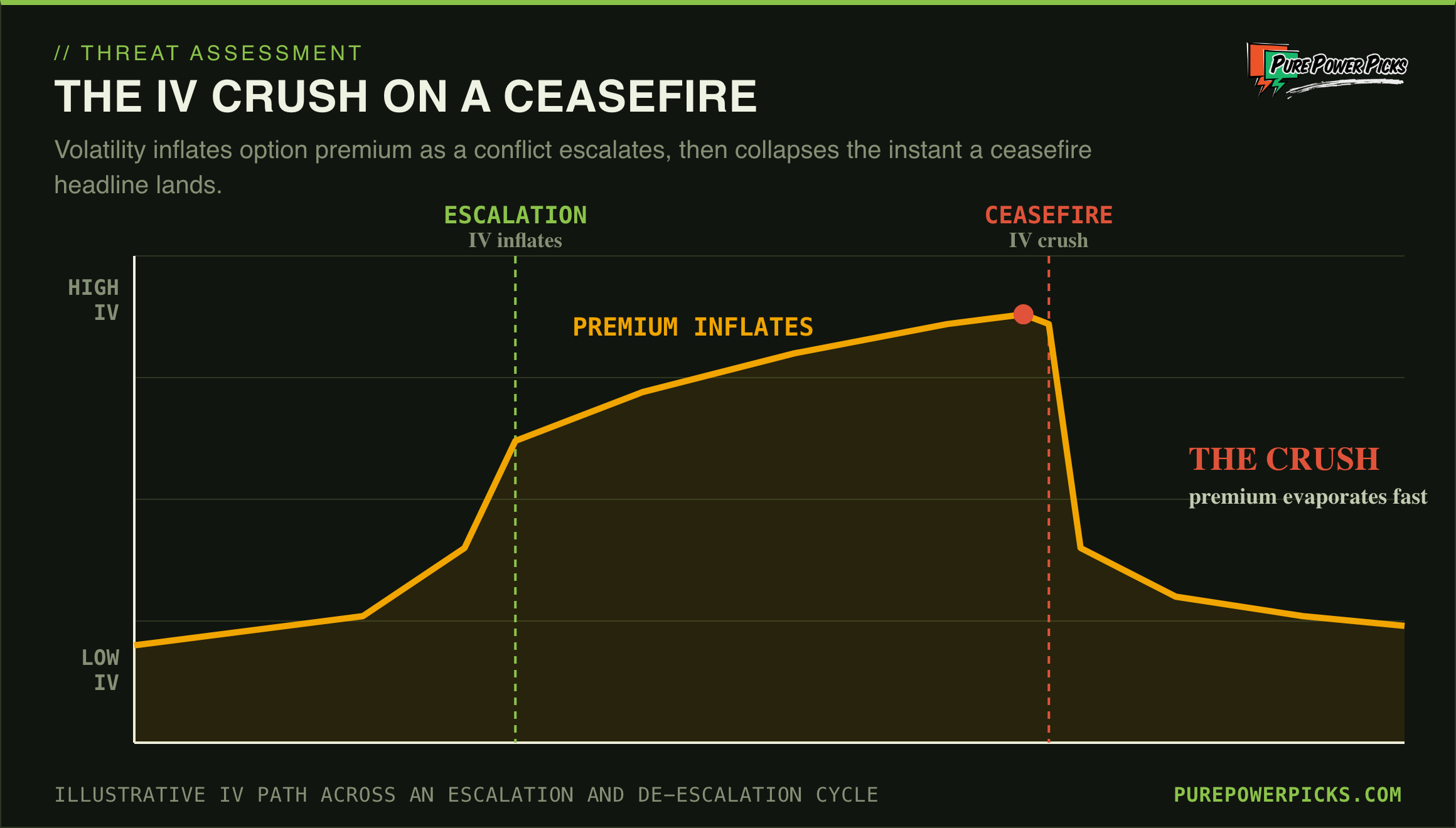
The trap is that this is a two-way street. The same headlines that send the sector vertical can reverse on a single ceasefire rumor, and when they do, the inflated premium you paid evaporates in the IV crush. So the goal is not to predict the next headline. It is to position for the move with a structure that survives the reversal. If you want the same framework applied to a scheduled catalyst, our guide on trading earnings with options covers the identical IV mechanics.
The Nine Defense and Drone Tickers
The nine names you want on your watchlist are LMT, RTX, NOC, GD, KTOS, AVAV, ONDS, RCAT, and LDOS. Each one has liquid options, real exposure to current conflict spending, and enough volatility to make directional plays worthwhile. They run the full spectrum, from slow-moving large-cap primes you trade with defined-risk spreads to high-beta drone makers where a small long call earns its keep. If drones are the reason you are here rather than the wider defense complex, the drone stocks guide sorts that sector on its own terms, including the small caps whose share counts grew by triple digits this year. Live prices below are as of the date shown.
-
 LMTLockheed Martin$504.10▼ -0.26% session changeMKT CAP $116.34BP/E 18.652W $437-692◎ BEST PLAY: Debit spread / covered call · 30-45 DTE
The biggest defense prime in the world. Builds the F-35, PAC-3 missiles, and THAAD systems in active use across the region. Deep, liquid options, but the stock moves slowly: a defined-risk ticker, not a lottery play.
-
RTXRTX (Raytheon)$183.49▼ -0.64% session changeMKT CAP $247.30BP/E 32.352W $156-227◎ BEST PLAY: Debit call spread · 21-30 DTE
Maker of the AMRAAM, Stinger, and SM-3 interceptors. Moves more than LMT on headline days because its mix is tied to consumable munitions. Defined-risk debit spreads shine when IV is elevated.
-
NOCNorthrop Grumman$477.42▼ -0.12% session changeMKT CAP $67.82BP/E 15.252W $470-774◎ BEST PLAY: Debit spread / covered call · 30-45 DTE
Builds the B-21 Raider stealth bomber, the Sentinel ICBM, and missile-defense systems. One of the cleanest large-cap plays on sustained defense spending. Deep, liquid options and a steady chart: a defined-risk name, not a lottery play.
-
GDGeneral Dynamics$330.48▲ +0.12% session changeMKT CAP $89.41BP/E 20.252W $307-400◎ BEST PLAY: Debit spread / covered call · 30-45 DTE
Makes munitions, combat vehicles, and nuclear submarines, plus Gulfstream jets. Munitions demand is the cleanest conflict tie-in on this list. A slow, liquid prime built for defined-risk spreads and covered calls.
-
KTOSKratos Defense$43.27▲ +0.48% session changeMKT CAP $8.11BP/E 254.652W $42-134◎ BEST PLAY: Long calls (small size) · 14-30 DTE
Small-cap, high-beta. Builds target drones and the Valkyrie unmanned combat aircraft. Rips 8-15% on big defense news days. Long calls earn their keep here, but position size has to stay small.
-
AVAVAeroVironment$141.29▲ +0.33% session changeMKT CAP $7.18BP/E N/A52W $135-418◎ BEST PLAY: Long calls / debit spread · 21-30 DTE
The Switchblade loitering-munition maker and one of the cleanest pure-plays on the AI drone thesis. Options chains carry rich premium during conflict cycles, so you pay up to play.
-
ONDSOndas Holdings$7.60▲ +4.97% session changeMKT CAP $4.43BP/E N/A52W $5-15◎ BEST PLAY: Long calls (very small) · 14-21 DTE
Drone networks and autonomous systems. Lower float, sharp moves, wider bid-ask spreads. Use limit orders only and keep the size tiny.
-
RCATRed Cat Holdings$6.46▲ +0.94% session changeMKT CAP $987MP/E N/A52W $6-19◎ BEST PLAY: Long calls (very small) · 14-21 DTE
Military drone maker awarded the Army's Short Range Reconnaissance program. Trades like a momentum stock with a defense overlay. Treat it accordingly.
-
LDOSLeidos$117.59▼ -0.13% session changeMKT CAP $14.79BP/E 11.052W $99-206◎ BEST PLAY: Covered calls · 30-45 DTE
Defense IT, intelligence systems, and electronic warfare. The quiet compounder on this list. Best used for covered calls if you already hold the shares.


If you want to extend this thesis into adjacent sectors, the defense theme overlaps heavily with orbital and satellite plays, and the same volatility-profile logic applies to any headline-driven group.
See What We Are Watching
Get on our free list and the watchlist and alerts we send land in your inbox. Defense and drone names turn up on them regularly.
Free. No spam. Education only, nothing here is financial advice. Unsubscribe anytime.
The Best Options Strategy for Each Ticker
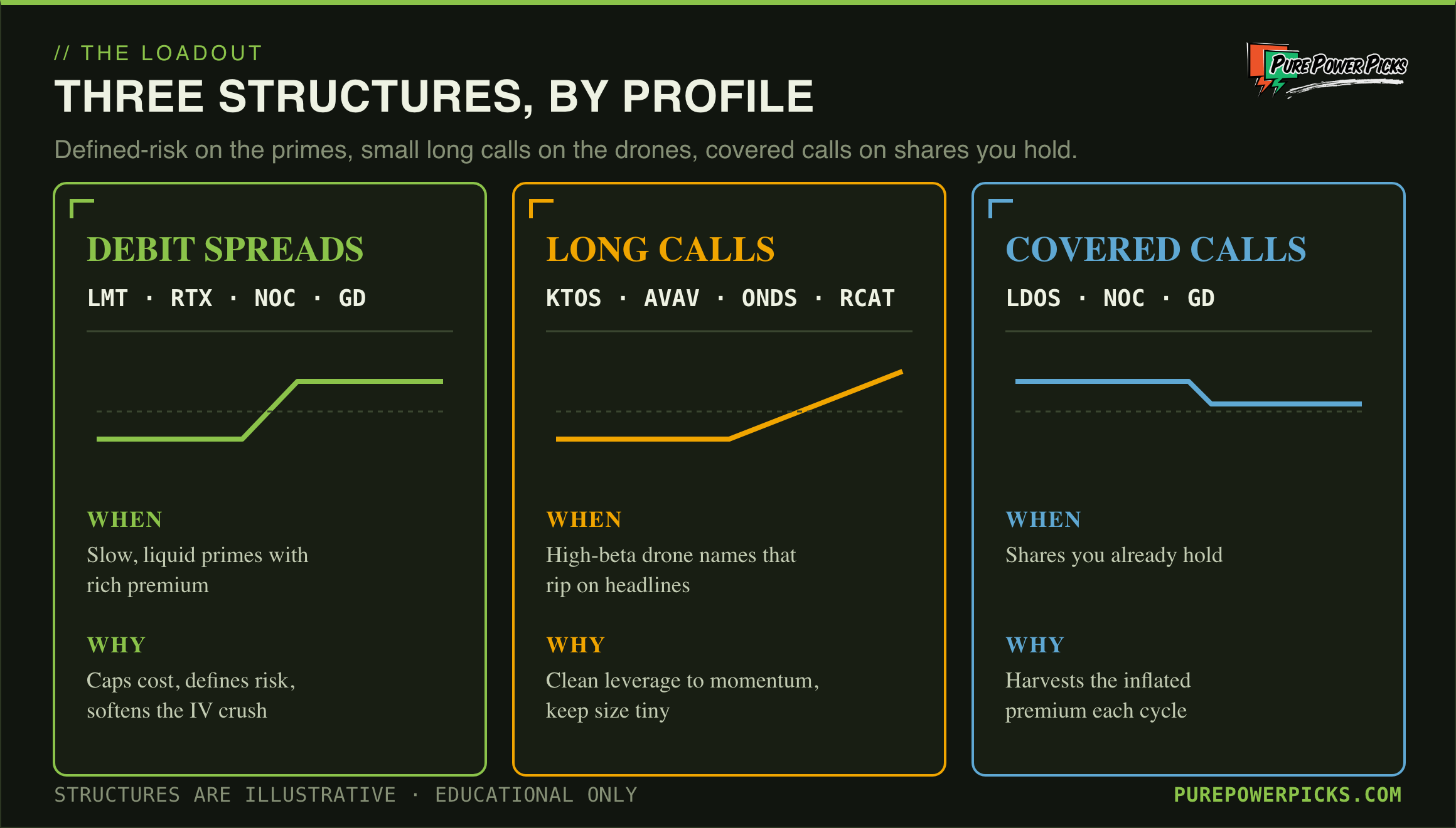
The right strategy depends on the ticker’s volatility profile and your conviction on direction. Large-cap primes call for defined-risk structures, small-cap drone names suit outright calls, and shareholders should be writing covered calls to harvest the inflated premium. Match the structure to the volatility profile, not the other way around.
Long Calls on the Drone Names
For KTOS, AVAV, RCAT, and ONDS, outright long calls give you the cleanest exposure to a momentum continuation. The catch is that you are paying peak IV. Pick strikes slightly out-of-the-money with 14 to 30 days to expiration so you balance leverage against decay, and keep the size small because these names can move 8 to 15 percent in a day in either direction. Our guide on picking strikes covers the exact delta framework.
Debit Spreads on the Primes
LMT (which builds the F-35), RTX, NOC (maker of the B-21 Raider), and GD carry rich premium that punishes outright call buyers. Debit call spreads cap your cost, define your risk, and let you express direction without paying full volatility. You give up some upside, but you stop the IV crush from gutting the position on the first ceasefire headline. The full mechanics are in our options strategies guide.
| Ticker | Profile | Best Structure | DTE |
|---|---|---|---|
| LMT | Slow-mover, rich premium | Debit call spread / covered call | 30-45 |
| RTX | Mid-beta munitions exposure | Debit call spread | 21-30 |
| NOC | Stealth bomber & ICBM prime | Debit call spread / covered call | 30-45 |
| GD | Munitions, subs, land systems | Debit call spread / covered call | 30-45 |
| KTOS | High-beta drone | Long calls (small size) | 14-30 |
| AVAV | Pure-play loitering munitions | Long calls or debit spread | 21-30 |
| ONDS | Low-float momentum | Long calls (very small size) | 14-21 |
| RCAT | High-beta drone | Long calls (very small size) | 14-21 |
| LDOS | Defense IT compounder | Covered calls | 30-45 |
Match the Weapon to the Target
The single biggest mistake in this sector is forcing one strategy across every ticker. A slow-moving prime like LMT and a high-beta drone like RCAT are completely different instruments, and the same trade structure cannot fit both. The spectrum below sorts the nine names by how violently they move, which tells you immediately whether you should be buying outright calls, structuring a defined-risk spread, or writing premium against shares you already own.
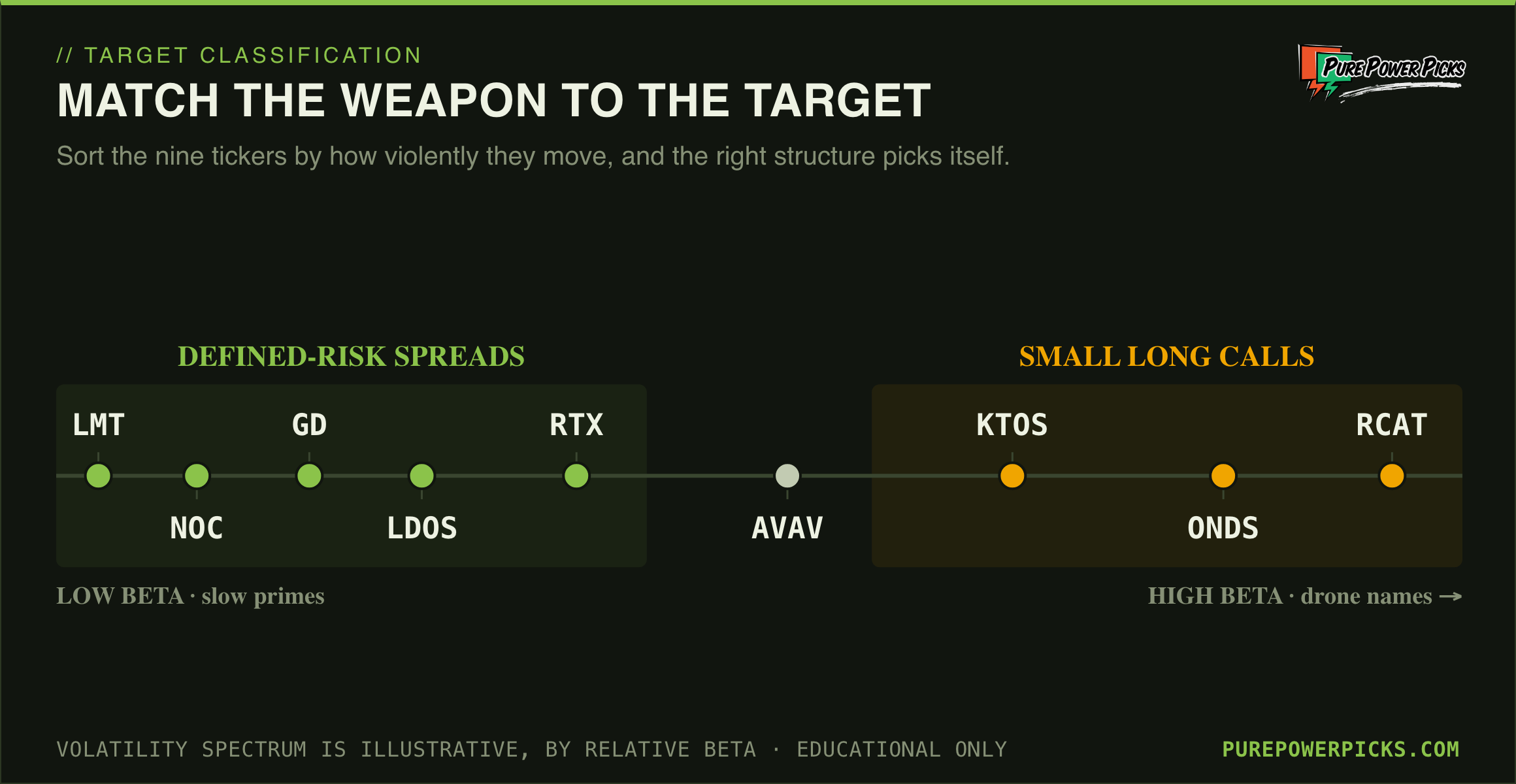
Read it left to right. The slow primes on the left carry deep, liquid, expensive options, so you define your risk with spreads. The high-beta drones on the right rip on headlines, so a small long call gives you the leverage without the spread’s capped upside, as long as you keep the size tiny.
Managing IV Crush When Ceasefire Headlines Hit
The single biggest risk in this trade is the IV crush. Buy calls into an escalation spike, then watch a ceasefire rumor cross the wire, and the volatility you paid for collapses faster than the stock can fall. You can be right that the conflict continues and still lose, because the premium deflated. This is the same dynamic that punishes earnings buyers, and the defense against it is the same.
A ceasefire headline can erase a long call even if the stock barely moves. Enter before IV fully ramps, use debit spreads so short premium offsets long premium, and never buy outright calls at peak volatility. The crush is not a tail risk in this sector, it is the base case on any de-escalation.
The structural defenses: enter before the volatility fully ramps, use spreads where the short leg offsets the crush on the long leg, and trade smaller so a reversal is an annoyance instead of an account event. For a deeper breakdown of how volatility collapses around events, see our guide on implied volatility around market shocks.
Hedging Against the Whipsaw
Conflict-driven trading is defined by whipsaw: violent moves in both directions on alternating headlines. If you are net long the sector through calls, a protective structure caps the damage when the tape reverses. The simplest version is a defined-risk spread instead of an outright call, which builds the hedge into the position itself. A more advanced version pairs a long position with a put or an offsetting short to cap the downside of a sudden de-escalation.
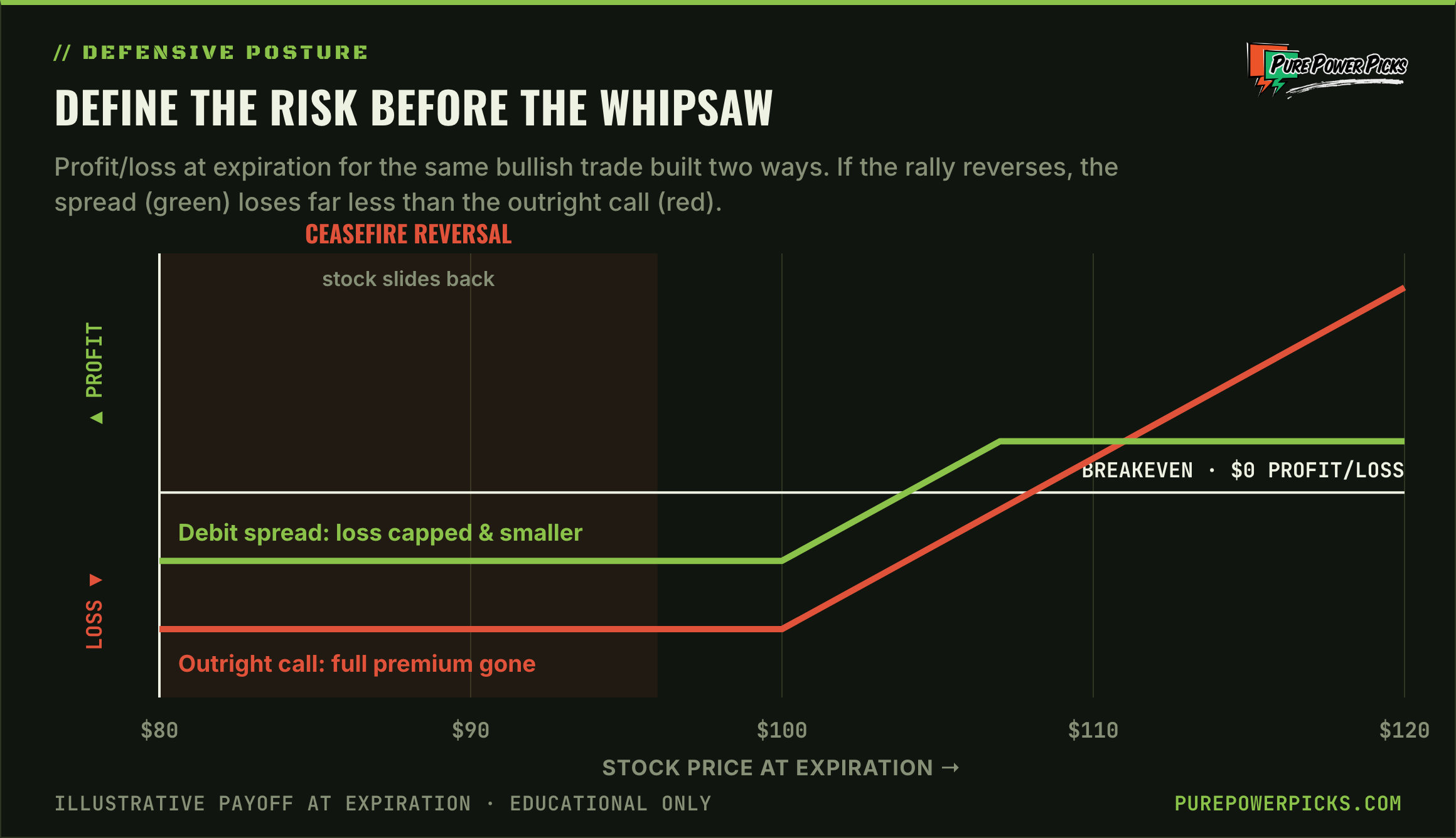
The point is not to eliminate risk, it is to define it. Position sizing does the same job from the other direction: if you load up on LMT, RTX, KTOS, and a drone name all at once, you are not diversified, you are four-times-long the same catalyst. Size accordingly, and review the basics of managing options risk before you build correlated positions.
Get On Our Free List
Our watchlist and our alerts go out to the free list, and Defense and drone names turn up on them regularly. It costs nothing, and it is the simplest way to see which names we are studying and what we are watching on them.
Free. No spam. Education only, nothing here is financial advice. Unsubscribe anytime.
Frequently Asked Questions
What are the best defense stocks for options trading right now?
The nine most actively traded are LMT, RTX, NOC, GD, KTOS, AVAV, ONDS, RCAT, and LDOS. The large-cap primes (LMT, RTX, NOC, GD, LDOS) suit defined-risk spreads and covered calls, while the high-beta drone names (KTOS, AVAV, ONDS, RCAT) suit small long calls. Which is best depends entirely on your view of the move and how much volatility you are willing to pay for.
Should I buy calls or use spreads on defense stocks?
It depends on the ticker. On the slow-moving primes with rich premium, debit spreads cap your cost and soften the IV crush. On the high-beta drone names, small outright calls give you cleaner leverage to a momentum move. The volatility profile of the ticker decides it, not personal preference.
How do I avoid getting crushed by a ceasefire headline?
Enter before implied volatility fully ramps, use spreads so short premium offsets the crush on your long leg, and keep size small. The IV crush on de-escalation is the base case in this sector, so build the position assuming it will happen.
Are small-cap drone stocks too risky for options?
They are higher risk, not automatically off-limits. Names like ONDS and RCAT have low floats, wider bid-ask spreads, and sharper moves, so use limit orders only and very small position sizes. The leverage is the appeal and the danger at the same time.
Bringing It Together
The 2026 Iran-Israel conflict turned defense stocks into one of the most active corners of the options market. The nine tickers covered here, LMT, RTX, NOC, GD, KTOS, AVAV, ONDS, RCAT, and LDOS, give you a full spectrum from slow-moving primes to high-beta drone makers. Match the strategy to the ticker, respect IV crush, and size every position so a single bad headline does not take you out of the game.
The traders who do well in environments like this are not the ones predicting headlines. They are the ones with a structured playbook, defined risk, and the discipline to follow their own rules when the market gets loud.
What Members Get When a Defense Name Sets Up
Everything above is homework you can do yourself. Members get the other half: three to five options alerts a week, each with the full contract and a written plan, sent by text, email and Discord. Every alert we send goes into the public tracker, the ones that worked and the ones that did not.
See What Members GetOr grab the free Options Trader’s Playbook first.

The PPP Team is the research and editorial team behind Pure Power Picks. We trade stocks and options and publish the work as we do it, with every alert tracked in public. Publishing since 2020. How we research and correct our work is written out in our editorial standards. Our content is strictly educational, never advice.
Disclosures: PPP is not a broker, investment advisor, or fiduciary. All content is for educational purposes only and is not a recommendation to buy or sell any security. Live prices are delayed snapshots captured at the date shown and are not real-time quotes. All examples are hypothetical. Trading options involves substantial risk of loss. Past performance does not guarantee future results.