


Options on Takeover Targets: How Hostile Bids Move Calls
Share


When a company becomes a takeover target, its call options stop behaving like normal options. The stock jumps toward the offer price, implied volatility collapses in an all-cash deal, and call premiums get capped because the stock has a ceiling: the bid itself. Hostile bids are the exception that keeps calls alive. A hostile offer signals a contested fight, and contested fights can produce a higher bid, a rival bidder, or a walk-away. That uncertainty keeps implied volatility elevated and keeps out-of-the-money calls above the offer price trading with real value. QXO’s hostile pursuit of Beacon Roofing Supply, which ended in a negotiated deal, is the textbook case. The same mechanics apply whether you follow building-products names or aerospace and defense, where consolidation and regulatory review shape every deal. Here’s exactly how options price in acquisitions, and how to think through a setup before you touch a deal target.
A cash takeover bid pins a stock near the offer price and crushes implied volatility, so calls lose most of their extrinsic value overnight. Hostile bids keep volatility alive because the market prices in a possible higher bid or a deal collapse. Your edge comes from pricing the deal spread and the break risk, not from chasing the headline.
What you’ll learn:
- How takeover bids reshape implied volatility and option pricing
- Why call premiums cap out near the offer price
- What options markets price in for hostile vs friendly bids
- How call spreads, collars, and covered calls fit deal situations
- The early assignment, dividend, and deal-break traps to avoid
- A checklist to run before touching any deal target
How Do Takeover Bids Change Implied Volatility and Option Pricing?
A cash takeover bid replaces an uncertain future with a known number, so implied volatility on the target collapses. Options are priced on uncertainty, and an all-cash offer removes most of it in a single headline.
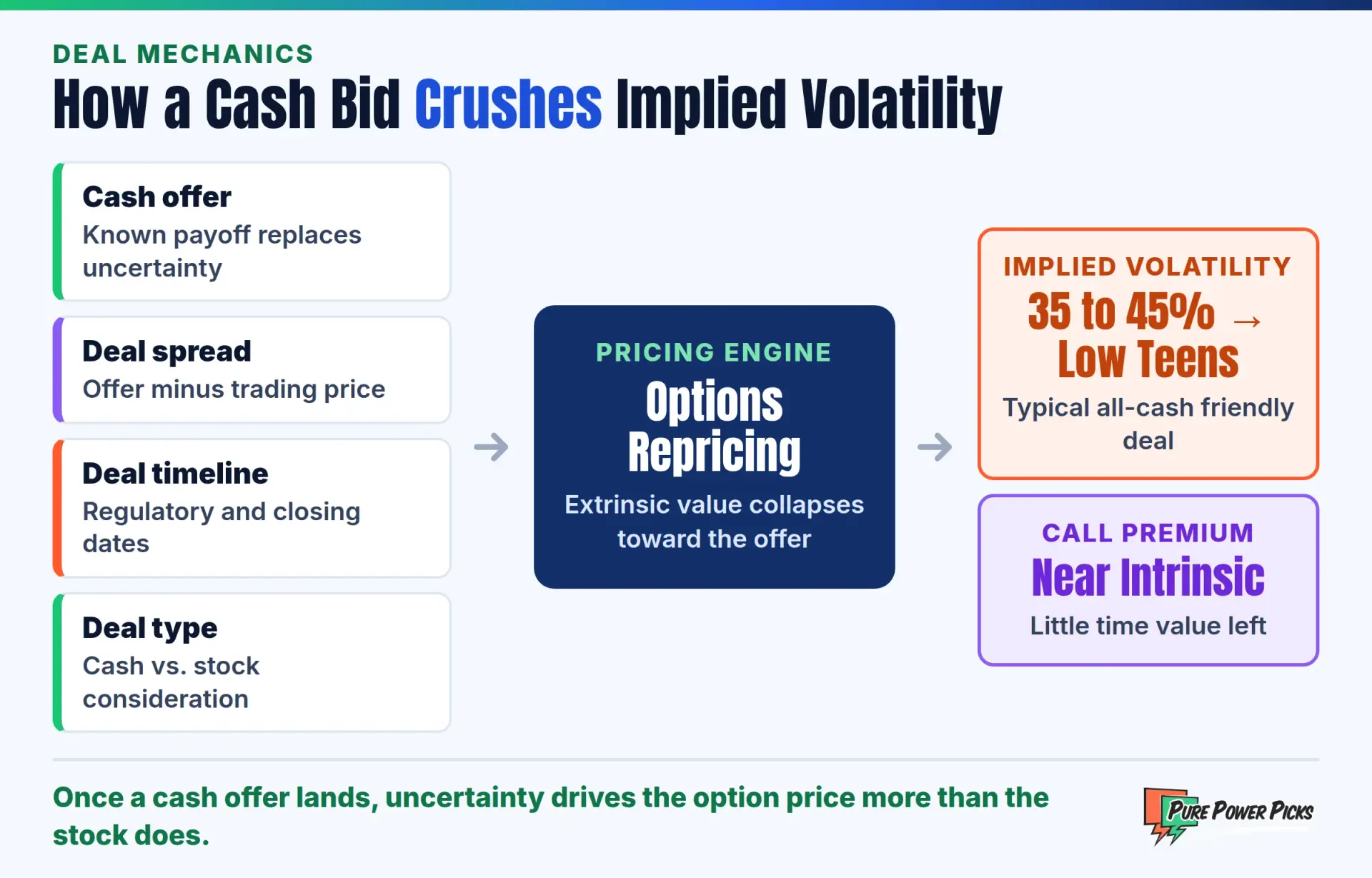
Before a bid, a stock might carry implied volatility in the 35% to 45% range. After a credible cash offer, that number can fall into the low teens or lower, because the market now expects the stock to drift toward the offer and sit there. If you need a refresher on why this matters, start with understanding implied volatility.
The result surprises a lot of newer traders. Calls bought the day before the announcement often explode in value, but calls bought the morning after can lose value even as the stock inches higher. The volatility component of their premium evaporates faster than the stock moves.
The gap between the offer price and where the target stock actually trades. A stock trading at $95 against a $100 cash offer has a $5 deal spread. That gap is the market’s price for time, financing risk, regulatory risk, and the chance the deal falls apart. Professionals who trade this gap practice merger arbitrage.
Stock deals behave differently. If the target receives acquirer shares instead of cash, the target’s options start tracking the acquirer’s volatility, adjusted by the exchange ratio. Always check the deal terms before assuming volatility will crush.
Why Do Call Premiums Cap Out Near the Offer Price?
Call premiums cap out because the offer price becomes the stock’s practical ceiling, and a call can’t be worth more than the stock’s realistic upside above its strike. If the deal closes at $100 in cash, a $105 call expires worthless no matter how bullish anyone feels.
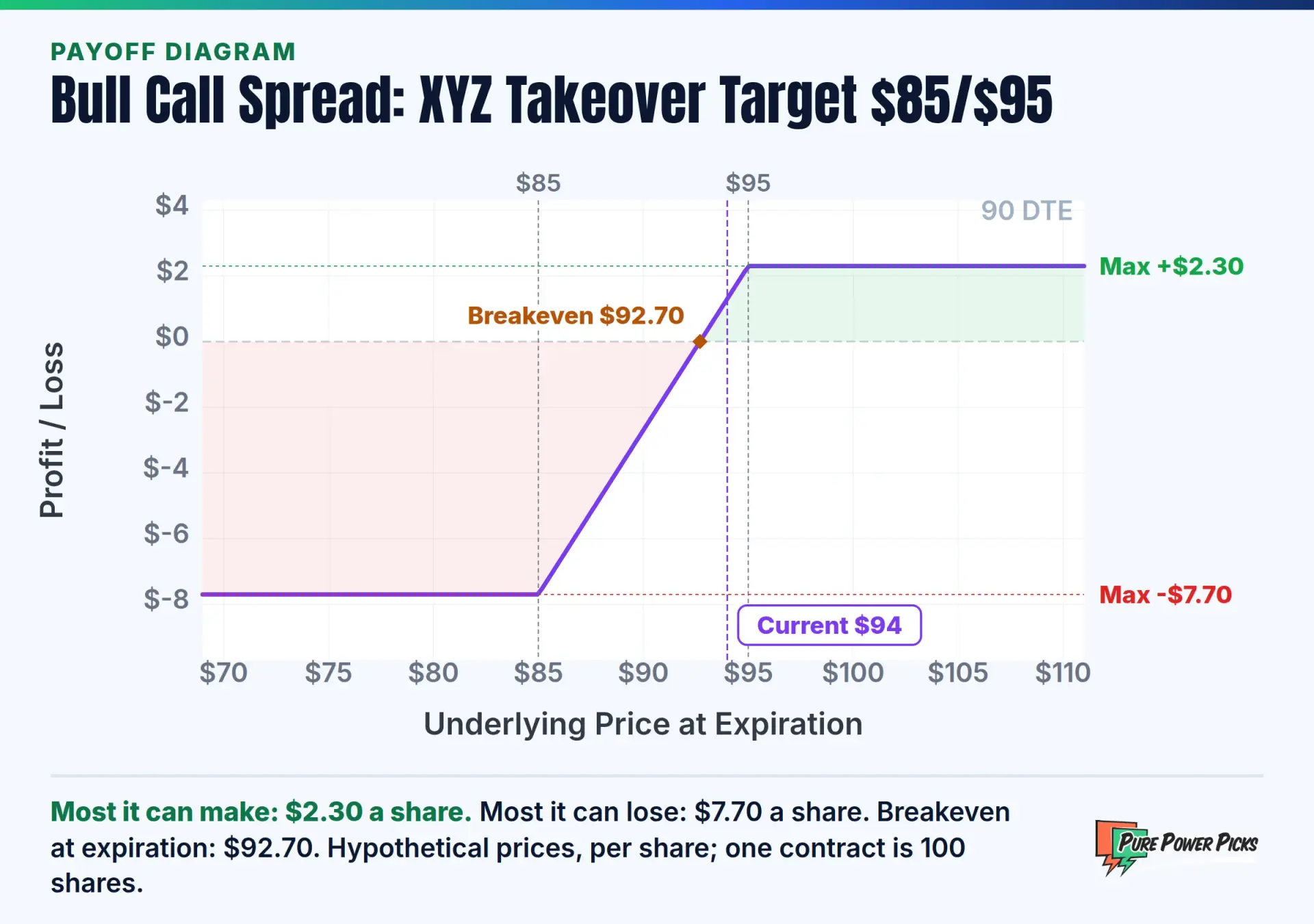
Think of the target as a bond with a known payoff date. In-the-money calls trade close to intrinsic value, because nobody pays much time premium for upside that can’t exist. Out-of-the-money calls above the offer only hold value if traders expect a higher bid.
Let’s Walk Through a Hypothetical Example
Here’s a hypothetical scenario with round numbers. Company XYZ trades at $60. An acquirer announces an all-cash offer of $100 per share. The next morning, XYZ opens at $94, leaving a $6 deal spread.
- The 85 call (three months out) trades near $9.20. Intrinsic value is $9, so you’re paying only $0.20 of time premium.
- The 95 call trades near $1.50. If the deal closes at $100, it settles at $5. If the deal breaks, it likely goes to zero.
- The 105 call trades for a few cents in a friendly deal. In a hostile fight, it might hold $1.00 or more because the market prices a bump.
Notice what the 105 call tells you. Its price is a live poll on whether a higher offer is coming. That’s the single most useful read in any takeover situation, and choosing the right strike around the offer price is where most of the decision-making happens.
Hostile vs Friendly Bids: What Do Options Markets Price In?
Options markets price friendly deals as a slow walk to closing and hostile bids as an open contest with three outcomes: a higher bid, a negotiated deal, or a collapse. That’s why hostile targets keep fatter premiums and steeper call skew above the offer.
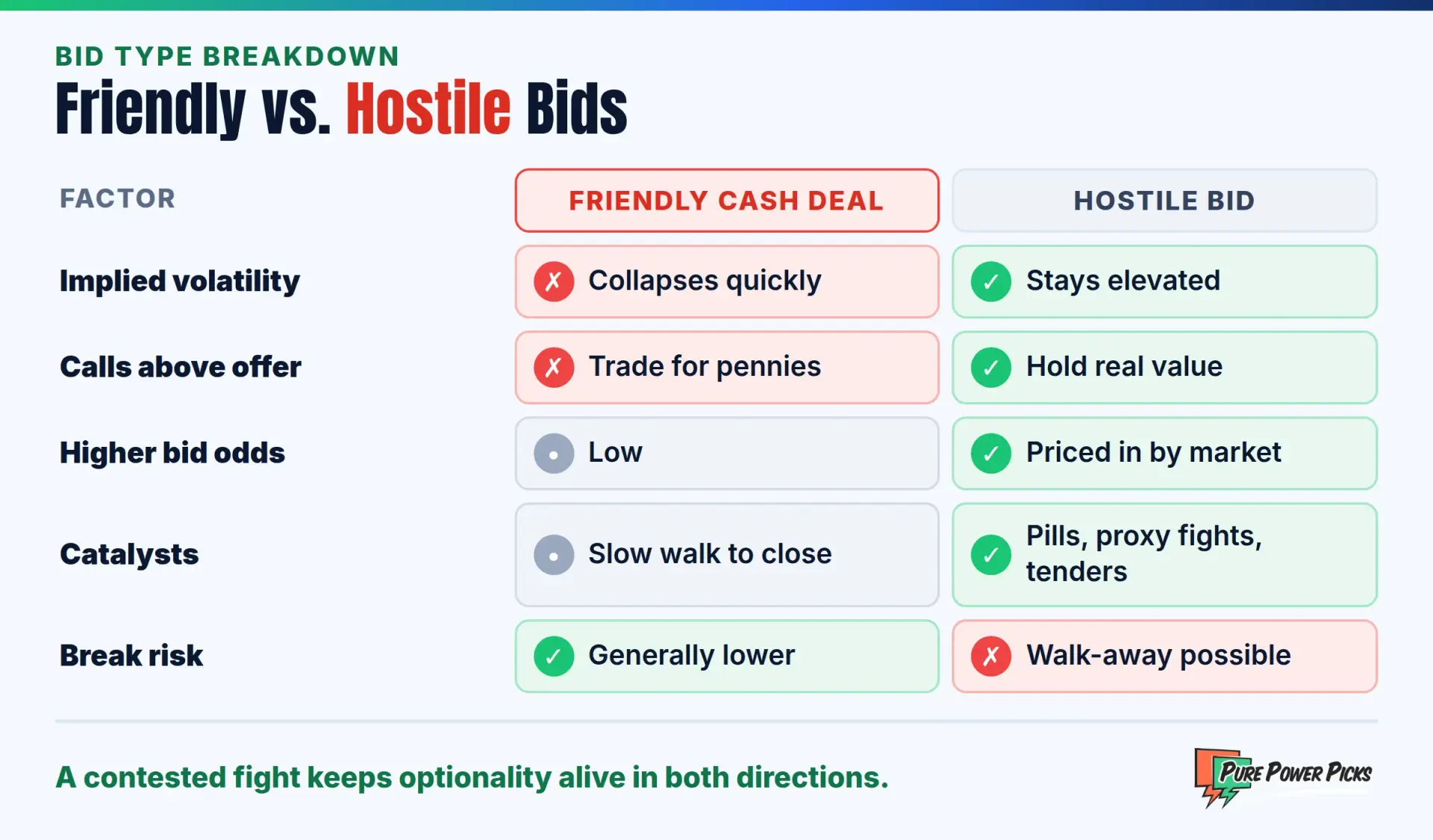
The QXO and Beacon situation shows the playbook. QXO went public with an unsolicited offer, took it directly to shareholders through a tender offer, and Beacon’s board resisted with defensive measures before the two sides eventually agreed to a negotiated deal. During a fight like that, the stock can trade near or even above the offer because the market smells a bump.
Hostile bids create catalysts that friendly deals don’t: board rejections, poison pill adoptions, proxy fights, and tender offer extensions. Each one can move implied volatility. You track those catalysts through filings like the SC TO-T and Schedule 14D-9, which we cover in our guide to SEC filings that move stocks.
Hostile vs Friendly Bids at a Glance
Sector matters too. In aerospace and defense, regulatory and national security review can stretch timelines for months, which widens deal spreads and keeps option premiums higher for longer.
Reading a deal spread is a skill, and skills come from watching real setups unfold with clear reasoning.
Every Pure Power Picks alert comes with a detailed plan covering key levels, risk zones, and the “why” behind the idea, so you build pattern recognition, not just a watchlist.
Which Strategies Work for Deals: Call Spreads, Collars or Covered Calls?
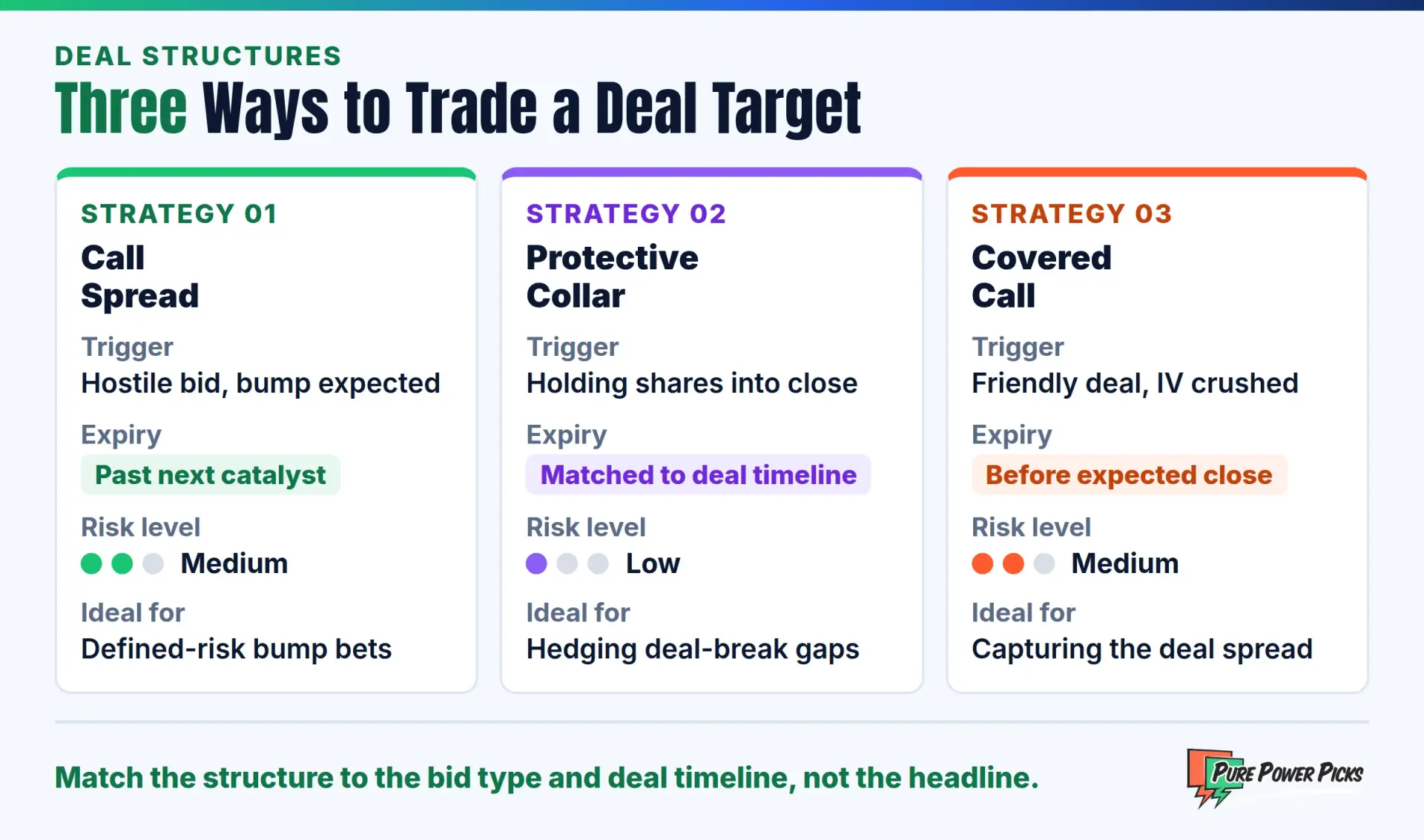
The best structures for deal targets are defined-risk ones that match the capped upside: call spreads for bump speculation, collars for shareholders protecting against a break, and covered calls for harvesting leftover premium. Naked long calls are usually the worst fit after a bid is public.
Takeover Bid Options Strategy Comparison
Back to our hypothetical XYZ at $94 under a $100 hostile offer. A 100/110 call spread might cost $1.20. If a rival pushes the price to $110, the spread pays up to $10. If no bump arrives, you lose the $1.20. That’s a clean, defined bet on the question the market is actually asking.
The collar is the shareholder’s tool. If you held XYZ before the bid, you can buy a put below the current price and sell a call at the offer, often for little net cost. You lock in most of the deal premium and cap your damage if the acquirer walks.
Watch the open interest in calls struck above the offer price. Sudden size there often means someone is positioning for a higher bid. Pair what you see in spikes in open interest with the latest filings before you draw any conclusion.
What Are the Early Assignment, Dividend and Deal-Break Risks?
The three biggest risks on deal targets are early assignment of short calls, dividend-driven assignment, and a deal break that erases the takeover premium overnight. All three hit hardest when you’re short options or holding calls that rely on the deal closing.
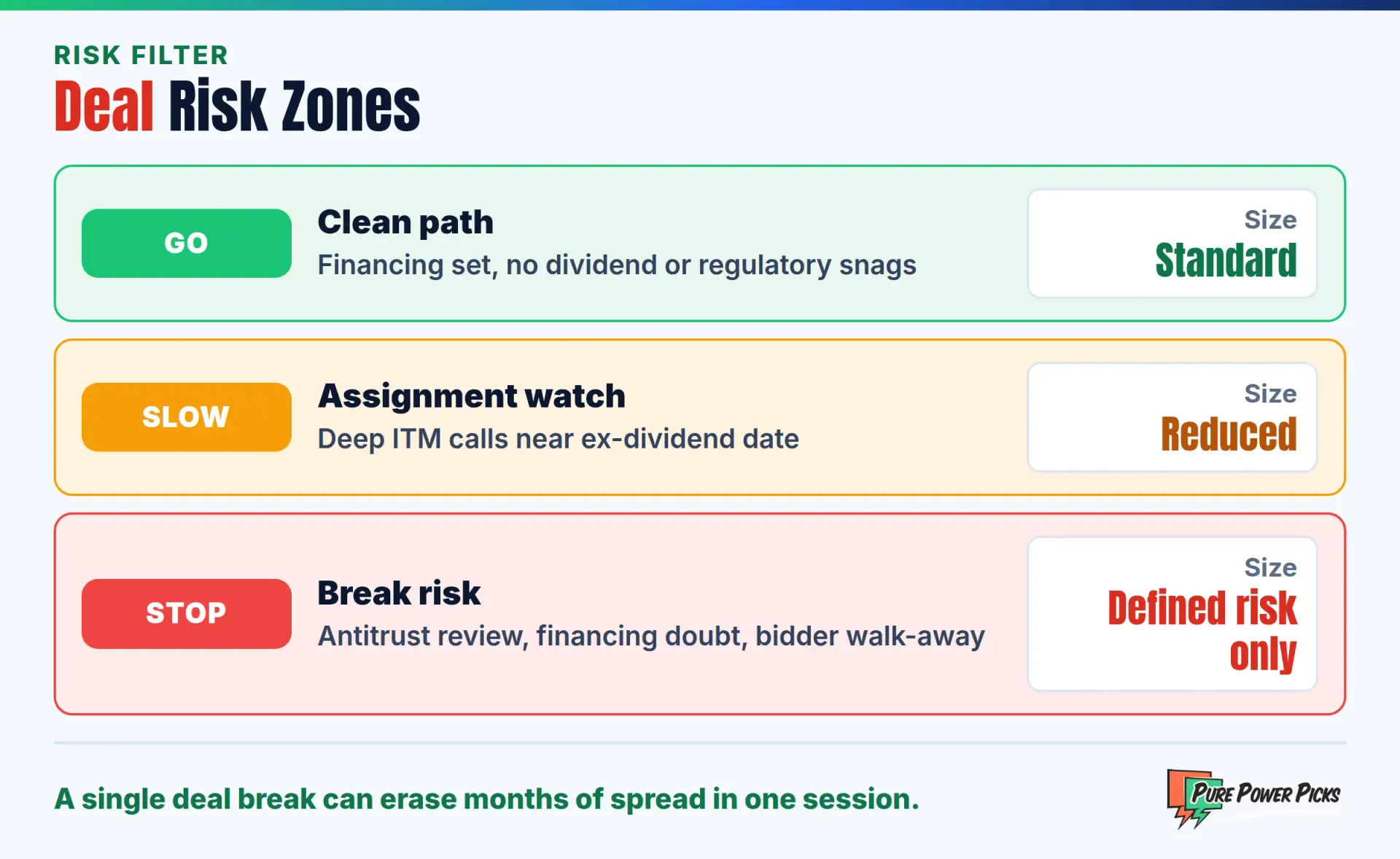
Deep in-the-money calls on a pinned stock carry almost no time value. That makes early exercise attractive to call holders, especially the day before an ex-dividend date. If you sold covered calls or a short leg of a spread, expect assignment and plan for it. Our breakdown of early assignment risk walks through the math.
When an all-cash deal closes, listed options get adjusted so they deliver cash instead of shares. Any remaining time value disappears, and contracts effectively settle at intrinsic value. The Options Industry Council explains how corporate actions trigger these contract adjustments.
Deal spreads look like easy money until a deal breaks. In our hypothetical, XYZ could drop from $94 back toward $60 in one session if financing fails or regulators block the merger. That’s a 36% loss on the stock, and in-the-money calls can lose nearly everything. Small deal spreads exist because the downside is large. Never size a deal play as if closing is guaranteed.
What Should You Check Before Aerospace Defense Options Trading on a Deal Target?
Before you trade options on any deal target, including names in aerospace and defense, confirm the deal terms, the timeline, the regulatory path, and the option chain’s read on a bump. If you can’t answer all four, you don’t have a setup yet.
- Read the terms. Cash, stock, or mixed? Cash deals crush volatility. Stock deals tie the target to the acquirer.
- Map the timeline. Pick expirations that cover the expected close, tender deadlines, and shareholder votes.
- Size up regulators. Antitrust review and, in defense, national security review can add months. Check the SEC’s EDGAR filing search for the merger agreement and tender documents.
- Measure the deal spread. A wide spread signals real doubt. Ask why before you assume it’s free money.
- Read the calls above the offer. Their premium tells you how much bump the market expects.
- Check the dividend calendar. Ex-dividend dates drive early assignment on short calls.
- Define your max loss. Use defined-risk structures and assume a break is possible.
Frequently Asked Questions
Do call options go up when a company is acquired?
Calls bought before the announcement usually jump because the stock gaps toward the offer price. Calls bought after the announcement often lose value as implied volatility collapses. Once a cash bid is public, upside is capped near the offer unless a higher bid emerges.
What happens to my options when an all-cash deal closes?
The contracts are adjusted to deliver cash instead of shares. In-the-money options settle at intrinsic value, and out-of-the-money options expire worthless. Any remaining time value disappears at closing.
Why do hostile bids keep implied volatility high?
Hostile bids have more possible outcomes: a higher offer, a rival bidder, a negotiated deal, or a collapse. More outcomes mean more uncertainty, and uncertainty is exactly what implied volatility prices. Friendly deals remove most of that uncertainty on day one.
What is the safest options strategy on a takeover target?
No strategy is safe, but defined-risk structures fit deals best. Call spreads limit your cost on a bump bet, and collars protect existing shares against a deal break. Avoid uncovered short puts on targets, because a break can blow through your strike.
The Bottom Line on Takeover Targets
Takeover bids rewrite the rules of option pricing. The offer becomes the ceiling, cash deals crush volatility, and hostile fights keep premiums alive because the market prices a bump or a break. You win the education game here by reading the deal spread, the calls above the offer, and the filings, then choosing a structure that respects the capped upside and the real downside.
Learn from detailed trade plans that explain the reasoning, key levels, and risk zones behind every alert, so you sharpen the same analytical skills covered in this guide.
Explore more trading guides to keep sharpening your edge.
Disclaimer: Pure Power Picks is not a licensed financial advisor. All content is for educational and informational purposes only and should not be considered investment advice. Options trading involves substantial risk of loss and is not suitable for all investors. Past performance does not guarantee future results.
Share

The PPP Team is the research and editorial team behind Pure Power Picks. We trade stocks and options and publish the work as we do it, with every alert tracked in public. Publishing since 2020. How we research and correct our work is written out in our editorial standards. Our content is strictly educational, never advice.