

TLT Options Strategy: How to Trade Bonds Around Fed Speeches
Share


A TLT options strategy is how you trade the bond market’s reaction to Federal Reserve policy using options on the iShares 20+ Year Treasury Bond ETF (TLT). Because TLT moves inversely to long-term interest rates, it reacts sharply whenever the Fed signals a shift in rate expectations, which makes it one of the cleanest vehicles for trading Fed speeches, FOMC meetings, and events like the Jackson Hole symposium. The core play is simple: rate-cut signals push TLT higher (buy calls or call spreads), while hawkish, higher-for-longer language pushes TLT lower (buy puts or put spreads). The catch is that implied volatility inflates option premiums before a big speech and collapses right after, so how you structure the trade matters as much as your directional call. Master the mechanics below and you can trade bonds around any Fed catalyst with a clear plan instead of a guess.
TLT is a direct proxy for long-term rate expectations, so it moves fast when the Fed talks. Trade it around speeches by pairing a clear directional bias with a volatility-aware structure: use spreads to blunt the IV crush that follows big events, and never size a single Fed trade so large that one surprise headline blows up your account.
What you’ll learn in this guide:
- Why TLT is the cleanest options vehicle for trading interest rate expectations
- How Fed speeches and the Jackson Hole symposium actually move TLT
- The three core TLT options structures: straddles, spreads, and directional plays
- How to read TLT’s options chain using IV, delta, and expiration selection
- The risk management rules that keep you in the game through a Fed surprise
Why Is TLT the Go-To Options Vehicle for Rate Expectations?
TLT is the go-to options vehicle for rate expectations because it holds a basket of long-dated U.S. Treasury bonds, and long-dated bonds are the most sensitive assets on the planet to changes in interest rates. When the market prices in rate cuts, bond prices rise and TLT climbs. When it prices in higher-for-longer, bond prices fall and TLT drops.
This gives you a pure, liquid, one-ticker way to express a view on Fed policy. You do not need a futures account or a bond broker. You just need an options-approved brokerage and an understanding of how the fund behaves.
Duration measures how much a bond’s price moves for a 1% change in interest rates. TLT holds bonds with very long duration, which is why a small shift in rate expectations creates an outsized move in the ETF. That amplification is exactly what makes it attractive for options traders.
TLT also has deep, tight options markets. Weekly and monthly expirations, penny-wide strikes near the money, and heavy volume mean you can get in and out without getting punished on the spread. For a fuller picture of the machinery behind these moves, read our breakdown of how Fed policy moves the markets. You can also track the underlying data yourself using the Federal Reserve’s FRED database, which publishes Treasury yields in near real time.
How Do Fed Speeches and Jackson Hole Move TLT?
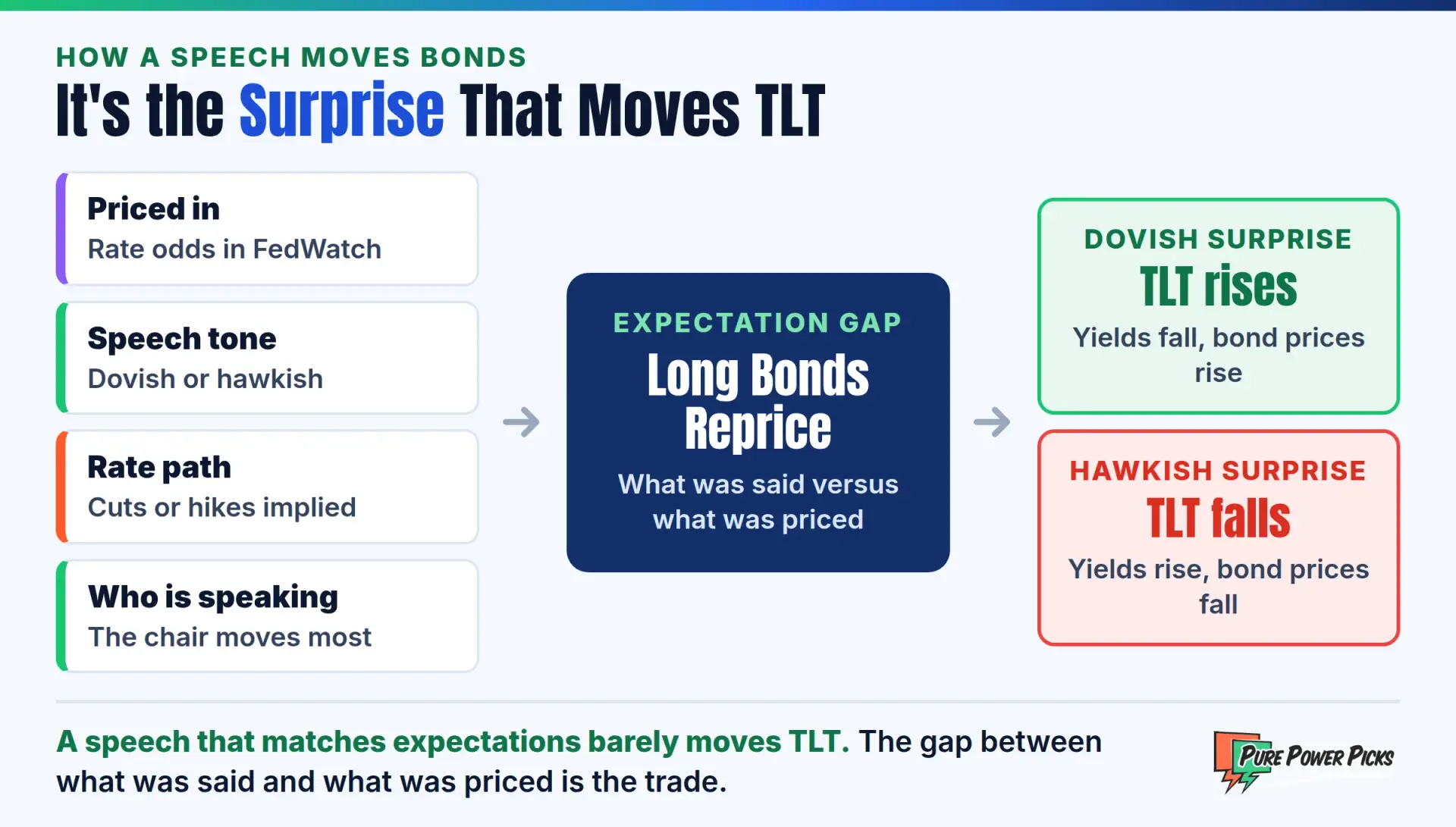
Fed speeches move TLT by shifting the market’s expectations for future interest rates, and long bonds reprice instantly on any surprise. A dovish tone that hints at cuts sends yields lower and TLT higher. A hawkish tone that stresses inflation risk sends yields higher and TLT lower.
The Jackson Hole Economic Symposium is a special case. It is where the Fed chair traditionally lays out the big-picture policy framework for the year ahead, so a single sentence can move the entire bond curve. That is why traders reliably search for a TLT options strategy every time the chair steps to the podium.
Here is the mechanism in plain terms. Bond traders build a set of expectations before the event. The speech either confirms those expectations, exceeds them, or falls short. TLT moves in proportion to the gap between what was priced in and what was actually said, not the headline itself. A “cut coming” comment barely moves TLT if the market already fully expected it.
Check what the market already expects before you place a Fed trade. The CME FedWatch Tool shows the probability of rate moves priced into futures. If a cut is already 90% priced in, a confirming speech gives you almost no follow-through. The money is in the surprise, not the consensus.
How Do Fed Rate Decisions Affect Options Pricing?
Fed rate decisions affect options pricing primarily through implied volatility. In the days leading up to a major speech or FOMC meeting, uncertainty rises and option premiums inflate as traders bid up protection. The moment the news drops and uncertainty resolves, that implied volatility collapses in what traders call the “IV crush.”
This is the single most important concept for options trading during Fed announcements. You can be right on direction and still lose money if you overpaid for volatility that then evaporated. To go deeper on how volatility behaves around big events, study our guide on implied volatility around events.
Buying a naked call or put right before a Fed speech is the most common way beginners lose money on these events. You are paying peak premium into a guaranteed IV crush. If TLT moves your way but not far enough to overcome the volatility drop, your option can lose value even with a correct directional call.
What Are the Best TLT Options Strategies Around Fed Speeches?
The best TLT options strategies around Fed speeches fall into three buckets: directional plays for when you have a strong bias, debit spreads for when you want direction with less IV risk, and straddles or strangles for when you expect a big move but do not know which way. Your choice depends on how confident you are in direction versus magnitude.

Comparing the Three Core Approaches
For most traders, the debit spread is the workhorse. You buy an option at one strike and sell a further out-of-the-money option of the same type, which lowers your cost and reduces your exposure to the IV crush because the option you sold also loses volatility value. If you want to sharpen how you decide which contract to buy, our guide on picking the right strike price walks through the exact framework.
- Defined maximum risk you know upfront
- Cheaper than a naked long option
- Less exposure to IV crush
- Clean directional expression of a Fed view
- Capped upside from the short leg
- Still loses if TLT moves against you
- Two legs mean two commissions and spreads
- Requires the move to reach your strikes
Understanding the mechanics is step one. Reading them on a live chart is where real skill is built.
At Pure Power Picks, every alert comes with a detailed trade plan that spells out the key levels, the reasoning, and the risk zones so you learn the “why” behind each idea.
How Do You Read TLT’s Options Chain: IV, Delta, and Expiration?
You read TLT’s options chain by checking three things before every Fed trade: implied volatility to gauge how expensive premiums are, delta to size your directional exposure, and expiration to control how much time you are paying for. Get these three right and the rest of the trade falls into place.
Implied volatility tells you if you are buying cheap or expensive protection. Compare the current IV to its recent range. If IV is already elevated into the event, lean toward spreads instead of naked options. Investopedia’s breakdown of implied volatility is a solid refresher if you need one.
Delta is your proxy for directional exposure and rough probability. A 0.30 delta call moves roughly 30 cents for every dollar TLT rises and carries about a 30% chance of finishing in the money. Higher delta means more cost and more sensitivity. For a full tour, see the option greeks that matter.
Expiration is about matching your timeframe to the catalyst. For a single Fed speech, a weekly expiration captures the move without paying for months of time value you do not need. If you want the trade to have room to develop over a policy cycle, a monthly gives you breathing room. Our comparison of choosing weekly vs monthly options covers exactly how to make that call.
A Hypothetical TLT Fed-Speech Trade
Let’s walk through a hypothetical example. Suppose TLT is trading at $90 the day before a Fed chair speech, and you believe the tone will lean dovish, hinting at cuts the market has not fully priced. You expect TLT to push higher.
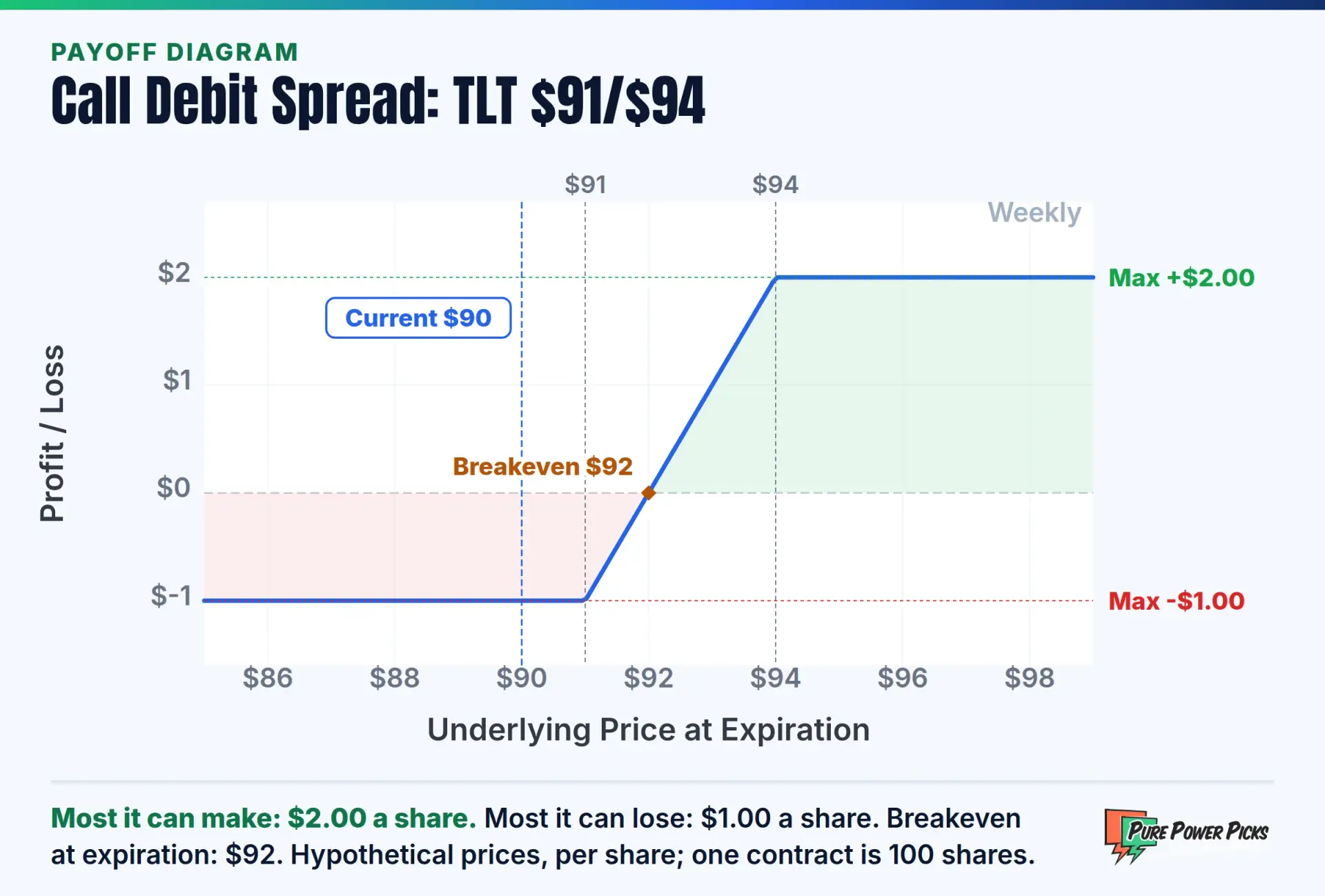
Instead of buying a naked call into peak IV, you build a call debit spread. You buy the $91 call and sell the $94 call in the nearest weekly expiration for a net cost of $1.00 per share, or $100 per contract. Your maximum risk is that $100. Your maximum theoretical value is the $3 spread width minus your cost, or $200 per contract, reached if TLT closes at or above $94 by expiration.
If the speech confirms your dovish read and TLT climbs toward $94, the spread gains value while the short leg cushions the IV crush. If the chair sounds hawkish and TLT falls, the most you lose is the $100 you paid. That defined-risk structure is why spreads shine around unpredictable Fed events. Remember, these are round hypothetical numbers to illustrate the mechanics, not a real trade or a projection of results.
What Are the Risk Management Rules for TLT Options Trades?
The core risk management rule for TLT options trades is simple: never risk more on a single Fed event than you can afford to lose entirely, because a surprise headline can move bonds violently in seconds. Fed events are binary catalysts, and no amount of analysis removes the possibility of a shock.
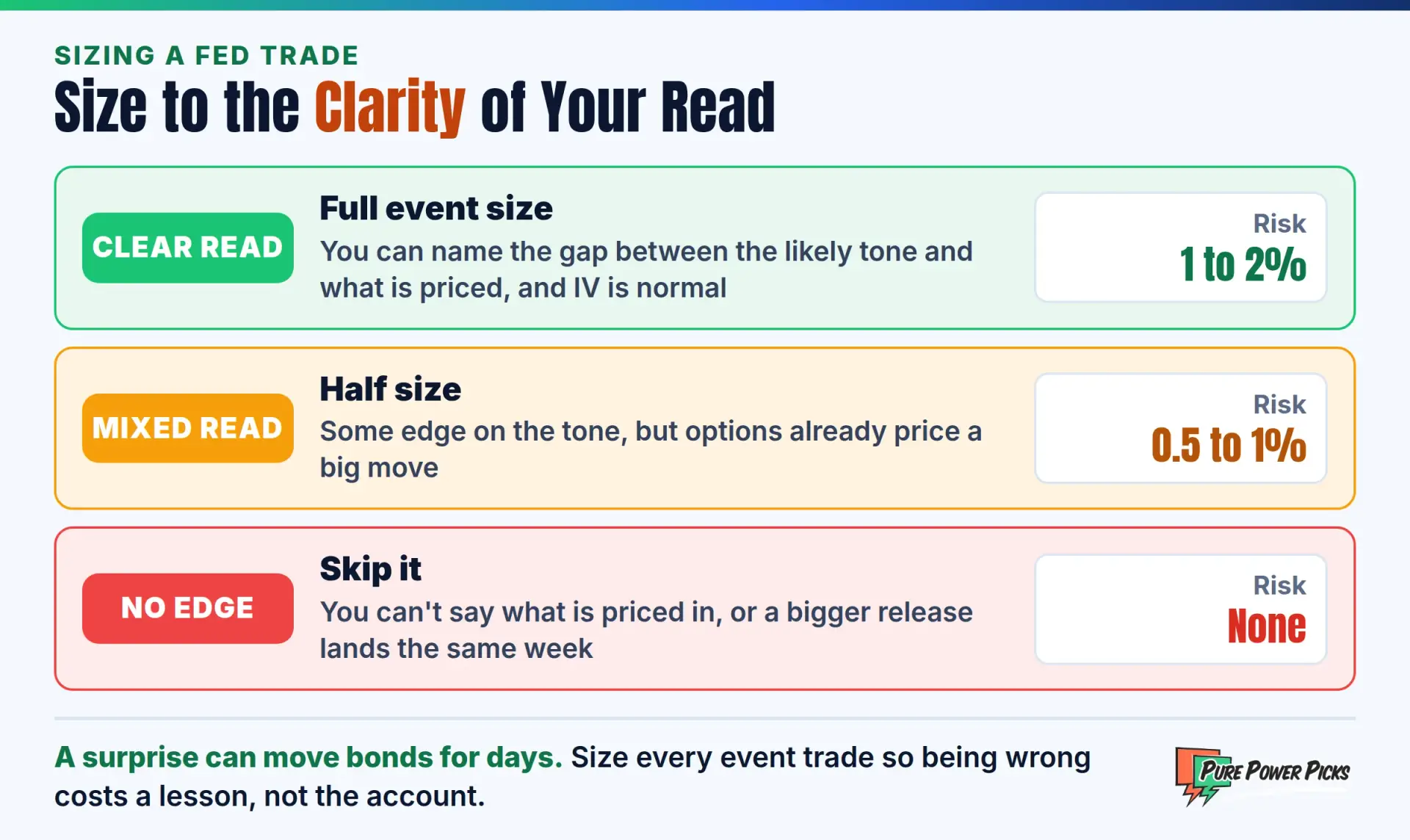
Position sizing comes first. A common framework is to risk no more than 1% to 2% of your account on any single event trade. That way a wrong call is a lesson, not a catastrophe. Our full playbook on solid risk management rules lays out the rest.
- Define your risk before you enter. Know the most you can lose on the trade, in dollars, before you click. With a debit spread that number is the debit you paid. With a long call or put it is the whole premium.
- Size to the event, not to your conviction. A Fed speech can surprise everyone, including you. Keep event trades at 1% to 2% of the account even when the read feels obvious.
- Plan the exit for both outcomes. Write down where you take profit if TLT moves your way and when you close if it does not. A spread that hasn’t moved by the next session has usually told you what you need to know.
- Don’t hold a short-dated trade into the next catalyst. Weekly options decay fast. If the speech has passed and the move didn’t come, close the trade rather than waiting for the next data release to rescue it.
- Use limit orders, especially around the event. Bid-ask spreads widen in the minutes around a speech. A market order at that moment can give away a large part of your edge.
Bond moves can continue well after the speech ends. A hawkish surprise can pull TLT lower for days as the market reprices the whole rate path, so a trade that is down after the first hour is not “due” to come back.
When Should You Skip a Fed Speech Trade Entirely?
You should skip a Fed speech trade when you have no clear read on the tone, when implied volatility already prices a large move, or when the event is minor. Not every Fed appearance moves TLT, and sitting out is a position.
- No edge on the tone. If you can’t say why the speech should lean dovish or hawkish compared with what is priced in, you are guessing.
- IV is already stretched. When options are pricing a move bigger than TLT usually makes on these events, buyers are overpaying and the math favors waiting.
- The speaker rarely moves markets. A regional Fed president on a routine topic is not the chair at Jackson Hole. Save your risk for the events that reset expectations.
- A bigger release is days away. If the jobs report or CPI lands later that week, the speech may be forgotten by the time your option expires.
For the full calendar of rate decisions and how options behave around them, see our guide to trading options around FOMC meetings.
Frequently Asked Questions
Why does TLT go up when interest rates fall?
TLT holds long-dated Treasury bonds, and bond prices move opposite to yields. When the market expects lower rates, existing bonds with higher coupons become more valuable, so TLT rises. Its long duration makes the move larger than it would be for short-term bonds.
What is the best TLT options strategy for a Fed speech?
For most traders it is a debit spread in the direction of your read. It costs less than a single long option, defines your max loss up front, and the short leg softens the drop in implied volatility after the event.
What is IV crush on TLT options?
IV crush is the fall in implied volatility once a known event passes. Premiums rise into a big Fed speech and drop as soon as the uncertainty is gone, so a long option can lose value even if TLT moves the way you expected.
Which expiration should you use for a Fed speech trade?
Use the nearest expiration that still gives the move time to happen, usually the weekly that expires a few days after the speech. Longer expirations cost more time value than a single event needs.
How much should you risk on a TLT Fed trade?
Keep it to 1% to 2% of your account per event. Fed surprises are binary, and the goal is for a wrong call to be a small, recoverable loss.
What Is the Bottom Line on Trading TLT Around Fed Speeches?
TLT gives you a clean, liquid way to trade what the Fed says about rates. The edge comes from knowing what is already priced in, choosing a structure that doesn’t overpay for volatility, and sizing every event trade so a surprise costs you a lesson rather than your account.
Learn from detailed trade plans that explain the reasoning, the key levels and the risk management behind every alert.
Explore more trading guides to keep sharpening your edge.
Disclaimer: Pure Power Picks is not a licensed financial advisor. All content is for educational and informational purposes only and should not be considered investment advice. Options trading involves substantial risk of loss and is not suitable for all investors. Past performance does not guarantee future results.
Share

The PPP Team is the research and editorial team behind Pure Power Picks. We trade stocks and options and publish the work as we do it, with every alert tracked in public. Publishing since 2020. How we research and correct our work is written out in our editorial standards. Our content is strictly educational, never advice.