

How to Trade Options Around FOMC Meetings (2026 Guide)
Share


To trade options around FOMC meetings, you need to master one thing above all else: implied volatility. Here’s exactly how it works. In the days leading up to a Federal Reserve announcement, IV inflates as traders hedge against uncertainty, which pumps up option premiums across the board. The moment the decision drops and the uncertainty resolves, that inflated volatility collapses in what traders call IV crush. Learning how to trade options around FOMC meetings means positioning for the direction of the move while respecting the volatility mechanics that can wreck an otherwise correct directional call. You either buy volatility before the event and manage it carefully, sell premium into the crush with defined risk, or trade the clean directional move after the dust settles. Get the timing and structure right, and Fed week becomes one of the most tradeable events on the calendar. Get it wrong, and IV crush eats you alive even when you called the direction.
The single biggest mistake around FOMC is buying a long call or put right before the announcement and getting the direction correct, only to lose money as IV crush deflates the premium. Respect volatility mechanics first, direction second. The pros structure trades around the crush, not against it.
What you’ll learn in this guide:
- Why FOMC meetings create explosive opportunities and equally explosive traps
- The exact Fed-week timeline and how to structure trades before, during, and after
- How IV crush works and why it destroys unprepared options traders
- The best Fed-week strategies: straddles, spreads, and defined-risk plays
- What July 2026 traders are watching as Fed Chief Kevin Warsh speaks at the ECB forum today
Why Do FOMC Meetings Create Explosive Options Opportunities and Traps?
FOMC meetings move markets because the Federal Reserve controls the price of money, and everything you trade is priced off that number. When the Fed shifts rates or even shifts its tone, entire sectors reprice in seconds. That creates the sharp, fast moves options traders live for.
But here’s the trap. Everybody knows the meeting is coming, so option prices inflate ahead of it. The market is essentially charging you a premium for the privilege of guessing. If you buy that inflated premium and the move doesn’t exceed what the market already priced in, you lose even when you’re right on direction. If you want the deeper mechanics, we broke down how Fed policy moves markets in a dedicated guide.
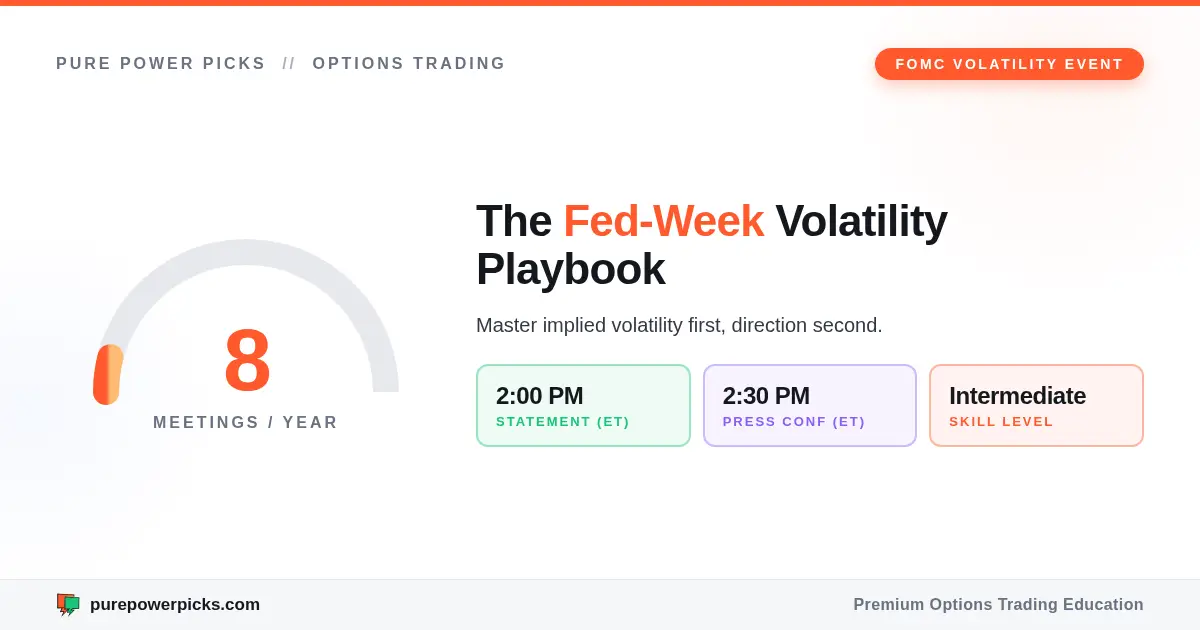
The Federal Open Market Committee is the policy arm of the Federal Reserve that sets the target federal funds rate. It meets eight times a year, and each announcement is a scheduled volatility event that reprices stocks, bonds, and options.
The move is often violent in both directions. Markets can spike up on the initial headline, then reverse hard during the press conference when the Fed Chief explains the reasoning. That two-part structure, the statement and then the Q&A, is why Fed day chops up traders who commit too early. You can read more about the raw mechanics of these events in our breakdown of implied volatility explained during market shocks.
What Is the FOMC Timeline and How Do You Structure Trades Around It?
The FOMC timeline is fixed and predictable, and that predictability is your edge. The statement drops at 2:00 PM ET, and the Fed Chief’s press conference begins at 2:30 PM ET. The 30-minute window between them is where the real fireworks happen.
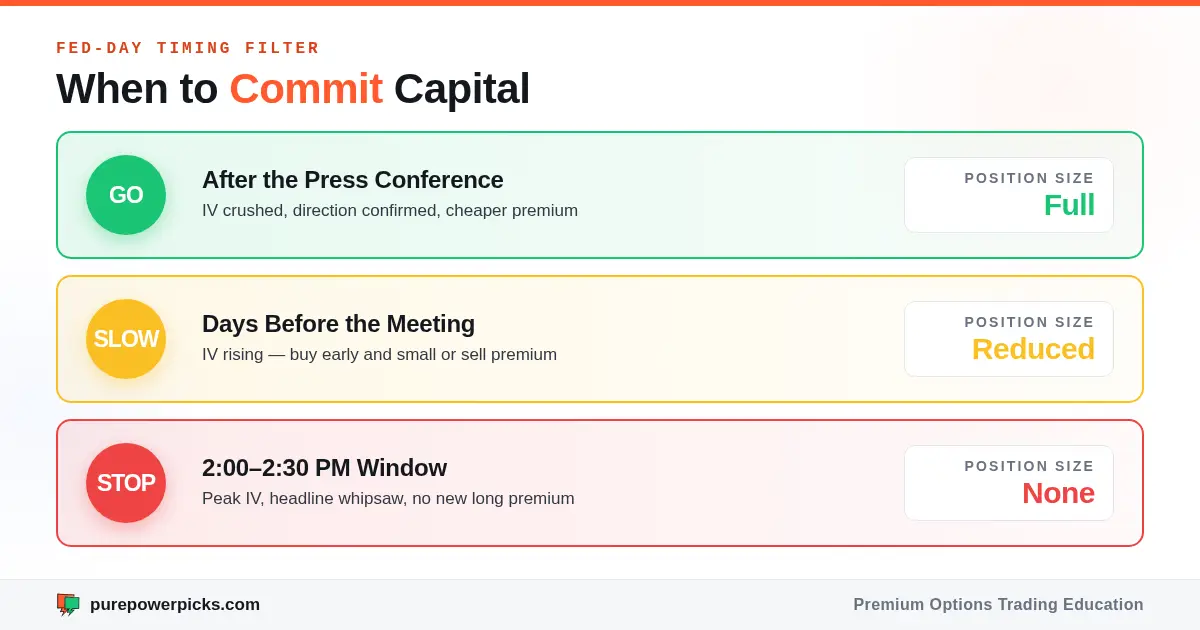
Structure your approach in three phases. Before the meeting, IV is climbing and premiums are rich. During the announcement, price whipsaws as algorithms digest the statement. After the press conference, the move usually settles into a cleaner trend once the market has fully processed the message.
How the Three Phases Compare
The cleanest opportunity for most traders comes after the press conference. IV has already crushed, so you’re buying cheaper premium, and the market has committed to a direction. If you’re going to trade the same-day contracts, review our guide on trading same-day expiries before you touch a 0DTE around Fed day, because those contracts move with brutal speed.
Don’t fade the first spike. The initial move on the 2:00 PM statement is often a headline reaction that reverses when the Fed Chief speaks at 2:30. Let the press conference confirm the real direction before you size up. Patience beats prediction on Fed day.
What Is IV Crush After Fed Announcements and Why Must Every Options Trader Understand It?
IV crush is the rapid collapse of implied volatility that happens the instant a scheduled event resolves. Before the FOMC decision, uncertainty is priced into options as elevated IV. Once the decision is public, that uncertainty vanishes, and the inflated premium deflates fast, sometimes in a single minute.
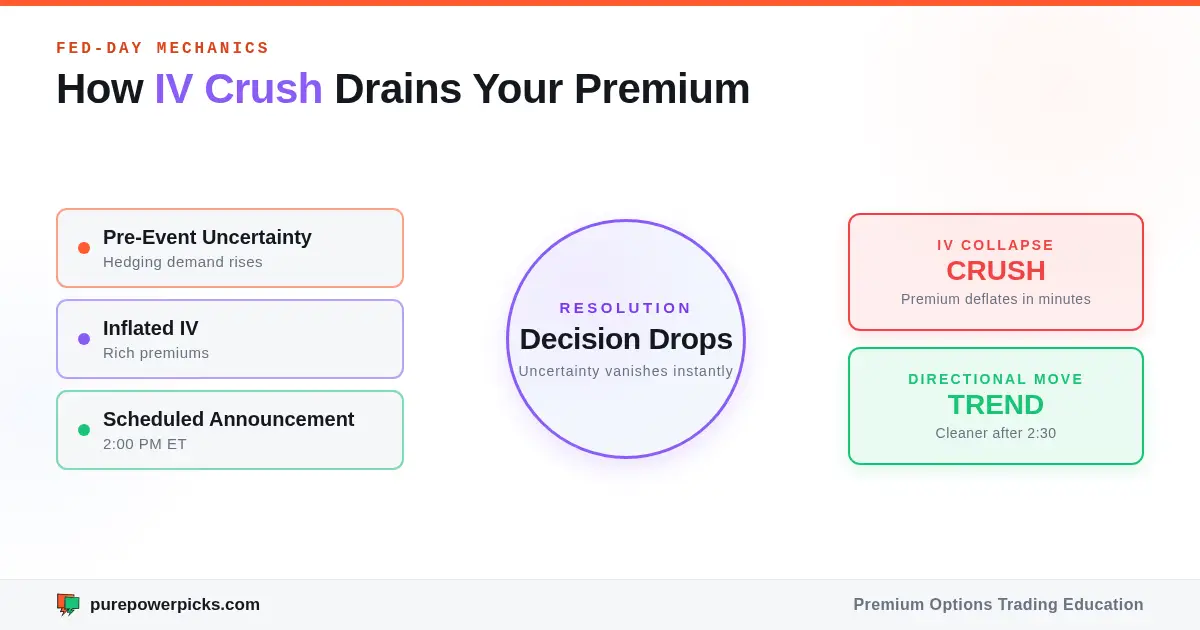
A sharp drop in an option’s implied volatility after a known event passes. Because IV is a major input to option pricing, a crush can drain value from your contract even if the stock moves in your favor.
This is the concept that separates traders who understand options from traders who just gamble on direction. You can buy a call, watch the underlying rally after the Fed announcement, and still lose money because the volatility component of your premium evaporated. To fully internalize this, work through our deep dive on IV crush around events and how it distorts pricing.
The lesson is simple. When you buy long options into a Fed meeting, the underlying has to move enough to overcome both the direction requirement and the IV deflation. The Options Industry Council’s education resources offer free tools to help you understand how volatility feeds into option pricing before you risk capital.
Understanding IV crush is exactly the kind of skill that turns a guesser into a trader.
At Pure Power Picks, every alert comes with a detailed trade plan: key levels, risk zones, and the reasoning behind the setup, so you learn to see it yourself.
What Are the Best Options Strategies for Fed Week?
The best FOMC options strategy depends on what you want to bet on: direction, volatility, or the crush itself. There are three main approaches, and each fits a different read on the meeting. Understanding which one matches your thesis is the entire game.
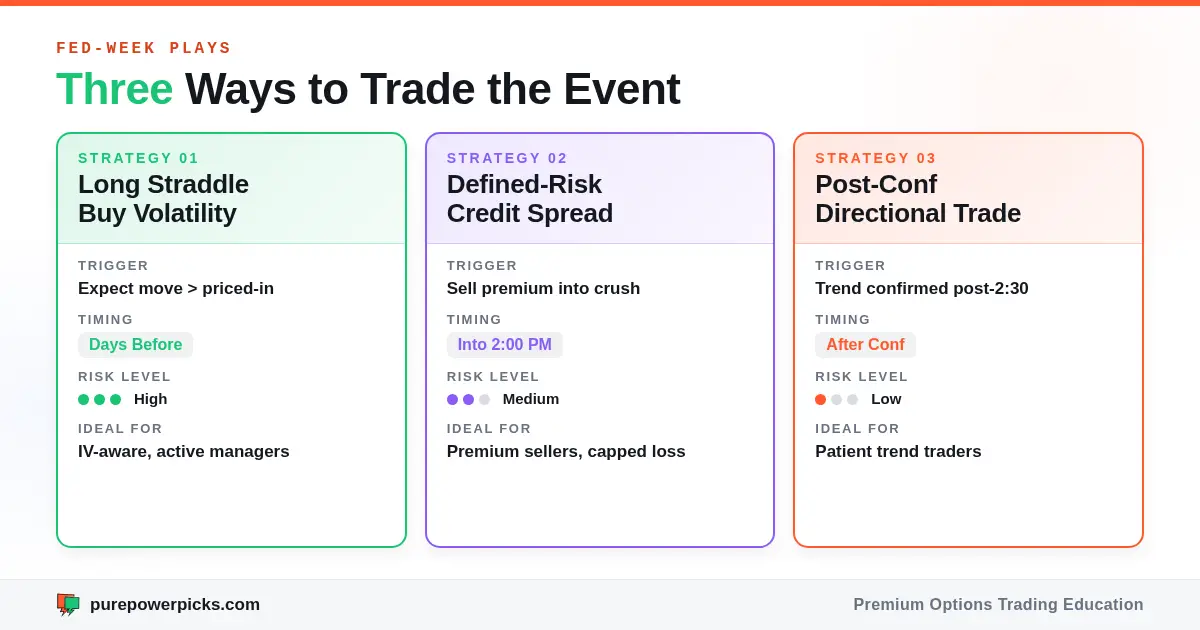
If you have no directional conviction but expect a big move, a straddle or strangle buys both a call and a put. The catch: you’re buying into peak IV, so the move must be large enough to overcome the crush. If you believe the move will be smaller than the market has priced, selling premium with defined-risk spreads like an iron condor strategy or a credit spread strategy lets you profit from the IV crush itself.
- You know your maximum loss before you enter
- You can profit from IV crush instead of fighting it
- Less sensitive to being slightly wrong on direction
- No panic if the underlying whipsaws intraday
- Capped upside compared to a naked long option
- Multiple legs mean more commissions and complexity
- A move outside your range can hit max loss fast
- Requires understanding of the greeks to manage well
For a purely directional read after the dust settles, a simple long call or put is cleanest. Just wait for the crush to happen first. If you’re deciding between the two after the announcement, our calls vs puts strategy guide walks through the exact decision framework. And before you commit real size, make sure you understand the option greeks that matter, especially vega, which measures your exposure to that volatility collapse.
A Hypothetical Fed-Day Example
Let’s walk through a hypothetical example. Say a broad market ETF is trading at $500 the morning of the FOMC decision. IV on the weekly options is elevated because everyone expects fireworks. A trader who wants pure direction after the news waits.
At 2:00 PM the statement drops and the ETF spikes to $503, then reverses to $499 when the Fed Chief clarifies the outlook at 2:30. By 2:45, the market has committed and the ETF trends up toward $505. The trader who waited for the crush and the confirmation buys a defined-risk call debit spread with strikes at $503 and $508, risking a known amount and targeting the emerging trend. This is illustrative only, using round numbers to show the concept, not a real trade.
Fed day whipsaws are notorious for triggering emotional decisions. Chasing the first spike, revenge trading after a reversal, and oversizing because “this is the big one” are how accounts blow up. Review our guides on psychology mistakes during volatility and risk management rules before you trade a single Fed announcement.
What Are July 2026 Traders Watching With Fed Chief Warsh at the ECB Forum?
Right now, July 1, 2026, the market’s attention is locked on Fed Chief Kevin Warsh speaking at the ECB forum on central banking. He’s addressing rates and a potential overhaul of central bank structure, and that combination is exactly the kind of headline that spikes implied volatility outside of a scheduled FOMC meeting.
Here’s why this matters for your options trading during Fed announcements. Unscheduled remarks from a Fed Chief can move markets almost as violently as the meetings themselves, but they catch unprepared traders off guard because there’s no fixed 2:00 PM timestamp to plan around. Volatility can gap in seconds on a single quotable line.
Your playbook is the same principle applied to an unscheduled event. Watch how IV reacts, don’t chase the first headline pop, and let the market digest the full context before committing capital. You can track the actual policy backdrop and rate data directly through the Federal Reserve’s FEDFUNDS series.
Frequently Asked Questions
What time does the FOMC decision actually move the market?
The statement drops at 2:00 PM ET and the chair’s press conference starts at 2:30 PM ET, and both legs are tradable events. The first move on the statement frequently reverses during the press conference, which is why experienced traders treat 2:00–3:00 PM as one continuous event rather than a single print.
Should you hold options positions through an FOMC announcement?
Only if the position is defined-risk and sized so a full IV crush plus an adverse move won’t break your risk plan. Long premium held through the decision fights both the post-event volatility collapse and the whipsaw. Most traders are better served either closing beforehand or waiting for the dust to settle.
How early does IV start building before a Fed meeting?
Options expiring just after the meeting usually start pricing in the event five to ten trading days ahead, and the ramp accelerates in the final 48 hours. That build is exactly why buying premium late is expensive and why the crush after the decision is so sharp.
Which strategies work best during FOMC weeks?
Before the meeting, defined-risk structures that don’t depend on cheap premium — debit spreads sized small — keep the IV bill manageable. After the decision, the IV crush favors patient entries on the post-event trend once the press-conference reversal risk has passed. Whatever the structure, position size matters more than strategy selection during Fed week.
Our trade plans lay out the key levels, risk zones, and reasoning before the event hits — so you learn to navigate the volatility instead of getting whipsawed by it.
Explore more trading guides to keep sharpening your edge.
Disclaimer: Pure Power Picks is not a licensed financial advisor. All content is for educational and informational purposes only and should not be considered investment advice. Options trading involves substantial risk of loss and is not suitable for all investors. Past performance does not guarantee future results.
Share

The PPP Team is the research and editorial team behind Pure Power Picks. We trade stocks and options and publish the work as we do it, with every alert tracked in public. Publishing since 2020. How we research and correct our work is written out in our editorial standards. Our content is strictly educational, never advice.