

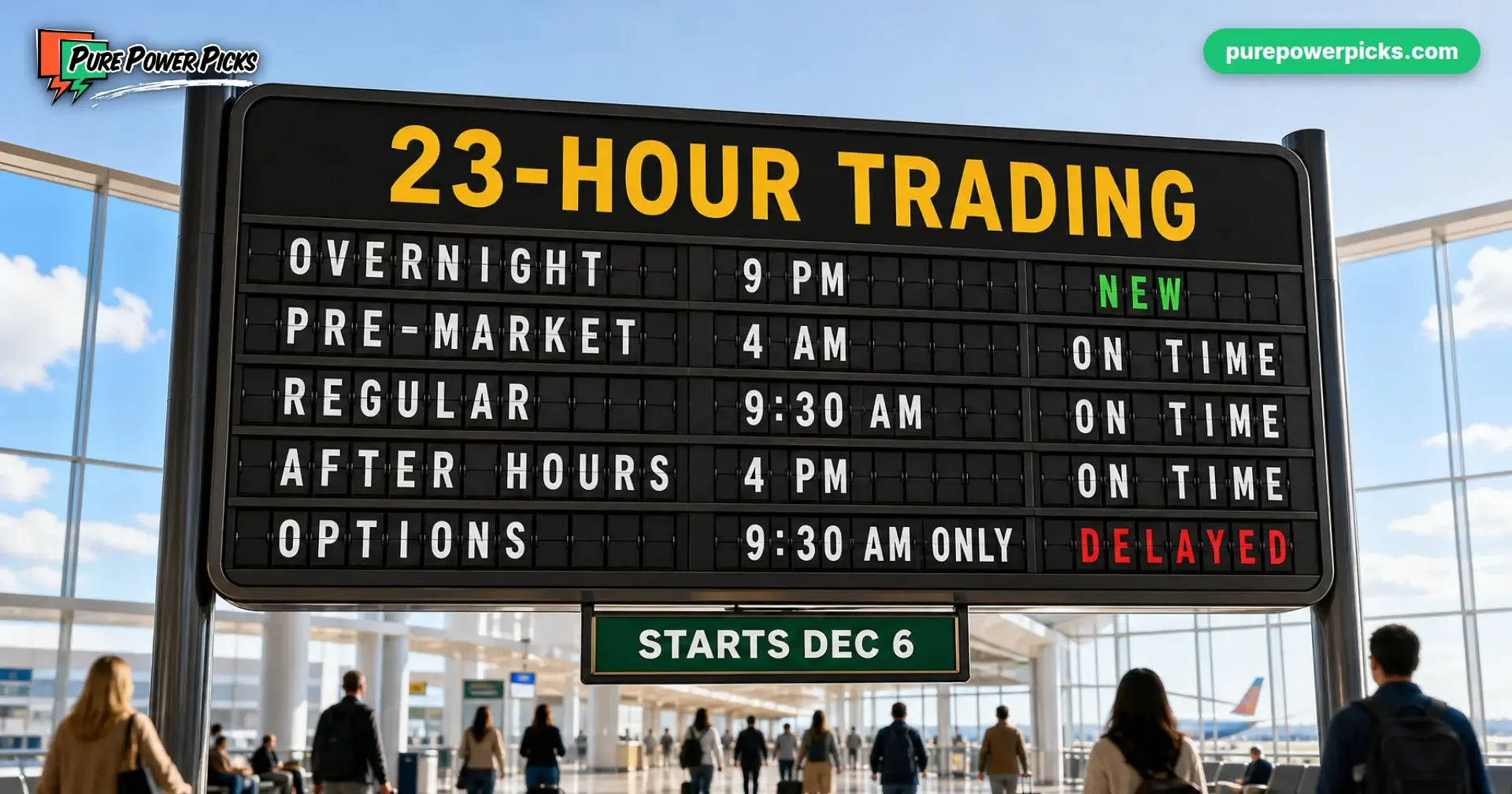
23-Hour Trading Starts Dec 6: What Changes for Stock and Options Traders
Share


Starting the night of Sunday, December 6, 2026, you will be able to buy and sell US stocks on a major exchange at 2 AM. Nasdaq, NYSE Arca and Cboe are adding an overnight session that runs from 9 PM to 4 AM Eastern, which turns the stock market into a 23-hour trading day, five days a week. It is the biggest change to US market hours in decades. For stock traders it means more chances to react to news. For options traders it means something less obvious: the stock will move all night, and your options still will not trade until morning.
This guide covers the new schedule, which exchanges are involved, the rules of the overnight session, and what 23/5 trading means for anyone who holds options overnight. The numbers come from the exchanges’ own rule filings and notices, SEC releases, and real market data we pulled for this post.
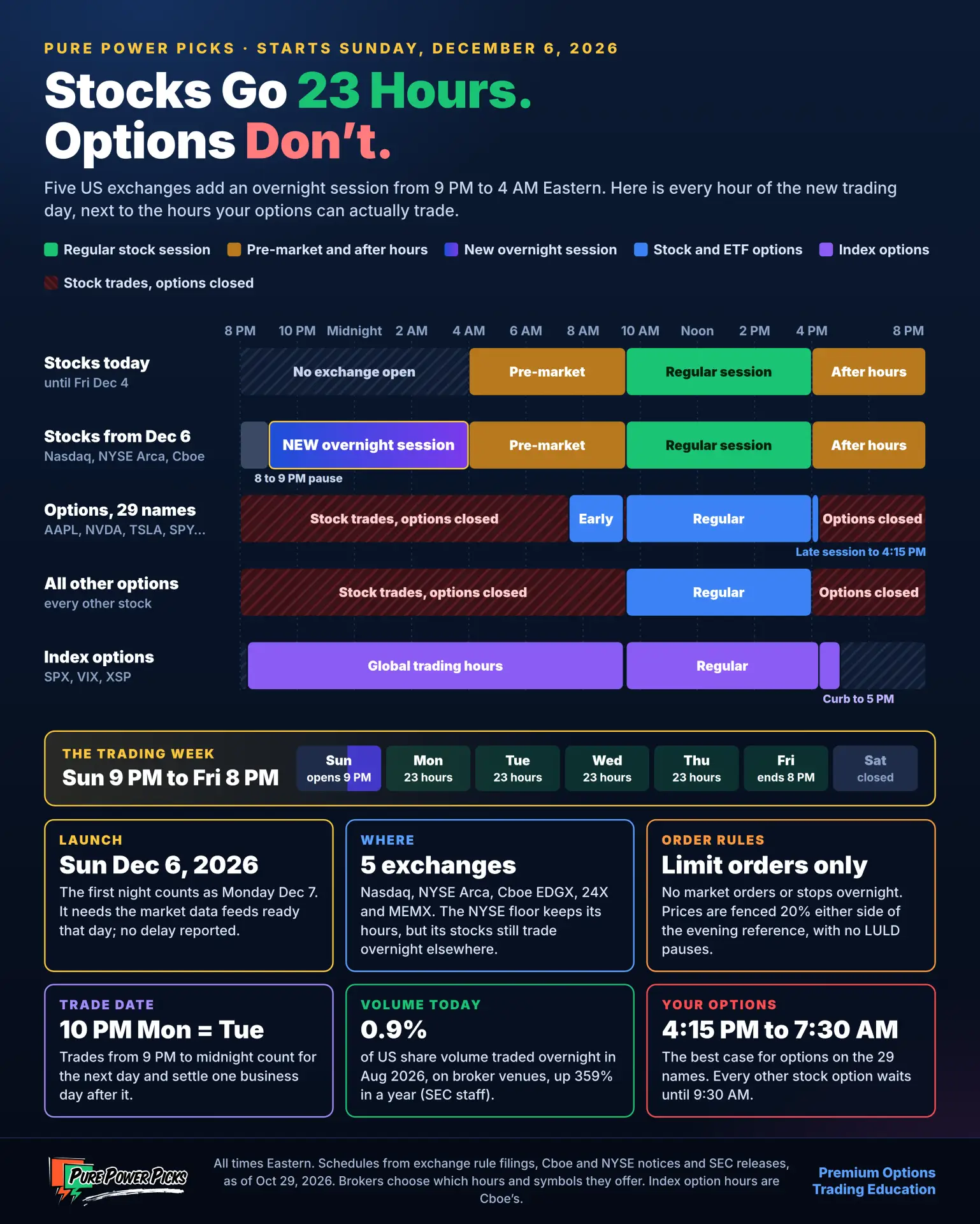
From Dec 6, 2026, US stocks trade 23 hours a day, Sunday 9 PM to Friday 8 PM Eastern, with a one-hour pause from 8 PM to 9 PM. The overnight session takes limit orders only. Single-stock options do not trade overnight: 29 popular names now trade from 7:30 AM, and every other stock option still opens at 9:30 AM.
What Is 23-Hour Trading?
23-hour trading, often written 23/5 trading, means US-listed stocks and ETFs trade on regulated exchanges for 23 hours a day, five days a week. The trading week opens Sunday at 9 PM Eastern and closes Friday at 8 PM Eastern. The one missing hour each weeknight, 8 PM to 9 PM, is a maintenance pause the exchanges and the market data feeds need to reset for the next trading day. Weekends stay closed.
Exchange trading of US stocks 23 hours a day, 5 days a week. It is not 24/7: there is a nightly one-hour pause, and nothing trades on exchanges from Friday 8 PM to Sunday 9 PM.
Overnight stock trading is not new. Retail brokers such as Robinhood, Charles Schwab, Interactive Brokers and Webull already offer it, routed to private venues called alternative trading systems, or ATSs. What changes on Dec 6 is that the overnight session moves onto exchanges, with exchange rules, a consolidated quote and trade feed for the whole market, and the same clearing system as the regular day. Nasdaq’s 23/5 page lays out its version of the plan.
When Does 23-Hour Trading Start?
The first overnight session opens at 9 PM Eastern on Sunday, December 6, 2026. Trades made that night count as Monday, Dec 7 trades. The SEC approved Nasdaq’s plan on April 10, 2026, and Nasdaq said in its third-quarter results on Oct 22 that it “remains on track to go live with 23/5 trading on December 6, 2026.” NYSE Arca and Cboe EDGX have published the same date.
The launch depends on one piece of plumbing: the securities information processors, or SIPs, that publish the official quote and trade feed for every US stock. The SEC approved their move to 23/5 hours in June 2026, effective Dec 6. Clearing is already done: the DTCC’s clearing house went live with 24×5 clearing on June 29, 2026. If the data feeds were to miss Dec 6, the SEC has given 24X permission to start its overnight session without them on Jan 24, 2027. As of Oct 29, no delay has been reported.
Cboe EDGX runs test symbols in its overnight session from Nov 9, 2026. If your broker lets you see EDGX test data, that is the first look at how the new session behaves before real money is on the line.
What Are the New Stock Market Hours?
The daytime sessions do not change. Pre-market still opens at 4 AM, the regular session still runs 9:30 AM to 4 PM, and after hours still ends at 8 PM. The overnight session fills the gap that used to sit between 8 PM and 4 AM.
Holidays follow a simple rule. When the market is closed for a holiday, the overnight session that night still opens at 9 PM. On New Year’s Day, Thursday, Jan 1, 2027, for example, trading resumes at 9 PM that evening for the Friday trade date. The NYSE extended hours FAQ walks through the calendar in detail. For the daytime sessions themselves, see our guide to pre-market and after-hours trading.
Which Exchanges Offer 23/5 Trading?
Five stock exchanges hold SEC approval to run an overnight session, each conditional on the data feeds being ready:
- Nasdaq. The Nasdaq Stock Market runs a Night Session from 9 PM to 4 AM for all NMS stocks. Nasdaq’s other exchanges, including its options markets, keep their current hours.
- NYSE Arca. The New York Stock Exchange’s electronic market adds an Overnight Session before its Early, Core and Late sessions.
- Cboe EDGX. Moves to a 23×5 schedule for every NMS security. Cboe’s other stock exchanges, BZX, BYX and EDGA, are not adding overnight trading.
- 24X National Exchange. A newer exchange built for around-the-clock trading. It has been trading in the daytime since October 2025.
- MEMX. Approved for 23×5 trading; its exact start date has not been published.
Does the NYSE have 23-hour trading? Not on the main exchange. The New York Stock Exchange itself and NYSE American keep their current hours. NYSE-listed stocks will still trade overnight, though, because Nasdaq’s Night Session and Cboe EDGX accept every NMS stock, wherever it is listed.
Is the Stock Market Open 24 Hours Now?
No. Even after Dec 6, US exchanges are open 23 hours a day on weekdays and closed from Friday 8 PM to Sunday 9 PM. Some brokers already advertise “24 hour” trading, and Robinhood calls its product the 24 Hour Market, but those orders go to ATSs rather than exchanges, and each broker picks which stocks it offers. Robinhood’s runs from Sunday 8 PM to Friday 8 PM Eastern. Schwab offers 24/5 trading on more than 1,100 stocks and ETFs. True 24/7 stock trading is still a plan: 24X has asked the SEC to let it trade around the clock in 2027.
The private-venue model has already shown its weak spot. On Monday, Aug 5, 2024, during the global sell-off triggered by the yen carry trade unwind, the overnight venue Blue Ocean ATS cancelled every trade executed from 1:45 AM to 3:06 AM Eastern and halted. Robinhood suspended its 24 Hour Market, and Korean regulators said about 90,000 accounts in Korea had trades cancelled. Moving the session onto exchanges with consolidated data and exchange-level price limits is meant to make nights like that less likely.
How Does Overnight Trading Work?
The overnight session is not a copy of the regular day. The rules are tighter, the market is thinner, and some familiar tools do not work.
- Limit orders only. All five exchanges accept only priced orders overnight. No market orders, no pegged orders, and no stop orders. If you are not sure how each order type behaves, start with our guide to order types for stock and options trading.
- 20% price bands. Prices are fenced 20% above and below reference prices set at 7:45 PM, and the bands stay fixed all night. There are no automatic Limit Up Limit Down pauses overnight.
- Halts last until morning. If a stock’s listing exchange halts it overnight, it stays halted for the rest of the session. Stocks with a split, merger, symbol change or similar corporate action that takes effect the next day are halted overnight and reopen at 8 AM.
- Orders do not carry over at the exchange. Nasdaq cancels resting orders at 4 AM and at 8 PM. Your broker may hold a good-till-cancelled order and resend it, but check how yours handles it.
- No auction at 9 PM. The session opens straight into continuous trading. The official opening and closing prices are still set at 9:30 AM and 4 PM.
- Overnight prints do not set the last price. Overnight trades are marked as extended-hours trades. They count in volume, but they are not “last sale” eligible, and fund prices still strike off the 4 PM close.
Thin markets punish market-style thinking. Overnight volume is a small fraction of the day’s, quotes can be far apart, and a large limit order can move the price. Price your orders where you are willing to trade, and read up on the difference between the bid and the ask before your first overnight trade.
Overnight trades count toward the next trading day
A trade from 9 PM to midnight gets the next calendar day’s trade date. A trade from midnight to 4 AM keeps that day’s date. Settlement stays T+1 from the trade date. NYSE’s own example: a trade at 10 PM on Monday, Nov 23, 2026 gets a trade date of Tuesday, Nov 24 and settles Wednesday, Nov 25. That matters for anyone tracking the wash sale rule, settled cash in a cash account, or a trade on the last evening of a month, which counts as next month’s trade.
Can You Trade Options Overnight?
No. Stock and ETF options do not trade in the 9 PM to 4 AM session. Options clear through the Options Clearing Corporation on a separate schedule, and the industry is extending options hours in small steps. An OCC executive put it plainly in May 2026: “We’re not going to be at 23/5 or 24/7 in the options market anytime soon.”
The first step has already happened. On Oct 19, 2026, Cboe and NYSE American launched early and late sessions for options on 29 heavily traded names: AAPL, AMD, AMZN, AVGO, BABA, BAC, F, GOOG, GOOGL, HOOD, INTC, META, MRVL, MSFT, MU, NFLX, NOK, NVDA, ORCL, PFE, PLTR, SNDK, TSLA and TSM, plus the GLD, IWM, QQQ, SPY and XLF ETFs. Cboe says options on those names made up about 53% of US options volume in 2026. These sessions take limit orders only; NYSE American does not accept market, stop or good-till-cancelled orders in them.
Index options are the exception, and they are not new. Cboe’s global trading hours for SPX, VIX and XSP options have run from 8:15 PM to 9:25 AM for years. If you want an overnight hedge on the broad market, that is the one options market that is open.
What Happens to Options You Hold Overnight?
This is the part most 23-hour trading articles skip. From Dec 6, the stock under your option can trade for 13 hours after the options market closes. For most names, the options stay frozen from 4 PM until 9:30 AM. Your position is still exposed to every one of those moves; you just cannot do anything about it with options.
Lam Research’s earnings on Oct 21, 2026 show what that looks like. Lam is not on the extended options list, so its options stopped at 4 PM like almost every other stock’s.
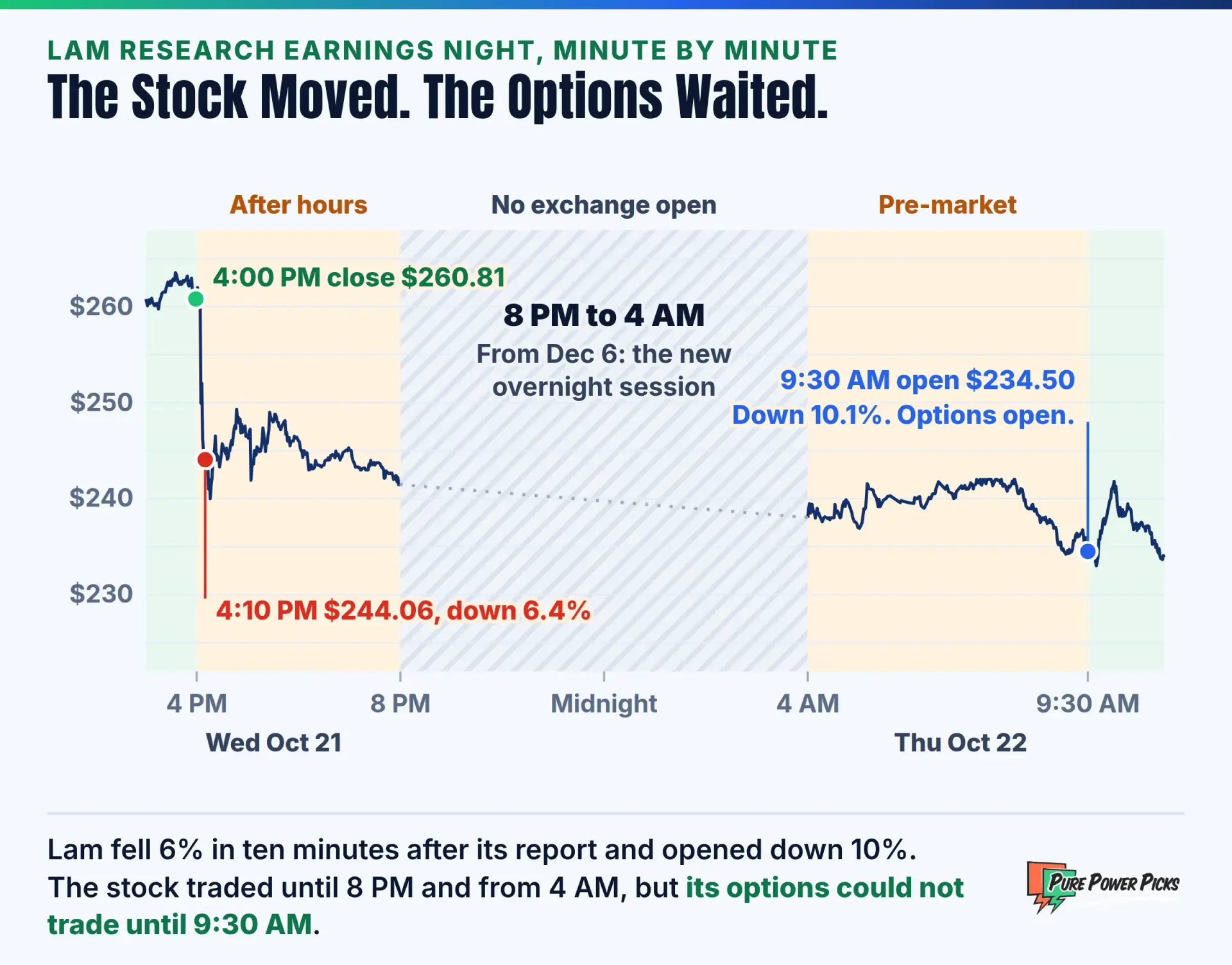
Lam closed at $260.81. Ten minutes after its report it was at $244.06, down 6.4%. It drifted lower through the evening, traded at $238.03 when the pre-market opened at 4 AM, and opened the regular session at $234.50, down 10.1%. Anyone holding Lam calls watched all of it and could not sell a single contract until 9:30 AM. From Dec 6, the same stock would also trade from 9 PM to 4 AM, closing the last dark stretch in the chart. The options would still wait.
Three practical consequences follow:
- Your stops cannot protect you overnight. Stop orders on options do not trigger while options are closed, and stops on stock are not accepted in the overnight session. Our guide to stop losses covers why a stop is never a guaranteed exit.
- The option opens at the new price. When options open, market makers price them off wherever the stock has traded overnight. There is no catching up: the gap is in the option’s price from the first quote.
- Size for the gap, not the stop. If an option position would hurt at a 10% overnight gap, it is too big to hold overnight. Our position sizing guide for options shows how to set that limit.
Why the Overnight Move Matters So Much
It is tempting to think of the overnight hours as dead time. The data says the opposite. We split QQQ’s history since March 1999 into two pieces: the move from each day’s close to the next morning’s open, and the move from the open to the close. Holding QQQ only overnight would have turned $10,000 into about $356,258. Holding it only during market hours would have left $4,739. Buy and hold, which captured both, ended near $168,816.
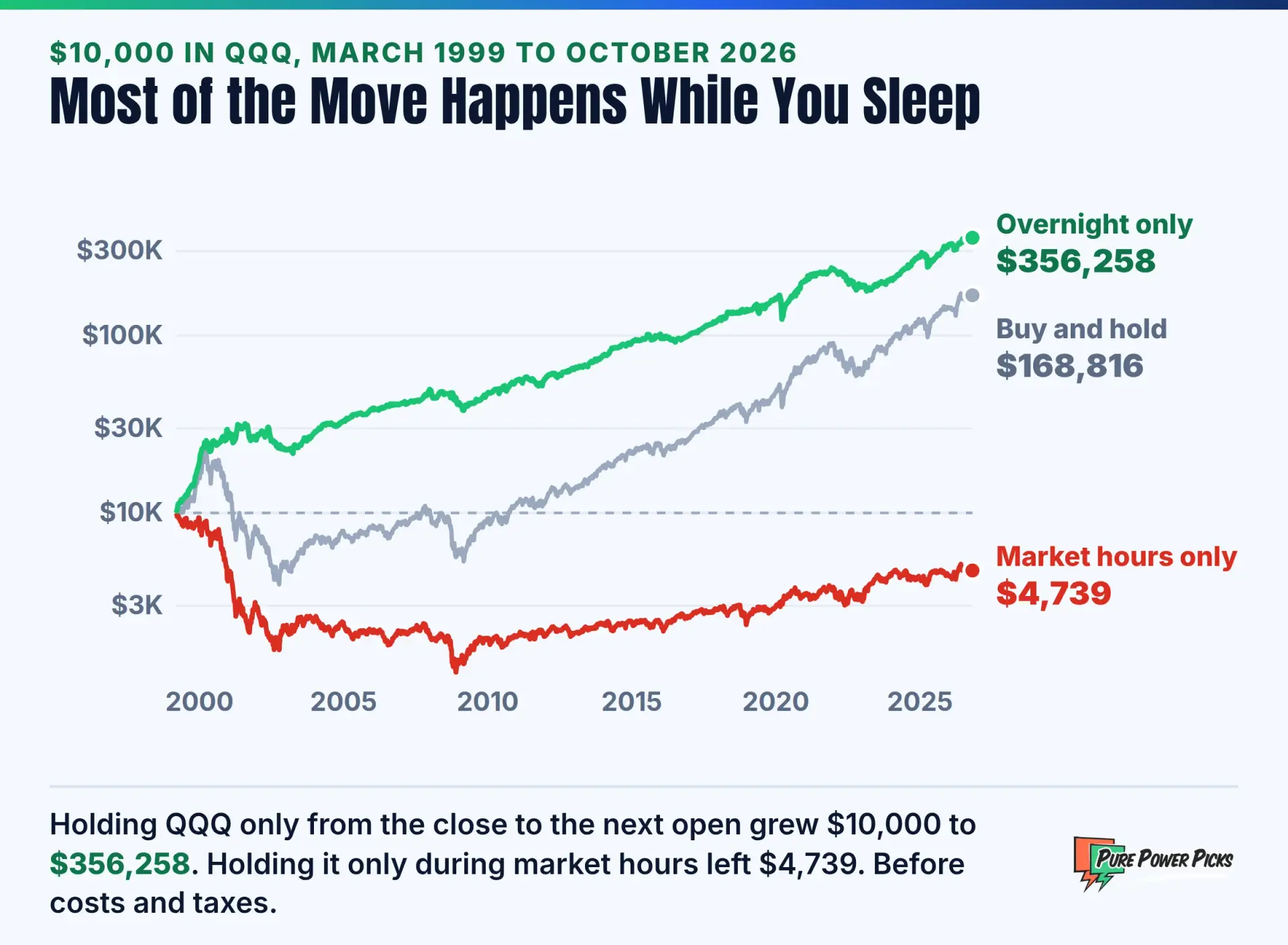
The S&P 500 shows the same split. SPY held only overnight since January 1993 grew $10,000 to about $252,394, while the market-hours half grew it to $12,721. Researchers at the Federal Reserve Bank of New York documented the pattern in a paper called The Overnight Drift. Nobody can trade the full overnight return by itself without paying costs that would eat much of it, so treat this as a picture of where prices move, not a strategy.
Big opening gaps are also getting more common again. QQQ has opened 1% or more away from its prior close 46 times in 2026 through Oct 28, after 49 in all of 2025 and only 26 in 2024.
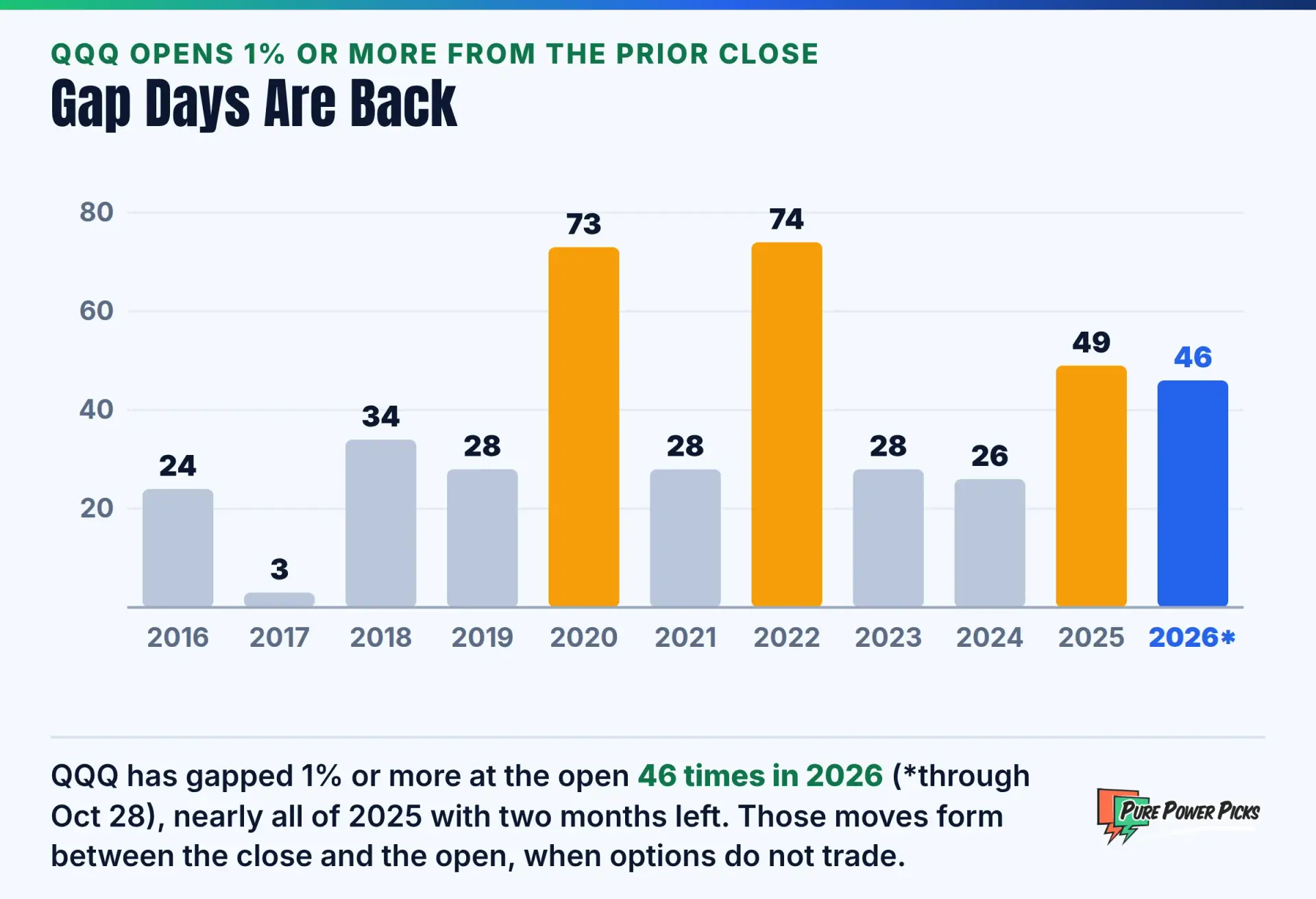
Most of the market’s move has historically happened between the close and the open, and for most stocks that is exactly when options cannot trade. 23-hour trading lets you trade the stock through that window. It does not let you trade the option.
How 23-Hour Trading Could Change the Open, Implied Volatility and Earnings Trades
Nobody knows yet how overnight exchange trading will change options pricing, so treat these as things to watch rather than predictions.
- More of the move may happen before 9:30. With exchanges open all night, more price discovery can happen before the regular session. The 9:30 open in the stock may be calmer, while options open at prices that already reflect a full night of trading.
- Market makers can hedge at night. Today, a dealer who is short options cannot easily hedge with shares at 2 AM. With exchange liquidity overnight, they can. Over time that could change how much overnight risk is priced into short-dated implied volatility. Our guide to implied volatility explains what that premium is.
- Earnings still crush at the open. Most companies report after 4 PM. The stock will now trade through the night on the news, but the options still reprice all at once when they open, so the volatility crush lands at 7:30 AM for the 29 names and 9:30 AM for the rest. Our guide to trading options around earnings covers how to plan for it.
- News at 2 AM becomes a price at 2 AM. Overseas headlines, central bank decisions in Asia and social media rumours will hit the tape in real time. That is useful information for an options trader planning the open, and a reason to read our guide to trading breaking news.
Can You Hedge Options Overnight With Shares?
In principle, yes, and this is the one new tool 23-hour trading gives an options trader. An option position has a delta, the number of shares it behaves like. Ten calls with a 0.50 delta act like roughly 500 shares. If bad news hits at 11 PM, selling about 500 shares in the overnight session offsets most of the move until the options open, at which point you can close both sides.
In practice, the hedge has limits. You need shares to sell or a margin account that allows short sales overnight, which many brokers will not offer at launch. You can only use limit orders, in a thin book, inside a 20% band. And delta changes as the stock moves, so the hedge is approximate. For most retail traders, the simpler hedge is still the one made before 4 PM: a smaller position, or a defined-risk spread instead of a naked option.
If you hold a long stock position with covered calls against it, do not sell the shares overnight to cut risk unless you also plan to buy back the calls at the open. Selling the stock leaves the calls uncovered until options trade again.
Which Brokers Will Offer 23-Hour Trading?
You can only reach the exchange sessions through a broker, and as of Oct 29, 2026 no major retail broker has said publicly whether it will route orders to the new exchange sessions on Dec 6. Here is what they offer today:
Check your own broker’s page the week of Dec 6. Hours, symbols and order types will differ from broker to broker, and the broker’s rules apply on top of the exchange’s.
Pros and Cons of 23-Hour Trading for Retail Traders
The overnight market is concentrated. SEC staff found that in August 2026 overnight trading was 0.9% of US share volume, up 359% from a year earlier, and the 10 busiest names made up 43% of it. Foreign accounts were about 37% of overnight volume. If you trade a smaller stock overnight, you may be one of very few people doing so.
For day traders, two more points. The pattern day trader rule is gone (see our note on the PDT rule being eliminated), so overnight round trips are not counted against a four-trade limit. And because a trade after 9 PM belongs to the next trading day, a buy at 10 PM and a sell at 10 AM the next morning is a same-day trade on your statement.
Frequently Asked Questions
When does 23-hour stock trading start?
The first overnight session opens at 9 PM Eastern on Sunday, December 6, 2026, and its trades count for Monday, Dec 7. Nasdaq, NYSE Arca and Cboe EDGX have all published that date. It depends on the market data feeds being ready, and no delay had been reported as of Oct 29, 2026.
Is the stock market open 24 hours a day now?
No. From Dec 6 the exchanges are open 23 hours a day, five days a week, with a pause from 8 PM to 9 PM Eastern on Monday through Thursday. Nothing trades on exchanges from Friday 8 PM to Sunday 9 PM. Some brokers offer overnight trading through private venues, but no US stock exchange is open 24/7.
Can you trade options overnight or after hours?
Stock and ETF options do not trade overnight. Since Oct 19, 2026, options on 29 popular names, including AAPL, NVDA, TSLA, SPY and QQQ, trade from 7:30 AM to 9:25 AM and from 4:00 PM to 4:15 PM Eastern. All other stock options trade 9:30 AM to 4:00 PM. Index options such as SPX, VIX and XSP trade overnight from 8:15 PM in Cboe’s global trading hours.
What are the overnight stock trading hours?
The new exchange overnight session runs from 9:00 PM to 4:00 AM Eastern, which is 6:00 PM to 1:00 AM Pacific, Sunday through Thursday nights. Pre-market then runs 4:00 AM to 9:30 AM, the regular session 9:30 AM to 4:00 PM and after hours 4:00 PM to 8:00 PM.
Does the NYSE have 23-hour trading?
The main New York Stock Exchange keeps its current hours. Its sister exchange NYSE Arca runs the overnight session, and NYSE-listed stocks can also trade overnight on Nasdaq and Cboe EDGX, which accept every NMS stock.
Can I use market orders or stop losses in the overnight session?
No. All five exchanges accept only limit orders overnight, and stop orders are not accepted. Brokers may hold a stop and send it in a later session, so check your broker’s rules before relying on one.
Will 23-hour trading make stock gaps at the open smaller?
For the stock, the gap at 9:30 AM may get smaller because more trading happens overnight. For options, nothing changes: an option still opens at a price that reflects every move the stock made while the option was closed.
Do overnight trades count toward the next day’s trade date?
Yes, partly. Trades from 9 PM to midnight carry the next calendar day’s trade date, and trades from midnight to 4 AM keep that day’s date. Settlement is T+1 from the trade date, so a trade at 10 PM Monday settles on Wednesday.
Every Pure Power Picks alert comes with the entry, targets and risk marked on the chart, so you know what you are holding before the market closes and the overnight session begins.
Explore more trading guides to keep sharpening your edge.
Disclaimer: Pure Power Picks is not a licensed financial advisor. All content is for educational and informational purposes only and should not be considered investment advice. Options trading involves substantial risk of loss and is not suitable for all investors. Past performance does not guarantee future results. Trading hours, rules and broker access described here are based on exchange and SEC documents as of Oct 29, 2026 and may change before or after launch.
Share

The PPP Team is the research and editorial team behind Pure Power Picks. We trade stocks and options and publish the work as we do it, with every alert tracked in public. Publishing since 2020. How we research and correct our work is written out in our editorial standards. Our content is strictly educational, never advice.