


How to Trade Options With a Full Time Job: Real Setup
Share


Here’s how to trade options with a full time job: stop trying to beat the market minute by minute and trade on a schedule your job can survive. Use defined-risk, longer-dated strategies such as vertical spreads, covered calls, and cash-secured puts with 30 to 60+ days to expiration. Place limit orders before work, at lunch, or after the close, and set good-til-canceled (GTC) exit orders the moment you open a trade. Then spend 30 to 60 minutes a day planning and reviewing, not watching charts. Working traders don’t need speed. They need a written plan, small position sizes, and orders that do the monitoring for them. If a strategy requires you to stare at a screen during a meeting, it’s the wrong strategy for your life right now.
Your job isn’t the obstacle. Your strategy choice is. Pick defined-risk strategies with 30 to 60+ day expirations, enter every order with a limit price, and attach your profit target, stop, and time exit the day you open the trade. As a working trader, your edge is patience and process, not speed.
What You’ll Learn
- A 7-step options setup built around a 9-to-5 schedule
- A daily and weekly routine that takes 30 to 60 minutes
- The best low-maintenance strategies, compared side by side
- A fully worked hypothetical put credit spread managed with pre-set orders
- How to handle earnings, small accounts, and the most common working-trader mistakes
- A simple 30-day action plan to get started safely
How Do You Trade Options With a Full-Time Job? (The Short Answer)
You trade options with a full-time job by choosing strategies that don’t need you during market hours. That means longer expirations, defined risk, and orders placed in advance that handle your targets and stops automatically.
Trading options with a full-time job means choosing strategies that do not need intraday monitoring: 30-60+ day expirations, pre-set limit orders, and GTC (good-til-canceled) exit orders that stay active until filled or canceled.
Set your expectations now. You will not day trade from your desk, and you shouldn’t try. The working trader’s edge is patience, disciplined position sizing, and a routine you can repeat every single week.
This guide was written by the Pure Power Picks education team. We build our lessons around one reality: most of our readers have jobs, families, and commutes. Everything below is designed for people who can’t watch the open, and it’s education, not a promise of results.
Why Can Options Work for Busy Professionals, and Where Don’t They?
Options work for busy professionals because you can define your risk and plan both sides of a trade before it ever goes live. They fail when you use short-dated, high-speed strategies that demand attention you can’t give.
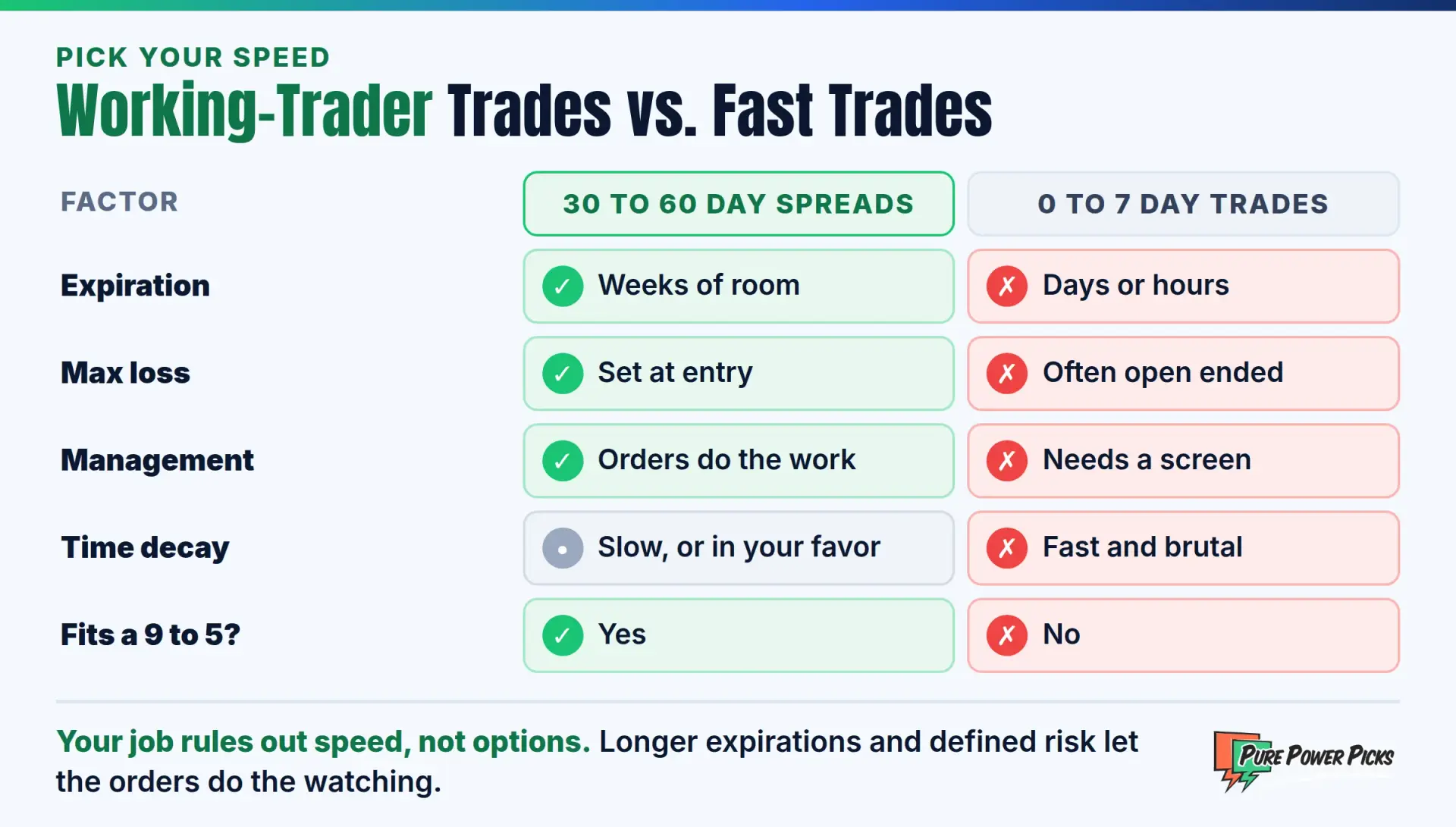
- Spreads cap your max loss in advance
- Capital efficiency: control exposure with less cash
- Targets and stops can be pre-set as orders
- Longer expirations give trades room to work
- Leverage magnifies losses as fast as gains
- Time decay works against long options every day
- Short options carry assignment risk
- The urge to check trades at work is real
Here’s what you should avoid entirely as a working trader:
- 0DTE and short-dated scalps. They can swing wildly in minutes. You can’t manage that from a meeting room.
- Naked short options. Undefined options risk, as FINRA’s investor guide explains, plus limited screen time is a dangerous combination.
- Earnings gambles without a plan. Overnight gaps don’t care about your lunch break.
If calls, puts, strikes, and expirations are still new to you, start with the fundamentals before anything else. The Options Industry Council’s free education library is a solid place to learn the basics of how to trade options for beginners.
What Does a Realistic Options Setup Around a 9-to-5 Look Like?
A realistic setup is a fixed process: a risk budget, the right broker tools, a short watchlist, one low-maintenance strategy, and exit orders placed on day one. Follow these seven steps in order.
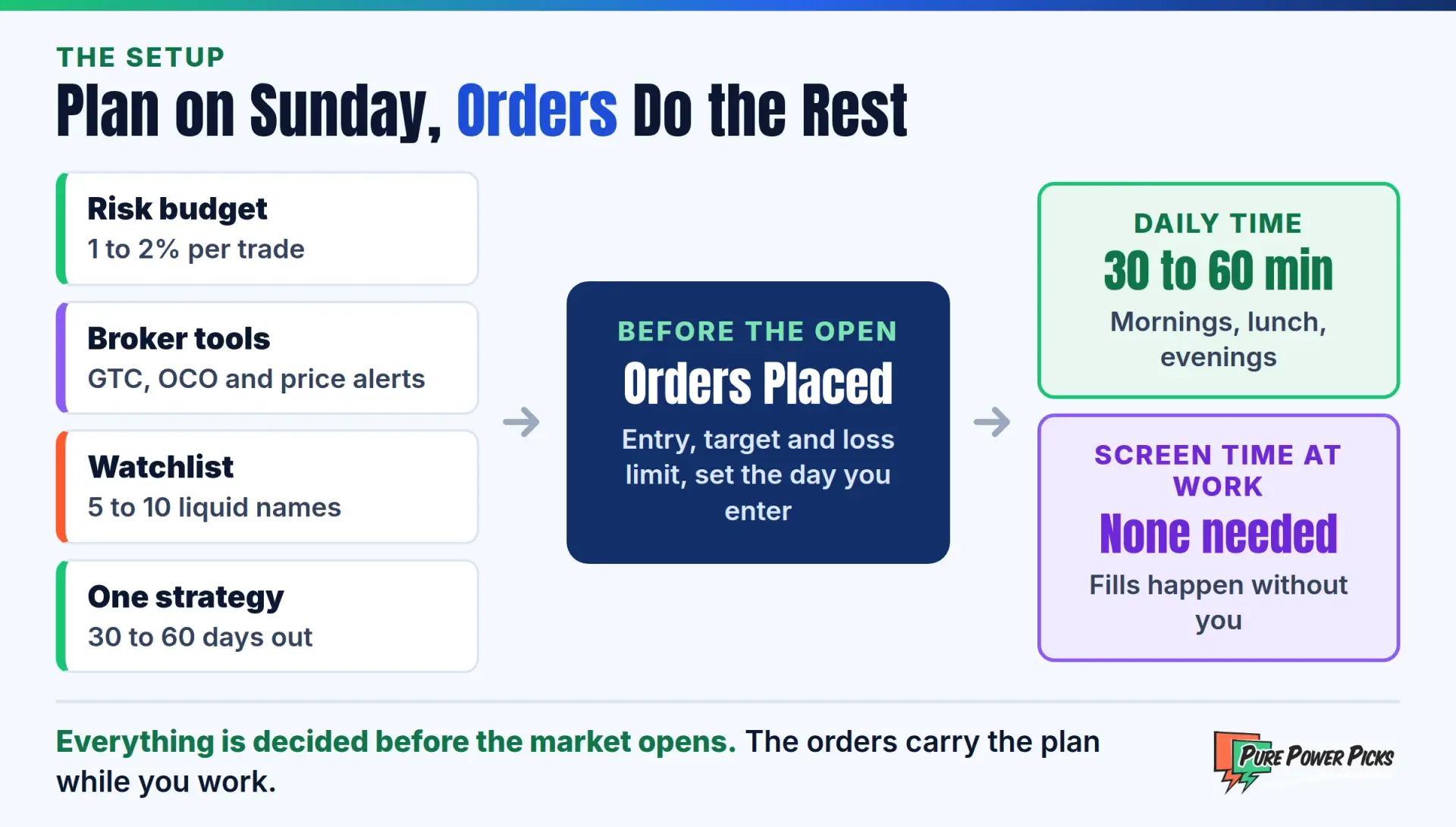
- Set a risk budget. Use only money you can afford to lose. Risk 1 to 2% of the account per trade, and cap total open risk at roughly 5 to 6% of the account at any time.
- Choose a broker built for working traders. You need a reliable mobile app, good-til-canceled (GTC) orders and conditional orders, OCO or bracket orders, and customizable price alerts.
- Build a short watchlist. Pick 5 to 10 liquid underlyings with tight bid-ask spreads, strong open interest, and weekly or monthly options.
- Pick one low-maintenance strategy. Choose spreads, covered calls, or cash-secured puts with 30 to 60+ days to expiration. Master one before adding a second.
- Enter with limit orders. Stage orders pre-market or after the close, or place them at lunch. Never use market orders on options. Our guide to limit and stop orders covers exactly how each type behaves.
- Set the exit plan on entry. Every trade gets a profit target, a max loss, and a time-based exit, entered as orders or written down before you click.
- Journal every trade and review weekly. Record the setup, the reason, the plan, and the result. Patterns in your mistakes show up fast.
What Should Your Weekly and Daily Trading Schedule Look Like?
Your schedule should take 30 to 60 minutes a day plus one planning session on Sunday. Almost all of it happens outside market hours, which is exactly why it works.
Sunday is your most important block. Spend 30 to 45 minutes reviewing the economic calendar and earnings dates, updating your list, and writing out the trades you’d take. If you need a process, here’s how to build a weekend watchlist that stays focused.
The Working Trader’s Daily Routine
Time zones matter. Regular U.S. market hours run 9:30 a.m. to 4:00 p.m. Eastern. West Coast workers get a natural advantage: the market opens at 6:30 a.m. Pacific and closes at 1:00 p.m., so you can see the open before work and review the close at lunch.
East Coast workers lose that buffer. If that’s you, lean even harder on pre-set orders and do your real work in the evening.
What Are the Best Options Strategies for People With Limited Screen Time?
The best options strategies for people with limited screen time are defined-risk spreads, covered calls, cash-secured puts, and protective puts or collars. Each one can be planned in advance and managed with standing orders.
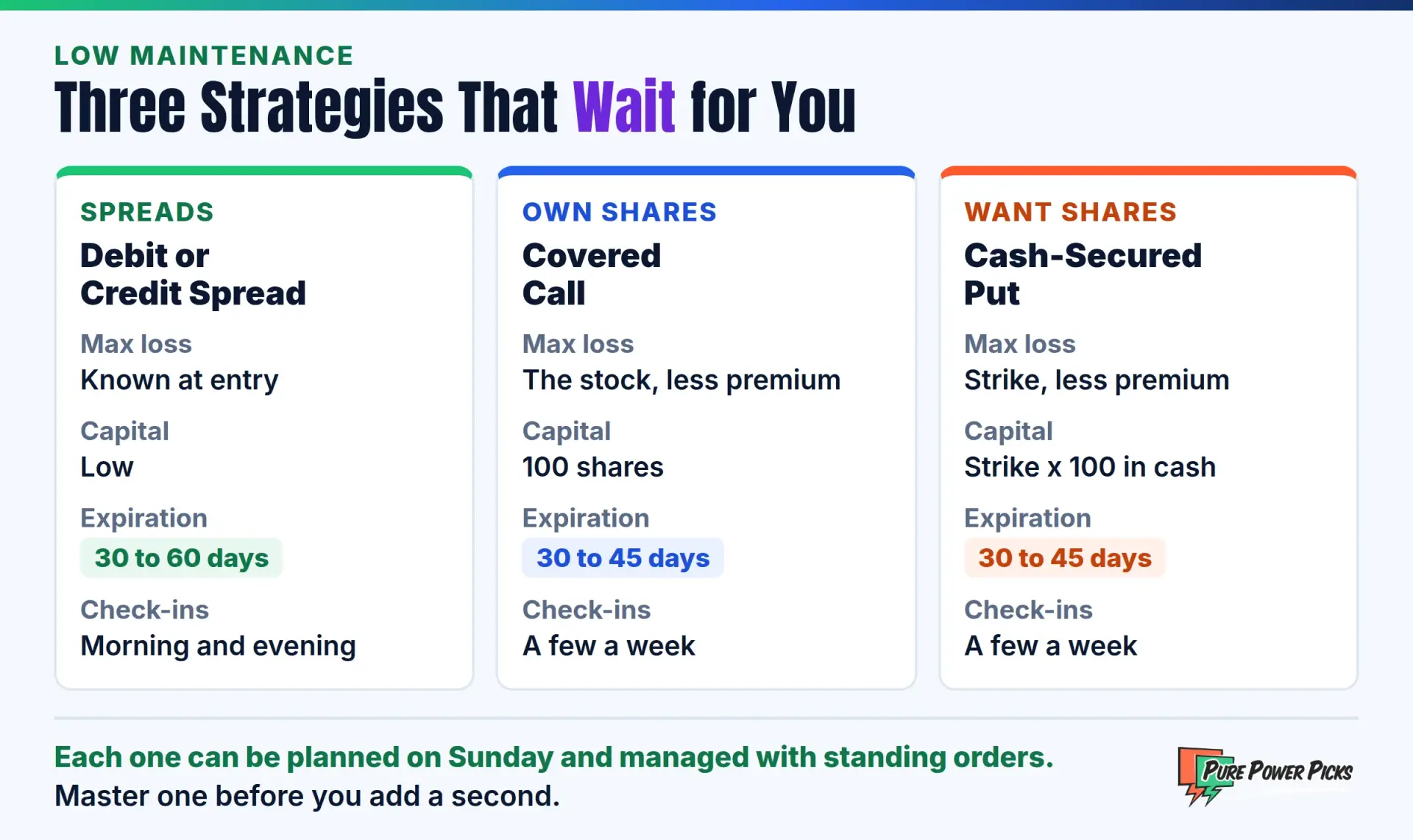
Vertical debit spreads. You buy one call (or put) and sell another further out of the money at the same expiration. Your max loss is the debit you paid, fixed the moment you enter, and your max gain is the width of the strikes minus that debit. Use it when you have a clear directional view and want the risk settled before you go to work.
Vertical credit spreads. You sell an option and buy a further out of the money one as protection, and you collect a credit up front. A put credit spread wins if the stock stays above your short strike; a call credit spread wins if it stays below. Time decay works for you every day, which suits a trader who checks in once in the morning and once at night.
Covered calls. You own 100 shares and sell a call 30 to 45 days out against them. It is the lowest maintenance strategy on this list, and the real risk is the stock itself. Our guide to options trading for income walks through strike selection.
Cash-secured puts. You sell a put on a stock you would be happy to own at a lower price and keep the cash to buy 100 shares set aside. If the stock falls below your strike, you buy it at a discount to where it traded when you sold the put. See cash-secured puts explained for the full mechanics.
Protective puts and collars. A put on shares you already hold is insurance with a known price. A collar pays for that put by selling a call above the stock, which caps your upside in exchange for a cheap or free hedge.
Low-Maintenance Strategies Compared
Pick one strategy and trade it for at least ten positions before you add a second. Ten trades of one strategy teach you how it behaves. Ten trades spread across four strategies teach you almost nothing.
How Do You Manage a Trade You Can’t Watch? A Worked Example
You manage a trade you can’t watch by placing every exit as an order on the day you enter, so the plan runs whether or not you’re at your desk. Here is how that looks on a put credit spread, start to finish.
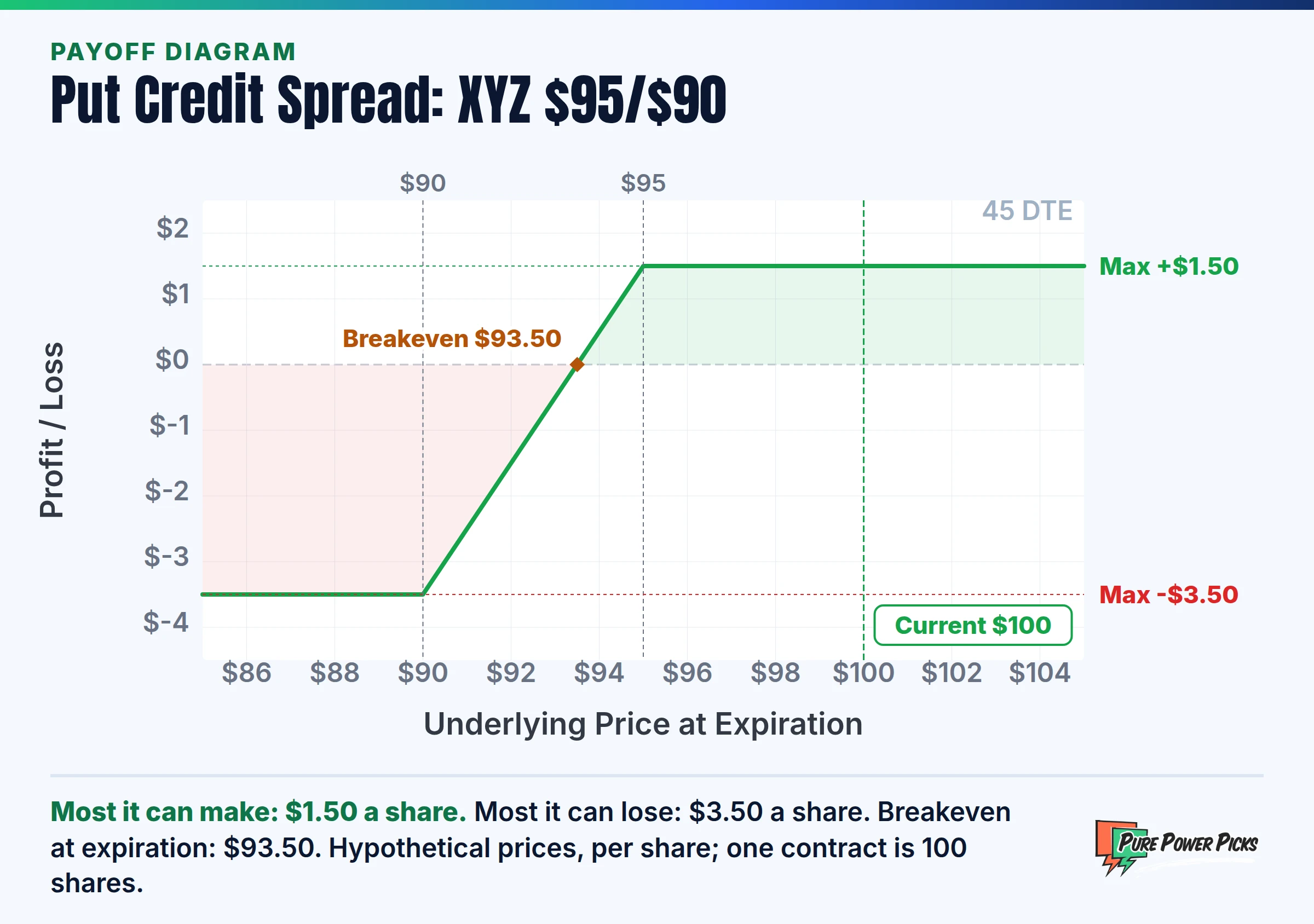
Let’s walk through a hypothetical example. You have a $20,000 account and a 2% risk budget, so no single trade can lose more than $400. Stock XYZ trades at $100 and has held $95 for months. On Sunday you plan a put credit spread 45 days out:
- Sell the $95 put and buy the $90 put for a net credit of $1.50, which is $150 per spread.
- Max loss: the $5 width minus the $1.50 credit, or $3.50, which is $350 per spread. One spread fits inside the $400 budget.
- Breakeven at expiration: $95 minus $1.50, or $93.50.
Monday at lunch you enter the spread with a limit order at $1.50. That evening you set three exits before you close the app:
- Profit target: a GTC order to buy the spread back at $0.75. That locks in $75, half the credit.
- Loss limit: a conditional order that closes the spread if XYZ trades below $96, or a price alert at $96 if your broker can’t trigger an order off the stock. Closing near there typically keeps the loss to $100 to $150, well under the $350 max.
- Time exit: a calendar reminder at 21 days to expiration to close whatever is left, because the last three weeks are when a spread moves fastest.
Three ways it can play out, none of which needs you at a screen:
- XYZ drifts up to $104. Time decay shrinks the spread to $0.75 around day 18 and your GTC order fills while you’re in a meeting. Result: +$75.
- XYZ slides to $95.80 on a soft guidance update. Your conditional order closes the spread at about $2.70. Result: about -$120, roughly a third of the max loss.
- XYZ goes nowhere. At 21 days left the spread is worth about $0.95 and you close it. Result: about +$55.
A plain stop order on an option or a spread can fill far from your price, because option quotes widen in fast markets. Trigger your loss exit off the STOCK price where your broker allows it, and remember that a gap at the open can skip past any level. Defined risk is what protects you when a stop can’t.
Want to see how a trade plan looks when the levels are set before the open?
Every Pure Power Picks alert comes with a written plan: the key levels, the risk zone and the reasoning, so you can act on it on your own schedule.
How Should Working Traders Handle Earnings?
Working traders should know every earnings date inside their expiration window before they enter, and either close before the report or size the trade so the gap is a loss they accept. A 30 to 60 day trade will often span an earnings report, and the stock can open 10% away from the close while you’re asleep.
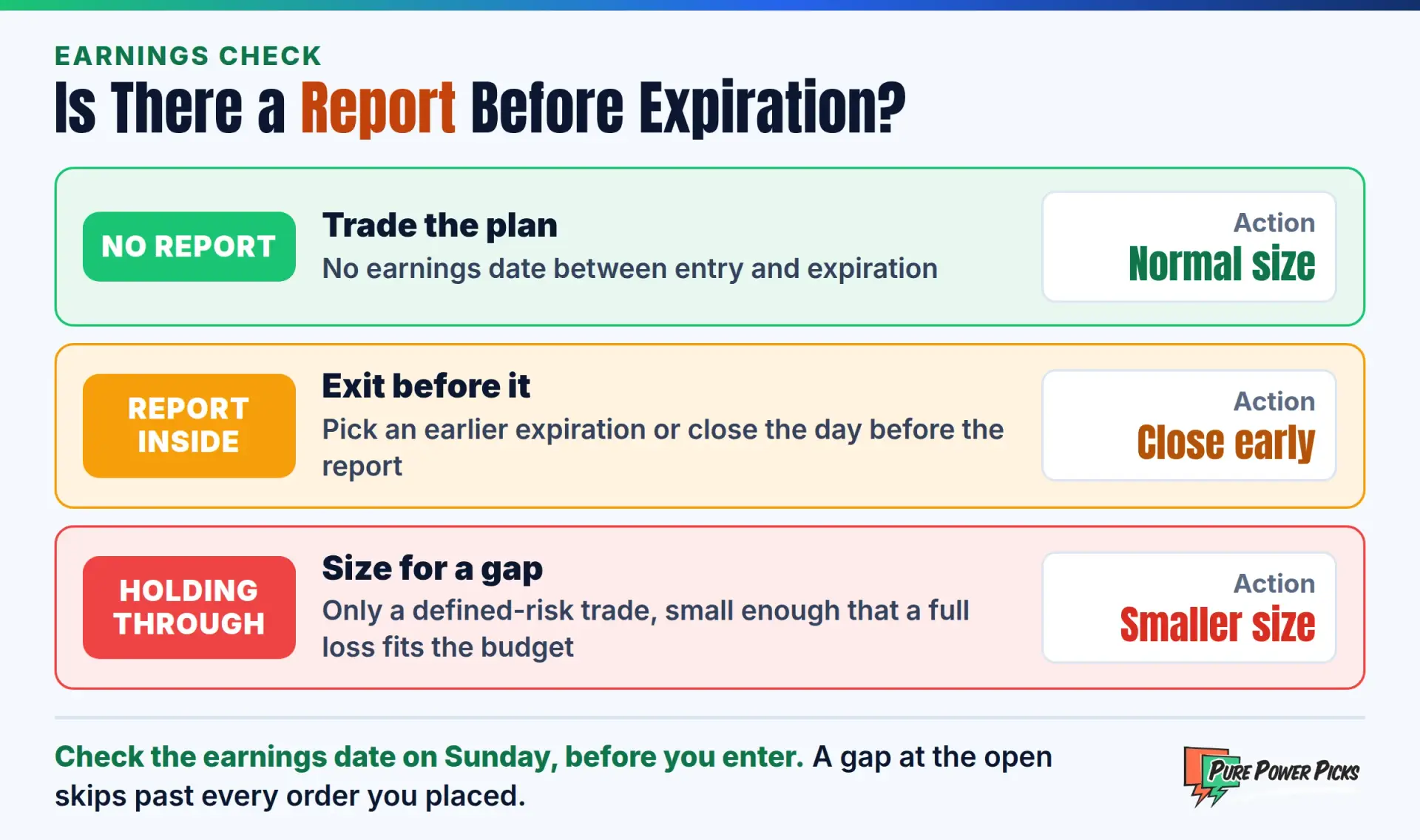
Check the date on Sunday when you build your plan. If the report falls inside your window, you have three choices: pick an expiration that ends before the report, plan to close the day before it, or trade a defined-risk spread small enough that a full loss stays inside your budget.
Option buyers have a second problem. Implied volatility rises into the report and collapses after it, so a long call can lose value even when the stock moves your way. That is one more reason a working trader should treat earnings as an event to step around, not a trade to chase.
Can You Trade Options With a Full-Time Job and a Small Account?
Yes. A small account works well with a full-time job, as long as every position is a defined-risk trade sized to the account. A $3,000 account at 2% risk has $60 to lose per trade, which points you to narrow spreads, one position at a time.
Skip covered calls and cash-secured puts on expensive stocks until the account can cover 100 shares without putting everything in one name. Our guide to options trading with a small account covers how much you need to start, and position sizing for options shows the math behind the 1 to 2% rule.
What Mistakes Do Working Traders Make Most Often?
The most common mistakes come from trading the way a full-time trader does without the screen time to back it up. Watch for these:
- Checking positions at work and closing on emotion. If the plan is in the orders, you don’t need to look.
- Using market orders at the open. Spreads are widest in the first minutes. Use limit orders, placed the night before.
- Buying short-dated options because they’re cheap. They’re cheap because they decay fast and need you to be right quickly.
- Entering without an exit order. A trade without a target and a loss limit is a hope, not a plan.
- Running too many positions. Three to five open trades is plenty for a 30 to 60 minute routine.
- Skipping the journal. A free trading journal template takes two minutes a trade and shows you which mistakes repeat.
What Does a 30-Day Plan to Get Started Look Like?
A 30-day plan to get started spends the first two weeks on setup and practice and the last two on small, real trades. Rushing the first half is how most working traders lose their first account.
Frequently Asked Questions
Can you trade options while working a 9 to 5?
Yes. Choose strategies with 30 to 60 day expirations, enter with limit orders outside market hours, and place your profit target and loss limit as orders on the day you enter. The plan then runs while you work.
How much time does options trading take with a full-time job?
About 30 to 60 minutes a day plus a 30 to 45 minute planning session on Sunday. Most of that time falls before the open, at lunch, or in the evening.
What is the best options strategy for someone with a full-time job?
Defined-risk spreads, covered calls and cash-secured puts with 30 to 60 days to expiration. Each one can be planned in advance and managed with standing orders, so none of them needs you at a screen during the day.
Should you use stop-loss orders on options?
Use them with care. Option quotes widen in fast markets, so a plain stop can fill far from your price. Trigger exits off the stock price where your broker allows it, and size every trade so the max loss is acceptable even if a stop fails.
Can you trade options at work?
Check your employer’s policy first. Some companies, especially in finance, restrict personal trading or require pre-clearance. Even where it’s allowed, placing orders before or after work keeps the job and the trading from getting in each other’s way.
What Is the Bottom Line for Working Traders?
A full-time job doesn’t stop you from trading options. It changes how you trade them. Pick defined-risk strategies with time to work, plan on Sunday, place every exit when you enter, and keep a journal. The traders who last are the ones whose plan runs without them watching.
Learn from detailed trade plans that spell out the levels, the risk and the reasoning behind every alert, written so you can plan your trades outside market hours.
Explore more trading guides to keep sharpening your edge.
Disclaimer: Pure Power Picks is not a licensed financial advisor. All content is for educational and informational purposes only and should not be considered investment advice. Options trading involves substantial risk of loss and is not suitable for all investors. Past performance does not guarantee future results.
Share

The PPP Team is the research and editorial team behind Pure Power Picks. We trade stocks and options and publish the work as we do it, with every alert tracked in public. Publishing since 2020. How we research and correct our work is written out in our editorial standards. Our content is strictly educational, never advice.
` tag. I returned it exactly as received. When you paste these edits into the full post, keep the rest of your original content and the closing tag.