

Covered Call ETFs in 2026: Real Yields & Returns (Updated Monthly)
· 🕑 14 min read · Refreshed monthly with live prices and distributions
A covered call ETF promises something that sounds impossible: double-digit income from a portfolio of ordinary blue-chip stocks, paid monthly, with no options account and no work on your part. Right now QYLD is distributing at 11.68% a year, RYLD at 11.44%, and JEPQ at 10.99%.
Those numbers are real. The cash lands every month and has for years. But a yield is not a return, and the gap between those two things is where most people buying these funds get hurt.
August 2026 market check: every price, distribution, expense ratio and return on this page was pulled live on August 5, 2026. We refresh it at the start of each month, the same way we do our best stocks for covered calls list.
What Is a Covered Call ETF?
A covered call ETF holds a portfolio of stocks and sells call options against them, then passes the option premium to you as a monthly distribution.
It is the same trade a retail investor makes when they own 100 shares of Apple and sell a call against it — the fund is just doing it across an entire index and handling the mechanics. You buy one ticker. The fund collects the premium. You get a monthly cheque.
The tradeoff is identical to the one in a single-name covered call, and it is worth stating plainly: when you sell a call, you cap your upside. If the index rips through the strike, you do not participate above it. A covered call ETF makes that trade every month, on every position, forever.
How Do Covered Call ETFs Work?
- Hold the underlying. The fund buys the index or a basket — Nasdaq-100, S&P 500, Russell 2000, or hand-picked dividend payers.
- Sell calls against it. Each cycle it writes call options on some or all of that portfolio, collecting premium up front.
- Distribute the premium. That premium plus any dividends goes out to shareholders, almost always monthly.
- Repeat. At expiration the calls settle and the fund writes the next batch.
The critical variable — the one that separates a fund that compounds from one that bleeds — is how much of the portfolio gets written against, and how close to the money the strikes sit. Write at the money on 100% and you harvest maximum premium and surrender essentially all upside. Write out of the money on part of the book and you collect less but keep room to grow. Every fund below sits somewhere on that spectrum, and where it sits predicts its long-run results almost perfectly.
The 6 Main Covered Call ETFs
Every figure in these cards is live as of August 5, 2026. The “monthly income” line assumes a $10,000 position and the fund’s most recent distribution.
Last distribution $0.705/share
Annual income: $1,425
Fund size: $40.7B
How it writes calls: The best-balanced fund in the group. Writing out of the money on a Nasdaq-100 basket leaves real room for the underlying to appreciate, which is why it has kept far more of QQQ’s return than the at-the-money funds kept of theirs — while still paying near the top of the list.
Last distribution $0.367/share
Annual income: $766
Fund size: $44.7B
How it writes calls: The conservative sibling. JEPI holds a low-volatility, defensively screened S&P 500 basket rather than the index itself, so it trails SPY by more than the options overlay alone would explain. You are buying smoother drawdowns and steady income, not index performance.
Last distribution $0.178/share
Annual income: $1,181
Fund size: $8.4B
How it writes calls: The purest income play and the clearest cautionary tale. Writing at the money on the entire book captures maximum premium and almost no appreciation, which is exactly why the share price has fallen over the last decade while the distributions kept landing.
Last distribution $0.409/share
Annual income: $1,182
Fund size: $3.2B
How it writes calls: The same mechanism as QYLD applied to the S&P 500. Slightly gentler because the underlying index is less volatile, but the structural tradeoff is identical — a high payout funded partly by giving up the index’s growth.
Last distribution $0.161/share
Annual income: $1,187
Fund size: $1.4B
How it writes calls: The most extreme example of the tradeoff. A double-digit distribution rate on a small-cap index that has been choppy for years has left the worst five-year total return in the group and the steepest share-price decline.
Last distribution $0.188/share
Annual income: $471
Fund size: $7.2B
How it writes calls: The quiet outperformer. DIVO writes calls tactically on chosen positions rather than blanketing an index, so it collects the least premium and keeps the most upside. Its share price has nearly doubled over the decade while the at-the-money funds went backwards.
What They Really Yield vs What They Return
Read those cards together and one pattern falls out. The funds with the highest yields have the lowest total returns. That is not bad luck — it is the mechanism working as designed.
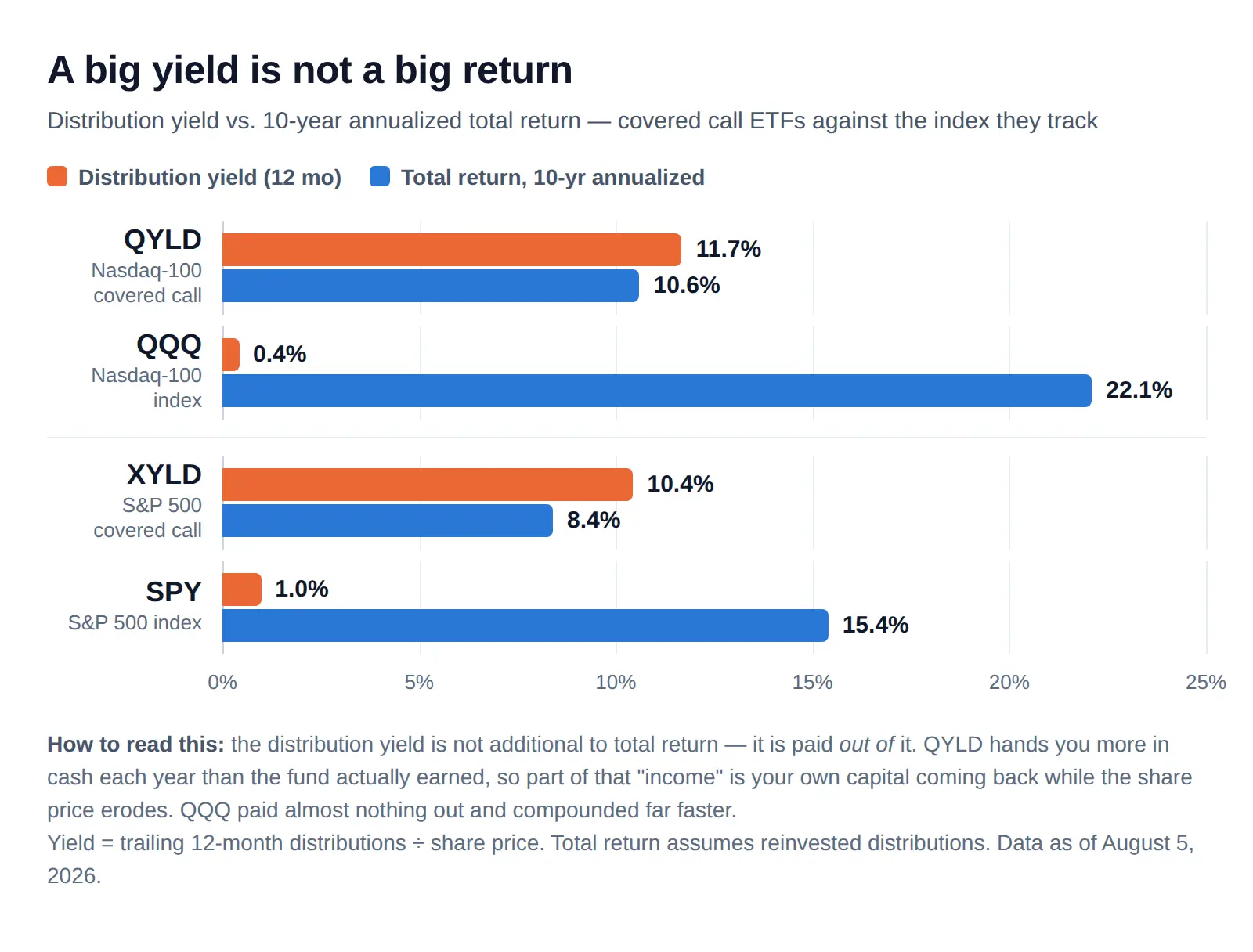
Distribution yield vs. 10-year annualized total return. Data as of August 5, 2026.
Look at QYLD. Over ten years it distributed at 11.68% a year and returned 10.6% a year in total. It paid out more than it made. When a fund does that, the shortfall comes out of the share price — you are receiving your own capital back and calling it income.
Meanwhile QQQ, the exact index QYLD holds, paid almost nothing out and compounded at 22.1% a year. That difference is roughly 11.5 percentage points a year, which over a decade compounds into a very large gap.
What Happens to Your Principal
The clearest way to see the cost is to strip the distributions out entirely and look only at what the share price did.
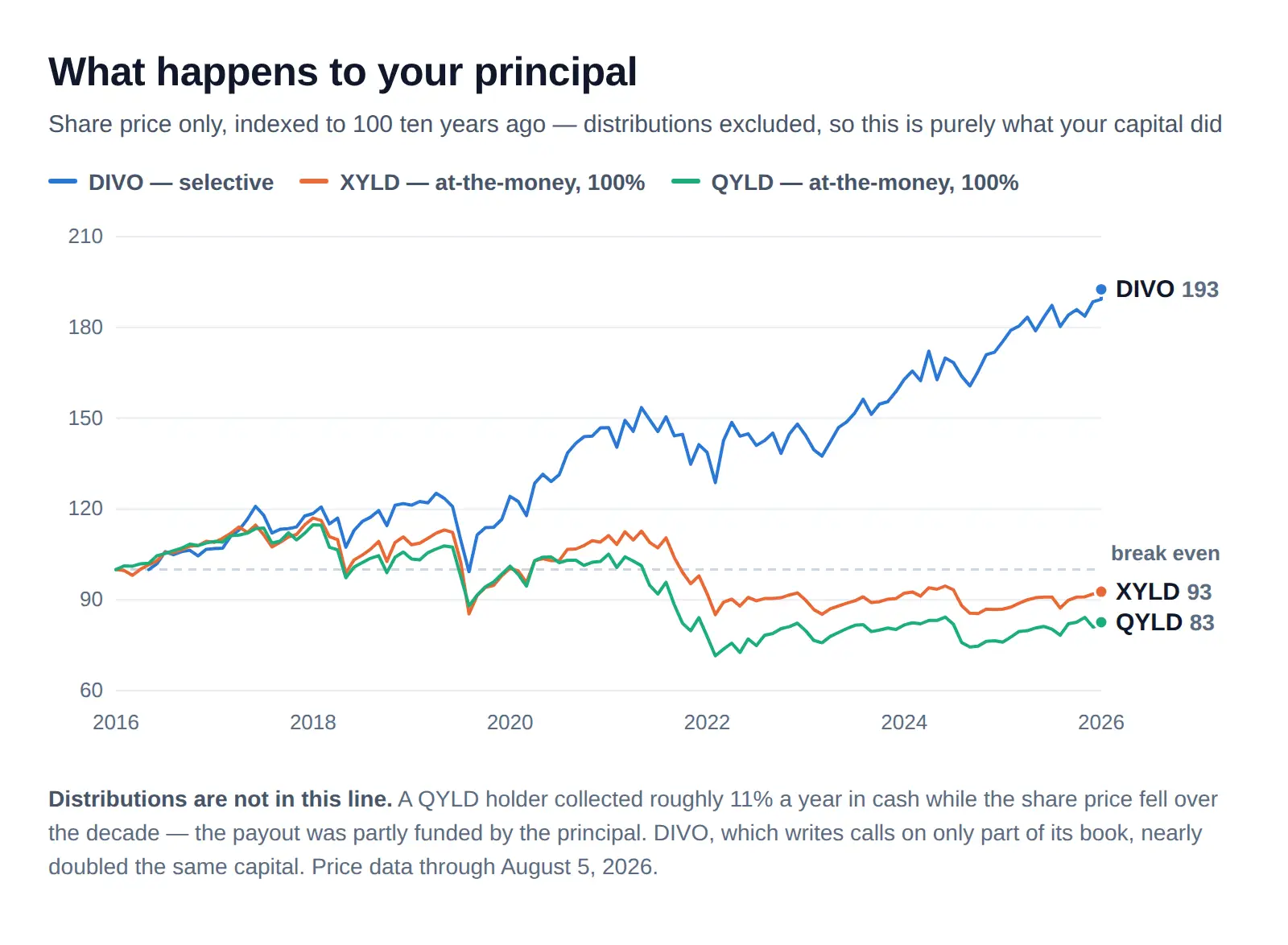
Share price only, indexed to 100 ten years ago. Distributions excluded. Data as of August 5, 2026.
The less aggressively a fund writes calls, the more total return it keeps — and the smaller its headline yield. DIVO writes selectively, yields 6.23%, and has nearly doubled its share price over the decade. QYLD, XYLD and RYLD write at the money on the entire portfolio, yield 11.44–11.68%, and have all lost principal. The yield you see advertised is a good predictor of how much upside the fund has sold away.
What $10,000 Actually Pays You
Here is the same comparison in dollars rather than percentages — what a $10,000 position in each fund sends you every month at current prices and distributions.
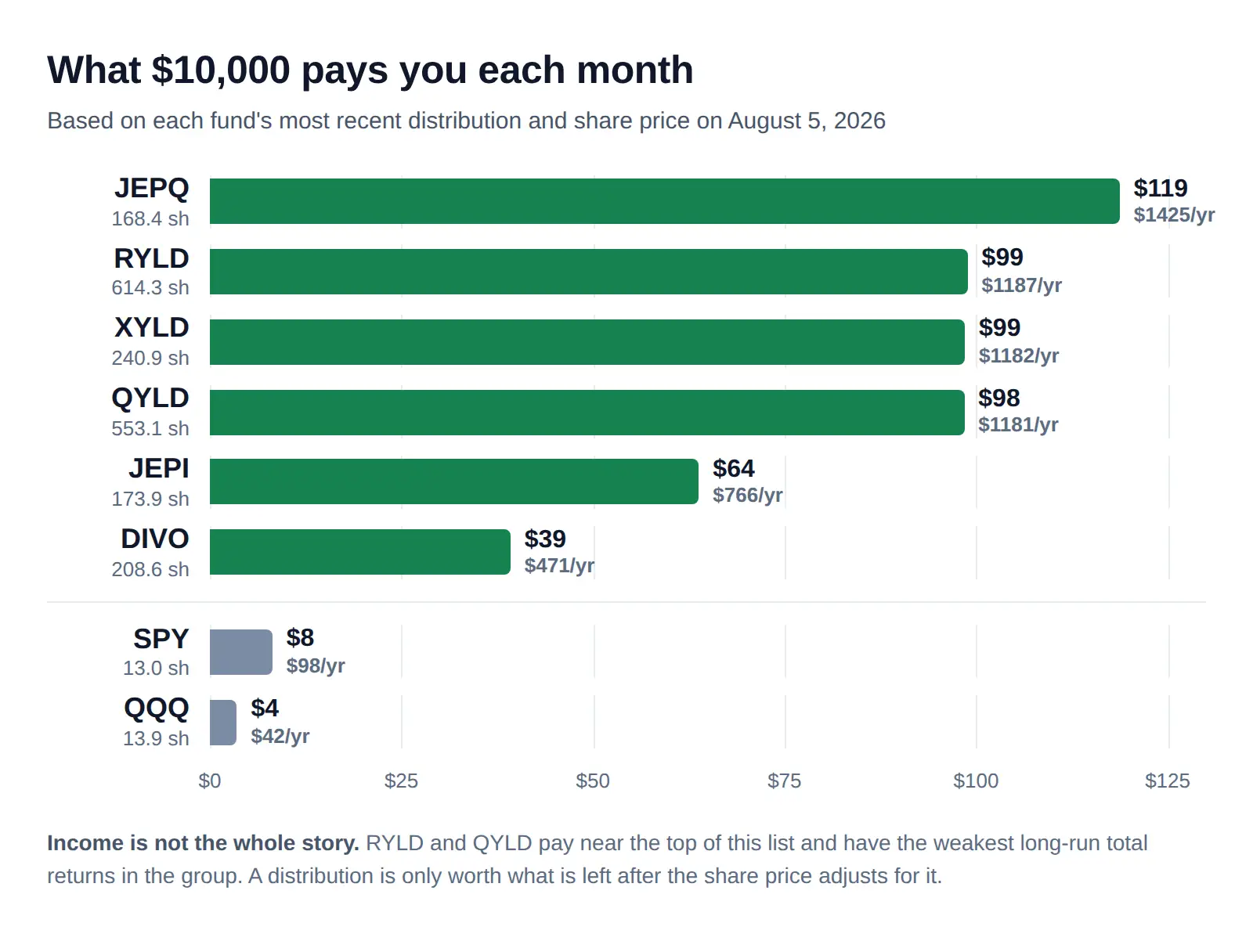
Monthly income per $10,000 invested, based on the most recent distribution. Data as of August 5, 2026.
Building a $100,000 Covered Call ETF Portfolio
Concentrating in the highest yielder is the mistake this data argues against. A sleeve weighted toward the funds that have actually preserved principal still throws off a strong monthly cheque, without the steady erosion that comes from putting everything in an at-the-money writer.
Here is one way to allocate $100,000, at August 5, 2026 prices:
That is roughly $811 a month, or $9,729 a year — about a 9.7% distribution rate on $100,000. You give up some headline yield against a pure QYLD position, and in exchange the majority of the sleeve sits in funds whose share price has held up or grown.
A worked example. Take the JEPQ slice: $30,000 buys 505 shares at $59.38. At its most recent distribution of $0.705 per share, that is $356.18 deposited next month. The distribution is declared monthly and floats with the option premium the fund collects, so treat it as a range rather than a fixed coupon — in a calm tape it shrinks, in a volatile one it grows.
JEPI vs JEPQ vs QYLD: Which One Fits?
JEPQ writes out-of-the-money calls on a Nasdaq-100 basket, leaving real room for the underlying to appreciate. Over three years it returned 20.4% annually against QQQ’s 26.6% while paying 10.99%. For an investor who wants Nasdaq exposure and monthly cash, that is a defensible trade.
JEPI is the conservative sibling. It holds a low-volatility, defensively screened S&P 500 basket rather than the index, which is why its returns diverge from SPY more than the options overlay alone would explain — 9% over three years against SPY’s 20.5%. You are buying lower drawdowns and steady income, not index performance.
QYLD is the pure income play and the one that demands the clearest eyes. At-the-money calls on the full portfolio means maximum premium and virtually no appreciation. If you need the largest possible monthly cheque and accept that your principal will likely drift lower, QYLD does exactly what it says. If you expected it to also keep pace with the Nasdaq, it never could.
DIVO deserves the mention it rarely gets: the lowest yield of the group at 6.23%, and the best-preserved principal by a wide margin.
What Are the Risks of Covered Call ETFs?
1. Capped upside in strong markets. In any year the index runs hard, these funds lag badly. They are least useful precisely when stocks do best.
2. Full downside exposure. Selling a call collects premium; it does not hedge. If the index drops 30%, you absorb nearly all of it, cushioned only by the premium collected. You have sold your upside and kept your downside. If protecting capital is the goal, a hedge is a different tool entirely.
3. NAV erosion. When distributions exceed what the fund earns, the share price absorbs the difference. The principal chart above shows a decade of it. A high distribution rate is not evidence of a healthy fund — sometimes it is evidence of the opposite.
4. Tax treatment. Distributions are often a mix of ordinary income, capital gains and return of capital, and are frequently taxed less favorably than qualified dividends. In a taxable account a 11.68% headline yield can shrink meaningfully after tax. Our guide to options trading taxes covers the categories, and a tax-advantaged account is usually the better home for these funds.
Covered Call ETF or Write the Calls Yourself?
This is the real decision, and it comes down to control.
A covered call ETF writes on a fixed schedule regardless of conditions. It sells when volatility is rich and when it is cheap. It writes on your best holding and your worst alike. That mechanical discipline is a feature if you would otherwise do nothing — and a real cost if you would exercise judgment.
Writing calls yourself means choosing the underlying, the strike, the expiration, and crucially whether to write at all this month. You can skip a name heading into earnings, write further out of the money when a stock has room to run, and leave your best positions uncovered. That flexibility is the entire reason a 6.23% selective writer like DIVO has preserved principal that an 11.68% mechanical writer like QYLD did not.
Buy the ETF if: you want monthly income with zero maintenance, your account is too small for 100-share lots of expensive stocks, you are in a tax-advantaged account, or you will not do the work consistently.
Write the calls yourself if: you want to keep upside on your best positions, you can size 100-share lots, and you will make a monthly decision. Start with our best stocks for covered calls list, refreshed monthly with live premiums and yields. If capital is the constraint, a poor man’s covered call reaches a similar payoff for far less, and cash-secured puts are the mirror-image trade for getting paid to buy in.
There is also a middle path: own the index fund for the bulk of your position and write calls yourself on a satellite sleeve. You keep the compounding that makes SPY and QQQ what they are, and generate income on the portion you are willing to cap.
Frequently Asked Questions
Are covered call ETFs a good investment?
They are a good income investment and a poor growth investment. If you need predictable monthly cash flow and accept lower long-run total return, they do the job. If you are accumulating for a goal a decade out, the historical record favors the plain index.
Why does QYLD keep going down?
Because it distributes more than it earns. At-the-money calls on the whole portfolio strip out nearly all appreciation, so little is left to offset the payout and the share price absorbs the shortfall. Its share price is $18.08 today.
What is the highest-yielding covered call ETF?
Among the major funds, QYLD at 11.68% and RYLD at 11.44%. Both also carry the widest gap between distribution rate and total return — the yield ranking and the performance ranking are close to inverse.
Are covered call ETF distributions qualified dividends?
Usually not in full. They tend to blend ordinary income, capital gains and return of capital, which is why these funds generally belong in a tax-advantaged account.
Can I lose money in a covered call ETF?
Yes. You carry essentially the full downside of the underlying index, offset only by the premium collected. In a sharp drawdown these funds fall nearly as much as the market.
Is JEPI or JEPQ better?
Different jobs. JEPQ tracks a Nasdaq-100 basket and has produced higher returns in a tech-led market. JEPI holds a defensive, low-volatility S&P basket built to smooth drawdowns. JEPQ for growth-tilted income; JEPI for stability.
How much do I need to start?
There is no minimum beyond one share — $18.08 for QYLD or $59.38 for JEPQ at today’s prices. That accessibility is a genuine advantage over writing calls yourself, which requires 100-share lots. See our guide to options trading with a small account.
The Bottom Line
Covered call ETFs deliver exactly what they advertise: a large, reliable, monthly distribution. The mistake is reading that distribution as a return. Over ten years QYLD paid 11.68% a year and returned 10.6% a year, while the index it holds returned 22.1% — and its share price fell along the way.
Use them deliberately: for income you need now, in an account where the tax treatment does not hurt, weighted toward the funds that have kept their principal intact, and sized as one piece of a portfolio rather than the whole thing. And if you want the premium without permanently selling your upside, learn to write the calls yourself on positions you choose. That is the version of this trade where you stay in control of the tradeoff.
This article is for educational purposes and is not investment advice. Fund data was sourced on August 5, 2026 and changes continuously — verify current yields, fees and holdings with the fund provider before investing. Options trading involves risk of loss and is not suitable for all investors. Past performance does not guarantee future results.