


Best Options Trading Courses for 2026 (Free and Paid, Honestly Ranked)
· Prices rechecked October 2026 · 12 min read
We compared the most popular ways to learn options, from free broker academies to premium mentorships and alert services, and ranked them by who each one actually serves best. Here is where to learn options in 2026, what each really costs, and how to choose.
Short version: you do not need to pay a cent to learn the basics of options. The three highest picks on this list are completely free. You pay when you want structure, live mentorship, real-time ideas, or a community to keep you accountable. A quick note on the field, some entries here are true video courses and some are alert or mentorship services, because people searching “options course” are usually after both. We label which is which.
The quick picks
- Core offering. Depth and quality of the actual teaching.
- Cost vs. value. What you get for the price, and free counts heavily.
- Usability. How well structured and easy to follow it is.
- Credibility. Instructor track record and brand reputation.
- Audience fit. Who it is genuinely best for, beginner through active trader.
- Extras. Community, alerts, tools, support, and free trials.
1. tastylive
Founded by the creators of thinkorswim (Tom Sosnoff and Scott Sheridan), tastylive runs hours of live, market-hours options programming every day plus a free, structured course library, and its Beginner Options Course is excellent. It is options-first, data-driven, and refreshingly un-hyped. The trade-off is volume: it is a firehose, and total beginners can struggle to find the on-ramp. Both tastylive and the tastytrade brokerage it funnels to are now owned by IG Group.
Best for: learning a probability-based, premium-selling options mindset for free from people who built a real platform.
Reputation: widely regarded as the gold standard of free options education. Note: the Trustpilot scores you will find are for the tastytrade brokerage, not the courses, so we do not attach a star rating to the education here.
Watch for: a heavy “sell premium, trade small, trade often” bias, and it ultimately points you toward opening a tastytrade account.
2. Cboe Options Institute
This is the education arm of the actual options exchange, running for 40 years. The free Learning Portal now includes guided learning paths and a “get started” assessment, so it is a structured curriculum, not just a glossary. If you want the mechanics, the Greeks, and how the market truly works from a source with nothing to sell you, it is hard to beat.
Best for: an unbiased, authoritative foundation on how options actually work.
Reputation: uniformly respected for credibility and neutrality. As a free, no-purchase resource it has no real third-party star rating, which is normal.
Watch for: it teaches the machinery of options, not how to find or manage live trades, so pair it with a strategy or community when you are ready to act.
3. Option Alpha
Option Alpha gives away a complete, well-structured free curriculum (around 124 lessons across nine courses) from founder Kirk Du Plessis, with a clear path from basics to strategy to risk. The education leans heavily toward option-selling and income strategies, and it funnels into the same company's no-code automation and backtesting platform. That platform's optional Pro tier is $99/mo billed annually or $149/mo monthly, and it is free if you fund a qualifying broker account (Tradier or TradeStation).
Best for: a free, structured grounding in income and premium-selling strategies, with a path into no-code trade automation.
Reputation: consistently named the best free curriculum in independent roundups. First-party reviews are thin (Trustpilot around 4.3 on roughly 10 reviews), and critics question the real-world results of the automation, so judge it on the free education.
Watch for: the slant toward selling income strategies, and that the free course naturally leads into the paid platform.
4. Selling Options for Income (Lincoln Olson)
A cheap, tightly focused Gumroad course by Lincoln Olson that teaches just two income strategies, covered calls and cash-secured puts, in about an hour. It is beginner-implementable but assumes you already own stock and understand the basics. The two cleanest independent roundups we checked both rank it highly for the selling-options niche.
Best for: a buy-and-hold investor with a $10,000-plus portfolio who wants a fast, low-cost intro to generating income on shares they already hold.
Reputation: ranked #2 by WallStreetZen and #3 by stockanalysis.com for selling options, but it is a newer indie course with almost no organic review base, so that coverage is the main signal. Its advertised win-rate numbers are self-reported and inconsistent between sources, so treat them as marketing, not fact.
Watch for: it is narrow (two strategies only), and the $79 price is described as introductory, with the creator saying he plans to raise it, so confirm the current price before buying.
5. Udemy options courses
If you just want a low-cost, self-paced video course to get the basics down, Udemy delivers a lot for very little, often with lifetime access. The best individual options courses (for example “Options Trading for Rookies”) are well rated on-platform and genuinely teach calls, puts, strikes, and expiration clearly. The list price near $120 is a permanent anchor, the real price on sale is usually $10 to $20.
Best for: total beginners learning options vocabulary and mechanics cheaply before committing real money.
Reputation: mixed and instructor-dependent. The Udemy consumer marketplace rates poorly overall (Trustpilot around 1.8), but the top individual options courses themselves rate roughly 4.8 across thousands of student ratings, so the course you pick matters more than the platform.
Watch for: wildly uneven quality, outdated courses left up indefinitely, and no live support or community.
6. Benzinga Options
A heads-up on naming: the popular $297/year “Benzinga Options” is an alert and mentorship service led by Nic Chahine, delivering roughly two options trade ideas a month plus the reasoning behind them, not a sit-down video course. A separate, higher-priced “Benzinga Options School” course also exists, but we could not verify its current price, so we are not quoting one.
Best for: traders who already know the basics and want a low-cost stream of pro options ideas with a live mentorship room, rather than a structured curriculum.
Reputation: mixed. Fans rate Nic Chahine highly as a teacher; critics point to hype-forward win-rate marketing and refund and billing complaints on the BBB. There is no course-specific review score, and the advertised win rate is unaudited.
Watch for: only about two ideas a month, an equities-leaning focus, and aggressive renewal and upsell tactics reported by some users.
7. Bullish Bears
A legit, budget-friendly trading-education community (founded around 2016) that bundles a big multi-strategy course library with a live Discord room. The tiers: Foundation (free beginner courses plus a year of intermediate courses, no live room), Next Level (a year of every course plus a 30-day trade room trial) and Next Level Premium (lifetime courses plus a year of the trade room). Prices move with promotions, so check the current price at checkout.
Best for: beginners on a budget who want a full multi-strategy library plus an active community in one place.
Reputation: generally well-liked and considered legit, with past “best value” and “best budget” nods from Investopedia and Business Insider. The supporting review data is thin and aging (Trustpilot around 4.6 on only about 27 reviews), and the core curriculum is reportedly not refreshed since around 2021.
Watch for: a strict no-refund policy, it is multi-strategy rather than options-specialist, and some find the live room aimless.
8. Pure Power Picks
We will be straight with you: Pure Power Picks is not a classroom-first brand, we are an options alert and community service, so we are not going to claim “best overall” on our own list. What we offer for learning is different from a video library. Instead of only watching lessons, you see real, educational options alert ideas as they happen, with the reasoning behind each setup, inside an active Discord of traders. Our written guides on covered calls, the wheel, credit spreads, iron condors, and risk management come free with a membership.
Live mentorship, on request: we don’t advertise it, but if you ask, we also do private one-on-one coaching over screen share, booked in 30-minute slots, and you can bring your own trades to review.
Best for: traders who know the basics and learn best by following real setups and talking them through with a community, rather than self-studying a video library alone, and anyone who wants one-on-one time with a coach on their own trades.
Watch for: if you want a from-zero, sit-down video curriculum today, start with one of the free courses above, then join us when you want to see ideas in real time. Our alerts are educational ideas, not advice and not executed trades. Every alert is tracked in public, and we never promise outcomes.
9. Simpler Trading
A long-running, premium Austin brand built around founder John Carter, his well-known TTM Squeeze indicator, and a roster of named mentor traders running about ten live rooms. You are paying for access and real-time mentorship. The entry point is a $7 30-day trial (low-cost, not free); live rooms run roughly $197 to $247 a month, one-time courses range from about $297 to $1,547, and the indicators are sold separately ($197 to $1,091).
Best for: intermediate-to-advanced options traders who want to learn alongside pros in real time and can handle premium, a la carte pricing.
Reputation: genuinely split. Trustpilot sits around 4.2 to 4.3 (roughly 540 reviews) and BBB complaints are low, but a vocal camp argues the signature indicators repackage common tools and that the brand profits more from selling education than from trading. Deep curriculum, but upsell-heavy.
Watch for: costs stack quickly because courses, rooms, and indicators are all separate, and it is not built for beginners.
10. SMB Training
The education arm of SMB Capital, a legitimate New York proprietary trading firm (home of Mike Bellafiore). Its options courses come with live mentoring and real-desk exposure rather than only recorded theory, and they are priced for professionals, well above everything else on this list. Confirm the current price with SMB before you commit.
Best for: serious, career-minded traders who want professional, prop-firm-style mentoring and can pay for it.
Reputation: respected for genuine prop-firm pedigree, but a niche pick here, it appears in only one of the major options-course roundups we checked, ranked last. Trader-forum sentiment is mixed (real value, but expensive, hard-sell, and some dated material). No reliable third-party rating exists for its options product.
Watch for: high prices aimed at professionals, aggressive marketing, and course “laddering” where you need several paid programs for a full strategy.
How to choose in 10 seconds
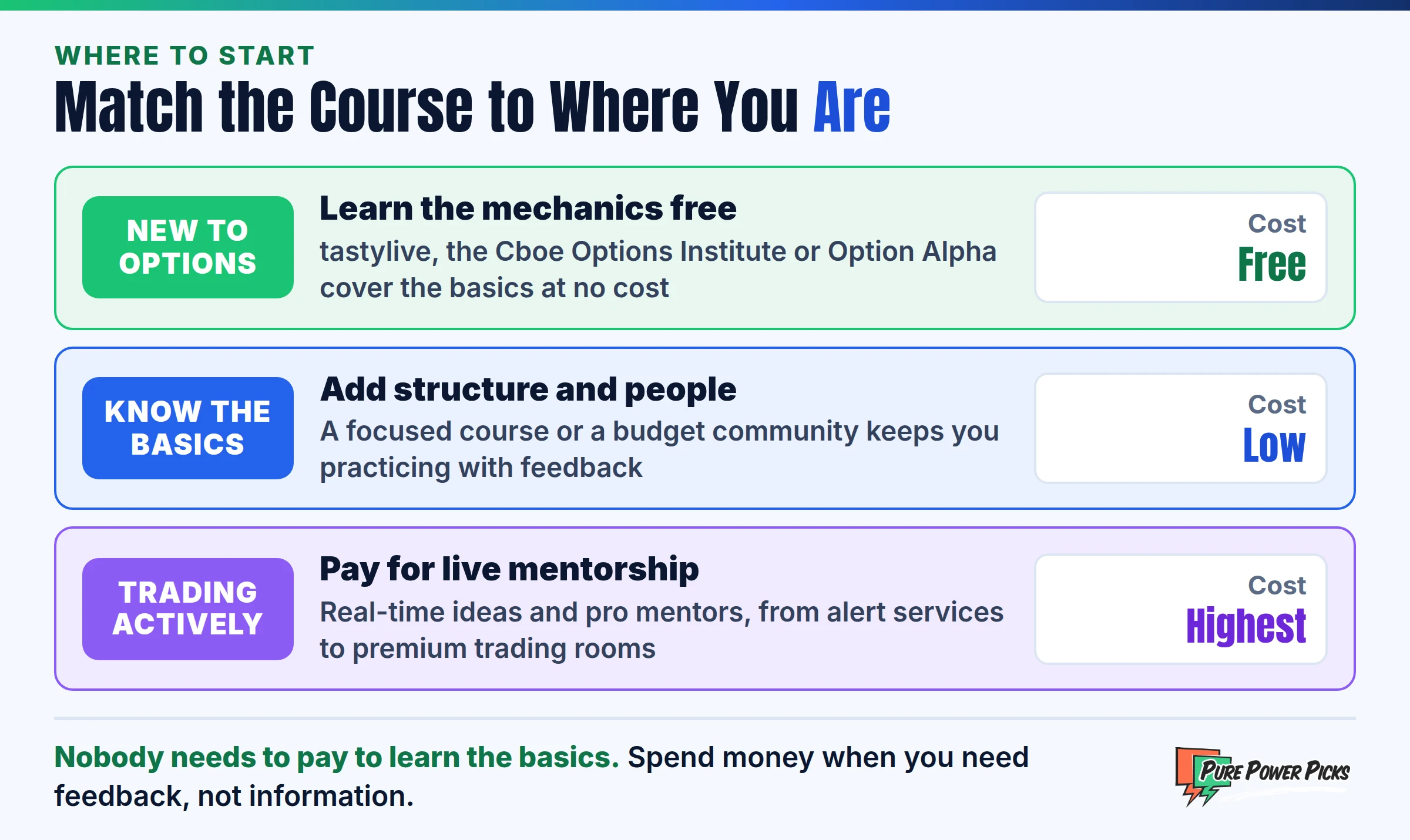
- Brand new and want free: start with tastylive or Cboe.
- Want a free, structured curriculum: Option Alpha.
- Just want to sell options for income on shares you own: Selling Options for Income.
- Want live mentorship and have capital: Simpler Trading, or SMB if you are going pro.
- Already trade and want real-time ideas, people to learn with, or one-on-one coaching: that is where we fit.
Frequently asked questions
Are options trading courses worth it?
The free options (tastylive, Cboe, Option Alpha) are genuinely excellent, so nobody needs to pay just to learn the basics. Paid courses, alerts, and communities earn their price when you want structure, live mentorship, real-time ideas, or accountability.
What is the best free options trading course?
tastylive for daily, options-first depth, Cboe for authoritative mechanics, and Option Alpha for a complete structured curriculum.
What is the best options course for beginners?
A free structured course like Option Alpha or tastylive, paired with a community to keep you accountable. Be cautious with anything that promises income or guaranteed outcomes.
Free vs. paid, what is the real difference?
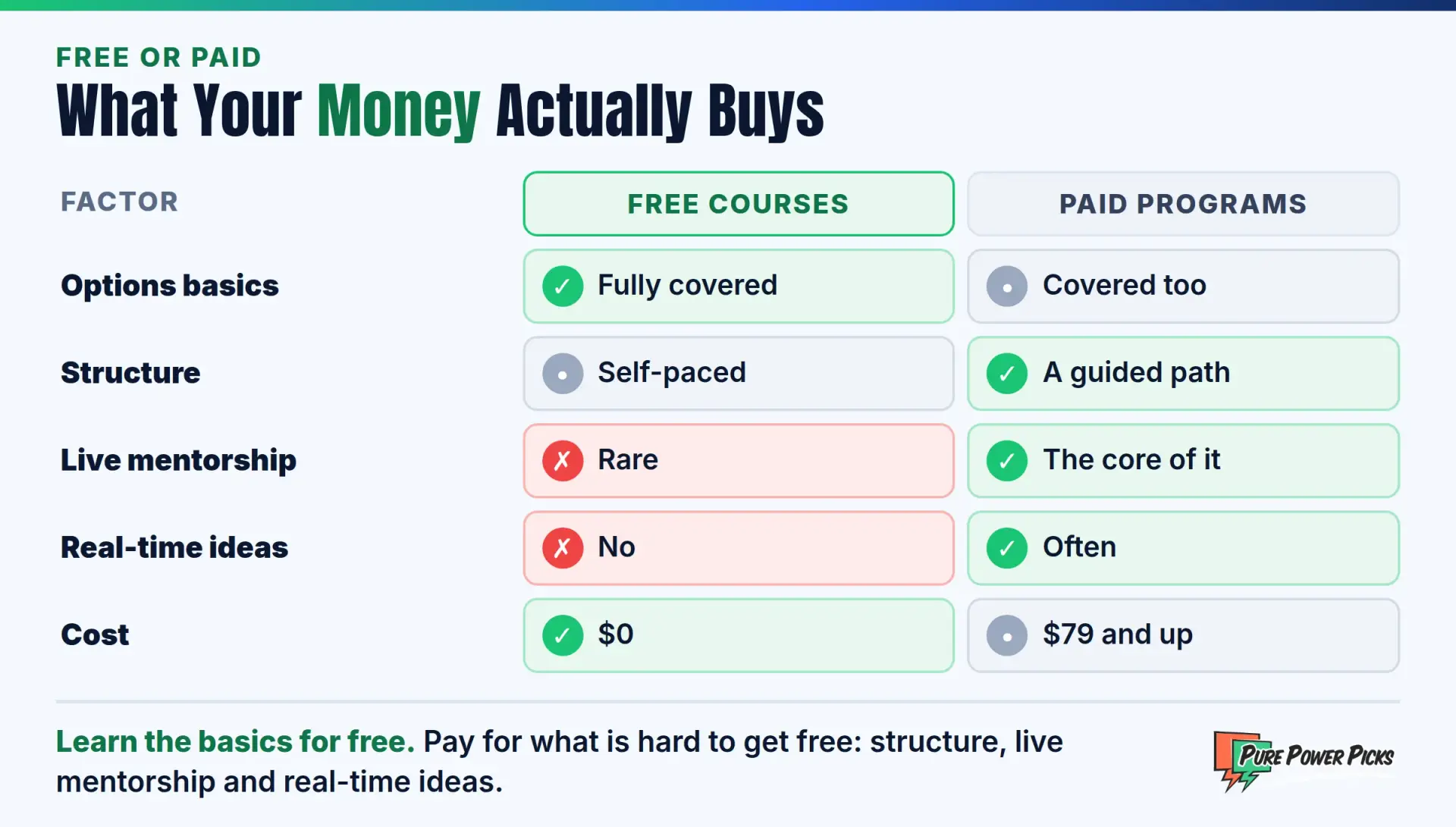
Learn the basics for free. Pay for the parts that are hard to get free, which are live mentorship, real-time ideas, and an active community.
Want to learn by watching real setups, not just slides?
Join the Pure Power Picks Discord. Educational options alert ideas, the reasoning behind them and free strategy guides.
Disclaimer: Educational content only and not financial advice. Options involve risk and are not suitable for every investor. Pure Power Picks alerts are educational ideas, not personalized investment advice, executed trades or promises of outcomes. Where a third-party course advertises its own win-rate or performance figures, those are the seller's claims and are not independently verified here. Prices were rechecked in October 2026 where published and may change. Some links may be partner links.

The PPP Team is the research and editorial team behind Pure Power Picks. We trade stocks and options and publish the work as we do it, with every alert tracked in public. Publishing since 2020. How we research and correct our work is written out in our editorial standards. Our content is strictly educational, never advice.