

Michael Burry: The Big Short, His AI Bets and His Crash Calls, Scored
Share


Michael Burry is the American investor and former doctor who bet against the US housing market before the 2008 financial crisis, the trade Michael Lewis made famous in The Big Short. He ran Scion Capital from 2000 to 2008, managed money again as Scion Asset Management, and wound that firm down in late 2025. Today he writes a paid Substack called Cassandra Unchained and posts on X, where his bets against Nvidia, Palantir and the AI trade make headlines. He is just as famous for warning that the market is about to crash. This guide covers his life and the Big Short trade, what he made, what he is worth, what he is betting on now, and a scorecard of his best known warnings against what the S&P 500 actually did.
Michael Burry earned his reputation on one long, specific, well researched bet against subprime mortgages. His market crash warnings since 2021 have a much weaker record: as of Oct 9, 2026, SPY closed higher than on the day of 11 of the 12 warnings we scored. The useful lesson for traders is how he bets, with defined risk and long timelines, not when he says the market will fall.
Who Is Michael Burry?
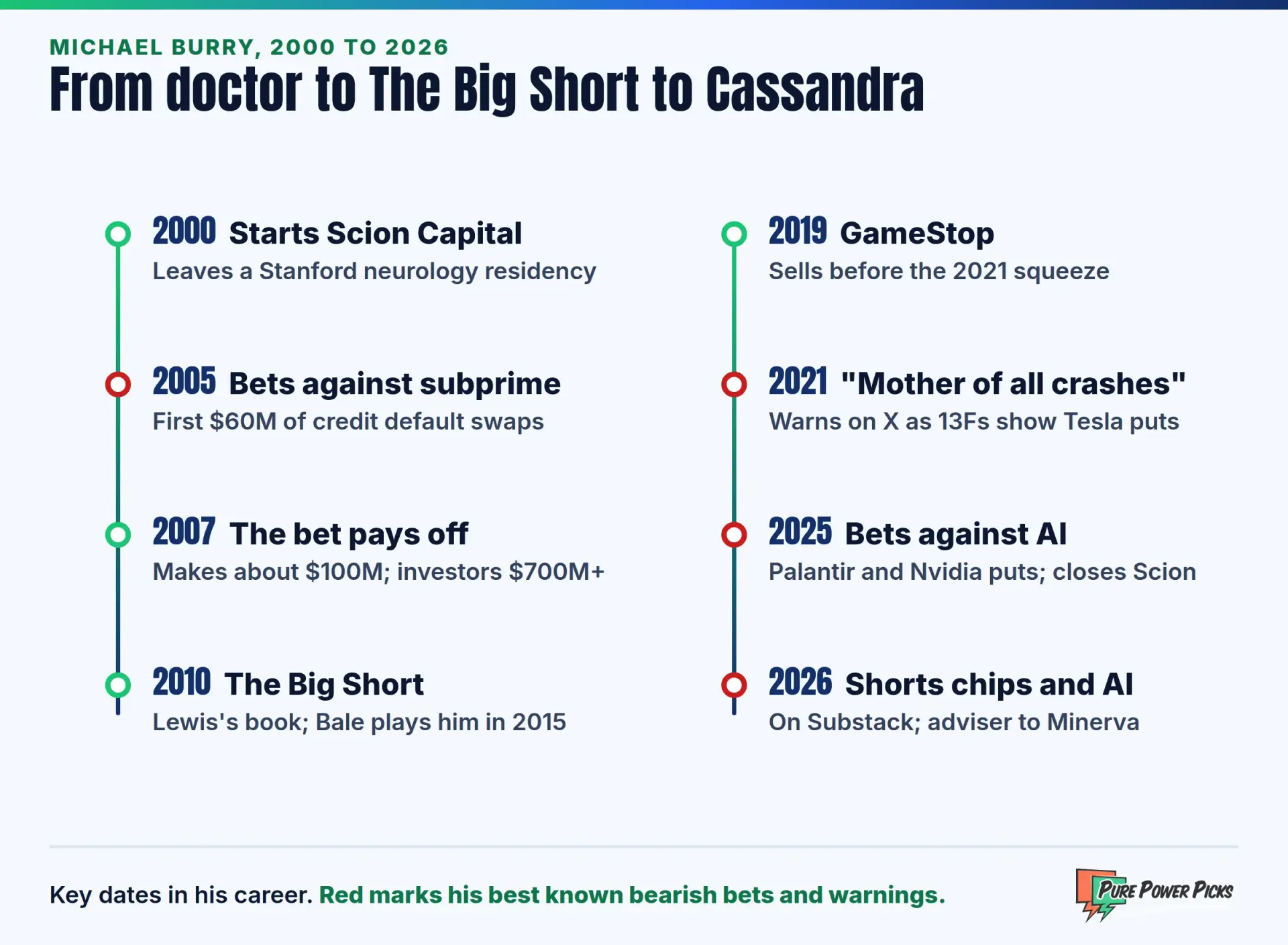
Michael Burry was born in 1971 in San Jose, California, and grew up there. He lost his left eye to retinoblastoma, a childhood cancer, at age 2 and has worn a glass eye since. He studied economics and pre-med at UCLA, earned his medical degree at Vanderbilt in 1997, and went on to a neurology residency at Stanford University Hospital.
Investing was the night job. In November 1996, while working a hospital rotation in Nashville as a medical student, he started a value investing thread on an online stock message board, and he later posted his analyses on his own site, Valuestocks.net. The posts drew a following among professional investors, including Joel Greenblatt of Gotham Capital.
In November 2000 he left the residency in its third year and started Scion Capital, named after the fantasy novel The Scions of Shannara. The seed money came from his own savings and from his mother and three brothers, and Joel Greenblatt’s Gotham Capital offered $1 million for a quarter of the new firm, becoming his partner. Burry has said he has Asperger’s syndrome, which he recognized in himself after his young son was diagnosed. As he put it to Michael Lewis, “Only someone who has Asperger’s would read a subprime-mortgage-bond prospectus.”
The Big Short: How Michael Burry Bet Against Housing
By 2005, Burry had concluded that US home prices were being held up by mortgages that borrowers could not repay, many of them adjustable loans with low starting rates that would reset higher within two years. Instead of shorting bank stocks, he went looking for a way to bet directly against the mortgage bonds.
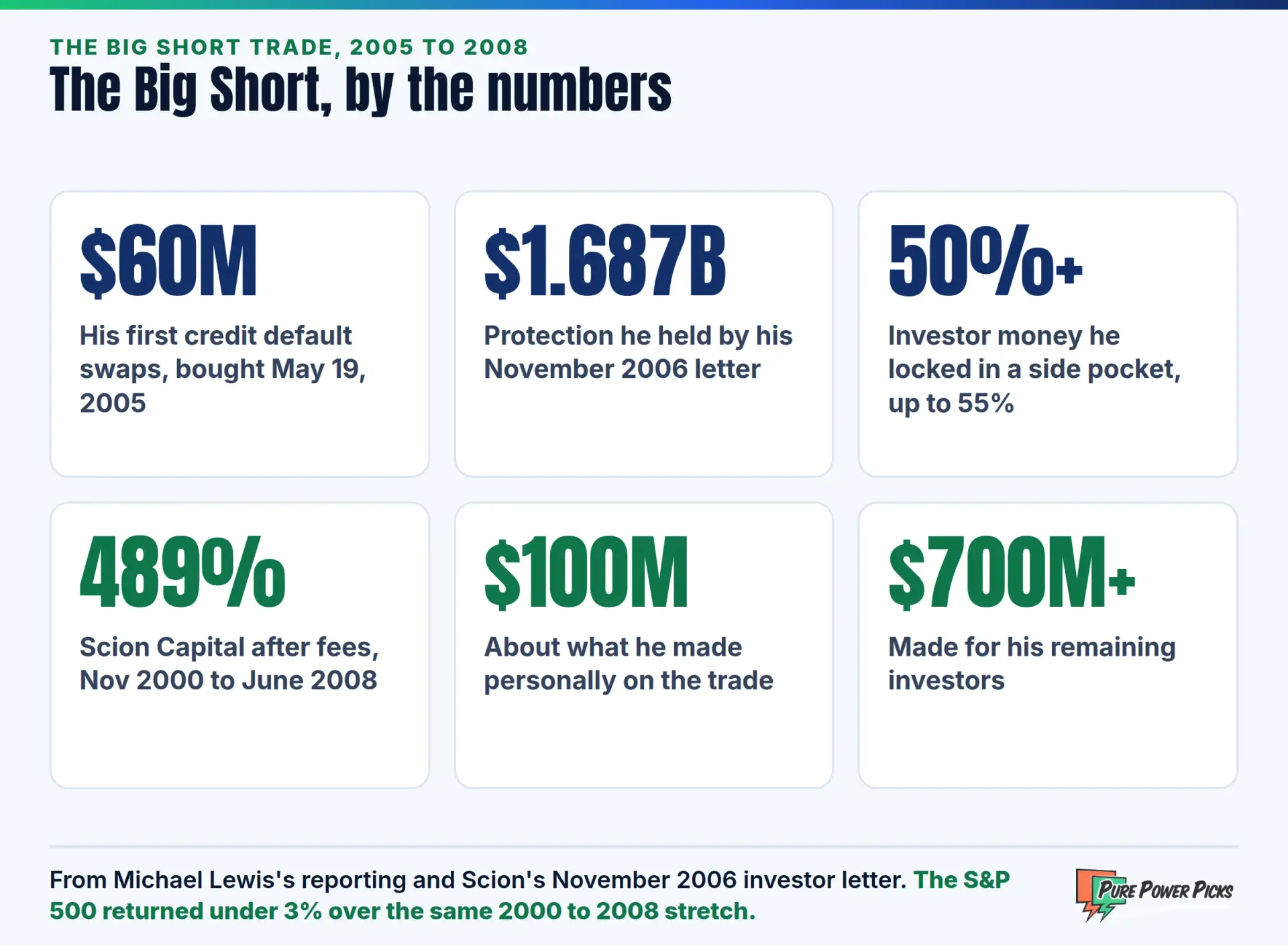
He found it in the credit default swap. On May 19, 2005 he bought $60 million of them from Deutsche Bank, covering six subprime mortgage bonds, and by October 2005 he held at least $1 billion. In his November 2006 letter to investors the position stood at $1.687 billion of protection, costing roughly 6% of the fund’s assets a year to keep.
Then he had to wait, and waiting was expensive. Home prices kept climbing into 2006, the premiums came due every quarter, and the fund lost money while the stock market rose. Investors wanted out. Burry used a clause in his fund documents to move the swaps into a side pocket, locking up 50 to 55 percent of their money, and his partners at Gotham Capital threatened to sue him. In 2007 the loans began to default in large numbers, the bonds he had bet against collapsed, and the swaps paid off.
A contract that works like insurance on a bond. The buyer pays a regular premium, and if the bond defaults, the seller pays out. Burry bought this protection on subprime mortgage bonds he expected to fail, so his cost was the premiums and his payoff was the losses on the bonds. Investopedia’s credit default swap explainer walks through the mechanics.
How much did Michael Burry make on The Big Short?
From its start on Nov 1, 2000 to June 2008, Scion Capital returned 489.34% after fees, according to figures Michael Lewis cites. The S&P 500 returned under 3% over the same stretch. The housing bet made Burry about $100 million personally and his remaining investors more than $700 million, and he closed Scion Capital in 2008.
Lewis told the story in The Big Short, published in March 2010. The 2015 film cast Christian Bale as Burry, a role that earned Bale an Oscar nomination for Best Supporting Actor, and the film won the Oscar for Best Adapted Screenplay.
After The Big Short: Water, GameStop and Tesla
After Scion Capital closed, Burry managed only his own money for several years. In a 2010 Bloomberg interview he said he had put “a good amount of money” into productive farmland with water on site, which he expected to become very valuable. In 2015 he told New York magazine, “What became clear to me is that food is the way to invest in water.” The film’s closing card, which says he focused all of his trading on water, overstates it.
He returned to managing outside money with Scion Asset Management, founded in 2013, which filed its first 13F in February 2016. His best known trade of that era was GameStop. In August 2019 he wrote to the company’s board urging it to finish a $237.6 million share buyback. At its peak his stake was 3.4 million shares, bought for about $15 million at $2 to $4.20 a share, and he sold the last of it in the fourth quarter of 2020, weeks before the Reddit squeeze of January 2021. Forbes estimated he may have made about $100 million; the peak stake would have been worth over $1.5 billion at the top.
In 2021 his 13F filings showed puts on Tesla, on 800,100 shares at the end of March and 1,075,500 shares by the end of June, about $731 million in notional value, plus puts on Cathie Wood’s ARK Innovation ETF. Both were gone by the third quarter. In January 2023 he posted a single word, “Sell.”, and deleted it. On March 30, 2023 he wrote, “I was wrong to say sell.” He then went quiet on X until late October 2025.
Michael Burry’s Net Worth
There is no verified figure for Michael Burry’s net worth. Forbes and Bloomberg have never published one. The widely repeated $300 million comes from Celebrity Net Worth, which Fox Business cited in 2024, and the same site now lists $200 million without showing its math.
What is documented is narrower. He made about $100 million personally on the Big Short trade. Scion Asset Management ran about $155 million in early 2025, but he called it essentially a friends and family fund, so most of that was other people’s money. His Substack is a newer income stream with undisclosed revenue: if just 20,000 readers pay the $379 to $479 annual price, that is $7.6 million to $9.6 million a year before Substack’s cut. Treat any single net worth number you see as an estimate, not a fact.
Why Michael Burry Closed Scion Asset Management
Burry wound down Scion Asset Management in late 2025. Reuters reported a letter to investors dated Oct 27, 2025 saying he would liquidate the funds and return capital, apart from a small holdback for audit and taxes, by the end of the year. The firm’s SEC adviser registration ended on Nov 10, 2025, and the SEC’s adviser database now lists Scion as inactive.
The letter gave his reason in one line: “My estimation of value in securities is not now, and has not been for some time, in sync with the markets.” He did not retire. In a Nov 12 post on X he signed off with “On to much better things Nov 25th,” and he told Bloomberg he was still running his own money and active in markets. The better things turned out to be a Substack, which went live on Nov 23.
Scion’s last 13F covered the quarter ended Sep 30, 2025 and was filed on Nov 3, 2025. It reported eight positions worth $1.38 billion, and the two put positions made up almost 80% of that value. No Scion 13F has been filed since, so the filing below is the last official snapshot of Michael Burry’s portfolio. Everything newer comes from what he writes himself.
Source: Scion Asset Management 13F-HR for the quarter ended Sep 30, 2025 on SEC EDGAR. Option rows show the value of the underlying shares, not what the options cost.
A 13F is the quarterly holdings report that US managers with more than $100 million in listed stocks file with the SEC within 45 days of quarter end (the SEC’s Form 13F FAQ). It lists options at the value of the shares they control, called notional value. Burry’s Palantir puts showed as $912 million, but he said they cost about $9.2 million. A 13F also never shows short stock, so it is a partial, delayed picture.
Cassandra Unchained: Michael Burry’s Substack
Burry started Cassandra Unchained on Substack on Nov 23, 2025, two weeks after Scion’s registration ended. The name comes from Cassandra, the prophet in Greek myth whose warnings were true and never believed, and it is also his display name on X.
A web subscription costs $49 a month or $479 a year, up from $39 and $379 at launch. Paid subscribers get his long research posts, shorter “Short Thoughts” notes and, since Apr 10, 2026, trade alerts by email. Free subscribers get occasional public posts. The subscribe page says the publication has over 341,000 subscribers, tens of thousands of them paying.
He posts about twice a week, and the posts are long. In early October 2026 he pointed readers on X to “9200 words of analysis” on Microsoft, Alphabet, Oracle, Meta and Amazon. Because the research is paid, the positions listed later in this guide come from press coverage of his posts, linked at each line, never from the posts themselves.
Senior adviser at Minerva
He has also taken an outside role. In September 2026 he became a senior adviser to a new short focused fund at Minerva Investment Management, working with Lakshmi Ganapathi, founder of Unicus, a Minerva business. Reuters reported that the fund targets companies in healthcare, retail, restaurants and smaller banks with ties to private credit.
Michael Burry vs Nvidia and Palantir: The AI Bubble Bet
Burry’s best known bet of the past year is against the AI trade. Scion’s final 13F showed puts on 5 million Palantir shares and 1 million Nvidia shares, about $1.1 billion in notional value, and headlines called it a billion dollar bet against AI. Burry pushed back on X on Nov 12, 2025: “So I spent $9,200,000, Not $912,000,000.” He had bought 50,000 Palantir put contracts at $1.84 each, giving him the right to sell 5 million shares at $50 in 2027.
His case rests on accounting. In November 2025 he argued that the largest cloud companies were stretching the useful lives of their servers and chips, which spreads depreciation over more years and lifts reported earnings. He called understating depreciation “one of the more common frauds of the modern era” and estimated $176 billion of understated depreciation across 2026 to 2028.
The targets answered back. Palantir CEO Alex Karp told CNBC the bet made no sense, since “the two companies he’s shorting are the ones making all the money.” Burry replied on X that Karp “cannot crack a simple 13F,” a jab at reading notional value as money spent. Nvidia’s investor relations team sent analysts a seven page memo disputing the buyback and depreciation figures, saying Burry “appears to have incorrectly included RSU taxes” in his buyback math. His answer: “I stand by my analysis,” and, “I am not claiming Nvidia is Enron. It is clearly Cisco.” Cisco was the network equipment maker that led the 2000 bubble and then lost most of its value.
So far the stocks have kept climbing. From the 13F date of Sep 30, 2025 to the Oct 9, 2026 close, Palantir rose 14.6% and Nvidia 22.9%. With Palantir near $209, a $50 put is far out of the money. Burry has kept adjusting rather than standing still: in September 2026, according to press reports on his paid posts, he sold his December 2026 Nvidia and Palantir puts and kept his 2027 Palantir puts and his puts on the Nasdaq 100 fund, QQQ.
A put is a bet on timing as well as direction. Every day the stock does not fall, the option loses some of its time value, and a put that expires above its strike is worth nothing. Burry has favored expiries a year or more out to give a thesis time to play out, and that time costs premium.
What Is Michael Burry Buying and Shorting Now?
Since Scion stopped filing, there is no official list of Michael Burry’s stocks. What is public comes from two places: his own posts on X, and press coverage of his paid Substack. The table collects the moves reported in 2026, each with its source. It is not a full list of his holdings, and the reports rarely give entry prices or sizes. Our Michael Burry tracker scores every one of these against the stock price since it became public, and adds new ones as he discloses them.
Two patterns run through the list. The bearish side is concentrated in the AI buildout: chip makers, chip equipment, the cloud names that buy the chips, and Palantir. The bullish side is a scatter of consumer, software and value names that had fallen out of favor, which is how Burry has invested since his Scion Capital days.
Michael Burry’s Crash Calls, Scored
Burry is famous for crash warnings, and he is tired of the reputation. In May 2026 he wrote, “I am now a meme for the number of times I have called a crash,” adding, “Every other time I supposedly called a crash, I had said nothing at all.” He blamed reporters who misread his regulatory filings.
That is a fair complaint, so this scorecard keeps the two apart. A red dot is a warning in his own words. A ring is a 13F filing that the press read as a crash bet; a filing shows positions, not the reasons for them. He posted many more warnings in 2022, most of them since deleted, so this is not every post; it is 12 widely reported ones. For each one we measured SPY, the largest S&P 500 fund, from its close on the day the warning became public. The live version of this scorecard, updated every market day, is on our Michael Burry tracker.
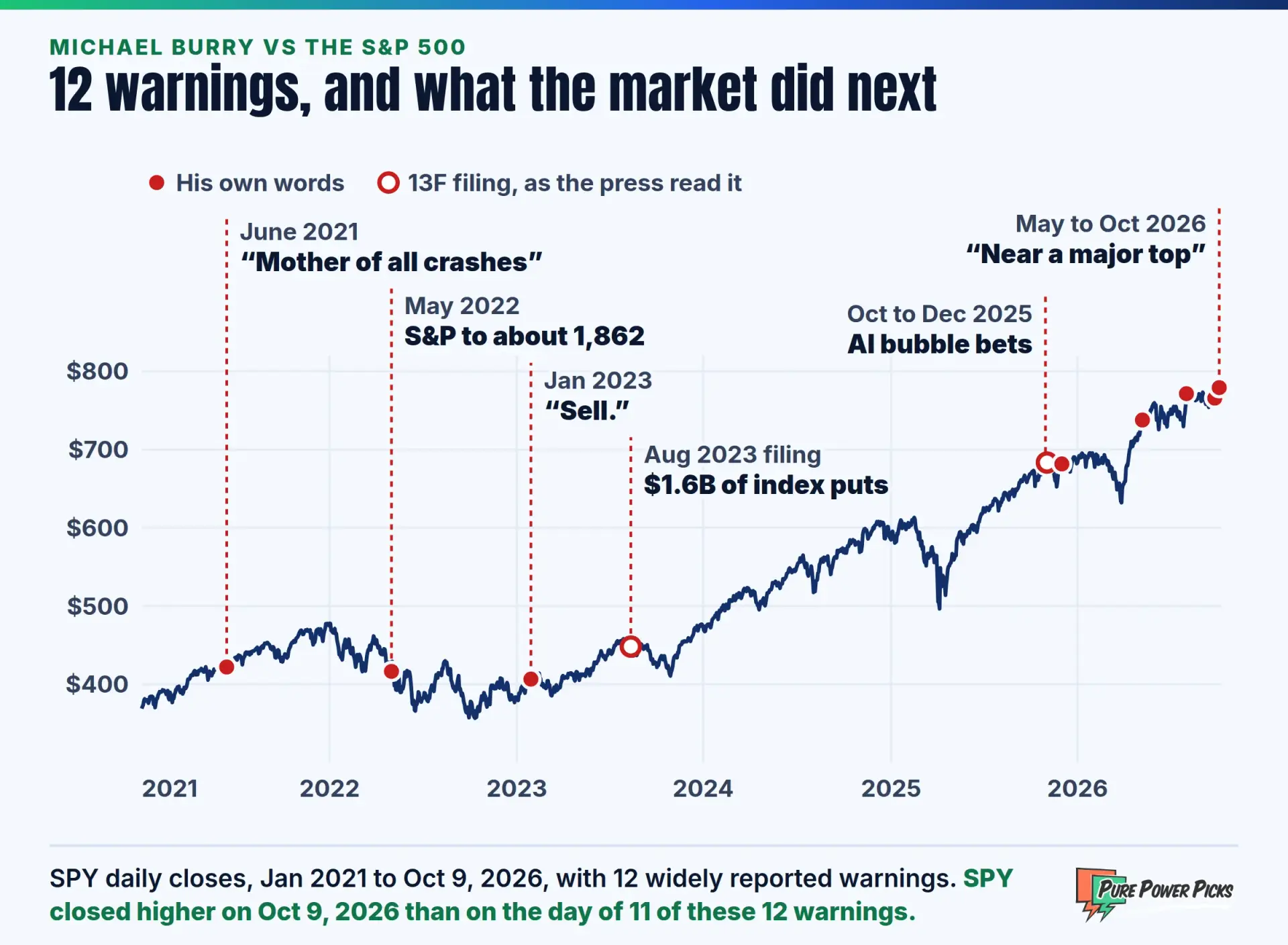
SPY closing prices, split adjusted, dividends not included. The base is the close on the day each warning became public. “Not yet” means 12 months have not passed.
Read fairly, the record splits into three parts.
- 2021 to 2022: early, and partly right. His June 2021 warnings came about six months before the S&P 500 peaked in January 2022. SPY then fell as much as 16% below its June 15, 2021 close by October 2022, the bottom of a real bear market. That was not “the mother of all crashes,” and anyone who sold in June 2021 and stayed out missed a SPY gain of 83.4% through Oct 9, 2026. His May 2022 call that the S&P 500 could fall to about 1,862, roughly 55% below that day’s level, never came close: at its October 2022 low, SPY was 14.4% below its May 3 close.
- 2023: wrong, and he said so. SPY rose 20.4% in the year after his one word “Sell.” post. Two months after it, he wrote, “I was wrong to say sell.”
- 2025 to 2026: too early to grade. None of these warnings is 12 months old yet. As of Oct 9, 2026, SPY was higher than on the day of each of them except Oct 6, 2026, which it trailed by 0.1%.
The tally: SPY closed higher on Oct 9, 2026 than on the day of 11 of the 12 warnings in the table. Being early on a real top still counts for something. But a reader who sold on the headlines would have given up far more by staying out than the 2022 drawdown cost.
What Options Traders Can Learn From Michael Burry
You do not need Burry’s conclusions to use his methods. Five habits stand out, and each one applies to an ordinary options account.
1. Bet with defined risk
A put caps the loss at the premium paid. Burry’s Palantir puts controlled $912 million of stock on paper and put about $9.2 million at risk. If Palantir finishes above $50 at expiry, the premium is all he loses. You can model the same shape on a smaller scale with our options profit calculator, or see how investors hedge a stock portfolio with puts.
2. Give the idea time, and know what time costs
Burry often buys expiries a year or more out, because a thesis about accounting takes quarters to show up in earnings. Long dated options cost more, and their price depends heavily on implied volatility. Buying puts after a scare, when volatility is high, is the expensive way to be bearish.
3. Respect the risk of short stock
Short stock has no ceiling on losses. Micron closed at $167.32 on Sep 30, 2025 and $1,029.00 on Oct 9, 2026, a gain of 515%. Burry was reported short Micron in August 2026 and, by late September, had replaced his short stock positions with puts, which caps what each bet can lose. Our guide to the risks of short selling covers why that swap matters.
4. Do not trade a headline
A 13F arrives up to 45 days after the quarter it describes, shows options at notional value, and leaves out short stock. Press summaries of paid posts arrive later still, and his positions change in between. Copying a famous investor from the news means buying his idea at a worse price and a later date, with none of his research.
5. Size for being early
The Big Short paid off, but only after two years of losses on paper and a revolt by his own investors. Most traders cannot survive two years of being wrong in public. If you trade a big picture view, size it so that being early is survivable. If the AI bubble debate is what brought you here, our look at whether AI is a bubble lays out 400 years of manias and what they had in common.
Frequently Asked Questions
What is Michael Burry famous for?
Michael Burry is famous for predicting the 2008 housing collapse and profiting from it by buying credit default swaps on subprime mortgage bonds starting in 2005. The trade helped his fund, Scion Capital, return 489% after fees from late 2000 to mid 2008, and it is the center of Michael Lewis’s book The Big Short and the 2015 film, in which Christian Bale played him.
How much did Michael Burry make from The Big Short?
About $100 million for himself and more than $700 million for his remaining investors, according to figures Michael Lewis cites. Scion Capital’s total return from November 2000 to June 2008 was 489.34% after fees, against under 3% for the S&P 500.
What is Michael Burry’s net worth?
No verified figure exists, and Forbes and Bloomberg have never published one. Celebrity Net Worth has put it at $200 million to $300 million at different times. His documented gains include about $100 million from the Big Short trade, and he now earns subscription income from his Substack.
Is Michael Burry shorting Nvidia and Palantir?
He has bet against both. Scion’s last 13F, for the quarter ended September 2025, showed puts on 5 million Palantir shares and 1 million Nvidia shares. Press coverage of his Substack reported that in September 2026 he sold his December 2026 puts on both but still held bearish positions in Palantir and Nvidia through puts by the end of that month. His positions change often, so check the latest reports.
Does Michael Burry still run a hedge fund?
No. He wound down Scion Asset Management in late 2025, and its SEC registration ended on Nov 10, 2025. He still manages his own money, writes the Cassandra Unchained Substack, and since September 2026 has been a senior adviser to a short focused fund at Minerva Investment Management.
What is Cassandra Unchained?
Cassandra Unchained is Michael Burry’s Substack newsletter, launched on Nov 23, 2025, and also his display name on X. A web subscription costs $49 a month or $479 a year, and paid subscribers get his research posts and, since April 2026, trade alerts by email.
Where can I see Michael Burry’s portfolio?
The last official portfolio is Scion’s 13F for the quarter ended Sep 30, 2025, on SEC EDGAR. Since then his positions are public only through his own posts on X and press coverage of his paid Substack, which this guide collects with sources.
Every Pure Power Picks alert comes with the reasoning, the key levels and the risk marked on the chart, so you learn how a trade is planned, not just what to buy.
Explore more trading guides to keep sharpening your edge.
Disclaimer: Pure Power Picks is not a licensed financial advisor. All content is for educational and informational purposes only and should not be considered investment advice. Options trading involves substantial risk of loss and is not suitable for all investors. Past performance does not guarantee future results. Pure Power Picks is not affiliated with Michael Burry, Scion or Cassandra Unchained.
Share

The PPP Team is the research and editorial team behind Pure Power Picks. We trade stocks and options and publish the work as we do it, with every alert tracked in public. Publishing since 2020. How we research and correct our work is written out in our editorial standards. Our content is strictly educational, never advice.