

5 Best Algorithmic Trading Strategies
The best algorithmic trading strategies share one thing in common: they turn a clear, rules based idea into a repeatable process a computer can run without emotion. Algorithmic trading, also called algo trading, uses code to scan data, spot conditions you defined ahead of time, and act the instant those conditions line up. That removes the fear and greed that wreck most manual decisions. In this refreshed guide we break down five proven strategy families: trend following, mean reversion, momentum, statistical arbitrage, and market making. You will learn how each one thinks, where it works, and how to pressure test it before risking a dollar. Whether you are brand new or already trading intermediate setups, use this as a framework, not a shortcut.
Algorithmic trading is only as strong as the rules behind it. The five core strategy families, trend following, mean reversion, momentum, statistical arbitrage, and market making, each fit different market conditions. Master the logic and the risk controls first, then let the code enforce your discipline.
| What it is | Rules based trading executed automatically by software |
| Core inputs | Price, volume, volatility, and technical indicators |
| Main benefit | Removes emotion, enforces consistency, acts fast |
| Main risk | Overfitting, tech failure, and shifting market regimes |
| Skill level | Beginner concepts, intermediate to advanced execution |
| Best paired with | Strong risk management and a written trading plan |
What Is Algorithmic Trading, Really?
Algorithmic trading is the practice of using a computer program to place trades based on a defined set of rules. Instead of you watching charts and clicking a mouse, the code watches for you and acts the moment your conditions trigger.
The appeal is simple. Humans get greedy at tops and scared at bottoms. Algorithms do neither. They follow the logic you gave them, every time, with no hesitation. That discipline is why so many desks lean on automation.
Under the hood, most algos borrow from the same math heavy foundation as quantitative trading basics. You collect data, model a pattern, and set rules for when to act and when to stand aside. According to Investopedia, algo trading also cuts transaction costs by timing orders more precisely than a human can.
One thing to be clear on: automation does not equal guaranteed results. A bad idea coded perfectly is still a bad idea. The strategy comes first.

Algorithmic trading: a method of executing orders using automated, pre programmed instructions that account for variables such as price, timing, and volume, with the goal of trading faster and more consistently than a human could by hand.
How Does Algo Trading Actually Work?
Algo trading runs on a repeatable loop: gather data, generate a signal, manage risk, then execute. Each step has a job, and skipping any one of them is where most systems fall apart.
- Analyze data. The system ingests price quotes, volume, and indicators to hunt for patterns or anomalies you can act on.
- Develop the strategy. You translate that pattern into precise if this, then that rules. Explore our top trading strategies for starting points.
- Manage risk. Stop levels and position sizing protect your capital. This is non negotiable and worth studying alongside money management skills.
- Execute orders. When a signal fires, the algo routes the order fast to reduce slippage. Traders using direct market access trading gain even tighter control here.
What Are the 5 Best Algorithmic Trading Strategies?
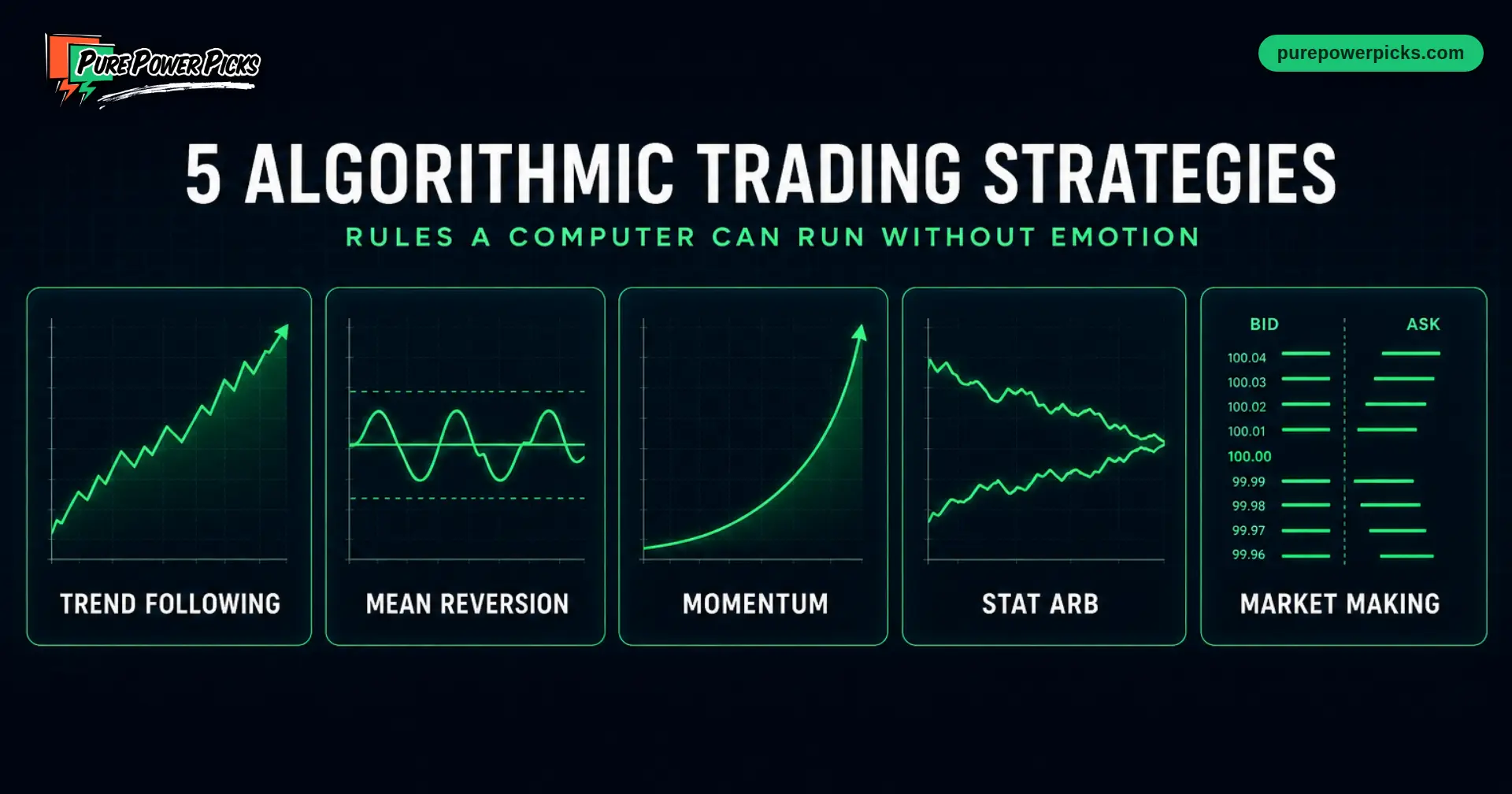
The five most reliable strategy families are trend following, mean reversion, momentum, statistical arbitrage, and market making. Each one exploits a different behavior in the market, so knowing which fits current conditions is half the battle.
1. Trend Following
Trend following assumes that an asset moving in one direction tends to keep moving that way. The algo buys strength and sells weakness, often using moving average crossovers or breakout levels as triggers. It shines in strong, directional markets and struggles in choppy, sideways ones. Pair it with a solid read on best trading indicators to filter out noise.
2. Mean Reversion
Mean reversion bets that prices stretched too far from their average will snap back. When a stock spikes above or drops below a statistical band, the algo fades the move and waits for a return to the mean. Tools like Bollinger Bands and RSI power this approach, and our technical indicators guide covers them in depth.

3. Momentum
Momentum strategies ride assets showing accelerating strength, whether measured by rate of change or by relative performance against a benchmark. The idea is that winners keep winning over a defined window before they fade.
The trading the MACD approach is a classic momentum tool, and reviewing the top technical indicators will help you build cleaner momentum signals.
4. Statistical Arbitrage
Stat arb hunts for temporary price gaps between related securities, then trades both sides to profit from convergence. It is math heavy and typically favors well capitalized, low latency traders.
5. Market Making
Market making places simultaneous buy and sell quotes to capture the bid ask spread. The algo profits from volume and tight pricing rather than betting on direction. It demands speed, deep liquidity, and disciplined risk limits, which is why it is more common on professional desks than in retail accounts.
Do not marry one strategy. Trend following thrives when momentum is strong, while mean reversion wins when markets stall. Build a simple filter that tells you which regime you are in, then let that decide which system gets the wheel.
How Do You Build an Algorithmic Trading Strategy?
Building a strategy comes down to five steps: define the edge, code the rules, backtest on historical data, forward test in a simulator, then deploy small and scale slowly. Each stage exists to catch flaws before real money is on the line.
Start with a clear hypothesis. What behavior are you exploiting, and why should it persist? Then translate that into exact rules with no gray area. Vague logic cannot be coded.
Backtesting shows how your rules would have behaved historically, but beware of overfitting to the past. A model tuned too perfectly to old data often falls flat live. Forward testing on new data is your reality check.
Weave in your risk-reward ratio targets from the start, and anchor everything to a documented plan. Our guide on building a trading plan walks through the structure step by step.

Which Strategy Fits Which Market? A Quick Comparison
No single strategy wins in every environment. Use this table to match the approach to the conditions you are seeing.
| Strategy | Best Market | Complexity |
|---|---|---|
| Trend Following | Strong directional moves | Low to medium |
| Mean Reversion | Range bound, choppy | Medium |
| Momentum | Accelerating trends | Medium |
| Statistical Arbitrage | Correlated pairs | High |
| Market Making | Liquid, high volume | High |
Automation multiplies mistakes as fast as it multiplies good decisions. A coding bug, a data glitch, or a sudden regime shift can drain an account in minutes. Always cap position size, use hard stops, and monitor live systems. The SEC investor resources are a good reminder that no strategy removes risk.
How Can You Turn Algo Concepts Into a Hypothetical Setup?
You can apply the same rules based thinking even if you trade by hand. Let us walk through a hypothetical example to show the logic, not a real trade.
Suppose you are studying a momentum idea on a hypothetical stock trading at 100. Your rule says: consider a bullish setup only when the 20 day moving average crosses above the 50 day and RSI holds above 55. If a defined bullish signal appears near an alert price of 100, your plan might set a risk level at 96 and watch a target zone toward 108, keeping the setup at a clean risk to reward of roughly 1 to 2.
That is the framework a good algo enforces automatically. To sharpen your read on triggers like this, study how to interpret buy and sell signals and how to go about choosing trade signals that actually carry an edge. For options specific mechanics, the CBOE education center is a solid reference.
Frequently Asked Questions
Is algorithmic trading profitable for beginners?
It can be, but profitability depends entirely on the quality of your strategy and risk controls, not the automation itself. Beginners should focus on learning the concepts and backtesting before deploying real capital. There are no guaranteed returns in any market.
Do I need to know how to code?
Not necessarily. Many platforms offer visual, drag and drop builders and pre built strategy templates. That said, learning some Python or a platform scripting language gives you far more flexibility to test and refine your own ideas.
What is the biggest mistake in algo trading?
Overfitting. It happens when you tune a model so tightly to historical data that it looks flawless on paper but breaks the moment live conditions differ. Forward testing on fresh data is the best defense.
How much money do I need to start?
Simple retail focused strategies like trend following need less capital than institutional approaches such as market making or statistical arbitrage. Start small, prove your system works, and scale only after it holds up.
Can I combine algo trading with manual trading?
Absolutely. Many traders let algorithms handle mechanical, repeatable setups while they apply discretion to more complex situations. The rules based discipline from algo trading tends to improve manual decisions too.
Learn the Setups Behind the Signals
Strategy is a skill, and skills are learned. At Pure Power Picks we teach the chart setups, risk frameworks, and decision making that make rules based trading click, so you can grow with confidence.
See Membership Options
The PPP Team is the research and editorial team behind Pure Power Picks. We trade stocks and options and publish the work as we do it, with every alert tracked in public. Publishing since 2020. How we research and correct our work is written out in our editorial standards. Our content is strictly educational, never advice.
Disclaimer: Pure Power Picks provides educational content only. We are not financial advisors, and nothing in this article constitutes financial, investment, or trading advice. All examples labeled hypothetical are illustrative and do not represent real trades, positions, or results. Trading stocks and options involves substantial risk of loss and is not suitable for every investor. Past performance and hypothetical scenarios do not guarantee future results. Always do your own research and consider consulting a licensed professional before making any financial decision.