


UNP Options +214%: Earnings Beat & $85B Deal Drive Move
Share


Union Pacific just delivered a textbook bullish reversal, and the PPP alert desk was on it a full month before the Q1 earnings catalyst hit the wire. On April 23, 2026, UNP gapped higher to close at $271.23 after the railroad operator beat Q1 estimates and CEO Jim Vena publicly defended the pending $85 billion Norfolk Southern acquisition — a deal that would create the first true transcontinental railroad in U.S. history.
The move sent the PPP-alerted $260 call contract ripping higher into the earnings catalyst, and the follow-through extended into the April 24 session with the contract peaking at $16.00 — a +214% max opportunity from the original $5.10 entry.
PPP alerted UNP $260 CALLs (June 18 expiration) at $5.10 on March 24, 2026, with the stock trading near $235 and RSI pinned at 40.7. The analyst thesis called for a “relief bounce back toward targets at $244 – 247 – 250” with upside extension to “February highs near $260+” if resistance cleared. Every single target printed.
As the analyst wrote at the time: “A name from recent watch needs to hold the critical $235-230 support level… setting up for a relief bounce.”
“A name from recent watch needs to hold the critical $235-230 support level. Price action is showing signs of stabilization after the recent selloff. Stock is oversold with RSI at 40.7 and trading below the 50-day SMA, setting up for a relief bounce back toward targets at $244 – 247 – 250. If $250 resistance clears and reclaims, that opens the door to retest $255 and February highs near $260+. Lower options volume so cautious on fills. Look for support $235 – 232 – 230, deeper support at 225 – 220.”
PPP identified UNP as an oversold bounce candidate at $235 support with a clear technical roadmap to $260. A Q1 earnings beat and renewed confidence in the Norfolk Southern acquisition catalyzed the move, driving the $260 calls from $5.10 to a $16.00 high for a +214% max opportunity.
What Was the PPP Alert Thesis?
On March 24, 2026, UNP had just finished a brutal leg down. The stock was trading around $235, RSI had cooled to 40.7, and price was sitting below the 50-day SMA. Most traders saw weakness. The PPP analyst saw a setup.
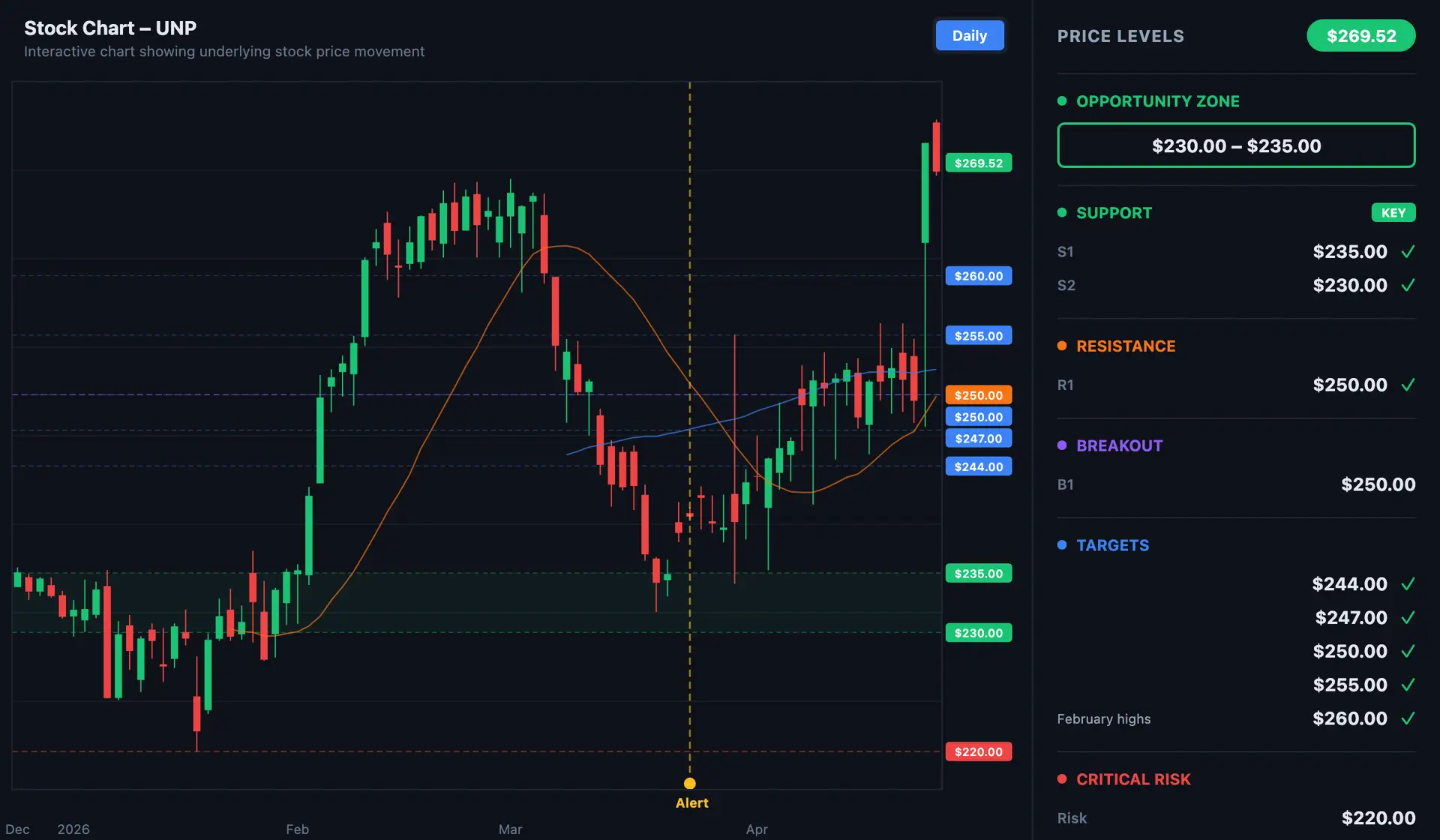
The thesis centered on one critical level: $235-$230 had to hold. That zone marked the optimal entry window for the alert and represented the line between “oversold bounce” and “broken structure.”
From there, the roadmap was laid out in layers. First targets at $244, $247, and $250 represented a standard relief rally. The $250 level was flagged as the breakout trigger — reclaim it, and the door opened to $255 and a retest of February highs near $260.
Just as important was the void level at $220. A close below that number would have invalidated the entire thesis, giving traders a pre-defined point to step aside. This is the backbone of how our trade alerts work — every alert has a structured exit plan, not just a hopeful entry.
The analyst also flagged a practical caution: “Lower options volume so cautious on fills.” That single note matters. UNP isn’t SPY or TSLA — it’s a railroad with thinner options flow, which means picking the right strike price and using limit orders is non-negotiable.
The $260 strike with June 18 expiration gave the trade roughly 86 days — enough runway to absorb an earnings cycle without theta burning a hole in the position.
What News Drove the Move?
Union Pacific reported Q1 2026 earnings on April 23, and the numbers delivered. Adjusted EPS came in at $2.93, beating consensus by 2.84%, while revenue climbed 3.2% year-over-year to $6.22 billion.
But the real fuel wasn’t just the beat — it was the $85 billion Norfolk Southern acquisition narrative. CEO Jim Vena used the earnings call to make an aggressive case for the merger, framing it as the creation of the first transcontinental railroad in American history.
That’s a storyline the market can price in. A combined UNP-NSC would dominate freight rail coast to coast, with significant pricing power and network synergies. The deal still needs Surface Transportation Board approval, but Vena’s confident tone signaled management isn’t blinking.
The combination of a clean earnings beat plus a re-energized M&A thesis is exactly the type of dual catalyst that drives outsized options moves. This is why trading options on earnings rewards traders who position before the event with a technical thesis already in place.
Efficiency gains and pricing power drove the top-line beat, which matters because it shows the core business is healthy independent of the merger. Bulls got both stories in one report.
The stock gapped higher on the open and never looked back, closing April 23 at $271.23 — well past the $260 target — with the April 24 session extending the move to a $274.79 intraday high.
How Did the Options React?
The $260 calls moved in stages, not a single explosion. The milestone timeline tells the story:
- +10% on March 24 (alert day) — initial stabilization
- +25% on April 8 — stock reclaims $244-247
- +50% on April 8 — $250 breakout trigger clears
- +75% on April 23 — earnings gap higher
- +100% on April 23 — $260 strike reclaimed on the catalyst
- +214% on April 24 — peak $16.00 as the move extended post-earnings
The earnings session delivered the bulk of the move as the contract ripped through +75% and +100% milestones on April 23. Follow-through buying into April 24 pushed the premium to a $16.00 peak, stretching the max opportunity to +214% from the $5.10 entry.
The Greeks explain the acceleration. With delta now at 0.71, the option behaves like 71 shares of stock — every $1 move in UNP adds roughly $0.71 to the contract. Gamma at 0.014 kept that sensitivity elevated as the stock pushed well through strike.
Interestingly, implied volatility sits at just 22.5% — relatively muted for a post-earnings name. That’s a feature of UNP’s lower-beta profile as a railroad. Traders didn’t get hammered by an IV crush the way they would on a high-flying tech name.
The June 18 expiration was the quiet hero here. Choosing dated contracts well past the earnings print meant theta decay (-0.08) stayed manageable while the stock worked through its technical roadmap.
Why the Trade May Still Have Room to Run
At +214%, plenty of traders would call it a trade and move on. One of the advantages of choosing a dated expiration in the first place, though, is that the June 18 contract still has roughly 23 days of runway — and the technical backdrop that drove the initial leg remains fully intact. UNP is trading above every major moving average, the Q1 earnings catalyst is confirmed rather than speculative, and the Norfolk Southern merger narrative continues to attract institutional flow.
The next technical reference sits at the $280 zone — UNP’s 2022 high — which functions as the natural overhead supply area for a stock in a confirmed breakout. A clean reclaim of $280 puts the chart in blue-sky territory: no meaningful resistance until price discovery sets new levels. That’s the kind of long tail that turns a +214% winner into something materially larger, but only for traders who don’t panic at the first pullback.
The trade management playbook here writes itself. Scale out in tranches — lock in a meaningful piece at the current level so the trade is “paid,” trim again as price approaches $280, and leave a final runner to work toward blue skies under a trailing stop on the underlying. Treating the position this way takes the emotion out of the exit and guarantees the opportunity is captured in pieces instead of gambled on a single top tick.
Equally important: a winner should never be allowed to go red. Once an option is up a multiple, the psychological cost of watching it retrace to zero is far larger than the dollar cost. Use a profit stop — a fixed retracement from the peak (e.g., exit the remaining contracts if the premium gives back 30% from the high), or a break of a structural support on the underlying like the 8-day or 20-day EMA. That discipline is what separates traders who compound from traders who chase. The setup is still active; the process is what protects the opportunity already earned.
What Can Traders Learn?
1. Oversold doesn’t mean broken. UNP was under its 50-day SMA with RSI at 40.7 when the alert fired. Bounces from legitimate support zones, backed by a defined void level, are some of the highest-quality setups in the book.
2. Strike selection matters more than being right. The $260 strike was out-of-the-money at entry but aligned perfectly with the upper technical target. Picking strikes at your thesis targets — not randomly — is covered in our swing trading with options alerts framework.
3. Scale out at milestones. With targets hit at $244, $247, $250, $255, and $260, disciplined traders had multiple exits. Our guide on taking profits and setting stops walks through exactly how to treat multi-target alerts.
Frequently Asked Questions
Why were the $260 strike calls chosen over closer-to-the-money strikes?
The $260 strike matched the upper price target in the analyst thesis — specifically the February highs retest. Buying calls at your target level offers higher leverage if the thesis plays out, though it requires the stock to actually reach that zone. Closer strikes would have cost more but offered less percentage upside.
What happens to the contract now that it’s in-the-money?
With UNP at $271.44 and the strike at $260, the call is $11.44 in-the-money with intrinsic value. The remaining $3.96 is extrinsic (time + volatility premium) that will decay as June 18 approaches. Delta near 0.71 means the contract now tracks the stock very closely.
How does a low-IV environment help or hurt this trade?
Low IV (22.5%) means options are relatively cheap to own and don’t suffer big “IV crush” drops after catalysts. The downside is less explosive movement from volatility expansion — most of the gain came from directional price movement and delta, not vega.
What would have invalidated this trade?
The void level was $220. A daily close below that would have broken the entire technical structure and ended the thesis. That pre-defined exit is what separates a planned trade from a hope-and-pray position — a concept explored in our INTC alert case study.
Every PPP alert comes with a detailed thesis, price targets, support/resistance levels, and a void level — the full roadmap, not just a ticker.
Explore Trade Alerts →Disclaimer: Pure Power Picks is not a licensed financial advisor. All content is for educational and informational purposes only and should not be considered investment advice. Options trading involves substantial risk of loss and is not suitable for all investors. Past alert performance does not guarantee future results.
Share

The PPP Team brings decades of combined experience from some of the most well-known companies in the trading industry. Founded in 2020, Pure Power Picks delivers options trading education, scanner reviews, and trade alerts to help everyday traders develop real skills. Our content is strictly educational.