

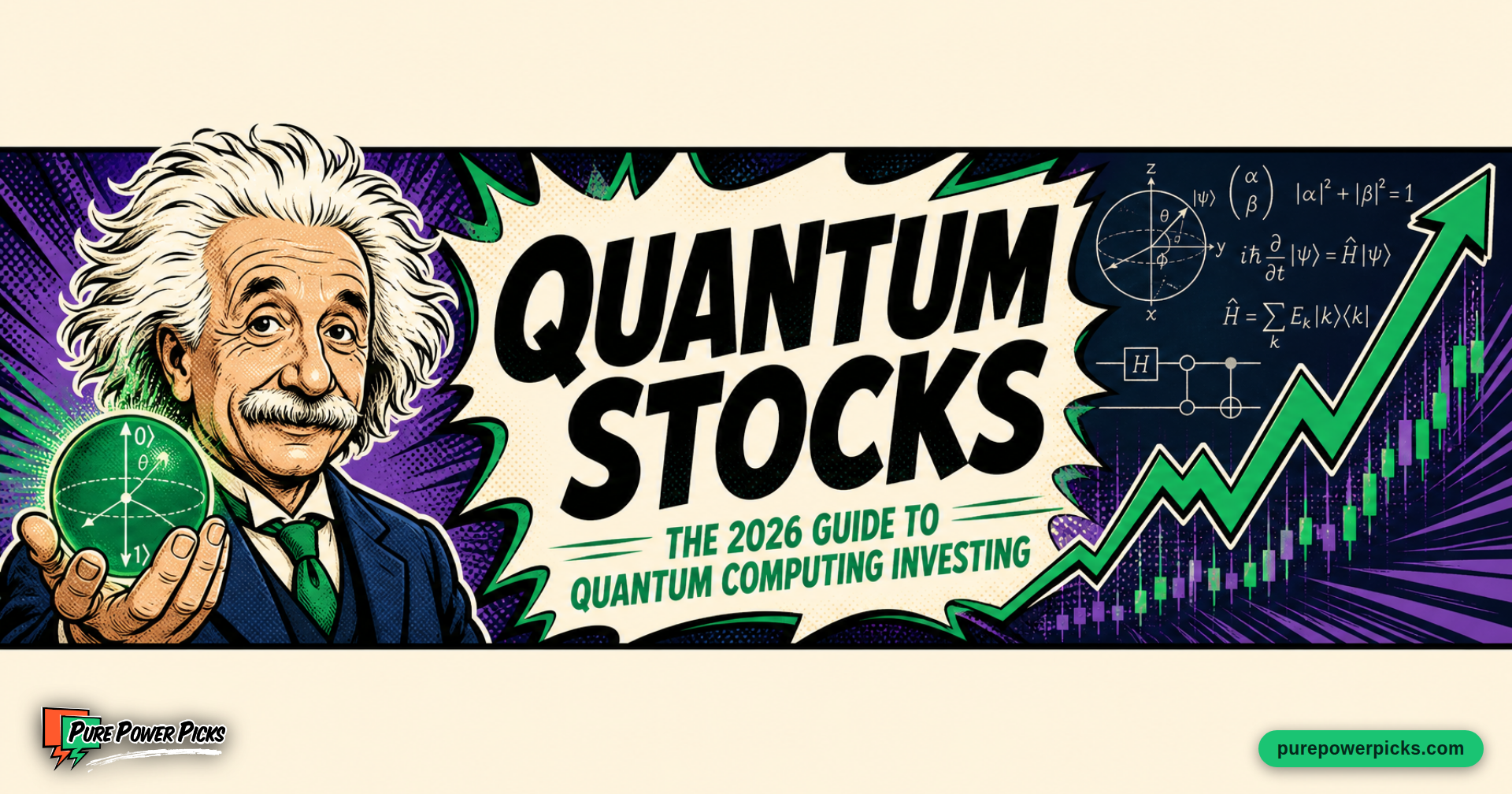
Quantum Computing Stocks in 2026: How to Invest in Quantum (Updated Weekly)
- The three tiers of the quantum trade, sorted by whether the company sells a quantum computer at all
- Live prices on the ten names the category is searched on, refreshed weekly
- Quantinuum (QNT), which IPO'd in June 2026 and is missing from almost every quantum stock list
- The revenue multiples, printed plainly, including the name trading at roughly 475 times sales and the one with no revenue at all
- Which of these are post-quantum cryptography companies rather than quantum computing companies, and why that distinction costs people money
Quantum computing is the most mislabeled category in the market. Search "quantum stocks" and you will get a list of ten companies, of which perhaps four actually build a quantum computer. The rest are semiconductor security vendors, photonics foundries and mega-cap research programs that disclose no quantum revenue whatsoever.
That is not pedantry. In the first half of 2026 one widely listed "quantum stock" reported zero revenue, in both quarters. Another grew its share count by roughly 304% in a year. A third derives most of its revenue from a chip packaging business it acquired. None of that shows up in a listicle that sorts by market cap.
So this page sorts by one question: does this company sell quantum computing, and how much of it?
The Three Tiers of the Quantum Trade
They Build Quantum Computers
Designs and operates its own quantum processors and sells access or systems. Revenue is real but small, and the losses are large. This is the actual sector.
IONQ · RGTI · QBTS · QNT
Quantum Adjacent
Sells something near quantum: post-quantum cryptography chips, photonics, packaging. Real businesses in some cases, but not quantum computers, and they trade on the quantum narrative anyway.
QUBT · LAES · BTQ
Research Programs Inside Giants
World-class quantum research attached to a company whose stock moves entirely on something else. No disclosed quantum revenue, no quantum segment.
IBM · GOOGL · MSFT
Quantum Computing Stocks: The Ten Tickers That Carry the Category
Prices refresh automatically every week. Everything else comes from company filings and is dated.
-
 IONQIonQ$36.84▼ -3.41% todayMKT CAP $14.93BP/E N/A52W $26-85◎ BEST PLAY: Defined-risk debit spread · 30-45 DTE
The revenue leader and the one with an asterisk. Q2 2026 revenue $80.05M (+287%) and FY guidance raised to $450M-$460M, but that guidance includes SkyWater from the July 31 2026 acquisition, so the mix is no longer mostly quantum. Q2 operating loss was $337M on $80M of revenue. The most liquid options chain of the pure plays.
-
RGTIRigetti Computing$15.16▼ -0.52% todayMKT CAP $5.06BP/E N/A52W $13-58◎ BEST PLAY: Defined-risk debit spread · 30-45 DTE
The purest of the group and the smallest: Q2 2026 revenue $5.138M (+185%) with a $52.6M net loss. Designs and fabricates its own superconducting processors and runs its own fab. About $541.3M in cash and investments, no debt, so no forced raise. Roughly $4.55B enterprise value on about $20M annualized revenue, near 220x.
-
QBTSD-Wave Quantum$16.66▼ -2.69% todayMKT CAP $6.21BP/E N/A52W $13-47◎ BEST PLAY: Defined-risk debit spread · 30-45 DTE
Where the order book and the income statement disagree. Q2 2026 revenue $3.1M, flat YoY, and H1 down 67% against a prior year inflated by a one-time system sale. But H1 bookings were $35.5M (+1,120%) and remaining performance obligations hit $40.7M (+668%), roughly seven times trailing revenue. Near 475x annualized sales.
-
QNTQuantinuum$48.67▼ -0.45% todayMKT CAP $12.93BP/E N/A52W $47-87◎ BEST PLAY: Newly listed, check the book · 30-45 DTE
Honeywell’s quantum arm, and the name missing from almost every quantum list. IPO’d on Nasdaq June 4 2026 at $60, above its $53-$55 range, raising $1.68B and closing near a $15.7B market value. Honeywell keeps control through an Up-C structure with the Class A float about 12.1% of economic interests. Chain is still thin.
-
QUBTQuantum Computing Inc$7.82▼ -2.74% todayMKT CAP $1.77BP/E N/A52W $6-26◎ BEST PLAY: Defined risk, size for volatility · 30-45 DTE
Has the name, increasingly a different business. H1 2026 revenue $9.242M against $100K a year earlier, but only about $0.8M came from legacy quantum products. The rest is thin-film lithium niobate photonics and semiconductor packaging from its Tempe foundry. Roughly $1.32B in cash and investments funds the pivot.
-
LAESSEALSQ$2.38▼ -0.83% todayMKT CAP $530MP/E N/A52W $2-9◎ BEST PLAY: Defined risk only, small size · 21-30 DTE
Not a quantum computing company. It sells classical semiconductor security chips and post-quantum cryptography, which defends against quantum computers rather than being one. H1 2026 revenue around $11M vs $5M, FY guidance $27M-$37M. Share count up roughly 304% in a year across raises at $7.50 and $4.11.
-
BTQBTQ Technologies$2.72▼ -7.80% todayMKT CAP $400MP/E N/A52W $2-16◎ BEST PLAY: Shares only, chain unverified · n/a DTE
Post-quantum cryptography IP, and the starkest number on the board: C$0 revenue for the quarter ended June 30 2026 and C$0 for the six months, against C$65,497 a year earlier, with a C$36.7M six-month loss. Pre-commercial IP licensing priced as a quantum stock. An active option chain could not be verified.
-
IBMIBM$234.02▼ -2.47% todayMKT CAP $220.48BP/E 20.852W $199-332◎ BEST PLAY: Covered call / debit spread · 30-45 DTE
The closest of the majors to commercial quantum, and it still points to 2028-2029 for material contribution. Q2 2026 revenue $17.162B (+1.1%) with company-wide remaining performance obligations near $68B, none of it broken out as quantum. Frontier quantum inside a cash-generative, investment-grade business.
-
GOOGLAlphabet$332.60▲ +0.59% todayMKT CAP $4.07TP/E 16.652W $236-409◎ BEST PLAY: Covered call / debit spread · 30-45 DTE
Reports no quantum revenue, no quantum segment and no quantum backlog. Q2 2026 revenue $119.8B (+24%). The stock trades on Cloud, up 82% YoY with a cited $514B backlog, and on capex guided to $195B-$205B for 2026. World-class quantum research that will not move this ticker.
-
MSFTMicrosoft$492.44▲ +0.16% todayMKT CAP $3.66TP/E 27.452W $349-554◎ BEST PLAY: Covered call / debit spread · 30-45 DTE
A research program plus Azure Quantum, which largely resells access to other people’s hardware. FY26 Q4 revenue $90.0B (+18%) with commercial remaining performance obligations of $678B, up 84%. Quantum is a strategic option here, not a revenue line.







See What We Are Watching
Get on our free list and the watchlist and alerts we send land in your inbox. Quantum and semiconductor names turn up on them regularly.
Free. No spam. Education only, nothing here is financial advice. Unsubscribe anytime.
The Four That Actually Build Them
Quantinuum (QNT) is the one most lists have not caught up with. Honeywell's quantum arm went public on Nasdaq on June 4, 2026, pricing at $60 per share above its $53 to $55 range and raising $1.68 billion. It closed its first day around a $15.7 billion market value. Honeywell remains the controlling holder through an Up-C structure, with the Class A public float representing about 12.1% of economic interests at the offering. The stock has since traded down meaningfully from the IPO price, which is the sort of detail a list that never mentions the company cannot tell you.
IonQ (IONQ) posted the largest revenue in the group by a wide margin: Q2 2026 revenue of $80.05 million, up 287% year over year, with full-year guidance raised on September 8, 2026 to $450 to $460 million. Read the footnote before you read the headline. That guidance includes SkyWater Technology from its July 31, 2026 acquisition date, so the revenue mix is no longer mostly quantum. Against that sits a Q2 operating loss of $337 million on $80 million of revenue.
Rigetti (RGTI) is the purest of the group and the smallest: Q2 2026 revenue of $5.138 million, up about 185%, with a GAAP net loss of $52.6 million. It designs and fabricates its own superconducting processors and runs its own chip fab. The balance sheet is the strength, roughly $541.3 million across cash and investments with no debt, which funds the roadmap for years without a forced raise. The price is the problem: about $4.55 billion of enterprise value against roughly $20 million of annualized revenue.
D-Wave (QBTS) is the one where the order book and the income statement disagree. Q2 2026 revenue was $3.1 million, flat year over year, and first-half revenue fell 67% to $5.9 million against a prior-year period inflated by a one-time system sale. But bookings were $35.5 million in the first half, up 1,120%, and remaining performance obligations reached $40.7 million, up 668%, with about 57% expected to convert inside twelve months. That is roughly seven times trailing revenue sitting in contracted backlog.
The Ones That Are Not Quantum Computing Companies
All three of these appear on quantum stock lists. None of them sells a quantum computer.
SEALSQ (LAES) sells classical semiconductor security chips: secure elements, TPMs and ASIC design services. Its quantum connection is post-quantum cryptography, which is defensive encryption designed to survive quantum computers, not quantum computing itself. The business is growing, with first-half 2026 revenue around $11 million versus $5 million a year earlier and full-year guidance of roughly $27 to $37 million. The dilution is the story: share count is up roughly 304% in a year across two raises priced at $7.50 and $4.11, with more than 110 million warrant shares still outstanding.
BTQ Technologies (BTQ) is also post-quantum cryptography, and it reported C$0 in revenue for the quarter ended June 30, 2026, and C$0 for the six months, against C$65,497 in the year-ago quarter. The six-month loss was C$36.7 million. Its option chain could not be verified as active. This is a pre-commercial IP licensing story, priced as a quantum stock.
Quantum Computing Inc (QUBT) has the name and, increasingly, a different business. First-half 2026 revenue was $9.242 million against $100 thousand a year earlier, but only about $0.8 million of that came from legacy quantum products. The rest is thin-film lithium niobate photonics and semiconductor advanced packaging out of its Tempe, Arizona foundry. It holds roughly $1.32 billion in cash and investments with essentially no debt, which is what is really funding the transformation.
IBM, Google and Microsoft: Real Science, No Revenue Line
These three run some of the most advanced quantum programs on earth. None of them discloses a dollar of quantum revenue.
IBM is the closest to commercial and still points to 2028 to 2029 for material contribution. Q2 2026 revenue was $17.162 billion, up about 1.1%, with company-wide remaining performance obligations near $68 billion, none of it broken out as quantum. It is the only way to own frontier quantum inside a cash-generative, investment-grade business, which is a genuine argument, just not a quantum one.
Alphabet (GOOGL) reports no quantum revenue, no quantum segment and no quantum backlog. Q2 2026 revenue was $119.8 billion, up 24%. The stock trades on Cloud, which grew 82% year over year with a cited $514 billion backlog, and on a capex program guided to $195 to $205 billion for 2026.
Microsoft (MSFT) is a research program plus Azure Quantum, which mostly resells access to other people's hardware. FY26 Q4 revenue was $90.0 billion, up 18%, with commercial remaining performance obligations of $678 billion, up 84%.
And Honeywell (HON) deserves a line here, because it used to be the quantum answer. After spinning Quantinuum out in June 2026 it is an industrial automation pure play that happens to retain a controlling stake in a listed quantum company. If you want Quantinuum exposure, QNT is the direct route and HON is the diluted one.
PsiQuantum, and the ETF Route
PsiQuantum is the largest quantum company you cannot buy: silicon photonics, a million-qubit fault-tolerant architecture, utility-scale sites targeted in Brisbane and Illinois, and a valuation around $10.5 billion post-money as of May 2026. There is no direct public exposure. The indirect routes are NVIDIA, which invested through NVentures and is doing GPU to QPU integration work, and Microsoft, an early investor.
For diversified exposure, the Defiance Quantum ETF (QTUM) holds about $5.55 billion in assets and tracks a modified equal-weighted index of companies with at least 50% of revenue or activity tied to quantum computing and machine learning. Equal weighting matters here: it means a pre-revenue name and a mega cap can carry similar weight, which is either the point or the problem depending on what you wanted.
What the Options Market Will Let You Do
| Ticker | Chain depth | What that permits |
|---|---|---|
| MSFT, GOOGL, IBM | Among the deepest listed anywhere | Any structure, any expiry, tight spreads |
| IONQ | Deep: weeklies, monthlies, LEAPS | Any structure. The most liquid pure play |
| RGTI | Deep: weeklies plus LEAPS | Defined-risk spreads, decent fills |
| QBTS | One of the most actively optioned small caps here | Defined-risk spreads around bookings news |
| QUBT | Weeklies, monthlies and LEAPS | Defined risk, size for the volatility |
| LAES | Listed with weeklies | Defined risk only, small size |
| QNT | Newly listed, chain still thin | Check the book before assuming a fill |
| BTQ | Could not verify an active chain | Treat as shares only |
How to Approach Quantum Without Buying a Label
1. Does this company sell a quantum computer? Four of the ten do. If the answer is no, you are buying something else, and the something else may be perfectly good, just not what the headline promised.
2. What is the revenue multiple, actually? Not the forward one. Take the last reported quarter, annualize it, and divide. When that number comes back in the hundreds, you are underwriting a roadmap, and roadmaps slip.
3. What happened to the share count? LAES is up roughly 304% in a year. RGTI is up 0.7% over seven months on a much larger cash pile. Those two facts describe completely different relationships between the company and its shareholders.
Get On Our Free List
Our watchlist and our alerts go out to the free list, and Quantum and semiconductor names turn up on them regularly. It costs nothing, and it is the simplest way to see which names we are studying and what we are watching on them.
Free. No spam. Education only, nothing here is financial advice. Unsubscribe anytime.
Frequently Asked Questions
What are the best quantum computing stocks to buy right now?
We do not publish buy calls. The first useful filter is whether the company sells a quantum computer at all. Four of the ten names commonly listed do: IonQ, Rigetti, D-Wave and Quantinuum. SEALSQ and BTQ are post-quantum cryptography companies, Quantum Computing Inc is now largely a photonics and chip packaging business, and IBM, Alphabet and Microsoft disclose no quantum revenue.
Did Quantinuum go public?
Yes, and most quantum stock lists have not caught up. Honeywell's quantum arm listed on Nasdaq under QNT on June 4 2026, pricing at 60 dollars per share above its 53 to 55 dollar range and raising 1.68 billion dollars, closing its first day near a 15.7 billion dollar market value. Honeywell remains the controlling holder through an Up-C structure, with the Class A public float at about 12.1 percent of economic interests at the offering.
Is SEALSQ a quantum computing stock?
No. SEALSQ designs and sells classical semiconductor security chips, secure elements, TPMs and ASIC design services. Its quantum link is post-quantum cryptography, which is encryption built to survive quantum computers rather than quantum computing itself. First half 2026 revenue was around 11 million dollars against 5 million a year earlier, and the share count is up roughly 304 percent in a year.
Which quantum stock has no revenue?
BTQ Technologies reported zero Canadian dollars of revenue for the quarter ended June 30 2026 and zero for the six months, against 65,497 Canadian dollars in the year-ago quarter, with a six-month loss of 36.7 million Canadian dollars. It is a pre-commercial post-quantum cryptography IP licensing business.
How expensive are quantum stocks compared to their revenue?
Very, and the multiples are rarely printed. On annualized current revenue D-Wave trades near 475 times sales and Rigetti near 220 times, on roughly 20 million dollars of annualized revenue against about 4.55 billion dollars of enterprise value. Those are venture-stage valuations attached to listed tickers, which is the actual risk being taken.
Can I invest in PsiQuantum?
Not directly. PsiQuantum is private, valued around 10.5 billion dollars post money as of May 2026, building a silicon photonics million-qubit architecture with utility-scale sites targeted in Brisbane and Illinois. The only exposure is indirect, through NVIDIA, which invested via NVentures and is doing GPU to QPU integration work, or Microsoft, an early investor.
Is there a quantum computing ETF?
Yes. The Defiance Quantum ETF, ticker QTUM, holds about 5.55 billion dollars in assets and tracks a modified equal-weighted index of companies with at least 50 percent of revenue or activity tied to quantum computing and machine learning. Equal weighting means a pre-revenue name can carry a similar weight to a mega cap, which is either the appeal or the drawback depending on what you wanted.
Do IBM, Google and Microsoft make money from quantum computing?
None of them discloses any quantum revenue. IBM is closest to commercial and management still points to 2028 to 2029 for material contribution. Alphabet reports no quantum revenue, no quantum segment and no quantum backlog. Microsoft runs a research program plus Azure Quantum, which largely resells access to other companies' hardware. All three are excellent businesses whose stocks move on entirely different things.
What Members Get When a Quantum Name Sets Up
Everything above is homework you can do yourself. Members get the other half: three to five options alerts a week, each with the full contract and a written plan, sent by text, email and Discord. Every alert we send goes into the public tracker, the ones that worked and the ones that did not.
See What Members Get
The PPP Team brings decades of combined experience from some of the most well-known companies in the trading industry. Founded in 2020, Pure Power Picks delivers options trading education, platform reviews, and trade alerts to help everyday traders develop real skills. Our content is strictly educational.