


How to Use VWAP (Volume Weighted Average Price) in Stocks and Options Trading
Whether you’re a day trader trying to find low-risk entries or an options trader looking for high-probability setups, VWAP is one of those tools that just hits different. It blends both price and volume into a single line that institutions rely on heavily — and you should too.
In this post, we’ll break down what VWAP is, how it works, and how to use it like a pro when trading stocks and options.
Table of Contents
ToggleWhat Is VWAP?
VWAP (Volume Weighted Average Price) is a technical indicator that calculates the average price a stock has traded at throughout the day, weighted by volume.
📌 VWAP Formula:
VWAP = (Cumulative Price × Volume) ÷ Cumulative Volume
This means that more heavily traded prices carry more weight. It’s not just about where the stock has been, but how important those price levels were in terms of volume.
VWAP vs Simple Moving Average (SMA)
| Metric | VWAP | SMA |
|---|---|---|
| Factors In | Price + Volume | Price only |
| Resets | Daily (typically) | Continuous (based on period length) |
| Used For | Intraday bias, trade execution, entries | Trend following |
| Users | Institutions, intraday traders | Everyone from swing traders to long-term |
💡 VWAP is more dynamic than a moving average because it factors in how much volume was traded at each price level.
How To Use VWAP When Trading Stocks
1. As an Intraday Trend Guide
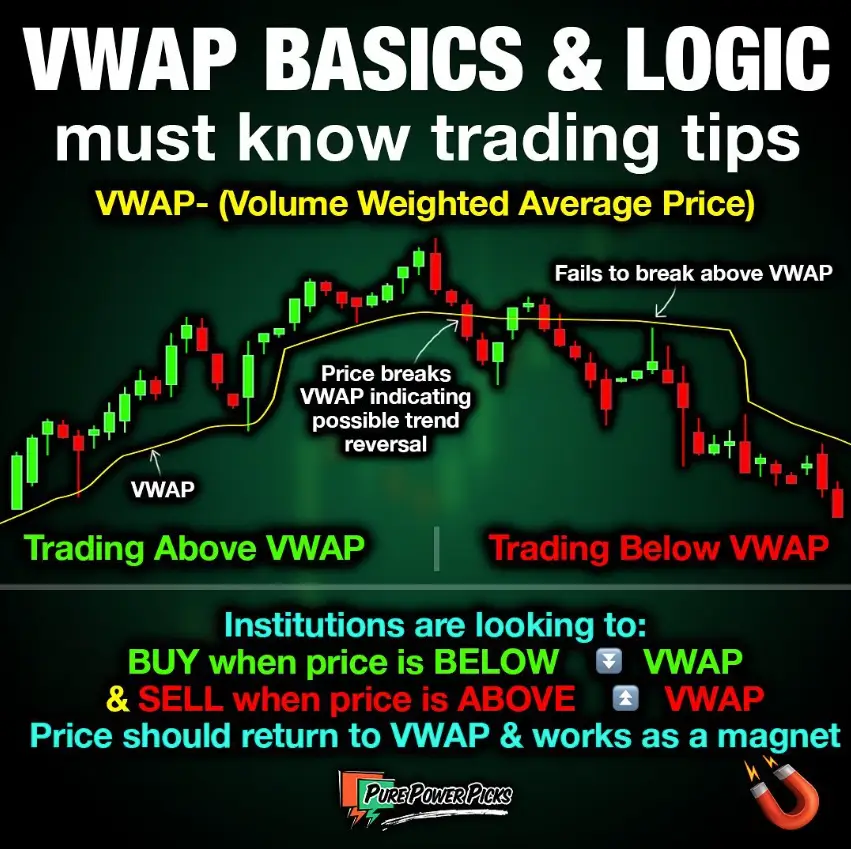
VWAP acts as a real-time benchmark for fair value. It helps you quickly see whether price is trading above (bullish) or below (bearish) the average price traders have paid that day.
Above VWAP: Bullish bias
Below VWAP: Bearish bias
Touching VWAP: Neutral/consolidation zone
2. Support and Resistance
VWAP often acts like a dynamic support or resistance line throughout the day. A bounce off VWAP after a pullback? That’s often a solid long entry. A rejection at VWAP? Possible short setup.
3. Volume Confirmation
If price breaks above VWAP on high volume, that can signal a real move — not just a head fake. Lower volume breakouts? More likely to fade.
How To Use VWAP When Trading Options
VWAP is just as useful — if not more so — in options trading because it helps you:
Time Your Entries
Buying calls when stock price reclaims VWAP = stronger odds
Buying puts when price gets rejected by VWAP = tighter setup
This gives you better directional confirmation, helping you avoid premium decay on sideways days.
Set Strike Price Targets
Let’s say you’re trading $AMD calls. If price breaks above VWAP and starts ramping toward a resistance level, you can pick a strike price above VWAP and ride the momentum.
Combine VWAP with Implied Volatility (IV) and Greeks like delta and theta to fine-tune risk/reward.
Avoid Choppy Setups
One of the biggest killers in options trading is time decay on sideways action. VWAP helps you spot those no-trade zones when price is just hovering and volume is thinning out.
VWAP Trading Strategy Example
Stock: $AAPL
Setup: Bullish open, price dips to VWAP
Action: Price holds VWAP and prints a higher low
Volume: Surge on the next candle as buyers step in
Play: Buy weekly 5-point OTM calls for a quick move
Stop: Below VWAP
Target: High of day or key resistance
VWAP Variations
Some platforms allow anchored VWAP, which starts the calculation from a custom point (like an earnings date or a Fed announcement). This is useful for swing traders or institutional-level setups.
Anchored VWAPs help determine where the bulk of institutional positioning occurred — perfect for swing trading options with expirations 2–4 weeks out.
Pro Tips
Use VWAP in conjunction with trendlines or key levels for cleaner entries.
On strong trend days, VWAP pullbacks often offer the best risk/reward.
On choppy days, VWAP can serve as a mean-reversion magnet — trade the range.
Frequently Asked Questions (FAQ)
What does VWAP tell you?
It shows the average price a stock has traded at throughout the day, weighted by volume. It’s used to gauge fair value.
Is VWAP good for swing trading?
Classic VWAP resets daily, so it’s more useful for intraday trading. But anchored VWAP can be helpful for longer setups.
Can I use VWAP with options?
Yes — it helps time entries, avoid chop, and confirm direction for higher-probability options trades.
What platform shows VWAP?
VWAP is available on most major platforms like TradingView, ThinkorSwim, Webull, and Interactive Brokers.
Final Thoughts
VWAP is one of those indicators that blends simplicity and power. Whether you’re day trading large caps or swing trading options, understanding how price reacts to VWAP can give you an edge.
Use it to filter noise, time your entries, and stay on the right side of momentum — all while avoiding the common traps that catch new traders off guard.
Want More Stock Market Insights?
💡 Stay ahead of the game with Pure Power Picks—where expert analysis meets real-time trade alerts! Sign up today and start making smarter trades. 🚀