


How to Trade the Head & Shoulders Pattern in Stocks and Options
The market speaks in patterns—and one of its clearest voices is the Head and Shoulders pattern. Whether you’re a day trader hunting short setups or an options trader seeking directional bias, this reversal pattern can be a powerful tool in your technical arsenal.
In this blog post, we’ll explore:
What the Head & Shoulders pattern is
The difference between bullish and bearish setups
How to confirm and trade them
And how options traders can profit from this classic setup
In This Article
ToggleWhat Is a Head & Shoulders Pattern?
The Head and Shoulders is a reversal pattern that signals a potential trend change. It forms when a stock makes a peak (shoulder), a higher peak (head), and then another lower peak (second shoulder), all resting on a support line called the neckline.
There are two types:
Bearish Head & Shoulders: Appears after an uptrend and hints at a reversal to the downside
Inverse Head & Shoulders: Appears after a downtrend and signals a potential reversal to the upside

Inverse Head & Shoulders – Bullish Reversal
This pattern forms during a downtrend and suggests the selling pressure is weakening. It looks like a sagging “W” with the middle dip (the head) lower than the others.
Components:
Left Shoulder – Price declines then rebounds
Head – Price drops lower, then recovers
Right Shoulder – Price dips again but doesn’t make a new low
Neckline – A resistance line connecting the highs of the shoulders
Breakout – When price breaks and closes above the neckline
🧠 How to Trade It:
Wait for a confirmed breakout above the neckline
Place a stop-loss below the right shoulder
Measure the distance from the head to neckline and use it to project your target
Head & Shoulders – Bearish Reversal
The traditional Head and Shoulders pattern forms after an uptrend and suggests that buying pressure is fading.
Components:
Left Shoulder – Price rises and pulls back
Head – Price climbs to a higher high, then pulls back
Right Shoulder – Price rallies again but fails to beat the previous high
Neckline – A support line drawn beneath the pullback lows
Breakdown – Price falls below the neckline with volume confirmation
🧠 How to Trade It:
Wait for a breakdown below the neckline
Place a stop-loss above the right shoulder
Use the height from the head to neckline to estimate downside targets
Real-World Example of a Head & Shoulders Pattern
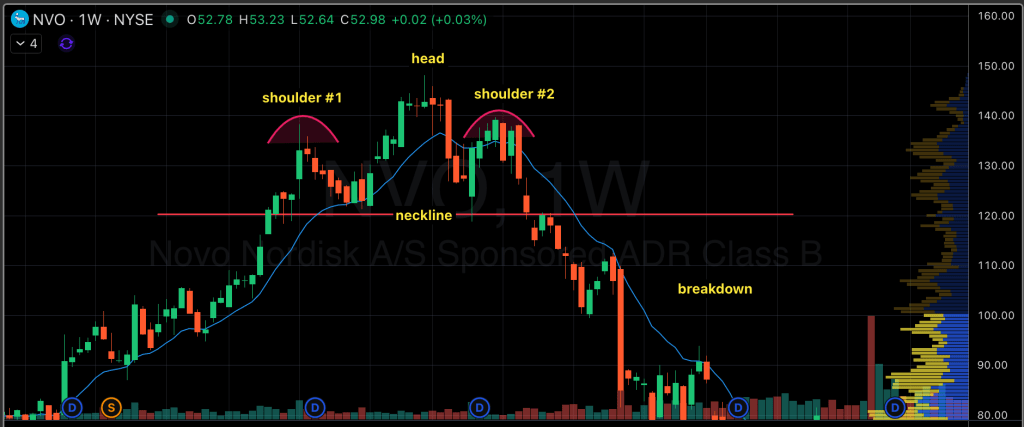
A textbook example of a bearish Head & Shoulders pattern can be seen on the weekly chart of Novo Nordisk (NVO). The pattern begins with a strong uptrend, followed by the formation of a clear left shoulder, a higher high (head), and a lower high (right shoulder)—all aligned along a horizontal neckline near the $120 level. Once the price decisively broke below the neckline, it triggered a strong downside move, confirming the bearish reversal. Traders watching this pattern could’ve entered with a put option or short position at the breakdown point, targeting the measured move between the head and neckline. Volume also spiked on the breakdown, adding conviction to the move—exactly the kind of confirmation traders look for when executing this pattern.
Using Head & Shoulders in Options Trading
The Head & Shoulders setup is a goldmine for options traders, offering opportunities for directional bias and high reward-to-risk ratios.
🟢 Inverse Head & Shoulders:
Buy call options or call debit spreads after breakout
Go out 2–4 weeks for expiration with a delta of 0.40–0.60
Consider selling puts or put credit spreads for Theta-positive income
🔴 Head & Shoulders:
Buy puts or put debit spreads after breakdown
Tighten risk with stop-losses above the neckline
Use the measured move to calculate your strike target
Final Thoughts
The Head and Shoulders pattern is more than just a chart formation—it’s a psychological map of a trend reversal. When used with volume confirmation, trendlines, and proper risk management, it becomes a reliable tool for both stock and options traders.
Whether you’re going long on a breakout or buying puts after a breakdown, understanding this pattern can boost your confidence and improve your trade execution.
Want More Stock Market Insights?
💡 Stay ahead of the game with Pure Power Picks—where expert analysis meets real-time trade alerts! Sign up today and start making smarter trades. 🚀