

AI Memory Stocks in 2026: How Micron and SanDisk Outran the Chip Giants
The loudest stock story of 2026 is not the AI chip everyone already owns. It is the unglamorous stuff bolted next to it: memory and storage. On June 24, Micron printed a record quarter, and the names that simply make the chips that hold data have gone on a run the market has rarely seen. This is the deep dive on what is driving it, how the leaders stack up against the rest of the sector, and the options lesson hiding inside the chaos.
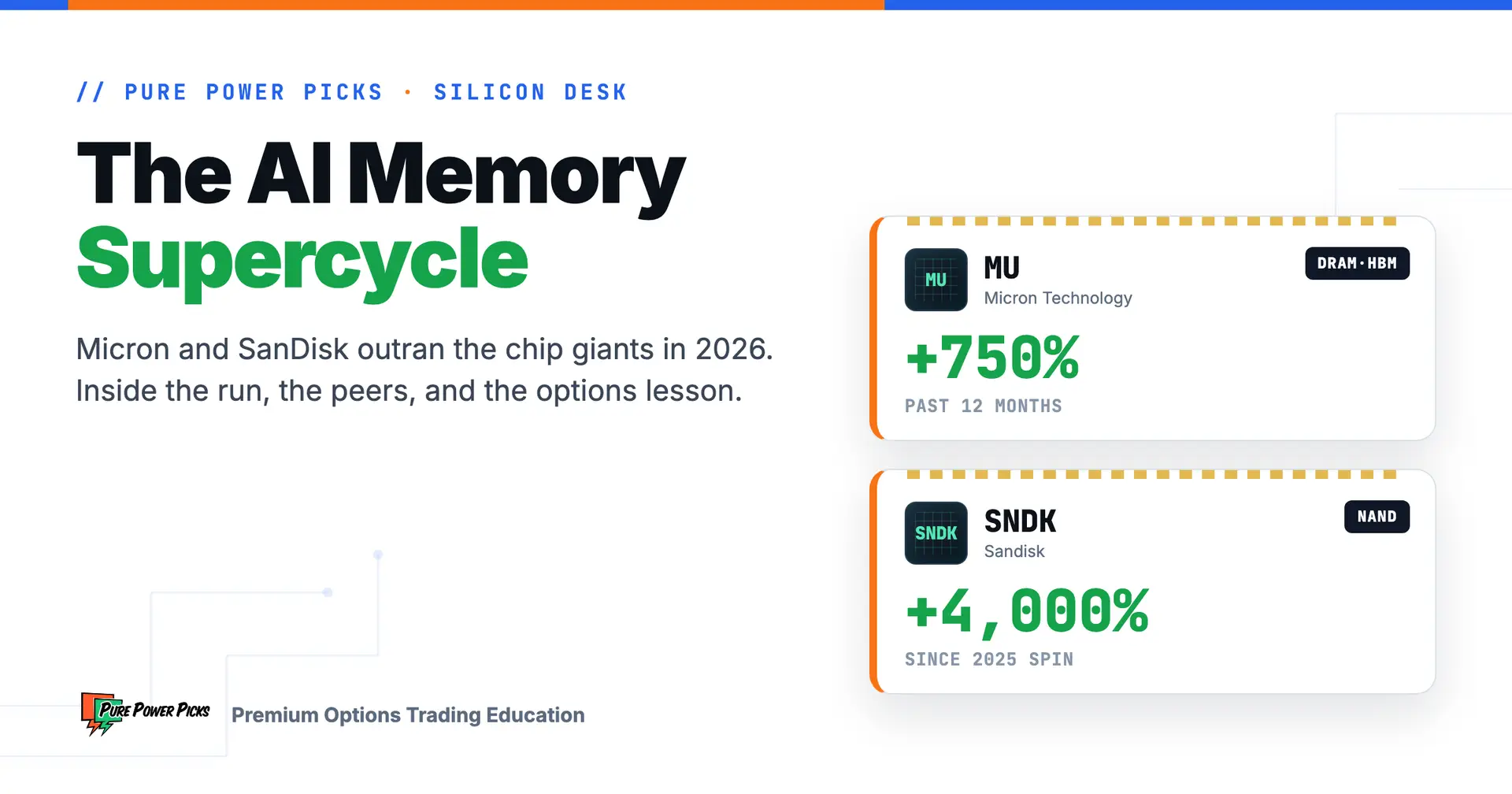
In 2026 the “boring” memory and storage names outran the AI-chip leaders. Micron (MU) crossed a $1 trillion market cap and just posted a record quarter, while SanDisk (SNDK) has climbed roughly 4,000% since its 2025 spinoff. But the real lesson for options traders is not the price moves, it is the volatility around them: implied volatility on these names ran among the highest in the entire market, which makes options expensive and sets up textbook IV crush. This is general education, not advice. Parabolic moves carry severe drawdown risk, and memory has always been a cyclical business.
-
MUMUMicron Technology$1,049▼ -0.3% todayYTD ~+232%Mkt Cap$1.18TFwd P/E9The HBM King DRAM · HBM · NAND
The only U.S. maker of DRAM, HBM and NAND at scale. Crossed a $1T market cap in May and just printed a record quarter. The cleanest large-cap on the whole memory theme.
-
SNDKSNDKSandisk$1,914▼ -2.5% todayYTD ~+660%Mkt Cap$284BFwd P/E10Pure NAND Play Flash · Enterprise SSD
Spun out of Western Digital in early 2025 and went vertical. The purest bet on the NAND flash and enterprise SSD shortage. A sharp pullback is underway after a 4,000%+ run.
01The 2026 Memory Supercycle, In Plain English
For two years, the AI trade was about one thing: GPUs. But a GPU with nothing next to it is a race car with no fuel tank. Every AI accelerator needs fast memory sitting beside it, and every AI datacenter needs mountains of storage behind it. In 2026 the demand for that memory finally outran the supply, and prices did something the industry had never seen.
DRAM contract prices rose a record ~90 to 95% in the first quarter of 2026, then jumped another ~58 to 63% in the second. NAND flash, the chips inside SSDs, climbed ~70 to 75% in Q2 alone. The reason is brutally simple: hyperscalers are projected to spend $600 to $725 billion on datacenters in 2026, up 36 to 77% year over year, and memory is now roughly 30% of that bill, about four times its 2023 share.
The cleanest way to picture the whole sector is a toll booth. Money flows from the cloud giants to the GPU makers, and to build those AI systems they have to pay the memory and storage suppliers on the way through. The suppliers are the toll booth, and in 2026 they finally got to set the price.

Two things act as supply governors this time: multi-year contracts that lock hyperscalers in, and HBM (the stacked memory on AI GPUs) eating roughly 4x the wafer capacity of standard DRAM. That tightness is real. The honest caveat is that 2017-18 and 2021 also felt permanent right up until oversupply broke them. That is the open question, not a settled fact.
02Micron (MU): The Headline Name Just Printed a Record Quarter
Micron is the only U.S. company that makes DRAM, HBM, and NAND at scale, which makes it the single cleanest large-cap on the memory theme. On May 26 it crossed a $1 trillion market cap. Then, on June 24, it reported a fiscal Q3 that beat almost everything Wall Street expected:
Revenue $41.46B (vs ~$35B expected) · non-GAAP EPS $25.11 (vs ~$20) · record GAAP gross margin 84.6% · data center revenue topped $25B of the total · HBM4 in volume production for NVIDIA’s next platform. Guidance for Q4: revenue near $50B, margin ~86%, EPS $31.00. The stock jumped 13 to 16% after hours.
Here is the number that matters for context: Micron’s 52-week range runs from about $103 to $1,214. A stock that can travel that far in a year is not a quiet compounder, it is a high-velocity name, and that velocity is exactly what shows up later in the options chain.
03SanDisk (SNDK): The Purest Bet on NAND Flash
If Micron is the diversified giant, SanDisk is the laser-focused one. It was spun out of Western Digital in February 2025 at roughly $38.50 and is now near $1,914, a gain of more than 4,000% from its spinoff lows. Almost all of its business is NAND flash and SSDs, both consumer and the enterprise drives that fill AI datacenters, so it gets the most direct earnings leverage when NAND prices spike.
Its most recent quarter showed datacenter revenue up 233% sequentially with roughly 78% gross margins, plus about $42 billion of multi-year supply contracts and a $6 billion buyback. It set an all-time high close of $2,273 on June 22.
One day after that record high, on June 23, SNDK fell roughly 13% in a Korea-led semiconductor selloff, with no company-specific bad news. That is the single best illustration in this whole post of how fast a parabolic name can reverse. Speed up is also speed down.
04The Valuation Paradox: Trailing vs Forward P/E
Look at these names on a trailing basis and they can seem either cheap or insane. Look forward and the picture flips. The reason is that memory earnings are exploding so fast that the same stock carries two very different multiples depending on which earnings you use.

Micron’s trailing P/E sits in the low 20s, but its forward multiple compresses toward ~9 to 10x because next year’s expected earnings are far higher. SanDisk’s trailing P/E looks extreme in the 60s, yet its forward P/E is roughly 11x on surging NAND-cycle profits. That sounds like a bargain, and it might be. But there is a catch every trader has to internalize: a low forward P/E only holds if those future earnings actually arrive. Memory is historically cyclical, so today’s record 80%-plus margins could be a peak rather than a floor. Present both sides. A forward multiple is a forecast, never a promise.
05Peers and the Great Rotation: Memory Beat the Chip Leaders
Here is the plot twist of 2026. NVIDIA, the most valuable company on earth, is up only about 15% year to date, while the memory and storage suppliers ran hundreds of percent. The bottleneck, not the brand-name leader, captured the marginal dollar.
The way to make sense of the whole sector is to sort every name into one of three buckets: who supplies memory, who consumes it, and who sits adjacent to the theme.

-
NVDANVDANVIDIA$199▼ -0.5% todayYTD ~+15%Mkt Cap$4.82TFwd P/E16HBM Buyer The customer, not the memory
The AI logic leader that buys Micron’s HBM. Roughly flat in 2026 while the memory it depends on did the running. The heart of the rotation.
-
AMDAMDAdvanced Micro Devices$520▼ -0.0% todayYTD ~+142%Mkt Cap$847BFwd P/E39HBM Buyer AI accelerators need HBM
Its MI-series AI accelerators are hungry for HBM. Ran with the AI trade but lagged the suppliers it relies on.
-
WDCWDCWestern Digital$644▼ -4.0% todayYTD ~+248%Mkt Cap$222BFwd P/E36HDD Supplier Nearline storage
The Western Digital parent after the SanDisk spin, now HDD-focused. Sold out nearline drive production years forward.
-
STXSTXSeagate Technology$993▼ -4.4% todayYTD ~+222%Mkt Cap$223BFwd P/E37HDD Supplier Cold storage spillover
The other nearline hard-drive maker. AI datacenters need vast cold storage, and HDDs caught the spillover bid.
-
INTCINTCIntel$132▼ -0.5% todayYTD ~+250%Mkt Cap$662BFwd P/E85Logic + Foundry Turnaround story
A logic and foundry turnaround, not a memory pure-play. Caught a big 2026 bid on its own narrative.
-
QCOMQCOMQualcomm$197▼ -3.3% todayYTD ~+46%Mkt Cap$208BFwd P/E18Mobile / Edge Indirect demand
Mobile and edge silicon. Benefits from memory demand indirectly, but it is not where the squeeze happened.
-
ORCLORCLOracle$158▼ -4.6% todayYTD ~-12%Mkt Cap$454BFwd P/E14Demand Driver Pays the toll
A hyperscaler building AI datacenters, so it pays the memory toll rather than collecting it. The group laggard in 2026.
Put it all in one place and the rotation becomes obvious. The suppliers (green) ran the hardest, the consumers (blue) lagged, and the adjacent names (amber) are a mixed bag:
| Ticker | Role | Price | YTD ~ | Mkt Cap | Fwd P/E |
|---|---|---|---|---|---|
| SNDK | Supplies memory | $1,914 | +660% | $284B | 10x |
| WDC | Supplies memory | $644 | +248% | $222B | 36x |
| MU | Supplies memory | $1,049 | +232% | $1.18T | 9x |
| STX | Supplies memory | $993 | +222% | $223B | 37x |
| AMD | Consumes memory | $520 | +142% | $847B | 39x |
| NVDA | Consumes memory | $199 | +15% | $4.82T | 16x |
| INTC | Adjacent | $132 | +250% | $662B | 85x |
| QCOM | Adjacent | $197 | +46% | $208B | 18x |
| ORCL | Adjacent | $158 | -12% | $454B | 14x |
This is sector beta versus single-name risk in one chart. When a true shortage hits, the companies that own the scarce supply can outperform even the dominant customer they sell to. NVIDIA still sells every chip it makes; it just was not the squeeze.
06Why Options on These Names Are So Expensive
Now the part that makes this a Pure Power Picks post and not just a sector recap. Implied volatility (IV) is the market’s estimate of how much a stock might move, and it is baked into the price of every option. When IV is high, options are expensive. In June 2026, Micron and SanDisk carried some of the highest IV in the entire S&P 500.
Into Micron’s June 24 earnings, front-week IV ran near 155% while the next monthly expiration sat near 108%. That gap of roughly 47 points is the earnings event premium: the extra cost traders pay for the uncertainty of a known catalyst. The market was pricing a one-day move of roughly 10 to 17% on Micron, with SanDisk IV near 107%.

IV was elevated for two compounding reasons. First, the parabolic run itself pumped baseline volatility. Second, a scheduled earnings date stacked an event premium on top. Understanding that distinction is half the lesson, because only one of those two pieces collapses on cue.
07IV Crush: Why Buying Calls Into the Print Can Lose
After a known earnings date, IV and option premiums balloon, then collapse the moment results are out and the uncertainty resolves. Front-month IV on a large single name often falls 30 to 50% the very next session. The crush is worst on short-dated, at-the-money, high-IV contracts, which are exactly the lottery tickets new traders reach for.
The trap is this: you can buy a call, be right on direction, and still lose money, because the volatility premium you paid evaporates faster than the stock moves. Micron is the live case study. It reported on June 24 and its option IV collapsed the following session no matter which way the stock went. Gap risk compounds it: an implied move of ~11% means a wrong-direction overnight gap can erase a naked long option in a single open.
08Education-Friendly Ways to Approach High-IV Names
None of the following is a recommendation to buy or sell anything. It is a tour of the defined-risk and premium-aware structures that exist precisely for high-IV conditions, so you understand the toolbox before you ever use it.
Structures that work with rich premium instead of paying it
- Covered call: if you already own 100 shares, selling a call against them collects premium income, in exchange for capping upside above the strike.
- Cash-secured put: set aside cash to potentially buy shares lower, and get paid the inflated premium for the patience.
- Vertical debit spread (instead of a naked long call): buy one option and sell a further-out one of the same type. The short leg offsets part of the long leg’s vega, so IV crush hurts less than a bare call.
- Vertical credit spread: a defined-risk way to work with elevated premium rather than simply handing it over.
Selling premium carries its own risks, which can be larger than buying it, and no structure is low-risk or guaranteed. “Wait for the reaction after the print” is one disciplined approach among many, not a sure thing. The goal here is to understand IV crush, not to chase it.
09The Risks: Cyclicality, Stretched Multiples, and Fast Data
Memory is a historic “pig cycle” business. The same supply-and-demand surge driving prices vertical can reverse hard into a downcycle, and analysts already debate whether that turn comes in 2027 or 2028. Several of these names are up 700 to 1,000%-plus on stretched multiples, and parabolic charts invite sharp drawdowns. Analyst price targets diverge wildly (Micron from roughly $840 to $1,750, SanDisk from below the current price to nearly $2,900), which signals genuine disagreement, not a consensus you can lean on.
One more thing, and it matters: every number in this post is timestamped to June 24, 2026. Prices, implied volatility, and analyst targets move intraday. Treat all of it as illustrative education, not a current quote and not a price call.
Want the setups, not just the story?
Our trading room breaks down real options ideas with defined risk, including how we think about IV, earnings, and the kind of high-velocity names in this post. Come see how it works, free for 7 days.
