

What RFK Jr. as HHS Secretary Has Meant for Stocks and Sectors (2026 Update)
Robert F. Kennedy Jr. has now run the Department of Health and Human Services (HHS) for almost 21 months, long enough to grade what his tenure has actually meant for stocks. He was confirmed on February 13, 2025, by a 52 to 48 vote, and his “Make America Healthy Again” agenda has since reshaped vaccine policy, food dyes, drug pricing and Medicare. The market results were not what most people expected, us included. Drugmakers that looked like the biggest losers signed pricing deals and rallied, while wellness stocks that looked like natural winners fell hard. This November 2026 update keeps our original February 2025 analysis, adds what actually happened sector by sector, and grades every stock we named. With Democrats winning the House and the Senate on November 3, 2026, it also covers what a new Congress can and cannot change.
Policy headlines moved healthcare stocks, but often not in the direction the theme suggested. From confirmation day to November 3, 2026, the Health Care Select Sector SPDR fund (XLV) returned 29.5% with dividends, against 26.1% for the S&P 500, helped by drug pricing deals that removed a tariff overhang. The biggest single moves came from company news and Medicare rate notices, not speeches. Follow the policy calendar, and size every idea so one surprise announcement cannot hurt you.
| Role | U.S. Secretary of Health and Human Services (confirmed February 13, 2025, 52 to 48; still serving in November 2026) |
| Agencies Under HHS | FDA, CDC, NIH, CMS (Medicare and Medicaid) |
| Core Agenda | Vaccine schedule changes, food dyes, drug pricing deals, chronic disease |
| Most Exposed Sectors | Vaccine makers, big pharma, managed care, packaged food |
| Health Care Since Confirmation | XLV +29.5% vs S&P 500 +26.1%, total return to Nov 3, 2026 |
| Congress From January 2027 | Democrats won the House and the Senate on Nov 3, 2026 |
| Trader Focus | Headline risk, implied volatility, sector rotation |
What Has RFK Jr. Actually Done at HHS? (February 2025 to November 2026)
Short answer: more than most health secretaries, and almost all of it through agency decisions rather than new laws. These are the moves that mattered most for markets.
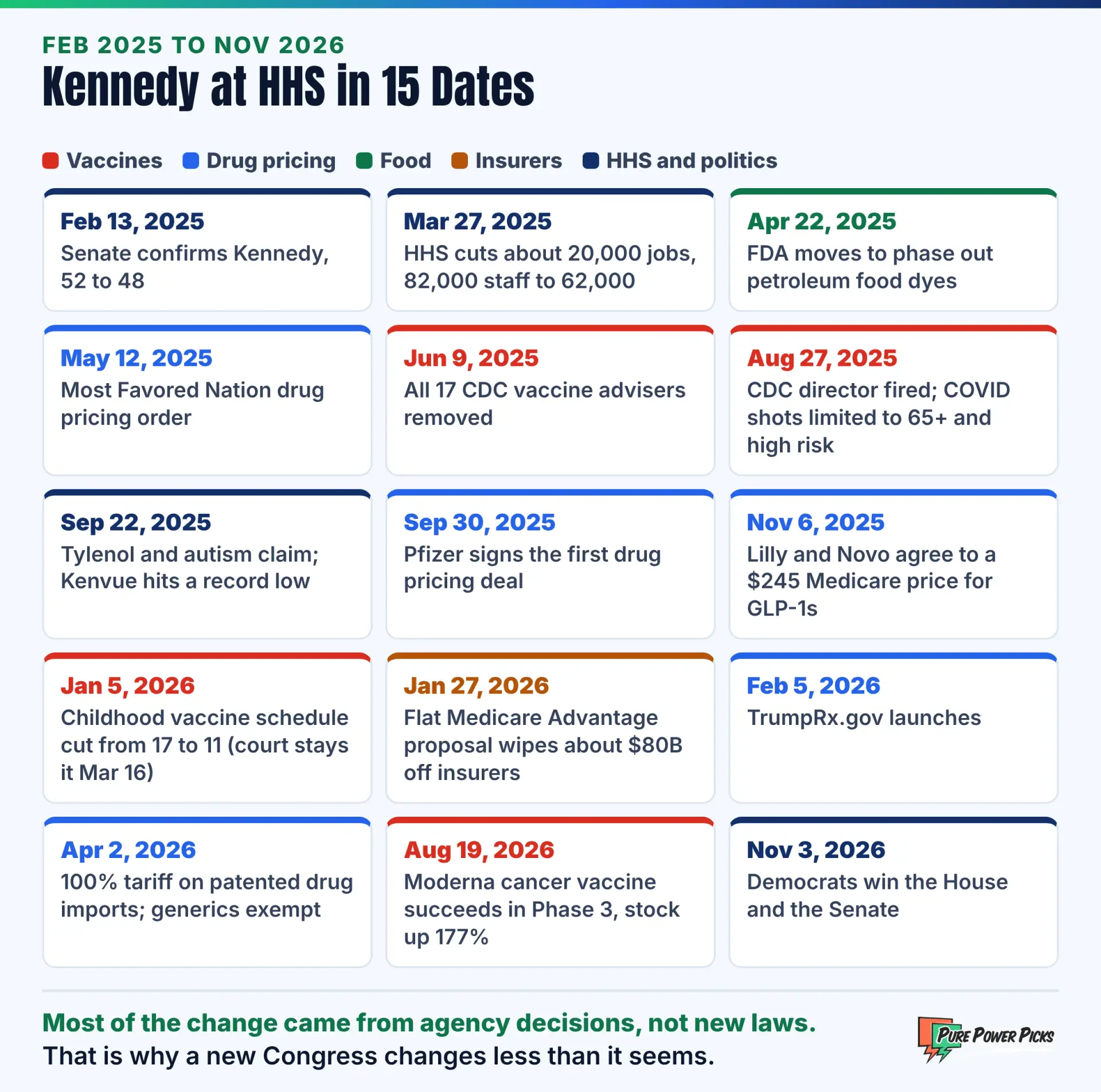
- Vaccines: In June 2025 he removed all 17 members of the CDC’s vaccine advisory committee (ACIP). In August 2025 HHS cancelled about $500 million of mRNA vaccine projects at BARDA, and the FDA limited 2025 COVID shots to people 65 and older or at high risk. In January 2026 the CDC cut the number of universally recommended childhood vaccines from 17 to 11, but a federal judge stayed that schedule and the new panel’s votes on March 16, 2026, and the appeal was still undecided in early November.
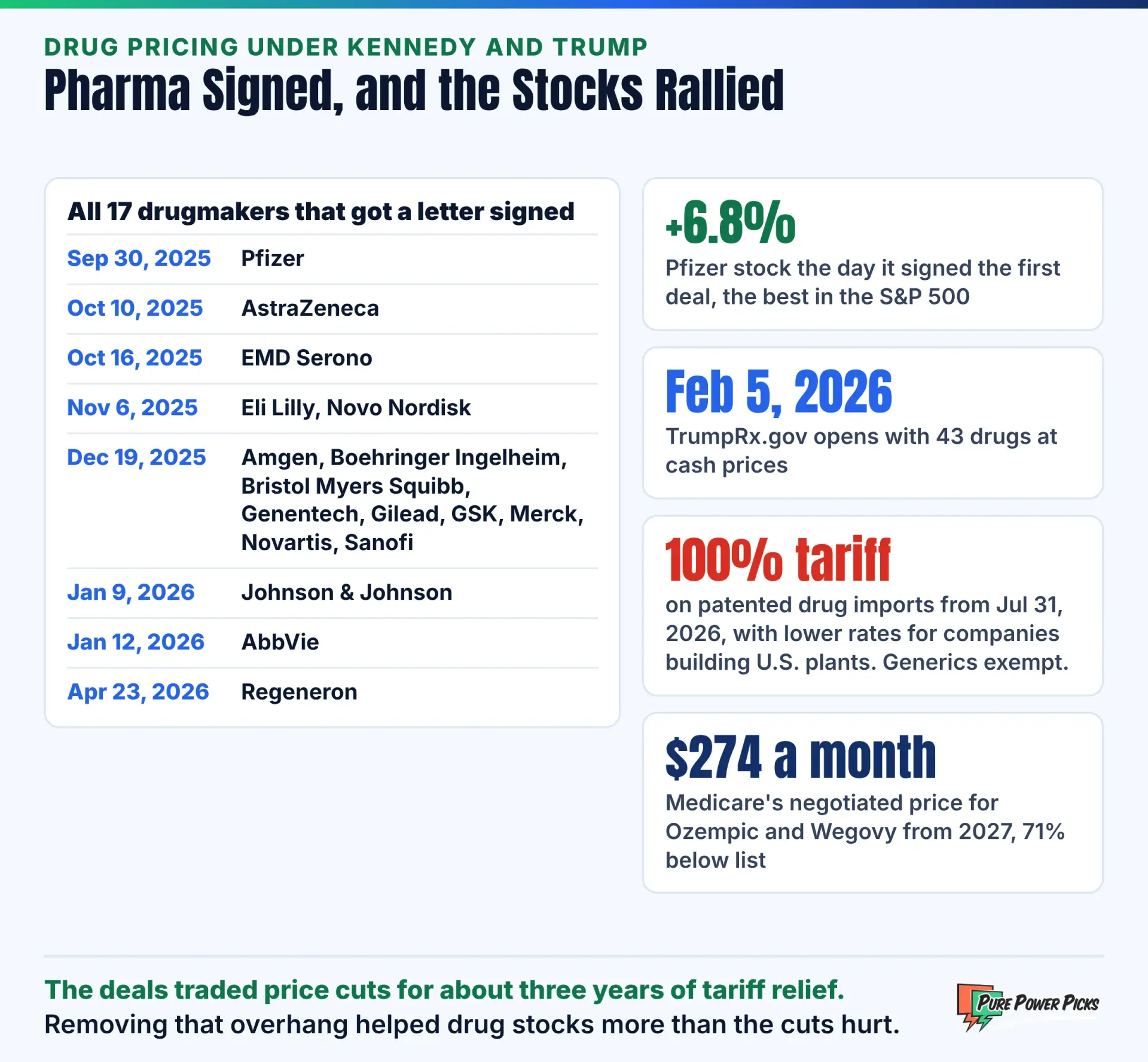
- Drug pricing: A Most Favored Nation executive order in May 2025 led to deals with all 17 drugmakers that received letters, starting with Pfizer on September 30, 2025. TrumpRx.gov launched on February 5, 2026, and a 100% tariff on patented drug imports followed, with generics exempt and lower rates for companies building U.S. plants.
- Food: HHS and the FDA asked companies in April 2025 to phase out petroleum based dyes, and most big U.S. food makers pledged to do it by the end of 2027. New Dietary Guidelines released January 7, 2026 favor protein, full fat dairy and fewer highly processed foods.
- Medicare and insurers: CMS proposed a nearly flat 2027 Medicare Advantage rate in January 2026, then finalized a 2.48% increase in April. The One Big Beautiful Bill Act, signed July 4, 2025, adds Medicaid work requirements by January 1, 2027, and the enhanced ACA subsidies expired at the end of 2025.
- The agency itself: HHS shrank from about 82,000 to 62,000 staff in 2025. The CDC director was fired in August 2025, FDA Commissioner Marty Makary resigned in May 2026, and the FDA still had an acting commissioner in early November 2026.
The Scorecard: How Did Our February 2025 Calls Hold Up?
Short answer: about half right. We named 23 stocks in February 2025. Measured from Kennedy’s confirmation day to November 3, 2026, with dividends included, here is how each one did against the S&P 500’s 26.1%.
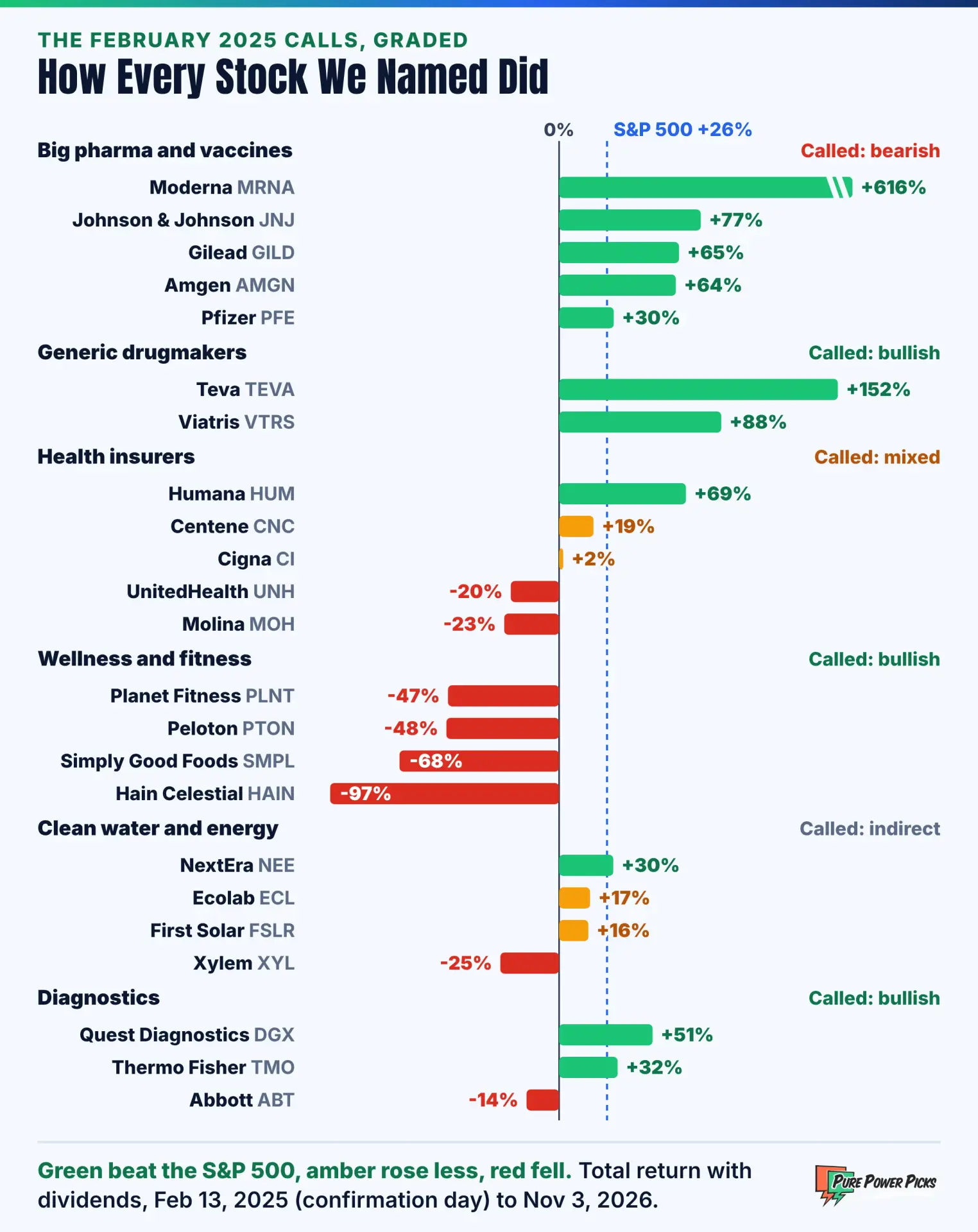
Three lessons stand out. First, the bearish case on big pharma was wrong. Every drugmaker we flagged rose, because the pricing deals traded discounts for about three years of tariff relief, and Pfizer jumped 6.8% the day it signed. Second, the bullish case on wellness was the worst call in the article. Simply Good Foods cut its outlook as Atkins sales fell 26.6%, with weight loss drugs named as one reason, and Hain Celestial was reported in October 2026 to be weighing bankruptcy. Third, the calls that worked, generics and diagnostics, mostly worked for company reasons. Teva’s growth has come largely from its own branded drugs, such as Austedo.
This is the video we made in February 2025, when this article first ran. It is worth watching next to the scorecard above.
1. Why Could Biotech and Pharmaceutical Stocks Face a Bearish Impact?
Short answer: because HHS controls the agencies that approve, price, and recommend drugs, and Kennedy has spent decades criticizing the industry. When the person overseeing the FDA and the CDC questions vaccine safety and pharmaceutical influence, the market prices in more uncertainty for drugmakers.
That uncertainty shows up in three ways. Approval timelines could stretch if reviews get tougher. Vaccine demand could soften if federal recommendations change. And pricing power faces pressure from the broader administration’s push to lower drug costs.
Stocks at Risk
- Pfizer (PFE), Moderna (MRNA), Johnson & Johnson (JNJ): Vaccine scrutiny and pricing reforms weigh most on companies with large vaccine or blockbuster franchises. Moderna, built heavily around mRNA, is the most concentrated bet on vaccine policy.
- Gilead Sciences (GILD), Amgen (AMGN): Biotechs that depend on smooth FDA reviews and accelerated pathways could see delays or tighter questions on their pipelines.
Potential Opportunities
- Teva Pharmaceuticals (TEVA), Viatris (VTRS): If policy pushes prescription prices lower, generic drug manufacturers could benefit from higher volume and more substitution away from branded drugs.
One nuance the original article missed: obesity drugs. Coverage and pricing decisions for GLP-1 medications have become a major swing factor for the sector. If you trade that theme, our guide to glp-1 and weight loss stocks breaks down the key players.
What Actually Happened to Pharma and Vaccine Stocks
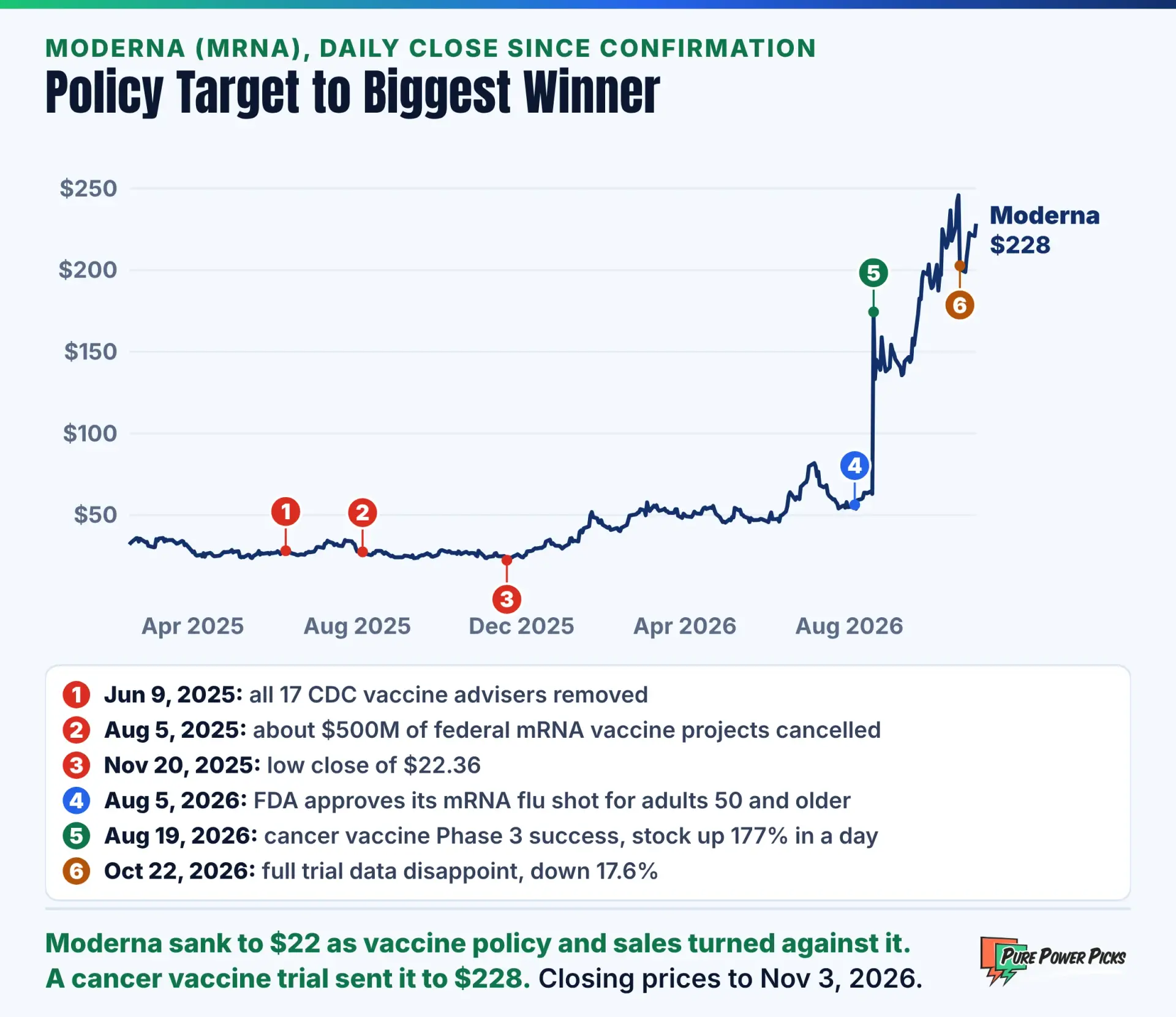
Vaccine policy did change sharply, and Moderna felt it. The stock fell from $31.92 on confirmation day to a low close of $22.36 on November 20, 2025, as HHS cut mRNA funding, the FDA narrowed COVID shot approvals and Moderna lowered its own sales outlook. Then the story flipped for reasons that had little to do with Washington. On August 19, 2026, Merck and Moderna said their personalized cancer vaccine, given with Keytruda, met its main goal in a Phase 3 melanoma trial, and Moderna rose 177% in a single day.
Drug pricing played out as a negotiation rather than a crackdown. Companies that signed agreed to Medicaid prices at Most Favored Nation levels, cash prices on TrumpRx and U.S. investment pledges, in exchange for about three years of relief from the new pharma tariff. Pharma stocks had their best week since 2009 after the Pfizer deal.
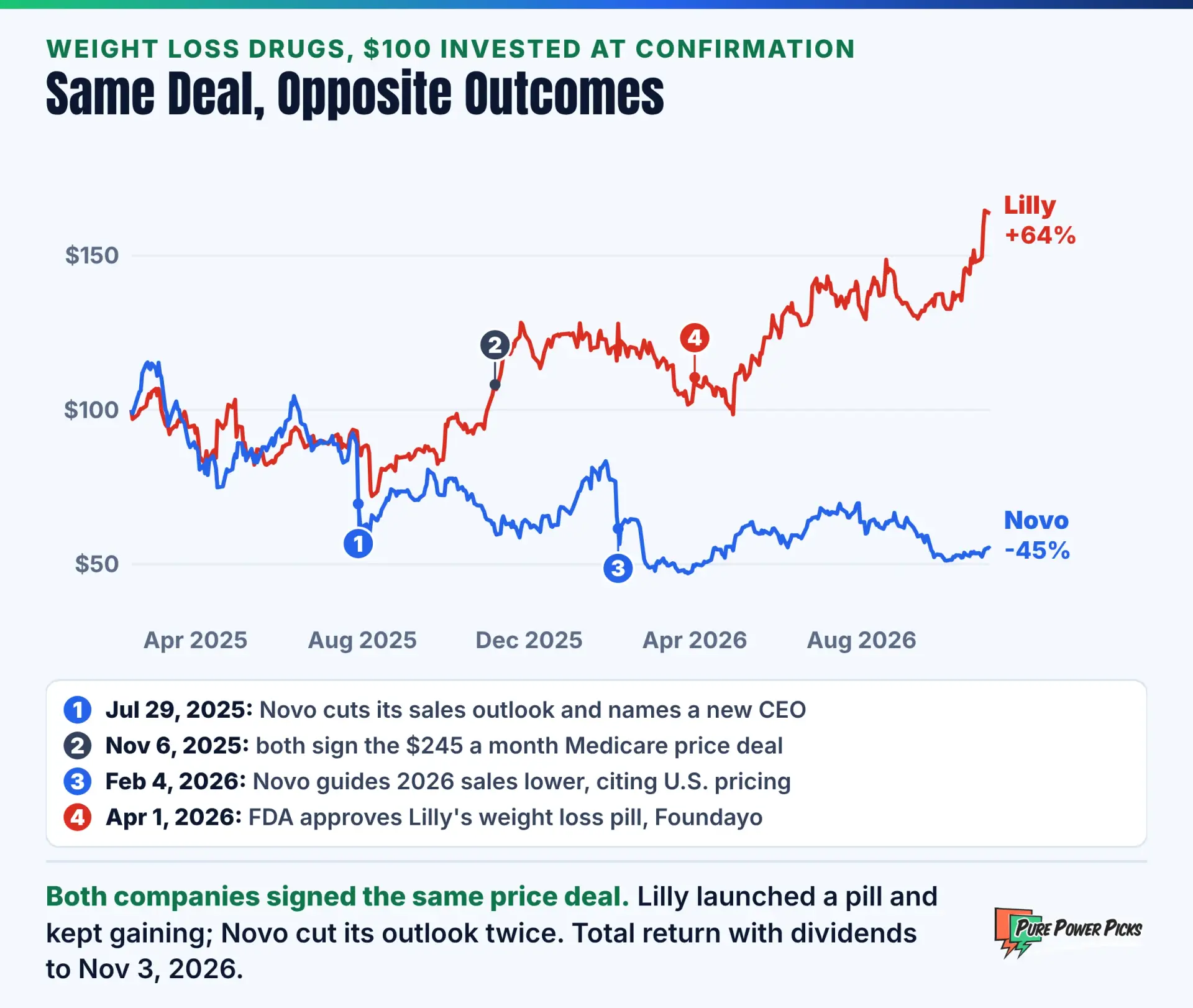
Obesity drugs show how the same policy can land very differently. Lilly and Novo Nordisk both signed the November 6, 2025 deal that set a $245 a month Medicare and Medicaid price, with a $50 copay for Medicare patients, and Medicare’s separately negotiated $274 price for Ozempic and Wegovy starts in 2027. Lilly kept growing and won approval for its Foundayo pill in April 2026, while Novo cut its outlook twice.
Headline risk is the chance that a news story, such as a policy announcement, hearing, or interview, moves a stock sharply regardless of its fundamentals. Healthcare names tied to HHS decisions carry elevated headline risk. That often shows up as higher implied volatility in their options.
2. Why Is the Health Insurance Sector a Mixed Impact?
Short answer: lower drug prices help insurers’ costs, but heavier government oversight of Medicare and Medicaid can squeeze their margins. Both forces run through HHS, because the Centers for Medicare & Medicaid Services (CMS) sits inside the department.
If pharmaceutical pricing comes down, insurers pay less for claims. If HHS tightens Medicare Advantage payment rules or audits, the large managed care companies feel it directly. That push and pull is why this group can swing hard on a single CMS rate notice.
Stocks to Watch
- UnitedHealth Group (UNH), Cigna (CI), Humana (HUM): Exposure to Medicare Advantage and private plans makes these names sensitive to any regulatory tightening. Humana is the most concentrated in Medicare Advantage.
- Centene (CNC), Molina Healthcare (MOH): The original thesis was that more government-supported healthcare would help Medicaid-focused insurers. That case is less clear today. The 2025 budget reconciliation law added Medicaid work requirements, which could reduce enrollment over time. Watch how each company guides on membership.
Mark the calendar for CMS rate announcements and earnings. Managed care stocks often move more on those dates than on general political headlines. Pair that calendar with solid fundamental analysis of healthcare stocks so you know what is already priced in before the news hits.
What Actually Happened to Health Insurers
The mixed call held up, but the swings were far bigger than we expected. UnitedHealth fell 18% on May 13, 2025, when it pulled its outlook and its CEO stepped down, and it later confirmed criminal and civil Justice Department inquiries into its Medicare business. On January 27, 2026, CMS proposed a nearly flat 0.09% Medicare Advantage rate increase for 2027, and insurers lost about $80 billion of market value in a day. The final rate in April came in at 2.48%. Humana then rallied on strong 2027 star ratings, while Molina fell about 28% in February 2026 on a weak profit outlook.
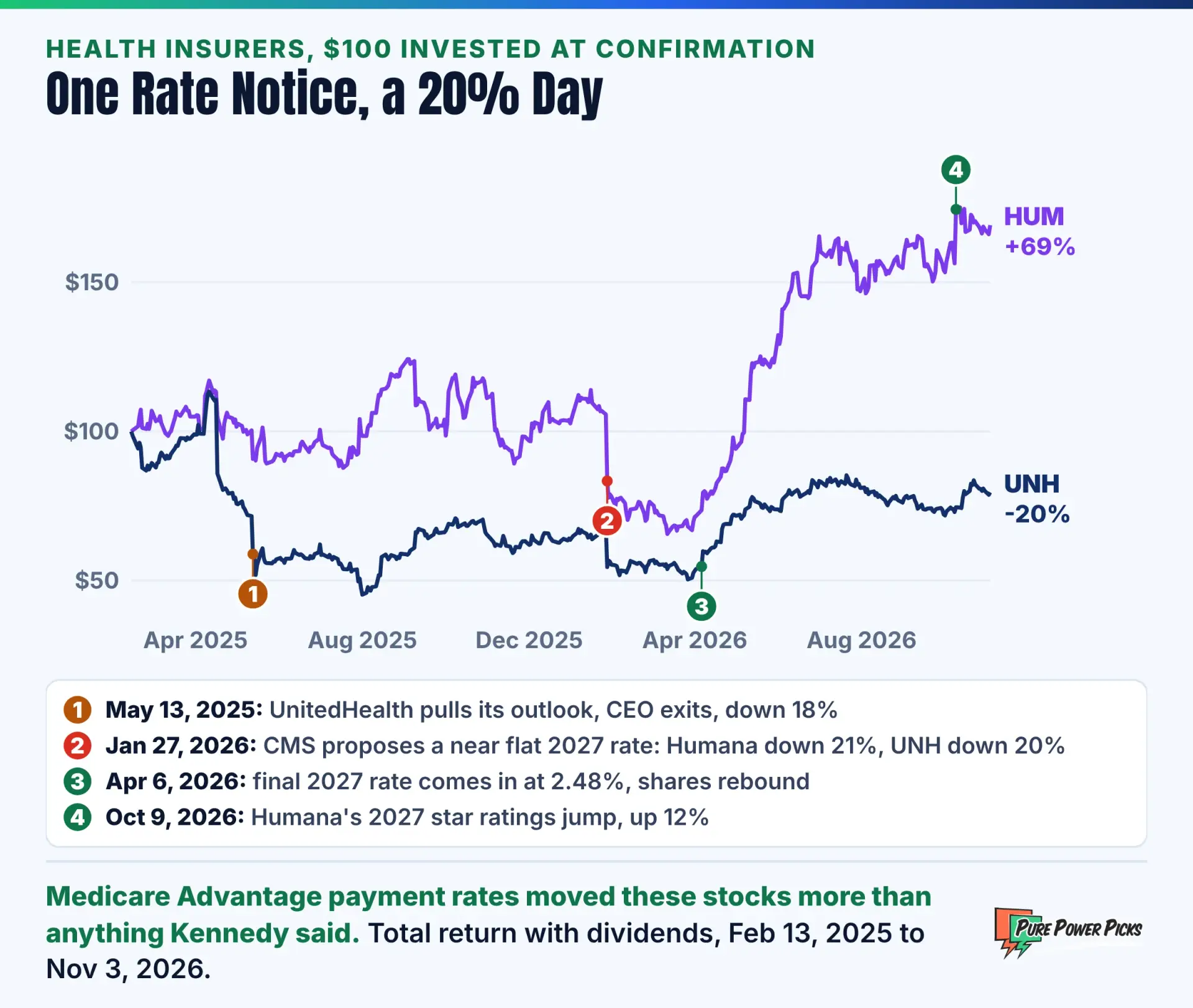
The Medicaid concern also proved valid. The One Big Beautiful Bill Act adds work requirements by January 1, 2027, and the Congressional Budget Office estimates about 10 million more people will be uninsured by 2034 under the law. For traders, the lesson is the one in the Pro Tip above: the CMS calendar mattered more than any speech.
3. Could Wellness and Holistic Health Stocks See a Bullish Impact?
Short answer: possibly, because Kennedy’s agenda centers on nutrition, exercise, and reducing reliance on pharmaceuticals. When the top health official talks about ultra-processed food, artificial dyes, and chronic disease, consumer attention can shift toward healthier products.
Attention alone does not guarantee sales, though. Many wellness stocks depend on consumer spending, competition, and execution far more than on federal messaging.
Stocks That Could Benefit
- The Simply Good Foods Company (SMPL), Hain Celestial (HAIN): Companies selling low-sugar, protein-focused, organic, or natural food products could benefit from greater consumer awareness. Check each company’s own sales trends before assuming the theme is working.
- Peloton (PTON), Planet Fitness (PLNT): If fitness and prevention stay in the spotlight, these names could draw renewed interest. Keep in mind that subscriptions and memberships are discretionary spending and sensitive to the economy.
There is a flip side here. Large packaged food companies that rely on synthetic dyes or heavily processed ingredients could face reformulation costs if pressure turns into regulation. Policy themes rarely help one group without creating a cost somewhere else.
What Actually Happened to Wellness and Food Stocks
This was the call that missed. From confirmation day, Planet Fitness and Peloton each fell about 47%, Simply Good Foods lost 68% and Hain Celestial 97%. A healthier eating message from Washington did not turn into sales for these companies, and weight loss drugs cut into demand for diet brands like Atkins. The policy itself did move. Most big food makers pledged to remove synthetic dyes, and the FDA revoked the dye Orange B in 2026.
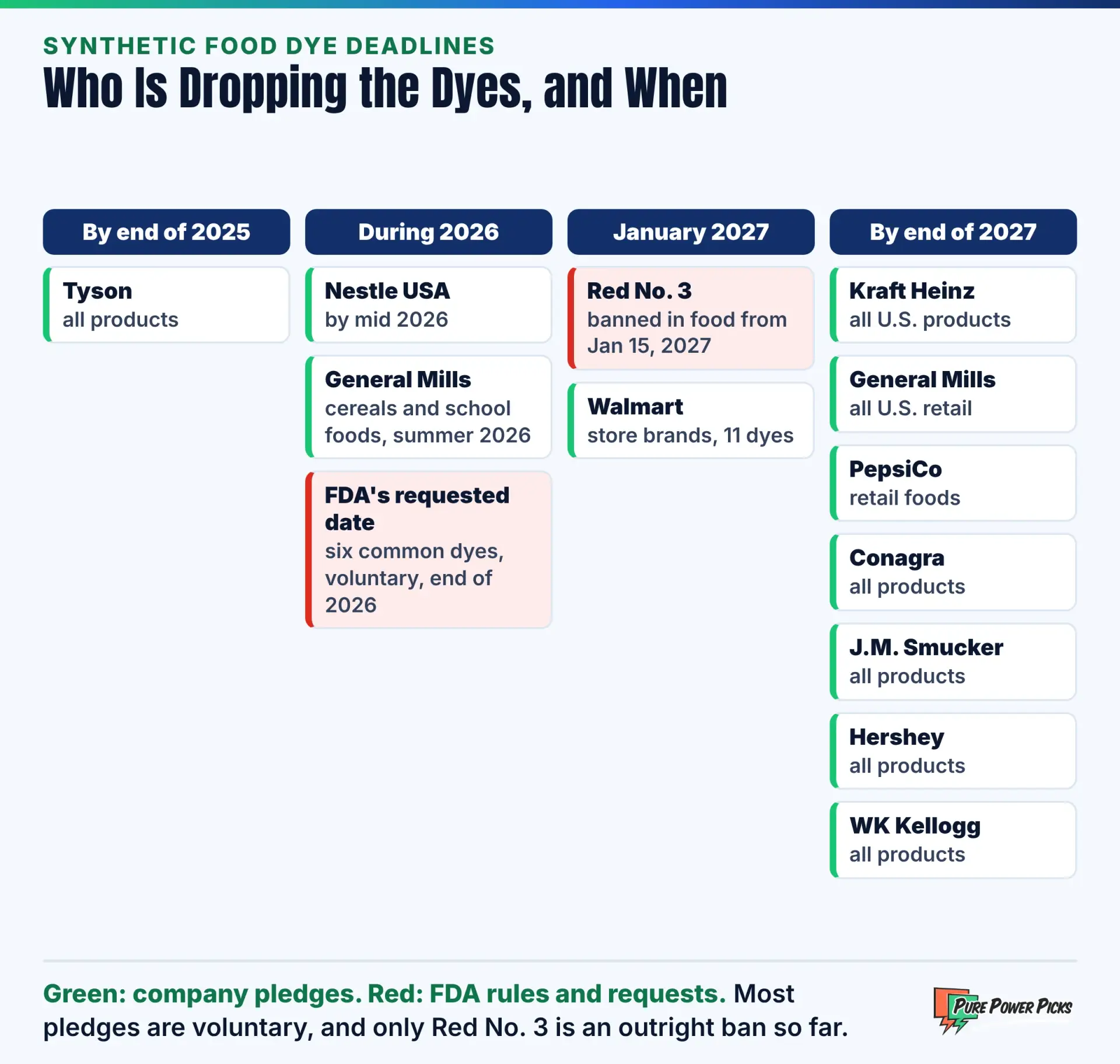
For the big packaged food stocks, dyes were a small part of a bigger problem. General Mills cut its outlook in February 2026, with its CEO calling consumer affordability pressure “not temporary,” and the stock lost about 37% from confirmation day, including dividends. Reformulation costs money, but price sensitive shoppers mattered more to these stocks than any dye rule.
4. Could Environmental and Clean Water Sectors Benefit?
Short answer: the theme fits Kennedy’s background, but the direct link to HHS is weaker than it looks. RFK Jr. built his career as an environmental attorney focused on clean water and industrial pollution. However, most environmental regulation runs through the EPA, not HHS.
Where HHS does overlap is in environmental health research and messaging. Kennedy’s well-known position against water fluoridation is one example of how public health and water policy can intersect.
Stocks to Watch
- Xylem (XYL), Ecolab (ECL): Water treatment, purification, and industrial hygiene companies could see interest if environmental health stays in the conversation. Their main drivers are still municipal and industrial spending.
- First Solar (FSLR), NextEra Energy (NEE): The original article linked clean energy to public health. Energy policy is set elsewhere in the government, and the broader administration has not prioritized renewables. Treat this as a loose connection, not a core HHS trade.
What Actually Happened on Fluoride and Water
Fluoride became a real policy story. Utah and Florida banned community water fluoridation in 2025, the FDA moved against unapproved ingestible fluoride prescriptions for young children in October 2025, and the EPA opened an expedited review. The CDC’s recommended level was still 0.7 mg/L as of October 2026. None of that moved water stocks much. Xylem fell 25% and Ecolab returned 17% from confirmation day, driven by municipal and industrial spending, as the original article expected.
5. Are Medical Device and Diagnostic Companies a Potential Growth Sector?
Short answer: yes, if HHS keeps emphasizing prevention, early detection, and transparency in testing. Diagnostics sit naturally inside a “find the problem early” philosophy, and they avoid much of the controversy surrounding vaccines.
Potential Beneficiaries
- Abbott Laboratories (ABT): Diagnostics plus consumer health devices such as continuous glucose monitors fit a prevention narrative.
- Thermo Fisher Scientific (TMO): A major supplier of lab tools and testing equipment. It is also sensitive to federal research funding through NIH, which cuts the other way if budgets shrink.
- Quest Diagnostics (DGX): Routine and preventive lab testing could see steady demand if early detection is encouraged.
What Actually Happened to Diagnostics
Two of the three names worked. Quest Diagnostics returned 51% and Thermo Fisher 32% from confirmation day, both ahead of the S&P 500, while Abbott fell 14%. The prevention theme never became a large federal program, and NIH grant cuts were a risk for lab tool makers, so this group held up on its own business more than on policy.
Here is a quick side by side of how each sector lined up against the main policy levers, and how each call turned out:
Final Thoughts: How Should You Handle Market Uncertainty and Opportunities?
Short answer: expect volatility, follow the policy calendar, and let your risk plan do the heavy lifting. RFK Jr.’s tenure is one of the biggest shifts in U.S. health policy in decades, and the stock market keeps repricing healthcare as new decisions land.
1. Increased Volatility in Healthcare and Pharma
Policy uncertainty drives price movement. Companies that relied on expedited approvals and pricing flexibility face new scrutiny, which can lead to sharp revaluations. Insurers can benefit or suffer depending on whether lower drug costs or tighter government oversight wins out.
2. Emerging Sectors Could See Growth
Holistic health, preventive care, and diagnostics may draw more interest under a prevention-first HHS. Clean water stocks remain a secondary theme tied more to Kennedy’s background than to HHS authority.
3. Investor Strategy: Adaptability Is Key
- Monitor regulatory announcements from HHS, FDA, CDC, and CMS so you are not surprised by policy-driven moves.
- Diversify across healthcare subsectors, balancing big pharma, generics, insurers, and wellness exposure.
- Watch sector ETFs focused on healthcare innovation, wellness, or sustainability as a broader way to express a view.
- Know how to hedge your portfolio with options if you already hold healthcare names that carry heavy policy exposure.
4. Expect Policy-Driven Trading Opportunities
As new initiatives roll out, news-driven reactions create short-term setups. Traders can approach these through swing trades, defined-risk options strategies, or longer-term repositioning across healthcare. Our guide on how to trade breaking policy news covers the playbook. Democrats won the House and the Senate on November 3, 2026, so it is also worth reviewing how midterm elections and the market have interacted historically. A Democratic Congress can hold oversight hearings and shape HHS funding from January 2027, but most of Kennedy’s changes were agency decisions that never needed a vote, and the drug pricing deals and tariffs run through the White House.
Here’s a hypothetical example. Say a large vaccine maker trades at a round $50, and an HHS advisory meeting on vaccine schedules is a week away. Options implied volatility climbs ahead of the meeting because the market expects a big move either way. A trader who buys calls or puts right before the event pays that inflated premium. If the news lands softer than feared, implied volatility can collapse and the option can lose value even if the stock moves in the expected direction. That is why understanding implied volatility spikes matters as much as picking direction. Investopedia’s primer on implied volatility and the Cboe’s resources on volatility indexes are good places to go deeper.
Policy headlines can gap a stock overnight, before you have any chance to react. Options can lose their entire premium. Keep trade size small on event-driven ideas and understand the risks before you act. The SEC’s investor bulletin on options basics is a useful refresher.
Bottom line: RFK Jr.’s HHS is reshaping the landscape for healthcare and pharma, with ripple effects into food, wellness, and diagnostics. Some companies face real regulatory headwinds, while others may find new demand. Traders who stay informed, respect volatility, and manage risk are best equipped to handle what comes next.
Frequently Asked Questions
When did RFK Jr. become HHS Secretary?
Robert F. Kennedy Jr. was confirmed by the Senate as Secretary of Health and Human Services on February 13, 2025, by a 52 to 48 vote, and he was still in the job in November 2026. He oversees the FDA, CDC, NIH, and CMS.
Which stocks are most sensitive to RFK Jr.’s policies?
Vaccine makers such as Moderna and Pfizer, large pharma, and managed care companies tied to Medicare and Medicaid tend to react most to HHS headlines. Packaged food companies can also move on food additive news.
Do wellness stocks automatically benefit from a prevention-focused HHS?
No. Federal messaging can raise awareness, but sales, competition, and consumer spending drive results. Always check a company’s fundamentals instead of relying on the theme alone.
How do options traders approach policy-driven volatility?
Many focus on implied volatility before scheduled events, use defined-risk structures such as spreads, and keep trade size small. Buying options right before a known event means paying a higher premium that can shrink quickly afterward.
Is it legal for officials to trade healthcare stocks around policy decisions?
Federal officials and members of Congress face disclosure rules under the STOCK Act and ethics requirements. Our breakdown of politicians’ stock trades explains how those rules work.
How have healthcare stocks done since RFK Jr. became HHS Secretary?
From his confirmation on February 13, 2025 to November 3, 2026, the Health Care Select Sector SPDR fund (XLV) returned 29.5% with dividends, slightly ahead of the S&P 500’s 26.1%. The gains were uneven: big drugmakers, generics and diagnostics did well, while wellness, packaged food and several insurers fell.
What does the 2026 midterm result mean for RFK Jr.’s agenda?
Democrats won control of the House and the Senate on November 3, 2026, which gives them more oversight power and a bigger say over HHS funding from January 2027. Most of Kennedy’s actions, such as the vaccine schedule changes and the drug pricing deals, came from the executive branch, so Congress can slow or challenge them but cannot undo them without new laws or court rulings.
Want to See How We Break Down Policy-Driven Setups?
Pure Power Picks shares educational options chart setups with the reasoning behind each idea, so you learn how to read volatility, timing, and risk for yourself.
Explore Membership Options
The PPP Team is the research and editorial team behind Pure Power Picks. We trade stocks and options and publish the work as we do it, with every alert tracked in public. Publishing since 2020. How we research and correct our work is written out in our editorial standards. Our content is strictly educational, never advice.
Disclaimer: The content provided by Pure Power Picks is for educational and informational purposes only and does not constitute financial, investment, or trading advice. We are not registered financial advisors. All examples are hypothetical and are not representative of actual trades or results. Options trading involves substantial risk and is not suitable for every investor; you can lose your entire investment. Past performance does not guarantee future results. Always do your own research and consult a licensed financial professional before making any investment decisions.
Great idea! We will post the dates on time sensitive content like this one.
You should post the date that these blog articles are published.
Be Well