

Camarilla Support and Resistance: How to Use the 8-Level Pivot System
Share


If you have been trading for a decade and you have never heard of Camarilla pivots, you are not alone. They are one of the most underrated tools in technical analysis. Nick Stott built them in 1989 to read intraday equity moves, and they have quietly been used by floor traders, futures desks, and a handful of intraday options traders ever since. Most retail traders skip them entirely. That is the opportunity.
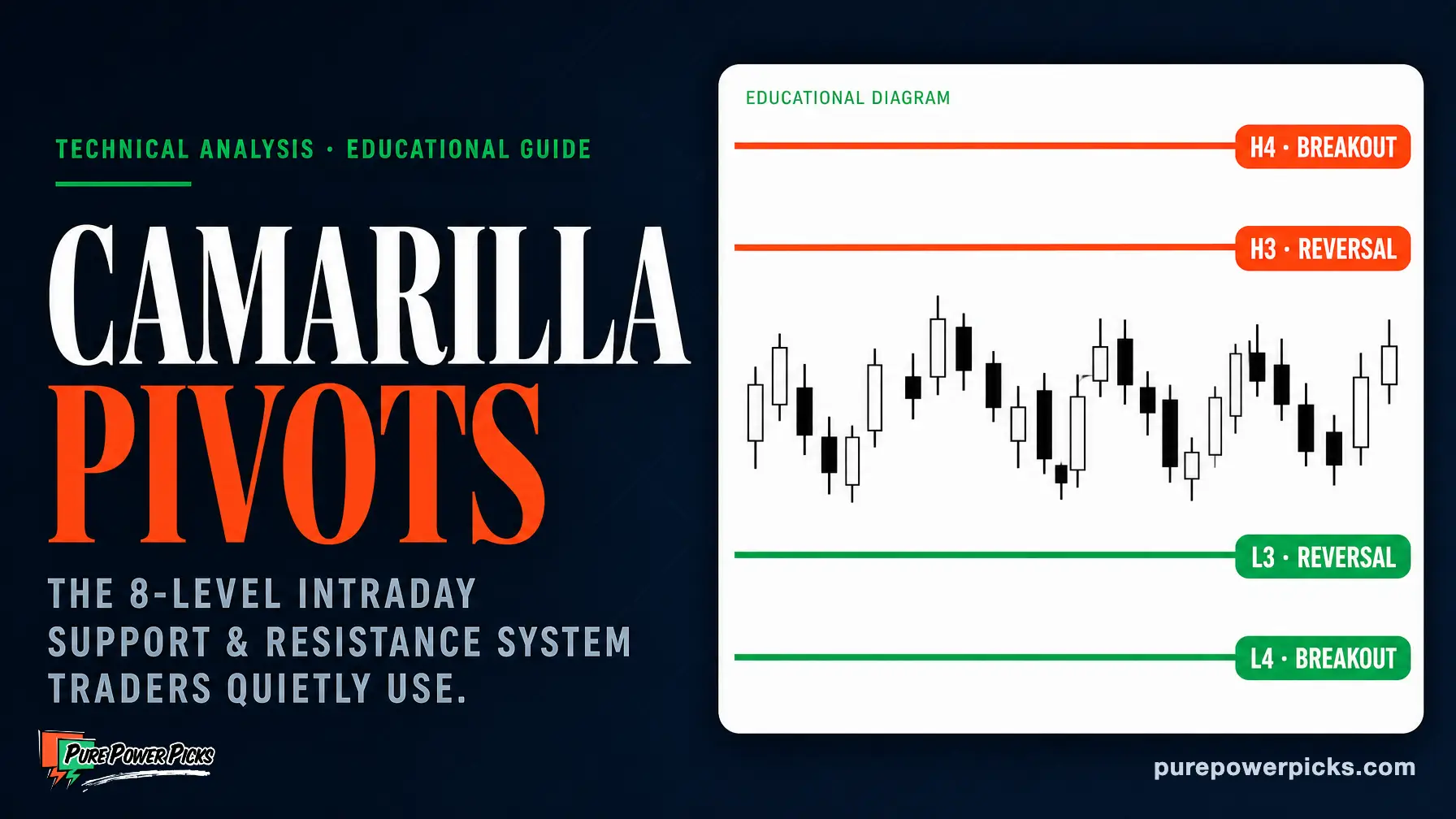
Here is what they actually do: Camarilla pivots take yesterday's High, Low, and Close and spit out eight levels for today. Four above price, four below. Two of those levels (H3 and L3) tend to act as reversal lines, where range-bound sessions turn around. Two more (H4 and L4) tend to act as breakout triggers, where trend days are born. The other four are mostly used as targets.
That is the whole framework. The rest of this post explains how to read the levels, when each setup fires, and how to actually trade them with examples.
What Camarilla Pivots Actually Are
Camarilla pivots are a type of daily pivot point, meaning the levels are recalculated every morning using the prior session's data. Unlike classic Floor Trader pivots (which use yesterday's average), Camarilla uses a multiplier-based formula that pulls the levels closer to the prior close. The result is a tighter, more reactive set of intraday levels.
Why traders use them:
- They reset every day, so you are never trading a stale line.
- They are derived purely from price, no subjective trendline drawing required.
- The same eight levels work on any liquid stock, ETF, futures contract, or forex pair.
- Two clear setups (reversal and breakout) emerge cleanly from the structure.
The Camarilla Formula
Take yesterday's Range (R = High − Low) and yesterday's Close (C). Then:
H3 = C + R × (1.1 / 4)
H2 = C + R × (1.1 / 6)
H1 = C + R × (1.1 / 12)
L1 = C − R × (1.1 / 12)
L2 = C − R × (1.1 / 6)
L3 = C − R × (1.1 / 4)
L4 = C − R × (1.1 / 2)
Some platforms also plot H5 and L5 as extension levels for trend days, calculated as H5 = (H4 / L4) × C and mirrored on the downside. Other variations use H5 = H4 + (H4 − H3). For practical trading, just remember H3, H4, L3, L4 and let your charting tool plot the rest.
You almost never need to do this math by hand. Every major charting platform (TradingView, ThinkOrSwim, Sierra Chart, NinjaTrader) has a built-in or community-published Camarilla pivot indicator. Add it once, set it to “daily,” and the lines redraw every morning.
The 8 Levels Visualized
Here is what a typical range-bound session looks like with all eight Camarilla levels plotted. Prior day Close = 100, Range = 12, so the levels work out to H4 = 106.60, H3 = 103.30, L3 = 96.70, L4 = 93.40.

Notice what the candles are doing. Most of the session lives between L3 and H3. Price probes one side, fails, rotates to the other side, fails again. That is the range-day signature, and it is the most common outcome on any given day. Roughly 70–80% of sessions in liquid index ETFs spend the majority of their time inside the H3/L3 band.
Action only happens at the edges. When price reaches H3 or L3, one of two things happens next, and your job is to read which one.
The Two Market Personalities
Camarilla traders simplify the entire market into two states:
The whole game is figuring out which one you are in before you commit to a setup. Camarilla gives you a built-in test: does price close beyond H3/L3, or does it reject? Close beyond = trend day. Reject = range day.
Setup #1: The Reversal (Range Day)
This is the most common Camarilla setup, and the one that pays the rent for most range-trading desks. The mechanics are simple:
- Price drifts toward L3 over the course of the morning.
- Price tags L3 and finds buyers. You want to see at least one candle close back above L3, ideally with a long lower wick.
- Enter long just above L3. Stop sits just below L4 (your invalidation).
- Targets ladder up: L2, L1, prior Close, H1, H2, H3.
- H3 is the primary target. If price reaches it and rejects, you can flip short with the mirror setup.

The reason this works is structural. By the time price has traveled from yesterday's close all the way down to L3, the move is already statistically stretched. The math behind the 1.1 / 4 multiplier sets L3 at roughly the 1-standard-deviation move below the prior close. Mean reversion kicks in here far more often than it does at random price points.
The risk-reward is the edge. You are risking the distance from L3 to L4 (one Camarilla unit) for the chance to capture L3 to H3 (three Camarilla units). Even at a 40% hit rate, the math works.
The short version of this setup is the mirror image. Price climbs to H3, prints a rejection candle (long upper wick, close back below H3), you short, stop above H4, target ladder down to L3.
Setup #2: The Breakout (Trend Day)
The reversal setup pays you most days. The breakout setup pays you the days the reversal fails. That is what makes Camarilla a complete framework: it has a built-in answer for both market personalities.
The trigger is unambiguous. You need a candle close above H3 (or below L3) on rising volume. Not a wick through. A close. Wicks through H3 are the most common reversal entry. Closes through H3 are the most common trend-day signal. That single distinction separates good Camarilla traders from frustrated ones.
- Watch price approach H3 with momentum (a few wide-bodied candles, not a slow grind).
- Wait for a candle to close above H3.
- Enter long on the close, or on a small pullback to H3 (which should now act as support).
- Stop goes below the breakout candle's low, or below H3, whichever is tighter.
- First target: H4. If price closes above H4, trail your stop and let it run to H5.

One detail that matters: once H3 confirms as a breakout, it flips role. The same level that would have been resistance on a range day becomes support on a trend day. Pullbacks to H3 are buyable in this environment, not sellable. This is true of every pivot system, but it is especially clean with Camarilla because the levels are tight enough that the flip is testable within the same session.
If you want to see what this level-respecting framework looks like applied to two real intraday options alerts (one that ran, one that failed at resistance), our QCOM vs OKLO case study walks through the chart structure on both trades side-by-side.
Camarilla vs. Classic Pivots vs. Fibonacci Pivots
If you have used pivot points before, you have probably used the classic Floor Trader formula. Here is how the three main pivot systems compare:
| System | Anchor | Best For |
|---|---|---|
| Classic (Floor Trader) | Central pivot = (H + L + C) / 3 | Swing trading, wider stops, daily bias |
| Camarilla | Prior Close + multipliers of Range | Intraday reversals and breakouts, tight stops |
| Fibonacci Pivots | Central pivot + Fib-based extensions of Range | Trend-day extension targets |
The honest take: classic pivots are too loose for fast intraday trading. The S1/R1 levels are usually too far from the action, and price spends most of the day between them with no clean trigger. Camarilla's tighter spacing and explicit reversal-vs-breakout structure makes it the better choice if you are looking at 5-minute or 15-minute charts for active entries.
How to Plot Camarilla Pivots on Your Charts
You should never calculate these by hand. Here is how to get them on the major platforms in under a minute:
- TradingView: Open the indicators menu, search for “Camarilla,” and pick the community indicator with the highest like count. Set the timeframe to “Daily” in the settings.
- ThinkOrSwim: Studies → Add Study → type “Camarilla” in the search. The built-in study is called “CamarillaPoints.”
- NinjaTrader / Sierra Chart: Both have native pivot indicators with a Camarilla mode in the dropdown.
- Webull / Robinhood: No Camarilla support natively. You will need to either calculate the four key levels manually each morning (it takes 30 seconds with the formula above) or use TradingView alongside.
If you trade options off these levels (Camarilla pairs nicely with 0DTE and weekly contracts because the levels are intraday), set price alerts at H3, L3, H4, and L4. You do not need to stare at the chart; let the alerts pull you in when price reaches a decision zone.
Common Mistakes That Kill Camarilla Trades
The setups look simple on paper. Here is what trips up traders who are new to them:
- Trading the inner levels. H1, H2, L1, L2 are not entry points. They are targets and intermediate reactions. Trying to scalp every tag of H1 is a fast way to overtrade.
- Entering on the wick instead of the close. A spike through H3 that closes back below is not a breakout, it is a stop-run. Wait for the close to confirm before sizing up.
- Ignoring the daily bias. On a strong-trend day in the broader index, fading L3 in a weak stock is fighting the tape. Check SPY and QQQ before trading reversal setups in individual names.
- Putting the stop too tight. The reversal stop goes below L4, not below the entry candle. Camarilla's edge depends on absorbing the noise between L3 and L4. Tight stops get you knocked out exactly when the setup is about to work.
- Trading low-volume names. Camarilla levels work best on liquid instruments where the prior day's range is meaningful. On a thinly-traded small cap, the levels are just noise.
Two of these mistakes are worth seeing on a chart
The wick-vs-close distinction is the single most common reason a trader misreads a Camarilla breakout. Here is what each one looks like in the same session, on the same H3 line:

The stop placement mistake is just as costly, and just as fixable. On a reversal long at L3, a stop placed too close to the entry gets knocked out by the very wick that creates the setup:

Frequently Asked Questions
Who created the Camarilla equation?
Nick Stott, a bond trader, developed the Camarilla pivot formula in 1989. The name has no specific meaning; Stott reportedly chose it because it sounded distinctive.
What is the difference between Camarilla and standard pivots?
Standard (Floor Trader) pivots use yesterday's average (H+L+C)/3 as the central anchor. Camarilla pivots use yesterday's Close plus a multiplier of the Range. Camarilla levels sit closer to the prior close and are better suited to intraday trading, while standard pivots are wider and better for swing setups.
Are Camarilla pivots accurate?
They are a tool, not a forecast. On any given day, H3 and L3 act as reversal levels with high frequency on liquid instruments, and H4/L4 reliably mark breakout zones. But like every technical indicator, they work best as one input alongside volume, broader market context, and your own risk plan.
Can I use Camarilla pivots for options trading?
Yes, and they pair particularly well with short-dated options (weekly and 0DTE contracts) because the levels are intraday in nature. Many traders use H3/L3 as the strike targets for credit spreads and L4/H4 as the wing strikes for defined-risk plays.
Do Camarilla pivots work on crypto and forex?
Yes, on any liquid 24-hour market you just need to define what counts as the “prior session” (most platforms default to the previous UTC day). The formula is asset-agnostic.
Bottom Line
Camarilla pivots reduce intraday trading to two questions: am I in a range day or a trend day, and is price near H3/L3 yet? If you can answer both, you have a setup. If you cannot, you stay flat. That clarity is rare in technical analysis, and it is why the indicator has quietly stuck around for 35+ years despite getting almost no mainstream attention.
Start by adding the indicator to one chart and just watching it for a week. Note how often price reverses at H3 or L3 without you having to draw a single trendline. By the end of the week you will see why Stott's formula keeps showing up on the screens of professional intraday traders.
Want to study real chart examples of intraday options setups? Our educational alert archive catalogs every alert we've published since 2020, each one logged with the Max Opp it reached. Six years of educational setups to learn from.
Educational content only. Not investment advice. Past performance does not guarantee future results.
Share

The PPP Team is the research and editorial team behind Pure Power Picks. We trade stocks and options and publish the work as we do it, with every alert tracked in public. Publishing since 2020. How we research and correct our work is written out in our editorial standards. Our content is strictly educational, never advice.