


MarketBeat Review (2026): Is It Worth It for Options Traders?
Share


Verdict: MarketBeat is best for data-focused, income-oriented investors who value analyst consensus, dividend, and institutional tracking, but active options traders will find its options tooling too shallow to serve as a primary platform.
MarketBeat is a research and data platform built for investors who want analyst consensus, dividend intelligence, and institutional flow in one affordable place. If you trade options actively, it works as a supporting research tool, not a primary trading platform, because it lacks a real options chain, Greeks, and strategy modeling.
Let’s get straight to the question in this MarketBeat review: is MarketBeat good for options trading? The honest answer is that it is a strong research platform but a weak options platform. MarketBeat shines at aggregating analyst ratings, price targets, upgrade and downgrade alerts, dividend data, and institutional ownership into a single clean dashboard. That makes it genuinely useful for finding catalysts and understanding what “smart money” is doing. But when you want a real options chain, live Greeks, a strategy builder, or profit-and-loss modeling, MarketBeat simply does not have those tools. For an active options trader, it functions as a research layer that feeds your ideas, while your actual analysis and execution happen elsewhere. Used that way, it earns its place. Used as your only platform, you will hit walls fast.
MarketBeat platform walkthrough.
MarketBeat Pricing: What Do You Actually Get?
At $29 a month, or $249 a year billed annually, the All Access tier is one of the better values in the research category. You get a broad set of data tools that would cost far more if you assembled them piecemeal. The free tier is also genuinely usable for casual investors who just want ratings and earnings dates. This is why MarketBeat scores an 8 on pricing and value.
- Excellent analyst consensus tracking with ratings, price targets, and upgrade/downgrade alerts aggregated in one place
- Strong institutional ownership and insider trading data that helps investors follow smart money
- Comprehensive dividend tracking tools, including dividend capture strategies, appealing to income investors
- Affordable All Access tier at $29/month ($249/year) delivers solid value relative to the breadth of research data
- Useful free tier and email alerts that make it accessible to beginners and casual investors
- Options-specific tooling is thin: no true options chain, Greeks display, strategy builder, or P&L modeling for serious options traders
- Education resources are limited and geared toward general investing rather than structured options learning
- Heavy reliance on email newsletters and upsells can feel spammy and cluttered
- Mobile experience lacks feature parity and depth compared to dedicated trading platforms
How Good Is MarketBeat’s Options Chain?
Short answer: there isn’t a true options chain in the sense an active trader expects. MarketBeat offers options activity data and volatility event tracking, but not the strike-by-strike, real-time chain with live Greeks you would use to structure a trade.

What you do get is directional context. MarketBeat surfaces unusual options activity summaries, earnings dates, and analyst-driven catalysts that hint at where volatility might build. That is useful when you are hunting for names worth a closer look. But once you have a candidate, you still need to open a dedicated platform to see the chain, the implied volatility skew, the bid-ask spreads, and the delta or theta on each strike.
This is the core limitation. MarketBeat tells you a stock has a pending catalyst and heavy call flow. It does not tell you whether the 30-day straddle is pricing in a 6% move or a 12% move, and it will not model a vertical spread’s max risk. For that workflow, you would pair it with a platform like Barchart or a broker’s chain. For a deeper look at flow tools specifically, our Unusual Whales review covers what serious options-flow traders need.
An options chain is the full grid of available calls and puts for a stock, organized by strike price and expiration date, showing bid, ask, volume, open interest, and often the Greeks. It is the primary tool you use to select and price an options trade. Learn more from Investopedia’s options chain explainer.
Can You Build Multi-Leg Strategies on MarketBeat?
No. MarketBeat has no strategy builder and no profit-and-loss modeling for spreads, iron condors, or any multi-leg structure. If your edge comes from constructing defined-risk positions, this is a hard gap.
Where MarketBeat helps a strategist is in the idea and catalyst phase. Say you want to structure an earnings play. MarketBeat’s earnings calendar, analyst-driven catalysts, and volatility event tracking help you identify which names have a scheduled event and how analysts are positioned heading in. That is real value at the top of the funnel.
But the moment you want to decide between a debit spread and a calendar, or size a position against defined max loss, you leave MarketBeat. The platform was never designed for trade construction. It is a research aggregator, not an execution or modeling tool.
Use MarketBeat as a screening layer, not a decision layer. Let its analyst consensus and earnings calendar hand you a shortlist of catalyst-rich names, then take those tickers to a real chain to build and price the actual structure. Our guide on trading options on earnings walks through that handoff step by step.
Is MarketBeat’s Analyst and Institutional Data Actually Useful?
Yes, and this is where MarketBeat genuinely earns its keep. The analyst consensus tracking is the platform’s flagship strength. You get aggregated ratings, average price targets, and, importantly, alerts when analysts upgrade, downgrade, or initiate coverage.
For an options trader, analyst moves matter because they can trigger sharp, tradeable repricing. A surprise downgrade on a widely held name can crush a stock and spike put demand. MarketBeat puts those events in front of you quickly, which supports the kind of catalyst-driven thinking we teach in how to find stocks to trade.
The institutional ownership and insider trading trackers add another layer. Watching 13F changes and insider buys or sells helps you gauge conviction behind a move. If you want to go deeper on the raw documents behind that data, our guide to SEC filings that move stocks pairs well with MarketBeat’s summaries. You can verify the underlying filings yourself through the SEC EDGAR database. The dividend tools, including dividend capture strategy data, round out a package that income investors will especially appreciate.
Who Is MarketBeat Best For?
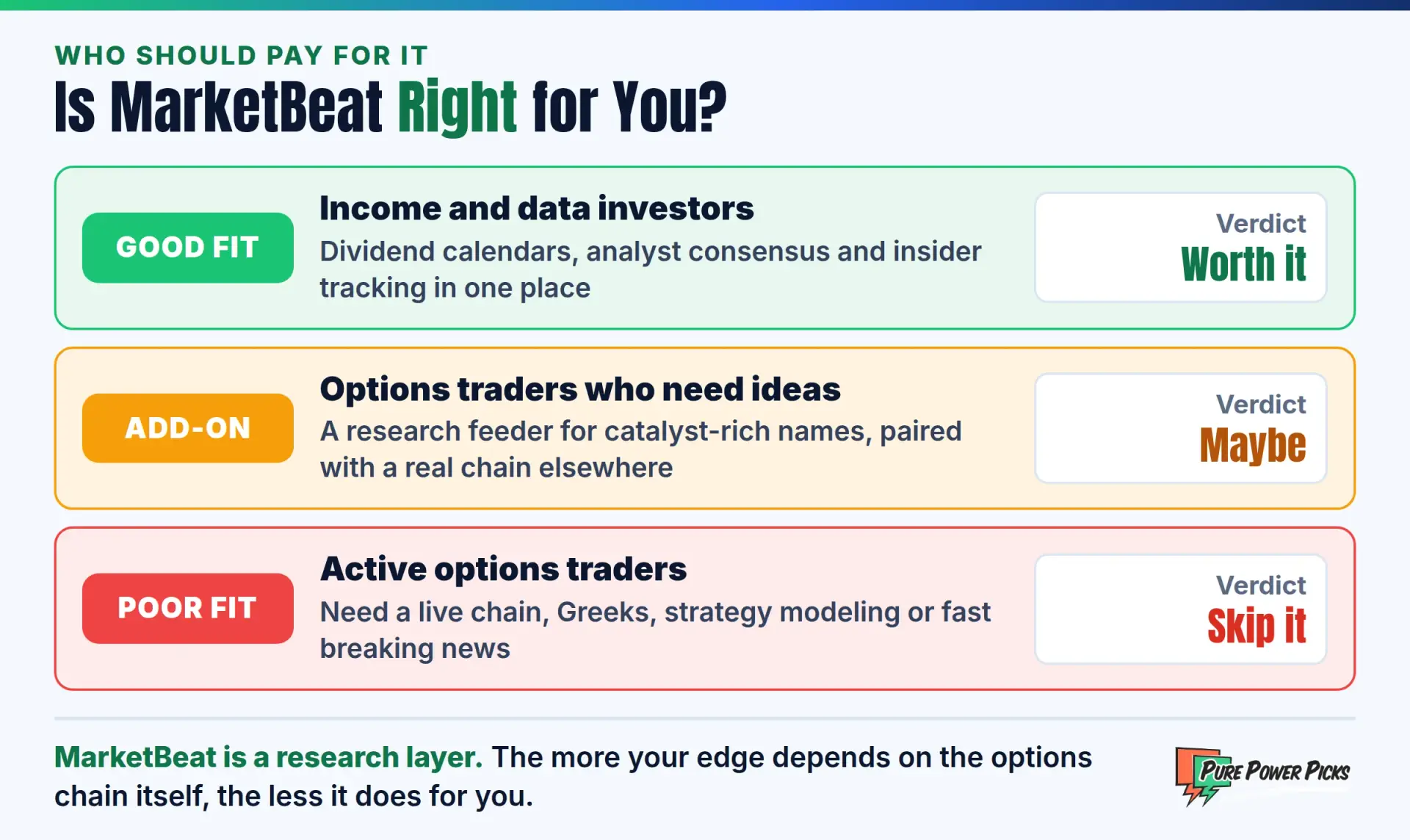
- Income and dividend investors who want capture-strategy data, ex-dividend calendars, and yield tracking in one dashboard.
- Data-focused swing traders who trade around analyst upgrades, downgrades, and institutional flow rather than intraday charts.
- Beginners and casual investors who want a clean free tier with ratings and earnings alerts before paying for anything.
- Options traders who need a research feeder to surface catalyst-rich names, then take those ideas to a dedicated chain elsewhere.
Skip this if… you are an active options trader who needs a live chain, Greeks, strategy modeling, or fast breaking-news tooling as your core workflow. In that case, look at platforms built for that job. Our Benzinga Pro review covers a stronger option for news-driven traders, and our roundup of the best tools for stock traders maps out how to build a complete stack.
How Does MarketBeat Compare?
If your priority is deep fundamental analysis and long-form research, see our Seeking Alpha review for the marketbeat vs seeking alpha comparison many investors ask about. For fast, news-driven trading, Benzinga Pro is the stronger pick.
How Do Other Reviewers Rate MarketBeat?
Our 3/5 is an options trader’s score. Step back to the whole platform, though, and the broader trading community rates MarketBeat highly across independent review sites, and it’s used by a reported 5.1 million active email subscribers:
PPP scores MarketBeat narrowly, on options-specific value: the tools options traders actually use day to day. These third-party scores rate the whole platform across all types of traders, which is a different lens, and both reads are useful. Ratings shown as of August 2026 and reflect each site’s full user base, not options traders alone.
Frequently Asked Questions
Is MarketBeat worth it for options traders?
For options traders, MarketBeat is worth it only as a supporting research tool, not a primary platform. It excels at analyst consensus, catalysts, and institutional data that can surface tradeable names, but it lacks an options chain, Greeks, and strategy modeling. Serious options traders will need to pair it with a dedicated chain and analysis platform to complete their workflow.
Does MarketBeat have an options chain?
No, MarketBeat does not offer a true, strike-by-strike options chain with live Greeks. It provides options activity summaries, volatility event tracking, and analyst-driven catalysts, which help with directional context. To view actual strikes, implied volatility, and bid-ask spreads, you will need a broker platform or a dedicated options tool.
How much does MarketBeat cost?
MarketBeat offers a free tier with analyst ratings, earnings data, and basic stock information. The paid MarketBeat All Access plan costs $29 per month, or $249 per year, and adds a stock screener, portfolio alerts, insider trading data, dividend tools, and the ideas engine. Pricing may change, so verify current rates on the official MarketBeat website.
MarketBeat vs Seeking Alpha: which is better?
They serve different needs. MarketBeat is stronger for analyst consensus, dividend tracking, and institutional flow in a clean, affordable dashboard. Seeking Alpha is stronger for deep, long-form fundamental research and crowd-sourced analysis. Income and data-focused investors often prefer MarketBeat’s price point, while research-heavy investors may favor Seeking Alpha’s article depth.
Can I cancel MarketBeat All Access anytime?
Yes, MarketBeat All Access is a month-to-month subscription that you can cancel through your account settings. Because billing terms and refund policies can change, always confirm the current cancellation and refund details directly on MarketBeat’s website before subscribing. Reading the terms up front avoids surprises on your next billing cycle.
What is MarketBeat best known for?
MarketBeat is best known for its analyst consensus tracking, aggregating ratings, price targets, and upgrade or downgrade alerts across many stocks in one place. It is also widely used for dividend intelligence, including dividend capture data, plus insider trading and institutional ownership tracking. These research strengths are what set it apart from execution-focused platforms.
MarketBeat earns a solid 3/5 as a research platform that punches above its price for analyst, dividend, and institutional data. Income and data-focused investors will love it. Active options traders should treat it as a research feeder, not a primary trading platform.
Our trade plans break down every setup with key levels, risk zones, and the reasoning behind each trade idea, so you can build the skills to analyze markets yourself.
Read more trading guides and reviews on our blog.
Disclaimer: Pure Power Picks is not a licensed financial advisor. All content is for educational and informational purposes only and should not be considered investment advice. Options trading involves substantial risk of loss and is not suitable for all investors. Past performance does not guarantee future results. Platform features and pricing may change: verify current details on the official website.
Related Reviews
More platforms we’ve reviewed for options traders:
- Motley Fool Review →Long-term investment advisory service with stock picks,…
- Seeking Alpha Review →Crowd-sourced investment research platform with analyst ratings,…
- Barchart Review →Comprehensive market data platform with powerful options…
- StockCharts Review →Classic web-based charting platform with ACP (Advanced Charting…
Share

The PPP Team is the research and editorial team behind Pure Power Picks. We trade stocks and options and publish the work as we do it, with every alert tracked in public. Publishing since 2020. How we research and correct our work is written out in our editorial standards. Our content is strictly educational, never advice.