


Understanding Buy and Sell Signals in Trading: How to Identify and Act on Them
In the world of trading—whether it’s stocks, options, forex, or crypto—buy and sell signals are the foundation of every successful trade. These signals help traders make informed decisions about when to enter or exit positions, aiming to maximize profits while minimizing losses.
If you’re new to trading or still struggling with when to pull the trigger, this guide will walk you through:
What buy and sell signals are
The most effective ways to identify them
Tools and strategies to help you act on them decisively
Let’s break it down.
What Are Buy and Sell Signals?
In trading, buy and sell signals are indicators that suggest it’s time to either enter (buy) or exit (sell) a position. These signals are generated through a combination of:
Price action patterns
Volume data
Momentum indicators
Fundamental catalysts (in some cases)
Traders rely on these signals to make decisions based on probability and timing, not emotion or speculation.
Example:
A buy signal could be a bullish breakout above a resistance level.
A sell signal might be a bearish engulfing pattern at the top of an uptrend.
Knowing what signals to trust and how to read them in real-time is what separates profitable traders from the rest.
Types of Trading Signals
There are two main categories of signals:
1. Technical Signals
These are derived from chart patterns and indicator setups. Common examples include:
Moving Average Crossovers: A short-term MA crossing above a long-term MA is a bullish sign.
RSI (Relative Strength Index): RSI below 30 indicates oversold (potential buy); above 70 indicates overbought (potential sell).
MACD Crossovers: When the MACD line crosses above the signal line, it often suggests a buy.
Support and Resistance Breakouts: Breaking above resistance or below support can signal a trend continuation.
2. Price Action Signals
These are signals based on candlestick patterns and the context of price movement:
Hammer Candlestick: Can be a buy signal at the bottom of a downtrend.
Bearish Engulfing: A reversal signal suggesting a potential sell at the top of a rally.
Double Bottoms or Tops: Reversal patterns signaling a change in trend.
How to Spot Buy and Sell Signals
1. Use Charting Tools and Platforms
Tools like TradingView, ThinkorSwim, and TrendSpider allow traders to customize indicators, scan patterns, and automate alerts.
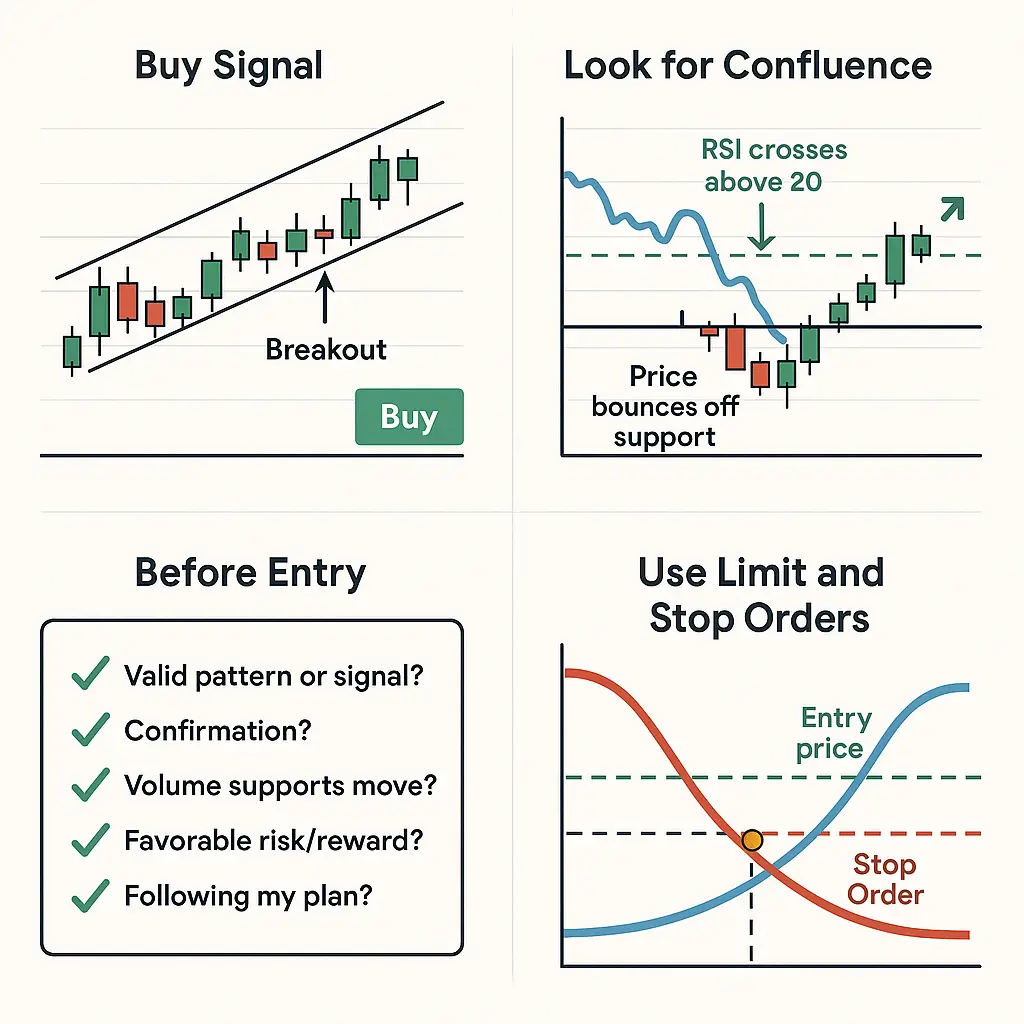
2. Look for Confluence
The most reliable signals occur when multiple indicators point to the same conclusion.
Example:
RSI is oversold
Price is bouncing off support
MACD is crossing bullish
This is a confluence of signals indicating a strong buy setup.
3. Use Volume Confirmation
Volume is a powerful filter. If a breakout or breakdown occurs on low volume, it’s more likely to fail. When volume confirms the move, the signal is stronger.
4. Backtest Patterns
Before relying on a particular signal, test how it performed historically. This gives you confidence to act when you see it again.
Platforms like MetaTrader, TrendSpider, and TradingSim are great for backtesting.
How to Act on Trading Signals
Knowing the signal is only half the game. Here’s how to execute properly:
1. Have a Trade Plan Ready
Every trade should include:
Entry Point
Stop Loss
Profit Target
Position Size
If you’re unsure how to create one, here’s a step-by-step guide on building a trading plan.
2. Use Limit and Stop Orders
Instead of market orders (which can lead to slippage), use limit orders for precision and stop-loss orders for protection. Learn more about order types here.
3. Act Without Hesitation
Once your signal aligns with your plan, execute without second-guessing. Hesitation leads to missed entries or worse, chasing a trade.
4. Review the Trade (Win or Lose)
After the trade is closed, ask:
Did the signal work?
Did I follow my plan?
What can I improve next time?
This post-trade analysis is essential for long-term success.
Mistakes to Avoid When Acting on Signals
Overloading Indicators
Chasing Signals
Ignoring Risk Management
Trading Without Confirmation
Remember: Even the best signal can fail. That’s why risk management is non-negotiable.
Advanced Tips for Signal Traders
1. Automate with Alerts and Bots
Tools like TradingView, TrendSpider, or ThinkorSwim let you create real-time alerts or trading bots based on your chosen signal triggers.
2. Join a Trading Community
You don’t have to trade alone. Consider signal services like Pure Power Picks or forums like r/Daytrading on Reddit to stay sharp.
3. Use a Pre-Trade Checklist
Before hitting “buy” or “sell,” ask yourself:
✅ Is this a valid pattern or signal?
✅ Is there confirmation?
✅ Is volume supporting the move?
✅ Is my risk/reward favorable?
✅ Am I following my plan?
Final Thoughts: Mastering Buy and Sell Signals Takes Time
Buy and sell signals are not magic arrows—they’re tools. The more experience you gain reading charts, testing strategies, and managing trades, the more you’ll trust your instincts and systems.
Be patient, stay consistent, and never stop learning.
Want to Take Your Trading to the Next Level?
Join our newsletter at Pure Power Picks to receive:
High-conviction trade alerts
Weekly market insights
Educational content and tools
Also, check out:
Want More Stock Market Insights?
💡 Stay ahead of the game with Pure Power Picks—where expert analysis meets real-time trade alerts! Sign up today and start making smarter trades. 🚀