

Elon Musk, DOGE and Tesla Stock: What Actually Happened
On February 12, 2025, we wrote a short post about a headline that knocked Tesla stock lower that afternoon. Fox Business correspondent Charles Gasparino reported that Elon Musk planned to spend about four months on the Department of Government Efficiency (DOGE), that he wanted to cut $2 trillion from the federal budget, and that he expected inflation to fall back to 2% once DOGE’s work was done.
Twenty one months later, DOGE is gone, the scorecard is in, and Tesla stock has been through one of the wildest stretches in its history. This is the follow up: what DOGE set out to do, what it actually accomplished, what it did to Tesla shares, and whether any of it still matters for traders in late 2026.
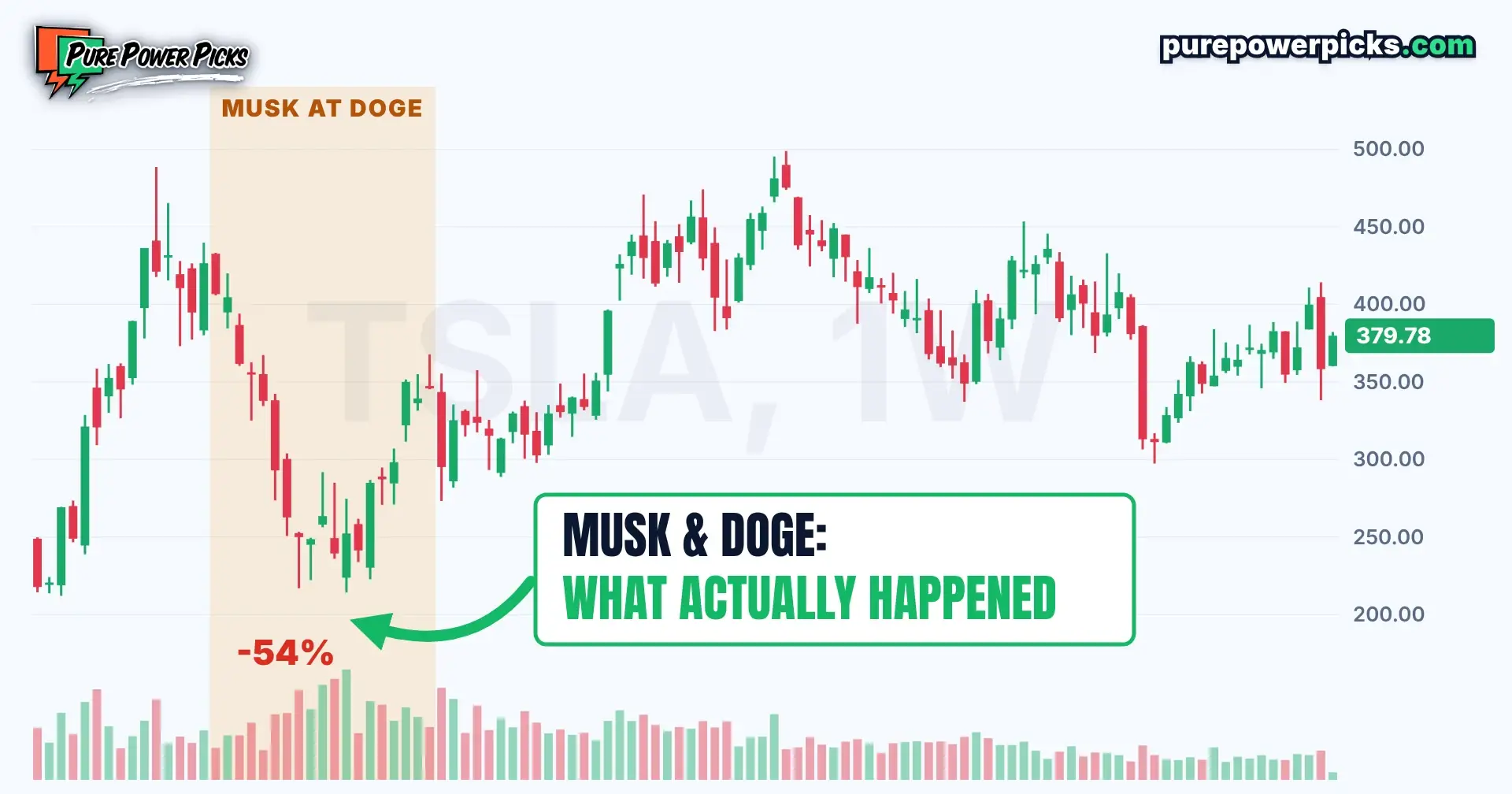
DOGE cut the federal workforce but never came close to its budget promises, and Washington’s spending kept rising. For Tesla, the real damage was not lost management time. It was Musk becoming a political figure: the stock fell 54% from its December 2024 record into April 2025, sales fell for a second straight year, and Musk’s politics still moved the stock in November 2026. The lesson for traders is key-person risk, and it has outlived DOGE itself.
| Item | Detail |
|---|---|
| What DOGE was | A White House cost cutting office created by executive order on January 20, 2025, set to expire July 4, 2026 |
| Musk’s role | Led it as a special government employee, limited to 130 days; left May 30, 2025 |
| Savings promised | $2 trillion (Musk later cut his own estimate to about $150 billion) |
| Savings claimed | $215 billion on DOGE’s own site; GAO could not verify most of it |
| How it ended | Folded into the Office of Personnel Management by November 2025; charter expired July 4, 2026 with no final report |
| TSLA on Feb 12, 2025 | $336.51 close |
| TSLA on Nov 10, 2026 | $379.78 close, up 12.9% (the S&P 500 ETF rose 24.3%) |
Where This Story Started: The February 2025 Headline
Gasparino’s post said Musk had told insiders he would spend the next four months on DOGE, that he was working so hard he was sleeping in his White House office, and that the goal was $2 trillion in cuts with inflation back at 2%. You can still read the original post on X: Charles Gasparino on X. Here is the screenshot we captured that day.
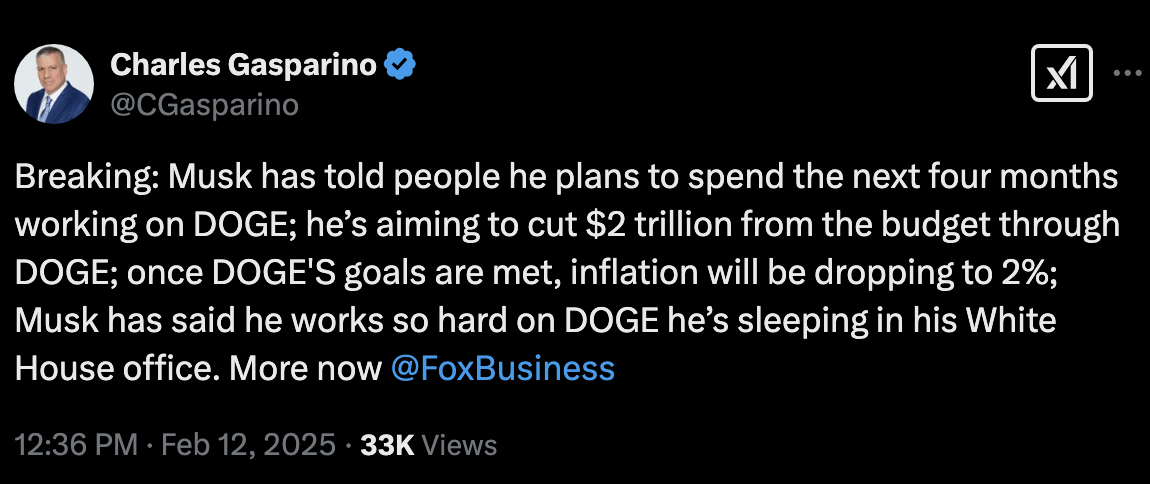
Tesla closed at $336.51 that day. It had already fallen about 30% from its December 17, 2024 record close of $479.86, and the post landed in the middle of that slide. Our original question was simple: would DOGE help Tesla through a friendlier Washington, or hurt it by pulling Musk away from the company? We now have the answer, and it was neither of those in the way most people expected.
The DOGE Timeline, From Launch to Shutdown
| Date | What happened | TSLA close |
|---|---|---|
| Nov 5, 2024 | Trump wins the election; Musk was his biggest backer | $251.44 (Nov 5) |
| Dec 17, 2024 | Tesla sets a record close as investors bet on a friendly White House | $479.86 |
| Jan 20, 2025 | DOGE is created by executive order on Inauguration Day | $426.50 (Jan 17) |
| Feb 12, 2025 | The Gasparino report and our original post | $336.51 |
| Mar to Apr 2025 | Protests at Tesla stores; Q1 deliveries fall 13% to 336,681 | $221.86 low (Apr 8) |
| Apr 22, 2025 | Q1 profit falls 71%; Musk says his DOGE time will “drop significantly” from May | $237.97 |
| May 30, 2025 | Musk’s last day after his 130 day limit | $346.46 |
| Jun 5, 2025 | Public feud with Trump over the tax and spending bill | $284.70 (down 14.3%) |
| Sep 30, 2025 | The $7,500 federal EV tax credit ends under that same bill | $444.72 |
| Nov 2025 | OPM director says DOGE “doesn’t exist” as a central office; shareholders approve Musk’s new pay plan | $445.91 (Nov 6) |
| Dec 16, 2025 | Tesla sets a new record close | $489.88 |
| Jul 4, 2026 | DOGE’s charter expires with no final report | $393.45 (Jul 2) |
| Aug 6, 2026 | GAO audit finds most claimed savings could not be verified | $319.53 |
| Nov 5, 2026 | Tesla falls 10.8% after the midterms | $343.69 |
What DOGE Promised vs What It Delivered
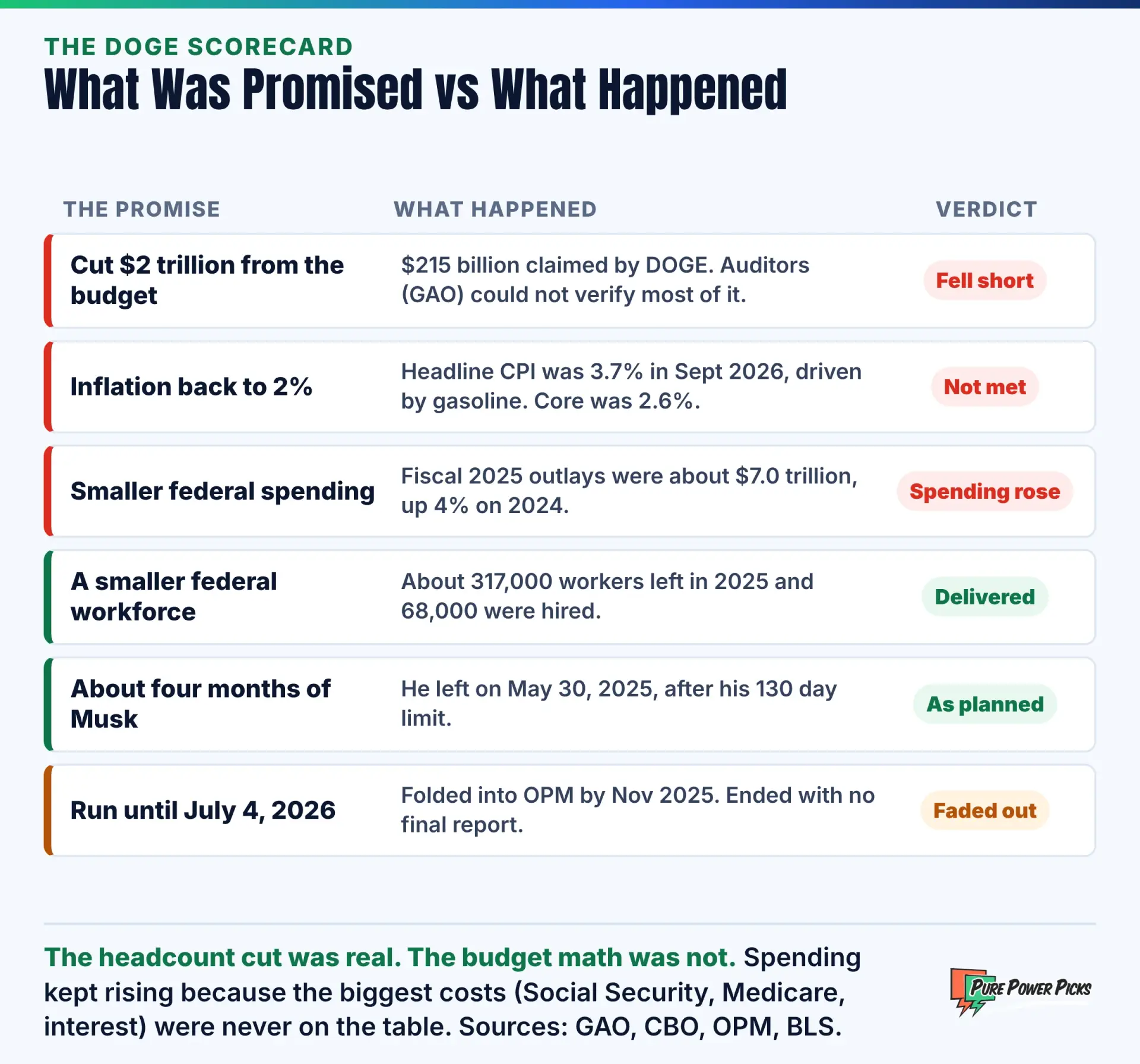
The fairest way to judge DOGE is against its own goals. On the most important one, the budget, it fell far short. On the workforce, it did what it said it would.
The $2 trillion target
Musk walked the number back almost immediately. By April 2025 he was projecting about $150 billion in savings for fiscal 2026. DOGE’s own website eventually claimed $215 billion, but DOGE never published the full accounting behind it, and the office issued no closing report when its charter expired.
In August 2026 the Government Accountability Office (GAO), Congress’s nonpartisan auditor, reviewed the claims. It could not verify the method behind 96% of the grant savings DOGE reported. About $27.4 billion of claimed savings came from contracts that were never actually cancelled, and one $1.7 billion Defense Health Agency contract counted as savings had never been terminated or changed at all. GAO did not conclude that DOGE saved nothing. It concluded that most of the number could not be checked.
The part Congress actually wrote into law was much smaller: a rescissions package of roughly $9 billion, signed in July 2025, that cancelled previously approved money for foreign aid and public broadcasting.
Federal spending and inflation
Total federal outlays for fiscal 2025 came in at about $7.0 trillion, roughly $275 billion (4%) more than in 2024, according to the Congressional Budget Office. The reason is structural. Social Security, Medicare, Medicaid and interest on the debt make up most of the budget, and DOGE never touched them. Interest costs alone rose about $80 billion.
Inflation did not fall to 2% either. The September 2026 consumer price index was up 3.7% from a year earlier, pushed higher by gasoline. Core inflation, which strips out food and energy, was 2.6%. Spending cuts of DOGE’s size were never going to be the lever that moved inflation; energy prices, tariffs and Federal Reserve policy mattered far more.
What it did accomplish
DOGE’s lasting mark is on the federal workforce. According to the Office of Personnel Management, about 317,000 employees left federal jobs in 2025 while about 68,000 were hired. Roughly 154,000 of the departures came through a deferred resignation offer, and OPM says 92% were voluntary. Whether that made government more efficient is a political argument. That the workforce got smaller is a fact.
DOGE also cancelled thousands of contracts, grants and leases, centralized a government wide hiring freeze, and pushed agencies toward deregulation. Many of those changes outlived the office itself, which is the point OPM director Scott Kupor made when he said DOGE’s principles live on across agencies even though DOGE as a central office no longer existed.
What It Did to Tesla Stock
Here is the full ride, from the election to this week, with the DOGE period shaded.
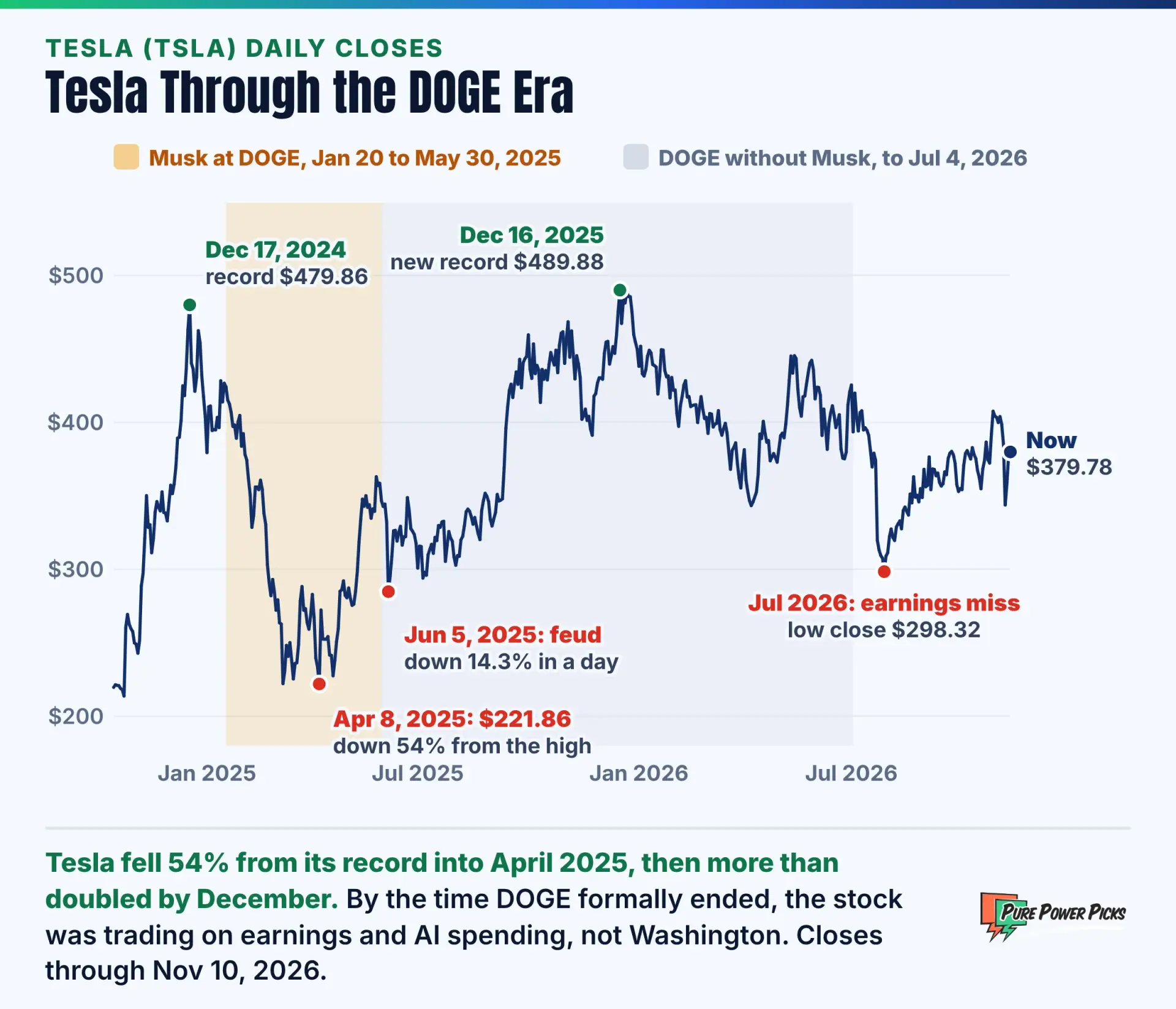
The chart tells a story in three acts.
Act one, the political premium (November to December 2024). Tesla almost doubled between the day before the election ($242.84) and its December 17 record ($479.86). Investors were betting that Musk’s closeness to the new administration would mean friendlier rules for self driving cars and a tougher time for competitors.
Act two, the DOGE drawdown (January to May 2025). While Musk ran DOGE, Tesla fell 54% from that record to a close of $221.86 on April 8, 2025. Some of that was the whole market: tariff fears hit everything that spring, and the S&P 500 ETF fell about 19% from its own February high to its April low. But Tesla’s problems were also its own. Protests and vandalism hit Tesla stores, first quarter deliveries fell 13%, and first quarter profit fell 71%. On the April 22 earnings call, Musk said his DOGE time would drop significantly starting in May. The stock rose 5.4% the next day.
Act three, the stock moves on (June 2025 onward). A week after Musk left, his public feud with President Trump over the tax and spending bill knocked Tesla down 14.3% in a single session on June 5, 2025, wiping out about $150 billion in market value, one of the largest one day losses for any company. Then the story changed. Investors refocused on robotaxis, the Optimus robot and Musk’s new pay plan, and Tesla more than doubled from its April low to a new record of $489.88 on December 16, 2025.
Since then, Tesla has traded on business news. Its worst day of 2026 came on July 23, when it fell 14.5% after second quarter earnings missed badly and the company outlined heavy spending on AI. It closed at $379.78 on November 10, 2026, down about 16% for the year.
Tesla vs the S&P 500
Whether Tesla “won” from all of this depends entirely on where you start counting.
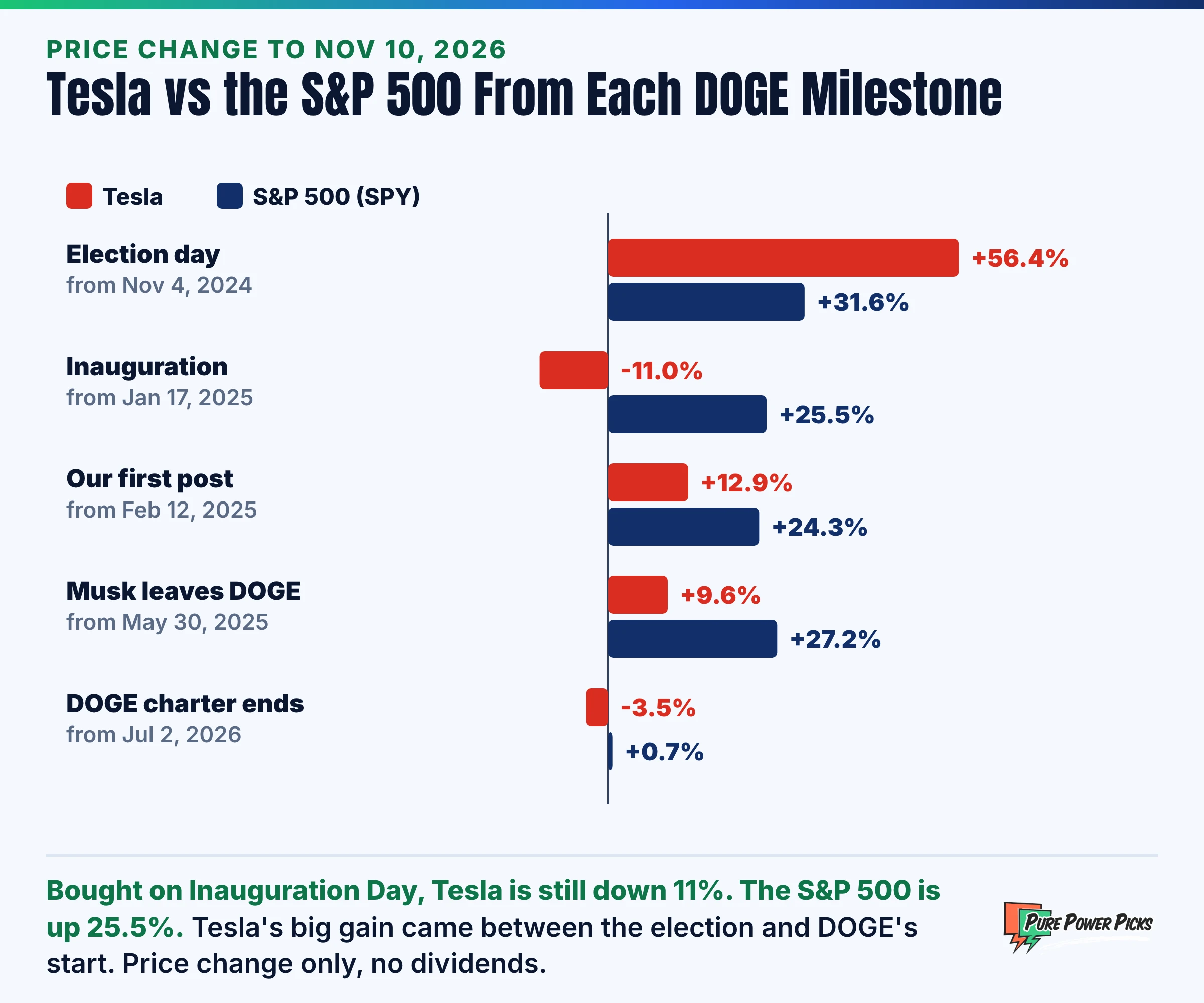
From Election Day, Tesla is still well ahead of the market. From Inauguration Day, the day DOGE began, it is down 11% while the S&P 500 ETF is up 25.5%. From the day Musk left DOGE, Tesla has gained 9.6% against the market’s 27.2%. In other words, the political run happened before DOGE started, and since DOGE started, Tesla has trailed the index by a wide margin.
The Business Damage Was Real
The stock recovered. The car business has not fully recovered yet.
| Year | Vehicles delivered | Change |
|---|---|---|
| 2023 | 1.81 million | Record year |
| 2024 | 1,789,226 | Down about 1% |
| 2025 | 1,636,129 | Down 8.6%, a second straight annual decline |
| Q3 2026 | 486,532 | Down 2% from Q3 2025, but ahead of estimates |
BYD passed Tesla as the world’s largest seller of battery electric cars in 2025. Several things drove Tesla’s slide at once: an aging lineup, cheaper competition from China, a Model Y changeover early in 2025, and the end of the $7,500 federal EV tax credit on September 30, 2025, which pulled demand into the third quarter and left a hole in the fourth.
Musk’s politics were one of those factors, and researchers tried to measure it. A working paper published through the National Bureau of Economic Research in October 2025, with Yale researchers among its authors, estimated that Tesla’s U.S. sales would have been 1.0 to 1.26 million vehicles higher from October 2022 to April 2025 without what it called a partisan effect, concentrated among buyers in Democratic leaning counties. Industry analysts were skeptical of the size of that estimate, and the window starts with Musk’s purchase of Twitter, long before DOGE. Still, DOGE made Musk’s politics impossible to ignore, and the effect showed up where it hurts: in the showroom.
Is DOGE Still Relevant to Tesla Stock?
DOGE itself is not. The office is closed, its savings claims have been audited, and nothing it does now can move Tesla’s earnings. If you are trading TSLA in late 2026, deliveries, margins, AI spending, robotaxi and robot progress and the proposed combination with SpaceX (tracked on our Tesla SpaceX merger page) matter far more than anything that happened in Washington in 2025.
What DOGE revealed is still very relevant. Musk did not leave politics when he left DOGE. He became the biggest known donor of the 2026 midterm elections, spending at least $445 million according to the Associated Press, mostly to help Republicans keep Congress. Democrats won both the House and the Senate on November 3. Two days later, on November 5, Tesla fell 10.8% while the S&P 500 ETF fell 4.4%. SpaceX fell about 9% the same day. That session was also part of a broad sell off in AI stocks, so not all of the drop was about politics, but Tesla fell more than twice as hard as the market.
Musk’s attention and Musk’s politics are still part of the Tesla trade. A Congress controlled by Democrats can mean more scrutiny of Musk’s companies, of autonomous vehicle rules and of government contracts for SpaceX. None of that shows up in a delivery report, but all of it can move the stock in a single session.
What This Means for Options Traders
The most useful lesson from DOGE is not about government. It is about how much a stock moves when its CEO becomes the story.
While Musk was running DOGE, Tesla moved 5% or more in a single day on 21 of 91 trading sessions, about one day in four. In the year after he left, that happened on 22 of 273 sessions, about one day in twelve. Some of the spring 2025 swings were market wide (the April 9 tariff pause lifted nearly everything), but Tesla’s moves were consistently larger than the market’s.
That has three practical consequences.
- Options get expensive when Musk is in the headlines. Buyers pay up for protection and for lottery tickets, which pushes up Tesla’s implied volatility. Buying calls or puts after a big headline means paying peak prices, and if the stock calms down the option can lose value even when you were right about direction.
- Size for the move you cannot predict. A 14% one day drop on a political feud is not something any chart pattern warns you about. Keep each position small enough that a gap like June 5, 2025 or November 5, 2026 hurts but does not wreck the account. Our guide to position sizing walks through the math.
- Prefer defined risk around political events. Spreads cap what you can lose, and shareholders can use protective puts or collars to hedge their TSLA shares around known dates like elections and earnings.
Before you act on a Musk headline, check three things: whether the report is confirmed, how far the stock has already moved, and where implied volatility sits against its recent range. If all three say the move is already priced in, waiting is usually the better trade. Our guide to trading breaking news covers this checklist in more depth.
Short dated TSLA options can lose most or all of their value quickly, especially after a volatility spike fades. Never trade unverified social media claims as fact, and never risk money you cannot afford to lose. The SEC’s investor education site, Investor.gov, explains options risks in plain language.
Final Thoughts
Our original post asked whether DOGE would help Tesla with a friendlier government or hurt it by distracting Musk. The answer turned out to be something else. DOGE did not save the money it promised, and it did not lower inflation. It did shrink the federal workforce. For Tesla, the cost was not mainly a CEO who was too busy. It was a CEO who became a political symbol, and that cost showed up in protests, in sales, and in a stock that has trailed the market since DOGE began.
DOGE is over. Musk’s influence on Tesla stock is not. As the November 2026 midterms showed, his choices outside the company can still move TSLA by double digits in a day. Treat that as a permanent feature of the stock, size your positions for it, and let the business numbers, not the headlines, drive your longer term view. For more on how Washington moves markets, see our guides to politics and the stock market and Washington insiders and stock trades.
Frequently Asked Questions
Did DOGE save $2 trillion?
No. Musk lowered his own estimate to about $150 billion by April 2025, DOGE claimed $215 billion on its website, and a GAO audit in August 2026 found most of that figure could not be verified. About $9 billion of cuts were written into law through a rescissions package in July 2025.
When did Elon Musk leave DOGE?
His last day was May 30, 2025, when his 130 day limit as a special government employee ran out. DOGE itself was folded into the Office of Personnel Management by November 2025 and its charter expired on July 4, 2026.
How much did Tesla stock fall during DOGE?
Tesla fell 54% from its record close of $479.86 on December 17, 2024 to $221.86 on April 8, 2025. It then more than doubled to a new record of $489.88 on December 16, 2025. From Inauguration Day to November 10, 2026, it was down 11% while the S&P 500 ETF was up 25.5%.
Did DOGE hurt Tesla sales?
It is one of several causes. Tesla’s deliveries fell 8.6% in 2025, its second straight annual decline. An aging lineup, Chinese competition and the end of the federal EV tax credit all played a part, and a study published through the NBER estimated Musk’s politics cost Tesla over a million U.S. sales between late 2022 and April 2025.
Is DOGE still relevant to Tesla stock?
DOGE itself is not, since the office no longer exists. But the key-person risk it exposed is. Musk spent at least $445 million on the 2026 midterms, and Tesla fell 10.8% on November 5, 2026 after Democrats won both chambers of Congress.
Sources
- Charles Gasparino on X, February 12, 2025
- GAO-26-108615, DOGE savings claims, August 6, 2026
- Congressional Budget Office, Monthly Budget Review for fiscal 2025
- OPM federal workforce departures for 2025, via FedManager
- Reuters reporting on DOGE being disbanded, via TIME, November 2025
- Yale Insights on the Musk partisan effect on Tesla sales
- PBS NewsHour (AP) on Musk’s 2026 midterm spending
- Tesla Q3 2026 deliveries, via Electrek
- Tesla and SPY daily closing prices, October 2024 to November 10, 2026
Stop Reacting to Headlines. Start Reading Setups.
Pure Power Picks is built education-first. Our alerts are educational chart setups that show you the alert price, the alert zone, and the reasoning behind each idea, so you learn how experienced traders think about volatility, catalysts, and risk.

The PPP Team is the research and editorial team behind Pure Power Picks. We trade stocks and options and publish the work as we do it, with every alert tracked in public. Publishing since 2020. How we research and correct our work is written out in our editorial standards. Our content is strictly educational, never advice.
Disclaimer: The content on Pure Power Picks is for educational and informational purposes only and does not constitute financial, investment, or trading advice. We are not registered financial advisors. All examples are hypothetical and for illustration only. Options trading involves substantial risk and is not suitable for every investor; you can lose some or all of the money you invest. Past performance and historical data points do not guarantee future results. Always do your own research and consult a licensed financial professional before making any investment decisions.