


Open Interest in Options Trading: How to Use It Like a Pro
When you pull up an options chain and see a bunch of numbers under “OI,” you’re looking at something a lot of new traders overlook: Open Interest. And trust me, if you’re serious about trading options — whether you’re swing trading SPY calls or selling covered puts on TSLA — Open Interest can give you a serious edge.
Let’s break it all down: what open interest is, how it differs from volume, and how to use it when trading options like a boss.
Table of Contents
ToggleWhat Is Open Interest?
Open Interest (OI) refers to the total number of active, outstanding options contracts that are currently open and have not been exercised, closed, or expired.
Think of it like this:
If you buy to open a call and someone else sells to open that same call, OI increases by 1.
If either party closes their position, OI decreases by 1.
📌 It resets daily, meaning it only updates at the end of the trading day — unlike volume, which updates in real time.
Open Interest vs. Volume
It’s easy to confuse the two, so here’s a quick side-by-side:
| Metric | Open Interest | Volume |
|---|---|---|
| Definition | # of contracts currently open | # of contracts traded today |
| Updates | End of day | Real-time |
| Indicates | Market participation + liquidity | Current trading activity |
| Best Use | Gauging market sentiment + depth | Spotting short-term interest |
💡 Pro tip: High volume with low open interest = short-term noise. High OI = deeper market participation and better liquidity.
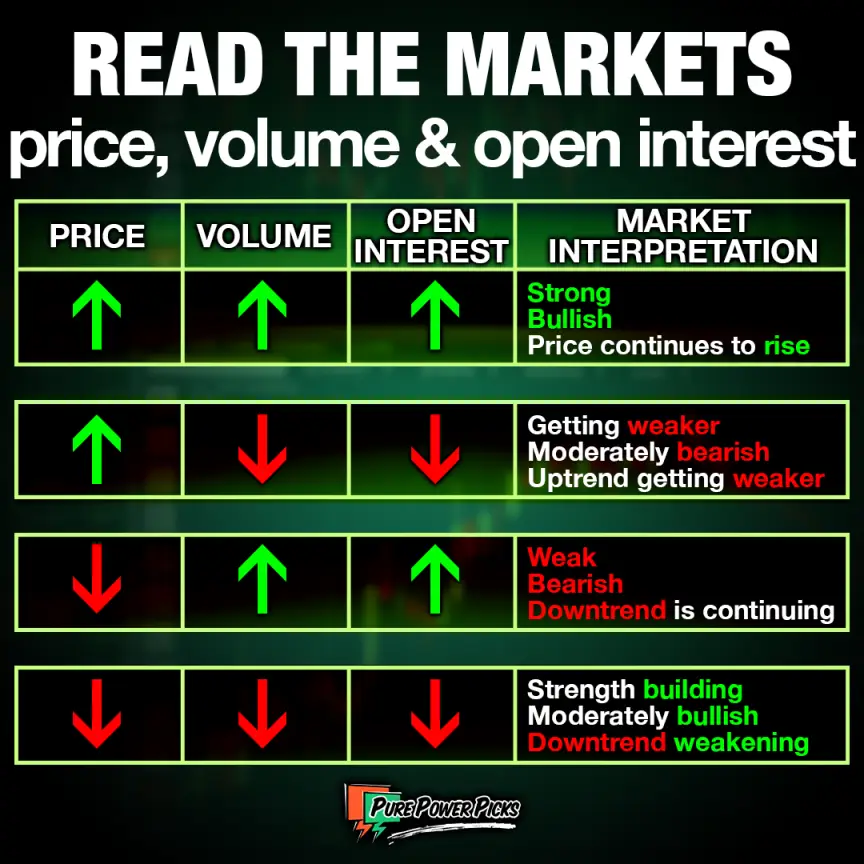
Why Open Interest Matters in Options Trading
Here’s why savvy traders always keep an eye on OI:
1. Liquidity Gauge
Options with higher open interest usually have tighter bid-ask spreads, making it easier to get in and out of trades without getting torched by slippage.
AAPL 150C with 25,000 OI? Smooth fills.
ROKU 87.5C with 42 OI? Good luck.
2. Market Sentiment
High open interest at a specific strike can act like a magnet or resistance zone — especially around big expiration dates (think: monthly OpEx).
3. Support/Resistance Clues
If a strike has unusually high OI, that price level could serve as a battleground. Use it in conjunction with technical analysis.
4. Unwinding & Pinning Effects
As expiration nears, market makers may “pin” the stock price near strikes with massive OI — this is known as options pinning or max pain theory.
How To Use Open Interest in Your Trading Strategy
🔍 1. Find the Sweet Spot for Liquidity
Stick with contracts that have at least 1000+ open interest and healthy volume. That’s where you’ll find the best fills and clearest sentiment.
⚔️ 2. Compare OI Across Strikes
Look at how OI stacks up at different strikes. Are traders crowding around a certain price? That could be a magnet as expiration approaches.
Example:
SPY has 150k OI at 530C and only 12k at 535C? Odds are, price action will feel gravity toward 530 on a slow day.
🔄 3. Watch for OI Changes
A sudden spike in OI can suggest new money entering a trade. Combine this with a breakout or trend confirmation for more conviction.
📅 4. Use OI With Expiry Dates
Volume can be deceptive near expiration. But open interest shows you where the real bets have been placed — often weeks prior. Use it to track rolling positions or institutional interest.
Real-World Example: Using OI on a Trade
Say you’re looking at NVIDIA (NVDA) and see this on the options chain:
700C, expiring next Friday:
Volume: 3,000
Open Interest: 65,000
IV: Elevated
Chart: Consolidating just below $700
Interpretation: That’s a huge amount of open interest. Could be a magnet level. If NVDA starts ramping up, it may gravitate toward $700 for a pin, especially if it’s near monthly expiration. You could trade a credit spread, straddle, or lotto call, depending on your outlook and risk appetite.
Common Misconceptions About Open Interest
“High OI means bullish.”
Not always. OI tells you how many contracts are open — not if they’re calls or puts, or whether they’re bullish or bearish. Always look at order flow, direction, and context.“Low OI = avoid.”
Sometimes low OI is fine for speculative plays — but expect wider spreads and slower fills.
Pairing OI With Other Tools
To make OI really work for you, combine it with:
Implied Volatility (IV) – to identify juiced premiums
Support/Resistance – to spot strike clustering
Time & Sales / Order Flow – to confirm big buys/sells
Max Pain Theory – for weekly expiration plays
Final Thoughts: Why You Should Care About Open Interest
Open Interest isn’t flashy, but it’s a core signal for serious options traders. It tells you where the crowd is, where the market might pivot, and whether you’ll get burned on a fill or slide in smoothly.
If you’re skipping over it, you’re basically trading in the dark.
So next time you pull up that options chain — take a second to check the OI. Your P&L will thank you later.
Frequently Asked Questions (FAQ)
Is high open interest good or bad?
It’s generally good — it indicates better liquidity, more efficient pricing, and tighter spreads.
What’s more important: volume or open interest?
Volume shows what’s moving today; OI shows what’s already in play. Both matter, but for long-term setups or exits, OI often gives the bigger picture.
How often does open interest update?
Once daily, after market close.
Does open interest impact price movement?
Indirectly. Large concentrations of OI can influence where price settles near expiration — but OI doesn’t “move” price on its own.
Want More Stock Market Insights?
💡 Stay ahead of the game with Pure Power Picks—where expert analysis meets real-time trade alerts! Sign up today and start making smarter trades. 🚀