

How to Calculate Options Profit: Formulas + Examples
Share
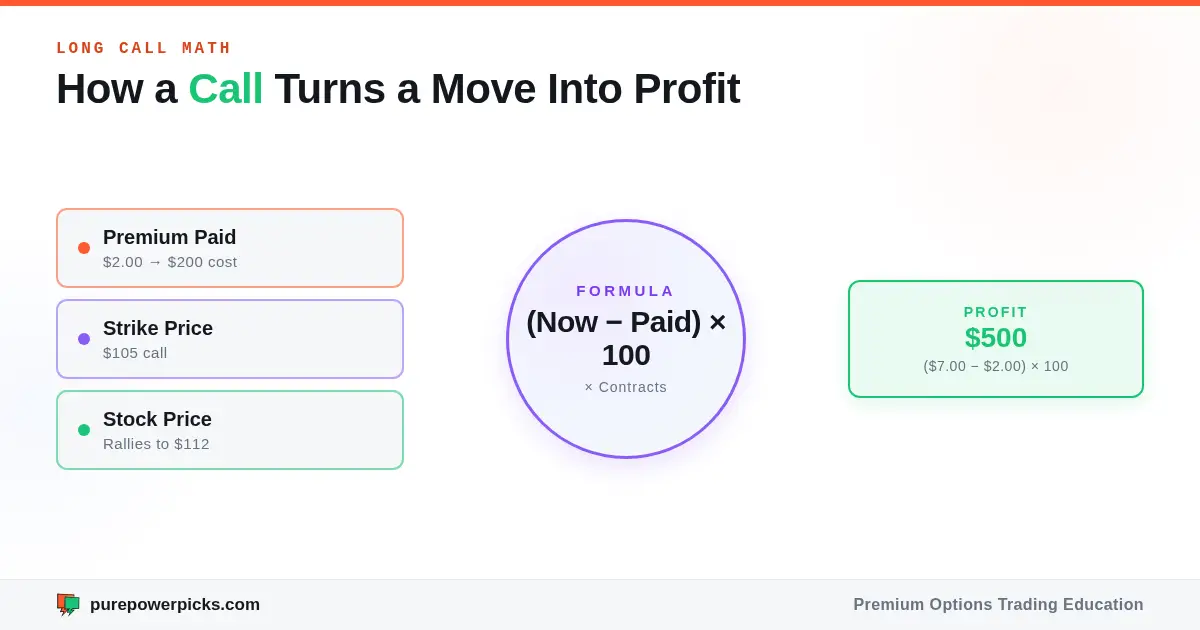
To calculate options profit on an open long call or put, subtract the premium you paid from the price at which you can close the option, then multiply by the contract multiplier and the number of contracts. For a standard U.S. equity option, the multiplier is typically 100:
At expiration, you can calculate profit directly from the stock price, strike price, and premium. That is a different calculation. Mixing these two methods is the most common reason options profit math seems confusing.
Use the option’s current closing price for profit or loss before expiration. Use intrinsic value and the stock’s expiration price for payoff at expiration. The break-even formulas in this guide are expiration break-evens—not promises that the option will be profitable before then.
Run the numbers without building a spreadsheet
Enter your stock price, strike, premium, days to expiration, volatility, and one or more option legs in PPP’s free calculator. It shows expiration P/L, break-even prices, a payoff chart, theoretical value, and the five major Greeks.
Why Are There Two Ways to Calculate Options Profit?
An option has a market price before expiration, but only intrinsic value remains once it expires. That creates two useful profit calculations:
- Mark-to-market P/L before expiration. Compare the option’s current bid, ask, mark, or actual closing execution price with your entry premium. The live option price reflects the stock price, time remaining, implied volatility, interest rates, and other inputs.
- Payoff at expiration. Calculate the option’s intrinsic value from the expiration stock price and strike, then subtract what you paid.
Your brokerage account usually displays unrealized P/L using a market quote or mark. That number can differ from what you could actually receive, especially when the bid-ask spread is wide. Realized profit uses the price at which your closing order fills, less applicable fees.

A standard U.S. equity option typically represents 100 shares, so a $2.00 premium normally costs $200 per contract. Some contracts are adjusted after corporate actions or use a different multiplier. Confirm the contract specifications instead of assuming every option represents exactly 100 shares.
How Do You Calculate Long Call Profit?
Before expiration, long call P/L is the difference between your closing option price and entry premium, multiplied by the contract multiplier and contract count. At expiration, the call is worth the amount by which the stock finishes above the strike—or zero if it finishes at or below the strike.
Complete Long Call Example
Assume a stock is at $100 and you buy one $105 call for $2.00. The position costs $200 before fees. These results are calculated at expiration:
| Stock at Expiry | Call Value | Position Value | Profit/Loss |
|---|---|---|---|
| $112 | $7 intrinsic | $700 | +$500 |
| $107 | $2 intrinsic | $200 | $0 |
| $104 | $0 | $0 | −$200 |
The expiration break-even is $107: the $105 strike plus the $2 premium. Maximum loss is the $200 premium paid, plus costs. Maximum gain is theoretically unlimited because the stock has no fixed upper limit.
Before expiration, do not substitute intrinsic value for the option’s market price. If this call’s tradable closing price rises from $2.00 to $3.40, the position has a $140 gross gain: ($3.40 − $2.00) × 100. It can have value—and even a profit—while the stock remains below the $107 expiration break-even because time value and implied volatility are still present.
How Do You Calculate Long Put Profit?
Long put P/L before expiration also uses the change in the option’s own price. At expiration, a put is worth the amount by which the strike exceeds the stock price—or zero if the stock finishes at or above the strike.
Complete Long Put Example
Assume the stock is at $100 and you buy one $95 put for $2.50. Your cost is $250 before fees:
| Stock at Expiry | Put Value | Position Value | Profit/Loss |
|---|---|---|---|
| $88 | $7 intrinsic | $700 | +$450 |
| $92.50 | $2.50 intrinsic | $250 | $0 |
| $101 | $0 | $0 | −$250 |
The expiration break-even is $92.50: the $95 strike minus the $2.50 premium. Maximum loss is $250 plus costs. Unlike a long call, a long put’s maximum gain is finite because a stock cannot fall below zero. Here, the maximum expiration profit would be ($95 − $0 − $2.50) × 100 = $9,250.
How Do You Calculate the Break-Even Price?
Expiration break-even is the stock price where the option’s intrinsic value equals the premium paid. It is useful for payoff planning, but it does not describe your precise profitability before expiration.
| Position | Expiration Break-Even | Example |
|---|---|---|
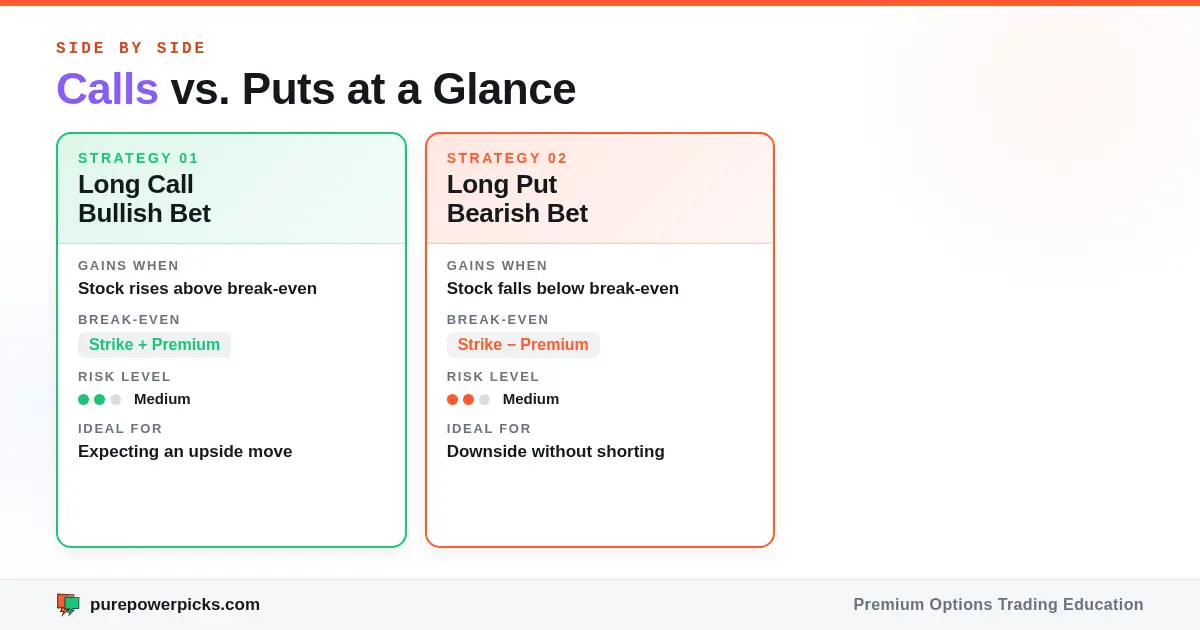
| Long call | Strike + Premium | $105 + $2 = $107 |
| Long put | Strike − Premium | $95 − $2.50 = $92.50 |
Fees slightly move the true economic break-even. Multi-leg strategies have their own formulas, and some positions can have more than one break-even. For a deeper explanation, see our guide to break-even prices in options trading.
How Do You Calculate Profit on Option Spreads?
A vertical spread combines two options of the same type and expiration at different strikes. The strike width, net debit or credit, multiplier, and contract quantity define the maximum expiration outcomes.
- Max profit = (Strike width − Net debit) × 100 × Contracts
- Max loss = Net debit × 100 × Contracts
- Call-spread break-even = Long strike + Net debit
- Max profit = Net credit × 100 × Contracts
- Max loss = (Strike width − Net credit) × 100 × Contracts
- Break-even depends on whether it is a call or put spread
Debit-spread example: Buy one $100 call and sell one $105 call with the same expiration for a $2.00 net debit. The spread is $5 wide. Maximum profit is ($5 − $2) × 100 = $300. Maximum loss is $2 × 100 = $200. Expiration break-even is $102.
Credit-spread example: Sell one $100 put and buy one $95 put with the same expiration for a $1.25 net credit. Maximum profit is $1.25 × 100 = $125. Maximum loss is ($5 − $1.25) × 100 = $375. Expiration break-even is $98.75.
Before expiration, close both legs together and calculate the difference between the spread’s opening and closing prices. Legging out separately can change the realized result and introduce additional execution and assignment risk.
How Should You Evaluate Maximum Gain, Maximum Loss, and Risk-Reward?
Maximum gain and loss describe payoff boundaries. They do not tell you how likely either outcome is. A complete trade review should also consider the probability of reaching the target, days to expiration, implied volatility, liquidity, bid-ask spreads, and position size.
The phrase “you can only lose the premium” applies to an option buyer—not every options strategy. Short options can create losses well beyond the premium collected, and an uncovered call has theoretically unlimited loss. Even for a long option, losing 100% of the premium is a real possibility.
If a $200 position has a realistic $400 target, the potential reward is twice the amount at risk. That may be described as 2:1 reward-to-risk. It is not automatically a good trade: a lower-probability payoff can look attractive on ratio alone. Use the ratio alongside a written exit plan and sensible options position sizing.
What Are the Most Common Options Profit Calculation Mistakes?
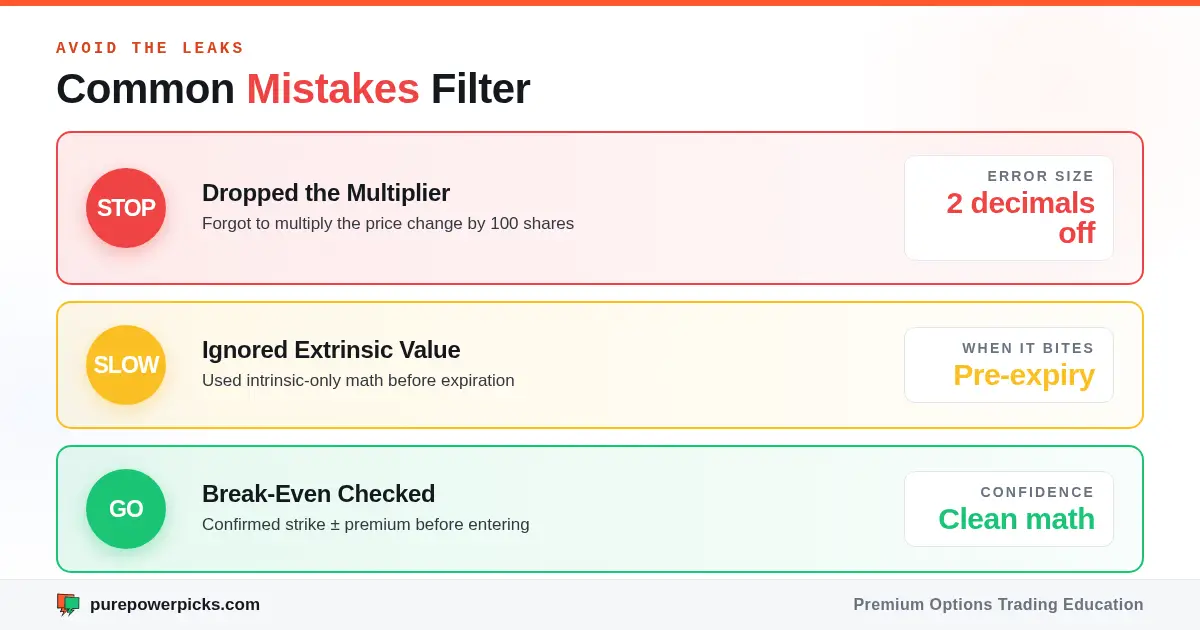
- Mixing market value with expiration value. Before expiration, use the option’s tradable price. At expiration, use intrinsic value.
- Forgetting the multiplier or contract count. A $1.50 premium change is normally $150 for one standard contract, but $450 for three.
- Treating expiration break-even as today’s profit threshold. Time value and implied volatility can make an option profitable or unprofitable before the stock reaches that expiration price.
- Using the last price as guaranteed value. An old trade can make the “last” price misleading. Check the bid, ask, volume, and open interest.
- Ignoring fees and slippage. Small contract fees and imperfect fills matter when the expected profit is modest.
- Assuming every contract represents 100 shares. Adjusted contracts and some non-equity products can use different deliverables or multipliers.
- Calling unrealized P/L a realized profit. The result is not locked in until you close, exercise, are assigned, or reach settlement.
How Do You Use PPP’s Options Profit Calculator?
- Open the free options profit calculator and choose a strategy preset or add the option legs manually.
- Enter the stock price, call or put, buy or sell, quantity, strike, premium, and days to expiration.
- For a theoretical current-value estimate, enter implied volatility and the other model inputs. A model estimate is not a guaranteed market price.
- Review maximum profit, maximum loss, break-even prices, the expiration payoff chart, and the five major Greeks: delta, gamma, theta, vega, and rho.
- Test several stock prices and volatility assumptions instead of relying on one forecast.
The calculator is especially useful for multi-leg positions because it combines every leg into one payoff. The manual formulas remain valuable because they help you catch an incorrect sign, quantity, premium, or multiplier before placing a trade.
Try PPP’s Free Options Calculators
Use the tool that matches the position you are planning.
Options Profit Calculator
Model calls, puts, spreads, and custom multi-leg positions.
Covered Call Calculator
Measure premium income, called-away return, and downside break-even.
Wheel Strategy Calculator
Connect cash-secured put and covered-call phases into one cycle.
Frequently Asked Questions
Can you calculate options profit before expiration?
Yes. For a long option, subtract your entry premium from the price at which you can close the option, then multiply by the contract multiplier and quantity. A theoretical pricing model can estimate value, but an actual closing fill determines realized P/L.
Why can a call lose money when the stock rises?
The stock may not rise enough or quickly enough to offset the premium paid and time decay. Implied volatility can also fall. At expiration, a long call must finish above the strike plus premium to show a profit before fees.
Is maximum loss always the premium paid?
No. That rule generally applies to buyers of calls and puts. Option sellers can face losses greater than the premium received, and an uncovered short call has theoretically unlimited loss.
Does one option contract always represent 100 shares?
A standard U.S. equity option typically represents 100 shares, but adjusted contracts and other option products can have different multipliers or deliverables. Confirm the contract details before calculating total dollars.
Should commissions and fees be included?
Yes. Subtract opening and closing transaction costs when calculating net realized profit. Fees can materially change small expected gains.
Is it usually better to sell an option or exercise it?
Exercise and sale are different decisions. Selling may preserve remaining time value, while exercising converts the option into the underlying position and can require substantial capital. Review liquidity, time value, taxes, dividends, and your broker’s expiration procedures before deciding.
The Bottom Line
Options profit math becomes manageable once you separate the option’s live market value from its expiration payoff. Before expiration, compare the option’s closing price with your entry. At expiration, calculate intrinsic value from the stock price and strike. Then apply the correct multiplier, quantity, fees, and every leg in the position.
Check the math before you place the trade
Build the position, test multiple outcomes, and save a shareable setup with PPP’s free calculator.
Use the Free Options Profit Calculator →
Want structured trade ideas after you understand the risk? See PPP’s trade-alert plans.
Share this guide

The PPP Team brings decades of combined experience from established companies in the trading industry. Founded in 2020, Pure Power Picks publishes options education, platform reviews, calculators, and trade alerts to help everyday traders develop practical skills. Our content is strictly educational.